
-
Bacon Meme of the Week
-
Day of Infamy

-
Mandatory Vehicle Inspections Expensive, Burdensome, Unproven
By Joshua Devamithran
Virginia’s mandatory vehicle safety inspection program is less than a decade away from its centennial anniversary. Established in 1932, Virginia’s inspection program is the oldest continuous program in the country. In 1975, thirty-one states and the District of Columbia had mandatory safety inspection programs. Today, Virginia is one of just fifteen states that have retained such a mandatory inspection program.

The stated purpose of Virginia’s mandatory vehicle safety inspection program is to promote highway safety. Inspection programs seek to accomplish this goal by reducing the number of vehicles with existing or potential conditions that may contribute to vehicle crashes and fatalities. The logic concludes that mandatory inspection programs are necessary to achieve this goal.
However, to date, studies have not shown a statistically significant relationship between mandatory inspection programs and an increase in motor safety. In 2015, the U.S. Government Accountability Office (GAO) analyzed studies published between 1992 and 2013 that were relevant for determining the safety benefits and costs of state vehicle inspection programs across the nation. Their survey of these studies examined the effect of inspection programs on crash rates related to vehicle component failure and found no clear influence. In some places like Nebraska, after the mandatory inspection program was eliminated in 1982, the number of crashes caused by vehicle component defects actually declined.
-
UVA Board Asserts Oversight of Strategic Investment Fund
by James A. Bacon

The Youngkin-appointed majority in the University of Virginia Board of Visitors flexed its muscles for the first time Friday, asserting its authority to oversee the Strategic Investment Fund (SIF) accounting for 2% to 3% of the UVA academic division’s total spending.
Board members also signaled that they wanted advance notice of the administration’s proposed 2025-26 academic-year budget rather than being presented with a fait accompli in the June meeting.
Board deliberations were civil and non-confrontational. Indeed, the board approved a 5.5% increase in student housing and meal plans next year as well as tuition increases up to 4%, depending upon the program, for graduate and professional students.
Board member Doug Wetmore, who introduced the motion authorizing the board to assume more oversight of the SIF, stressed that the overwhelming majority of the administration’s proposals probably would meet board approval. “It’s been a very successful program,” he said.
However, he described it as “essential” for the board to review the proposals, which have added up to a half billion dollars since its creation in 2016. “A core responsibility of the board is to review spending of this magnitude,” he said.
A majority of board members agreed.
(more…)
-
RGGI Carbon Tax Decreases in Latest Regional Auction
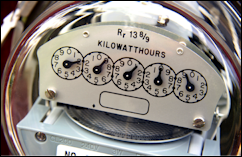
The final 2024 auction for Regional Greenhouse Gas Initiative carbon allowances, held December 4, broke the recent pattern and produced a noticeably lower clearing price. The price of $20.05 per ton of emitted carbon dioxide is still higher than was ever charged to Virginia electricity producers during Virginia’s three years in the program.
The December 2024 auction price was 38% above the amount generators had to pay a year ago but is down from the 2024 peak of $25.75 per ton in September. A Floyd County Circuit Court judge has ruled that the Youngkin Administration erred in removing Virginia from the RGGI regime a year ago, and only an Act of the Assembly could accomplish that, but an appeal is likely. Virginia may or may not be back in the auction business for 2025, but if it is, expect revenue to the state of at least $400 million per annum.
The money paid out by the energy generators ends up being charged to energy customers, one way or another. The largest buyer of RGGI carbon allowances in Virginia has been Dominion Energy Virginia, which simply passed the cost along dollar for dollar to customers. RGGI is simply a carbon tax. Just like the carbon tax in Europe, but there the tax hits all forms of hydrocarbon energy, not just electricity. The European Union carbon tax is also three times as high as the RGGI tax, after converting euros to dollars. If Democrats have their way, Virginia will catch up.
The background information on Wednesday’s RGGI auction does not list Dominion or Appalachian Power Company among the bidders for new allowances. Old Dominion Electric Cooperative, part owner of a major coal plant in southern Virginia, was listed as a registered bidder but what it may have bought is not reported.
December was also supposed to see the next capacity auction for the load serving utilities in the PJM Interconnection Region, which has some (but only some) overlap with the RGGI states. That auction has been postponed to next summer. The last PJM auction, like the immediate previous RGGI auction, produced record prices for reliable hydrocarbon-based generation, prompting Dominion to seek a method of charging customers more for that, too.
— SDH
-
Ellis Goes Rogue
by James A. Bacon
Bert Ellis was mad as hell and wasn’t going to take it anymore. He didn’t reenact Peter Finch playing Howard Beale in his famous rant in the movie “Network.” In fact, he was very calm and deliberate. But he made it clear to the University of Virginia Board of Visitors Thursday that he had run out of patience.
He would refuse to vote in favor of any new spending project until the University got serious about cutting costs, Ellis said.
He proceeded to vote against approving the schematic design for a $50 million parking garage for the University’s Ivy Corridor expansion…. and against approving the addition of a $150-million to $160-million expansion of student housing to the University’s capital spending plan… and against adopting a schematic design for a $315 million center for the arts.
All three proposals were approved overwhelmingly by voice vote. Ellis was the only board member to vote nay, although from my vantage point in the cheap seats it appeared that a couple other board members declined to give their approval, effectively abstaining. Individual votes were not recorded.
“I’m voting no on this project and all other projects presented at this committee meeting,” Ellis said. “Furthermore, I’m going to vote no on any expenditures to be brought to this board until I have seen a ’25-’26 budget for this university that includes significant cuts in administrative expense.”
(more…)
-
Radical Idea: Virginia H.S. Grads Should Know More About Their Country Than Foreigners Do
by Kerry Dougherty

What do you say we start this morning with a little quiz? Pour yourself a cup of coffee and get out your number 2s!
What is the name of the national anthem:
- The Star Spangled Banner
- The Pledge of Allegiance
- God Bless America
- America the Beautiful
“1” you say? Well done!
How many U.S Senators are there?
- 435
- 50
- 27
- 100 If you guessed “4” you are really smart! (No you’re not, but you may be smarter than a high school kid, so there’s that.)
Let’s try one more: In what month do we vote for president?
- May
- April
- November
- December
Yep, “3” it is! Looks like someone was paying attention last month!
These incredibly easy questions are actual samples of those provided to non-citizens preparing to take the naturalization test. One delegate in the General Assembly – Republican Del. Lee Ware of Powhatan – is once again introducing a bill that would require all high school seniors to score at lest a 70 on the naturalization test in order to graduate.
That bill did not pass in the last session. Continue reading.
-
What Happened to All the Water?
by Dick Hall-Sizemore
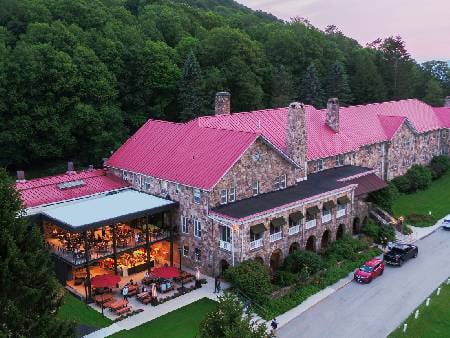
Main building, Mountain Lake Lodge Mountain Lake in Giles County has two claims to fame. First, it was the location at which much of the 1987 hit movie Dirty Dancing was filmed. Second, it is one of only two natural lakes in Virginia. (Lake Drummond in the Dismal Swamp in Chesapeake is the other one.) However, the basis of that second claim may be fading away.
Mountain Lake is situated in a bowl, or valley, between two converging mountain ridges. A stream, Pond Drain, flows through the valley. At one end of the valley is a narrow water gap. Salt Pond Mountain rises to the east immediately adjacent to the lake. The Eastern Continental Divide runs along the crest of Salt Pond Mountain. Surface water on the western side of the mountain flows to the New River and, ultimately, to the Gulf of Mexico, while surface water on the eastern side flows to the Atlantic Ocean via the James River and its tributaries.

There has been considerable debate among geologists regarding the origin of Mountain Lake. The first scientific work on the lake was conducted by William Rogers. Rogers taught chemistry and natural philosophy at the College of William and Mary and was later chair of natural philosophy at the University of Virginia. While at UVa., he became the first state geologist and led the first geological survey of the state. He later founded the Massachusetts Institute of Technology. (Rogers Hall at William and Mary is named for him, as is Mt. Rogers, the tallest mountain in Virginia.) Rogers’s work was published posthumously in 1884. His conclusion for the origin of the lake: “Rocks and earth gradually accumulating at the passage have dammed the waters up.”
(more…)
-
City’s Too Big, Council’s Too Small
by Joe Fitzgerald
Harrisonburg is a city of 60,000 or so with a City Council for a town of 15,000.
A quick check of Virginia’s cities finds that besides Harrisonburg, only Charlottesville among the larger cities has five council members. Most have seven, or six and a mayor, with Winchester’s nine and Virginia Beach’s eleven being the outliers.
The smaller council size, with only three votes needed to make major changes for the city, makes it more possible for a small clique of like-minded council members to make changes out of step with the city at large. The most unfortunate example of this is the Bluestone Town Center, passed by three members with less than three years of experience, combined.
No one would argue that a seven-member council makes fewer mistakes. But the extra vote needed on a seven-person council makes it a little less likely that inexperienced or ideological members will push through a project without any real deliberations.
(more…)
-
Voting to Impose Big Solar on Other Legislator’s Voters
by Steve Haner
Virginia’s legislators are expected to look at more bills in January to provide ways to override local objections to major renewable energy projects, especially the large solar fields that can cover hundreds of acres. A regional media outlet with a focus on rural Virginia just pointed out an inconvenient truth.
The legislators likely to vote to force these projects on the balking rural Virginians won’t be the legislators who represent the balking rural Virginians.
The insight comes from Dwayne Yancey at Cardinal News. Loyal readers know Yancey was a colleague of mine and Jim Bacon’s in Roanoke 40 years ago, and keeping up with his work at Cardinal News is exhausting. It is always interesting, and always data driven.
The data here comes from 1) the 2020 almost purely partisan roll call on passage of the Virginia Clean Economy Act and 2) a new database of pending and approved solar project proposals proffered by Weldon Cooper Center at the University of Virginia. He produced a quick map of the localities where at least some of the legislators voted “aye.” Yancey cross references and writes:
(more…)
-
The New Normal: Massive Infrastructure Cost Overruns
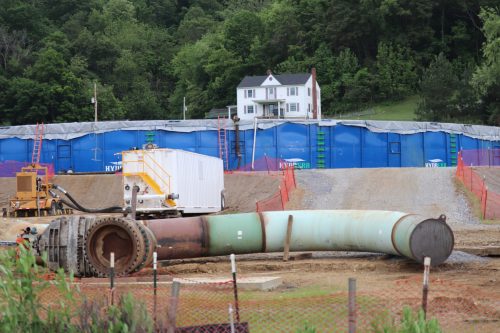
Mountain Valley Pipeline site in Lafayette, Va. Image credit: West Virginia Public Broadcasting by James A. Bacon
When the Mountain Valley Pipeline was proposed in 2018, the estimated cost was $3.5 billion. When completed in June, the final cost was reported in a Federal Energy Regulatory Commission filing to be $9.6 billion — nearly three times as much.
A fraction of that increase can be attributed to inflation over the eight years the 303-mile natural gas pipeline was bitterly contested and bogged down by lawsuits and regulatory appeals. Management failures undoubtedly contributed — a portion of pipe near Roanoke burst under a pressure test, suggesting manufacturing flaws — and WV Broadcasting cites weather and labor issues.
But three times the cost? The sad reality is that it has become nearly impossible to build any large infrastructure project in the United States. Remember the Atlantic Coast Pipeline? Dominion Energy just gave up and took $1 billion+ in write-offs.
Now PJM, the regional electric transmission organization of which Virginia is a part, says someone needs to build a 765kw transmission line across Loudoun County to upgrade the electric grid in anticipation of unprecedented demand growth.
(more…)
-
Caves, Hokie Stone, and Crayons
by Dick Hall-Sizemore
This year’s Virginia Geological Field Conference was held in Radford the weekend before Election Day. Like the one I attended last year in the Mt. Rogers area, it was an opportunity to go back in time as well as get a brief respite from the drumbeat of politics.
The tenor of this conference was different from last year’s, which focused on ancient rock formations and the forces that created them. There was a considerable amount of that kind of focus this year, as well. After all, these are geologists and that is what they do. However, the main focus was on the current effects of these geological forces and formations. The theme of the conference was “Rocks, Water, and People: Establishing Connections Between Geological Processes, Water and Mineral Resources, and Human Activity in the New River Valley of Virginia.”The geology of the New River Valley is significantly different from that of the Mt. Rogers area. Mt. Rogers is part of the Blue Ridge physiographic province, dominated by granites and “basement rock.” The New River Valley is in the Valley and Ridge province, which encompasses the area west of the Blue Ridge to the West Virginia border, including a good part of Southwest Virginia.
The area that now constitutes the Valley and Ridge, along with most of the northeastern coast of the United States, began to form during the break-up (rifting) of the ancient supercontinent Rodinia about 800 million years ago. For about 500 million years, that tectonic plate drifted in ancient seas with much of it covered in fluctuating levels of water. As a result, some of the basement rock is still present, but the most prevalent geological formations are sedimentary—sandstones, shale, limestone, and dolomite. These are the formations that have shaped the interconnections among rocks, water, and people.
(more…)
-
New Accountability System Supports Advanced Math Learners

Image credit: Grok by Todd Truitt
Virginia’s new accountability system incentivizes schools to provide valuable middle-school math pathways, resulting in more opportunities for Virginia students, especially the most underprivileged. It will also counter the non-evidence-based, anti-acceleration ideology of certain discredited thought leaders in K-12 math education who have had a corrosive effect on Virginia K-12 math education.
Why Algebra in Middle School Is Civil Rights Issue
Civil rights leader Bob Moses referred to the ability to accelerate in math (i.e. go above grade level) in order to take Algebra in middle school as a civil right. It has been a longstanding goal of the US Department of Education and civil rights organizations. Nationally, middle schools that are not offering Algebra disproportionately serve lower income and underrepresented minority students.
As explained by Stanford University Math Professor, and Director of Undergraduate Math Studies, Brian Conrad:
“A solid grounding in math from high school—which traditionally has included two years of algebra, a year of geometry, and then, for more advanced students, other coursework leading up to calculus [and beyond]—is a prerequisite for a four-year college degree in data science, computer science, economics, and other quantitative fields. Such a degree is, in turn, the price of entry for jobs not only in the sciences and Silicon Valley but also in a number of seemingly distant fields. …
(more…)
-
How to Frame a Positive Story as a Negative
Graphic credit: Richmond Times-Dispatch by James A. Bacon
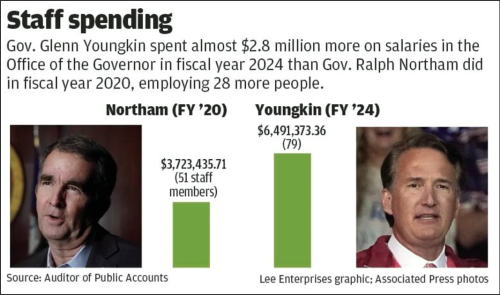
The Governor’s Office under Glenn Youngkin grew staff from 51 under former Governor Ralph Northam to 79 by the end of fiscal 2023, and increased spending on salaries from $3.7 million to $6.5 million, finds an audit by the Auditor of Public Accounts.
Cue the partisan sniping.
“His actions don’t add up to his rhetoric,” Sen. Adam Ebbin, D-Alexandria, chairman of the Senate Committee on General Laws and Technology, told the Richmond Times-Dispatch in referring to Youngkin’s claims to have made state government more efficient. “This is not a transformational governorship that requires a transformational staff.”
How, exactly, do Youngkin’s actions fall short of rhetoric? Details, please, Mr. Ebbin.
It turns out, as Michael Martz reports a bit lower in the story, that the apparent growth in the Governor’s Office staff and spending can be attributed mainly to (1) pay raises enacted by the General Assembly; (2) new staff authorized at the initiative of the General Assembly, such as for the Office of Diversity, Equity & Inclusion (renamed Diversity, Opportunity & Inclusion); and (3) the hiring of a Chief Transformation Officer and staff.
In other words, the primary spending increase that can be pinned on Youngkin was the hiring of a Chief Transformation Officer and staff. The only meaningful question raised by the numbers is this: has the Chief Transformation Officer paid his way?
-
Bacon Meme of the Week