
By Steve Haner
The dollar cost for permission to burn hydrocarbon fuels in the Regional Greenhouse Gas Initiative region spiked another 22 percent in just three months.
This is one more sign electric power producers in those states know they will need to keep using hydrocarbons despite the political policy push to eliminate them.
The RGGI auction earlier this week set a clearing price of $25.75 per ton, up more than 22% from the $21.03 in the June auction, which itself had been a 31% increase over March’s $16. When Virginia first forced its power companies to pay the carbon tax to fuel their plants, the price for an allowance was $7.60. So, the price has risen 240 percent in less than four years.
Virginia is no longer a member of the multi-state RGGI compact, and Virginia’s power producers have not needed to own and “retire” carbon “allowances” to run their coal, natural gas or oil generators since last year. But the legal effort to return to RGGI is still churning in litigation, and every Virginia politician with a D after their name – every single one – praises RGGI like manna from Heaven.
So, Bacon’s Rebellion will keep an eye on the quarterly auctions, which set a carbon price always (always) passed along to consumers, one way or the other. RGGI is a carbon tax. During the three years Virginia was part of it, $828 million in carbon taxes were collected and the Democrat politicos are hot to raise more and spend more. Were Virginia still taxing us this way, just one year’s take could now approach $500 million to $600 million.
It will all come rushing back to your power bills -– or not — depending on the outcome in court or at the 2025 ballot box. The claim that this is affecting the climate, and will reduce extreme temperatures or bad weather, is a fairy tale to keep the masses paying like sheep. A compliant and quite ignorant news media is deeply complicit.
The almost exponential increase in the carbon price through RGGI has its roots in the same energy realpolitik that explains the similar increase in PJM Interconnection auction prices for guaranteed energy capacity. The guaranteed capacity drawing the highest prices comes from the highly reliable hydrocarbon plants.
After power company managers leave their Zoom call about tracking their net-zero fantasies, they get busy lining up the energy assets they really need to keep our lights on and economy booming.
By the end of this calendar year, PJM will hold another auction for guaranteed capacity (to cover the 2026-2027 cycle) and RGGI will hold its final 2024 carbon tax auction. Guesses on the trend line?
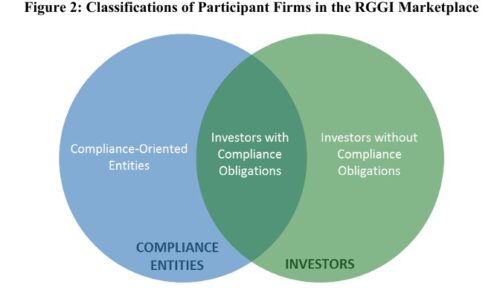
Another report on the RGGI news release website describes an exploding secondary market for RGGI allowances. As is common when the cap-and-trade model is used to set an excise tax price on a commodity, anybody can buy the allowances. The buyers don’t actually have to be in the business of running power plants. Speculators get involved to make money off future trades.
From the introduction: The secondary market is important for several reasons. First, it gives firms an ability to obtain CO2 allowances at any time during the three months between the RGGI auctions. Second, it provides firms a way to protect themselves against the potential volatility of future auction clearing prices. Third, it provides price signals that assist firms in making investment decisions in markets affected by the cost of RGGI compliance.
Fourth (somehow, they skipped this), it allows speculators to get rich. Look at the potential return if somebody had purchased some of those $7.60 allowances in 2021 and offloaded them now. And the speculators who bought in this week’s auction are not expecting the price to drop. How can it, with the absolute political hostility to any new hydrocarbon plants? Supply will keep dropping as concerns about the reliability of wind and solar keep growing. How will these investors vote on the future of RGGI? The secondary market is their manna from Heaven.
More on the secondary market activity: Overall activity increased considerably from the second quarter of 2023, and while activity typically falls after the March 1st compliance deadline each year, futures trading increased from the first quarter to the second quarter of 2024.
- Physical allowance transfers between unaffiliated firms totaled 20 million, which was 51 percent higher than the second quarter of 2023 and 52 percent lower than the first quarter of 2024.
- The volume of trading of RGGI futures was 158 million CO2 allowances in the second quarter of 2024, which is more than double the volume in the second quarter of 2023 and is 26 percent higher than the first quarter of 2024.
- Open interest in RGGI futures and options increased from 88 million allowances at the end of the first quarter to 118 million at the close of the second quarter of 2024.
- “Spread” transactions accounted for an increased share of long open interest in vintage 2024 ICE futures and options contracts, accounting for 25 percent of long positions at the end of the second quarter.
This is the market telling America, or its northeastern quarter at least, home to RGGI and PJM, what kind of electric power has the greatest economic value. Listen.
Leave a Reply
You must be logged in to post a comment.