
By Steve Haner
The surprise explosion in the capacity auction prices within the PJM electricity collective is expected to cost Dominion Energy Virginia $145 million next year. The company just proposed to the State Corporation Commission that it eventually collect some or all of that directly from its customers, but not until its rates are reviewed again in 2027.
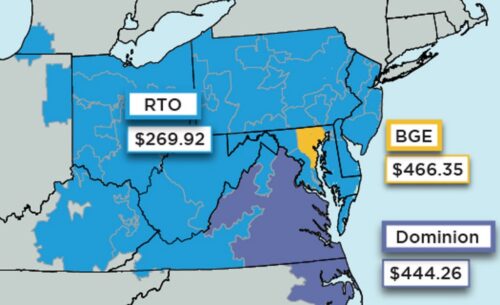
The ratepayer impact of the massive increase in future capacity charges within Dominion’s service territory was unclear immediately after the auction results were announced in July. It was fair to assume some impact once the new capacity pricing hit come July 2025. Each auction sets the capacity contract prices for a 12-month period, and another auction will be held for the period beginning July 2026.
In a filing with the SCC last week, Dominion revealed its estimate that it will spend $145 million more for capacity contracts within PJM than it had planned to. That is just for 12 months, July 2025-June 2026. It requested permission to treat that as a “regulatory asset” which it can collect later rather than a normal cost of service which it would just absorb within its base rate price.
Simply paying the bill and not adjusting its prices to recoup it means the money comes out of company profits, as the petition to the SCC notes:
The $145 million in capacity expense equates to a 162 basis point (1.6 percentage points) degradation in Dominion Energy Virginia’s earned return on equity (“ROE”) for the 2023 rate year and approximately 10% of Dominion Energy Virginia’s 2023 net income on a (generally accepted accounting) basis.
By designating the cost as a “regulatory asset,” a term of art in utility accounting, it is held separate on the books for possible future collection. Dominion proposes that it be part of the next cost of service review in 2027, and if the company has earned excess revenues beyond its allowed profits, the excess could be applied to the bill. Then the rest would be baked into its cost of service and the future base rates adjusted to collect it. It adds: “Along with ongoing carrying costs.” If not used for this, any excess profits might be refunded to customers. We pay either way.
Dominion wants a quick decision on this for its own internal budget process, asking the SCC to rule on this by mid-December.
The short petition provides a nice summary of what qualifies as a “regulatory asset” and one key requirement is that the expense be non-recurring. But the massive price spike for capacity contracts may indeed recur again and again. PJM delayed its annual capacity auctions during the pandemic and is playing catch up. The capacity auction for the period beginning July 2026 is also set for December, and if held then there is little reason to expect much change from the last one.
A strong push is on to delay that auction until next summer, giving the industry time for some adjustments or the recognition of some additional assets to include on the supply side. The downside of that is, once again, the utilities would have a very short time to react if the outcome is detrimental. What the SCC does with the 2025 surprise costs may need to be replicated with a 2026 batch of capacity price increases.
As a member of the PJM Interconnection, the largest multistate electricity sharing network in the country, Dominion is required to have sufficient generation of its own to meet its projected need, with a cushion. It does not. So, it must either directly contract with outside suppliers to cover the balance or participate in the PJM capacity auction to secure firm commitments for future need.
PJM leadership and others in the industry have been increasingly loud in complaining that the cause of the capacity crunch is the early and unnecessary retirements of thermal (coal and gas) generation units within the PJM region. The wind and solar and battery assets coming online simply are not as reliable because dark or windless days or weeks do happen and cannot be predicted.
As a participant in the capacity auctions, Dominion both buys and sells power across state lines and the market signals being sent by these capacity auctions are clear. Those buying capacity are looking for reliable supply. That may play a major role in the company’s decision to propose increasing the amount of natural gas generation in its fleet, the most controversial aspect of its most recent integrated resource plan. It also makes the planned nuclear units more valuable, but they are further in the future.
If approved, the new gas-driven assets should reduce future expenses for power purchases and provide Dominion with some balancing revenue when it is the one selling into PJM.
The data on just how dependent on imported electricity Virginia is, and will continue to be, is included throughout that IRP document. Major purchases of other people’s power are predicted by Dominion over the 15-year planning period, despite plans to basically double its overall generation fleet.
Leave a Reply
You must be logged in to post a comment.