
Neither does the climate.
by Derrick Max
The thick haze now covering much of the East Coast arrived without requesting a permit from Virginia regulators.
It did not stop at the Canadian border. It did not recognize state lines. It did not distinguish between jurisdictions that have adopted aggressive renewable-energy mandates and those that have not. It did not care if it was over a red or a blue state.
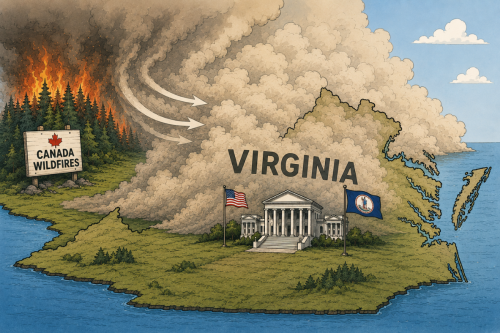
Smoke from Canadian wildfires is degrading air quality across large portions of the United States. The fires themselves are in another country, but their consequences are visible in Virginia’s skies and felt in the lungs of all Virginians.
The lesson to be drawn from this smoke should produce some humility in Richmond: Atmosphere is global.
Virginia has just authorized a new State Climate Office at George Mason University. Yet, as these fires reinforce, there is no Virginia climate. There is only a shared atmosphere in which smoke, emissions and weather systems move freely across state and national boundaries. That reality should make policymakers skeptical of expensive new state climate offices and environmental mandates presented as though Virginia can regulate its way to a different climate from the rest of the planet or even impact the global climate.
Virginia policymakers have spent years treating climate policy as though imposing increasingly expensive mandates on the Commonwealth’s electric utilities can meaningfully control global temperatures, weather patterns or the air Virginians breathe.
The Virginia Clean Economy Act requires Dominion Energy to move toward carbon-free electricity by 2045 and Appalachian Power by 2050. In pursuit of those deadlines, Virginia is requiring enormous investments in wind, solar, battery storage and transmission while restricting the future use of reliable fossil-fuel generation.
Whatever one thinks of those technologies, the smoke outside our windows demonstrates the limits of unilateral state climate policy.
Consider the scale.
Supporters of the Virginia Clean Economy Act argue that eliminating most carbon emissions from Virginia’s electricity sector will make the Commonwealth a leader in addressing climate change. But even eliminating every ton of carbon dioxide produced by every Virginia power plant would represent only a miniscule reduction in the global atmosphere.
Now compare Virginia’s effort with Canada’s historic 2023 wildfire season – the last fire whose climate impact has already been evaluated and can be instructive to the fires impacting Virginia today.
According to the Canadian government, the 2023 fires burned more than 18.5 million hectares of forest and produced approximately 1.1 billion metric tons of immediate greenhouse-gas emissions. That was roughly four times Canada’s average wildfire emissions since 1990 and considerably more than Canada’s total annual emissions from its industrial, transportation, energy and other human activities.
Those figures do not mean that the fires currently producing this summer’s smoke are as large as the record-setting 2023 season. They are not. The current season is only one-fifth the size of the extraordinary acreage burned in 2023. But it is still equal to 220 million metric tons of greenhouse gas emissions – an amount in excess of Virginia’s 138.7 million metric tons of gross greenhouse gas emission in 2021, the last year for which data is available.
The comparison between the Canadian wildfires and the Commonwealth’s emissions reveals the enormous mismatch between the global scale of the atmosphere and the narrow scale of Virginia’s proposed solution.
One historic Canadian wildfire season released many times the amount of carbon Virginia’s electricity sector emits in a year. It likely also exceeded several decades of the maximum annual carbon reductions the Virginia Clean Economy Act is expected eventually to achieve.
Put differently, Virginia families are being forced to spend billions of dollars on offshore wind projects, solar installations, batteries, transmission lines, backup capacity and prematurely retired power plants — and none of that spending will prevent smoke from a Canadian wildfire from entering a child’s lungs in Loudoun County, or from the potential greenhouse gases altering the global climate.
That is not an argument for doing nothing. It is an argument for having an honest perspective on the limitations of state-level climate policy. Most importantly, such severely limited state-level environmental policy should not be used to weaken the electric grid on which Virginia’s economy depends.
During periods of extreme heat and poor air quality (as we have had this week), Virginians need dependable electricity for air conditioning, filtration systems, hospitals and medical equipment not to mention fuel Virginia’s booming industrial sectors. That means preserving and expanding reliable nuclear and natural-gas generation while encouraging the development of new technologies that can produce power whenever it is needed — not merely when weather conditions cooperate.
Conservatives should not deny that the climate changes or that pollution has consequences. We should challenge the conceit that symbolic state mandates, imposed without adequate regard for cost, reliability or global scale, constitute an effective response.
Virginia represents only a tiny fraction of worldwide greenhouse-gas emissions – and only a fraction of Canadian wildfire emissions. Fires, industrial growth and energy decisions made throughout the world can overwhelm the marginal reductions achieved by one state.
That reality does not absolve Virginia of responsibility. It requires Virginia to act intelligently.
We should encourage innovation, cleaner technology, nuclear power, efficient energy use, responsible forest management and sound environmental stewardship. We should prepare communities for risks that originate beyond our borders.
But we should stop pretending that raising Virginians’ electric bills and closing reliable power plants will build an invisible wall around the Commonwealth’s atmosphere.
The smoke drifting down from Canada carries a clear message: climate and air pollution have no boundaries. Our policies should recognize the same reality.
Derrick Max is Vice President of Policy at the Jefferson Forum. This column is republished here with the permission of the Jefferson Forum.
Leave a Reply
You must be logged in to post a comment.