The New Normal: Massive Infrastructure Cost Overruns

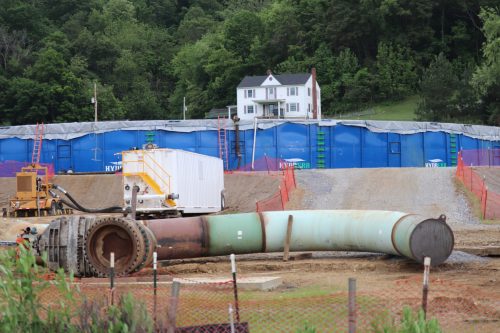
Mountain Valley Pipeline site in Lafayette, Va. Image credit: West Virginia Public Broadcasting

by James A. Bacon

When the Mountain Valley Pipeline was proposed in 2018, the estimated cost was $3.5 billion. When completed in June, the final cost was reported in a Federal Energy Regulatory Commission filing to be $9.6 billion — nearly three times as much.

A fraction of that increase can be attributed to inflation over the eight years the 303-mile natural gas pipeline was bitterly contested and bogged down by lawsuits and regulatory appeals. Management failures undoubtedly contributed — a portion of pipe near Roanoke burst under a pressure test, suggesting manufacturing flaws — and WV Broadcasting cites weather and labor issues.

But three times the cost? The sad reality is that it has become nearly impossible to build any large infrastructure project in the United States. Remember the Atlantic Coast Pipeline? Dominion Energy just gave up and took $1 billion+ in write-offs.

Now PJM, the regional electric transmission organization of which Virginia is a part, says someone needs to build a 765kw transmission line across Loudoun County to upgrade the electric grid in anticipation of unprecedented demand growth.

The proposed route would run across the Appalachian Trail and through Virginia’s Sweet Run State Park. Moreover, 150-foot-tall towers would wreck pristine rural viewsheds, upsetting affluent landowners in horse country.

Good luck with that.

How many years will it take to gain regulatory approval, how many endangered snails and salamanders and warbler nests will lie in the transmission line’s path, what concessions will the power-line operator have to make, and how much will costs increase?

Most of the projected electricity demand growth is tied to data centers to serve Artificial Intelligence applications. Don’t be surprised if residents along the 261-mile transmission-line route start touting apocalyptic scenarios in the hope of putting AI on trial. Insufficient electric power will throttle AI development, with unknowable consequences for every other sphere of human existence.

President-elect Trump says he wants to slash regulations. Politically, the job is easier said than done, especially if it requires changes in legislation. And, as much as I sympathize with his broader aims in the abstract, it is important to remember that environmental and landowner-rights considerations are not things to be trampled lightly.

I keep returning to the idea that society is getting increasingly complex with more moving and interacting parts than ever. The problem isn’t capitalism, as some contend, it’s complexity and the inevitability of tradeoffs, many of them unknowable until they manifest themselves. I will deem Americans lucky if the whole economic-social-political machinery of 21st-century life merely grinds slowly to a halt. But I fear that massive vulnerabilities are hidden within the complexity that could lead to collapse.

Whatever the future portends, soaring costs for massive infrastructure projects are the new normal.


ADVERTISEMENT

(comments below)


Comments


Comments

15 responses to “The New Normal: Massive Infrastructure Cost Overruns”

  1. Stephen Haner Avatar
    Stephen Haner

    Yeah, but when the solar farms are being disassembled or replaced (at way higher prices) and the wind turbines are being removed (sooner than they claim), the gas coming thru that line will still be heating homes and running factories.

  2. Don't forget the northern long-eared bat…

  3. LarrytheG Avatar

    Meanwhile , back at the ranch:

    " Dominion said the much-watched offshore wind projectโ€”which will comprise 176 Siemens Gamesa SG 14-222 Direct Drive offshore wind turbine turbines and associated monopile foundations, each with a capacity of 14.7 MWโ€”remains on time and on budget to begin operation in late 2026.Oct 29, 2024"

    ๐Ÿ˜‰

  4. Dick Hall-Sizemore Avatar
    Dick Hall-Sizemore

    There is a way to transmit more power other than building more transmission lines–replace the existing transmission lines with ones that carry more power and are more efficient. A major problem is getting utilities to do it. After all, Dominion's guaranteed 10 percent profit would be a lot less.
    https://www.volts.wtf/p/one-easy-way-to-boost-the-grid-upgrade

  5. Teddy007 Avatar

    Long term massive projects are beyond the management skills of anyone in the U.S. If a project takes 8 years, very few people who are there at the beginning will be there at the end. The U.S. changed the environmental laws in the 1970's to make things harder and more complicated to do to keep urban center from being paved over. Those laws are now used to make most projects unmanageable and unprofitable.

  6. Lefty665 Avatar

    <i>"I will deem Americans lucky if the whole economic-social-political machinery of 21st-century life merely grinds slowly to a halt."</i>

    May be the best we can hope for.

    Local Small Modular Reactors seem like a better solution than big new long distance power lines, although 765kv lines are a lot of transmission for the buck. They're certainly the first ones the Russians went after in Ukraine, they're now down to the 345kv structure.

  7. James McCarthy Avatar
    James McCarthy

    OMG!! Wait, wait…..without sufficient power what will become of JAB's newly introduced AI avatars??? Has he advised them of the pending dangers and voicelessness?

  8. Nancy Naive Avatar
    Nancy Naive

    I like bursting pipelinesโ€ฆ under pressure test. Otherwise they light up the night sky with burning houses.

  9. You ask: "How many years will it take to gain regulatory approval, how many endangered snails and salamanders and warbler nests will lie in the transmission lineโ€™s path, what concessions will the power-line operator have to make, and how much will costs increase?"
    But your left out the most impactful action that will delay the project – enviormentalnists' lawfare.

    The solution to stop that is easy – have the company individual workers sue the protesters, vandals, and organizations which delay the project. The blue collar workers can sue for lost wages, lost time, cost of lodging and food during the stand down, future work that could be obtained if the project was completed on time…. make those who cost the project and workers pay for their actions. And sue in the workers' states [where they pay taxes] so individuals will have cases in many jurisdictions

  10. DJRippert Avatar

    The largest office building in the world is the Pentagon in Arlington, Va. It has twice the floor space of the Empire State Building.

    Ironically, construction was started on Sept 11, 1941. It was completed on January 15, 1943.

    That means it took 16 months to complete the project.

    Somebody ought to check my math, but …

    The Infrastructure Investment and Jobs Act, signed into law in November 2021, allocated $7.5 billion to develop a nationwide network of 500,000 electric vehicle (EV) chargers by 2030.

    That's $15,000 per EV charger.

    Today, 214 chargers are operational across 12 states under the NEVI program.

    That's about 6 EV charging ports per month, or 72 per year.

    At that pace, the project will take 6,944 years to build the 500,000 EV chargers.

    33% of the way through the timeline 4 100th of 1% of the chargers have been built.

    The Charging and Fueling Infrastructure (CFI) Discretionary Grant Program has distributed $623 million to support 47 projects across 22 states and Puerto Rico, aiming to construct around 7,500 EV charging ports. That's $83,066 per EV charging port.

    At that rate, it will cost $41.5B to build the 500,000 EV chargers, rather than the $7.5B allocated.

    The annual electricity consumption per EV charging port varies based on charger type and utilization. Level 2 chargers may consume around 5,000 kWh per year, while DC fast chargers can consume upwards of 18,000 kWh per year.

    18,000 kw/yr * 500,000 chargers means the 500,000 chargers would consume 9 billion kilowatt-hours (kWh) of electricity per year.

    A typical nuclear power plant generates about 1 billion kWh per year, meaning about 9 nuclear power plants would be needed to supply this electricity.

    Let's hope they become a lot more efficient and faster as they go.

  11. James Kiser Avatar
    James Kiser

    That demand comes from all the data centers going up.

  12. Turbocohen Avatar
    Turbocohen

    Small Modular Nuclear Reactor, repeat..
    Small Modular Nuclear Reactor, repeat..
    Small Modular Nuclear Reactor, repeat..
    Small Modular Nuclear Reactor, repeat..
    Small Modular Nuclear Reactor, repeat..
    Small Modular Nuclear Reactor, repeat..

    Stop expanding wireline and start building small nukes.

  13. Nancy Naive Avatar
    Nancy Naive

    SMRs are meant to fit new applications such as replacing shut coal plants and being located in remote communities.

    Backers have said the design was safer than today's reactors, but critics have said SMRs still produce hazardous nuclear waste.

    So far, only NuScale's SMR design has been approved by the NRC.

    The public U.S. money for NuScale was awarded through a non-competitive funding vehicle that came before the energy and climate bills passed during the Biden administration.

    But lookie, lookie! Moโ€™ money, moโ€™ money, moโ€™ moneyโ€ฆ
    https://www.ans.org/news/article-6481/doe-to-award-900-million-for-milestonebased-smr-deployment-projects/

  14. Nancy Naive Avatar
    Nancy Naive

    โ€œAs announced in 2015, the UAMPS project initially involved constructing 12 reactor modules capable of generating 600 MW, with the aim of starting operations โ€œaround 2023,โ€ and at an โ€œovernight costโ€ of $3 billion. In 2018, NuScale announced a design modification with each module now producing 60 MW of electricity, or 720 MW for the whole plant, claiming this would lower the cost โ€œon a per kilowatt basis from an expected $5,000 to approximately $4,200.โ€
    The estimated costs of the project rose to $4.2 billion in 2018, then $6.1 billion in 2020, and finally $9.3 billion in 2023, after it was scaled down to 462 MW in 2021. In the end, the costs were clearly too high for UAMPS members to bear.โ€

    Ooh-wee. $9.3B for 462MW. Whatโ€™s the cost of Va. Offshore? $9.8B for 2.6GW? Which is bigger again? MW, or GW?

  15. Nancy Naive Avatar
    Nancy Naive

    Wait! Cost overruns. $9.8B for offshore wind, $9.3B for an SMNR, $9.6B for MVPโ€ฆ I see a pattern. Everything is under $10B. Energy is a 5-and-dime.

Leave a Reply


ADVERTISEMENT