• Youngkin’s No-Lose Proposition

    by James A. Bacon

    Tattooed alien with guns. Image credit: Bing Image Creator

    Governor Glenn Youngkin wants to eliminate sanctuary cities in Virginia. He faces tough opposition from Democrats in the General Assembly, but I see the issue as a political winner no matter what the legislative outcome.

    The Governor announced yesterday that he plans to introduce a budget for the 2025-26 fiscal year that would withhold police and jail funding from localities that refuse to cooperate with Immigration and Customs Enforcement authorities seeking to detain illegal immigrants already in local custody.

    Dozens of Virginia localities have adopted policies that limit cooperation with federal immigration authorities to varying degrees. With the term “sanctuary studies” in bad odor, some have rebranded their policies as “building trust” with immigrant communities for purposes of combating crime. But the practical effect is the same.

    If Democrats want to take the pro-criminal side of the immigration debate, then they’re committing electoral suicide. Do they really want to be painted as defending the rights of violent Salvadoran MS-13 gang members like Melvin Canales Saldana — sentenced to life in prison for involvement in multiple murders — to stay in the U.S.?

    (more…)

  • Still Crucial to Shine Light on Educational Disparity

    Barbara Johns, a participant in the Prince Edward County school walkout.

    By Chris Braunlich,

    More than 70 years ago, black and white students in Virginia received separate and very unequal educations.

    In They Closed Their Schools, author Bob Smith writes that in Farmville, a city not unlike the rest of Virginia, the white public school built after a 1939 fire โ€œhad a gymnasium, cafeteria, locker rooms, infirmary and an auditorium with fixed seats.โ€ Moton High School, built for black students in 1939, had none of these.ย Constructed to accommodate 180 students, by 1950 it held 470 โ€“ so many that the school held three classes in the auditorium (โ€œone on stage, two in the backโ€), and occasionally a class on the school bus. The white schools had none of that.

    Those buses had been discarded by the white schools, as were the textbooks, as were other supplies. Teachers were paid about 40 percent less than white counterparts.ย And the curriculum for black students emphasized vocational training, especially agriculture โ€ฆ which coincidentally allowed courses to be taught outdoors and relieve the overcrowding that forced students to be taught in โ€œtarpaper shacks.โ€

    That dual system muddled along for nearly four decades until, in 1951, 16-year-old Barbara Johns shined a spotlight on it when she led students in a walk-out to demand equal education.ย She faced opposition not only from a white education establishment but also from an older generation of black leaders worn down by time.ย Her own attorneys, notably Oliver Hill, questioned the effort but ultimately the light she shone resulted in her cause becoming part of Brown v. Board of Education.

    Over time (too much time), educational inputs narrowed significantly. But educational outcomes remained lower than desired and achievement gaps remained large.

    (more…)

  • Rolling Back “Protections” — What Does That Even Mean?

    by James A. Bacon

    Wordsmiths. Image credit ChatGPT

    “He who controls the language controls the masses,” left-wing activist Saul Alinsky famously wrote in his 1971 book, “Rules for Radicals.” A modern-day example is how cultural elites have smuggled their language about the transgender movement into popular discourse.

    Axios Richmond had this to say this morning about a change in Chesterfield County school policy: “Chesterfield School Board voted early Wednesday to roll back some protections for transgender students that have been in place since 2021.”

    The changes will (1) give parents more input about the counseling services their children receive, (2) require parental permission to call trans-identifying children by a different name, and (3) forbid the district from forcing students or staff to use a student’s chosen name or pronouns if it “would violate their constitutionally protected rights.”

    Axios has framed the issue as “rolling back protections for transgender students.”

    The reporters could have just as easily framed the issue as Chesterfield advancing the rights of parents… but didn’t.

    (more…)

  • Flyover Country’s Budget Dilemma

    by James A. Bacon

    Dwayne Yancey, founding editor of Cardinal News, may be the most prolific purveyor of commentary in the Old Dominion (although I try to give him a run for his money). He loves making deep dives into the data. He’s often insightful and his tone is always reasonable. I do quibble, however, with the way he has framed his commentary today.

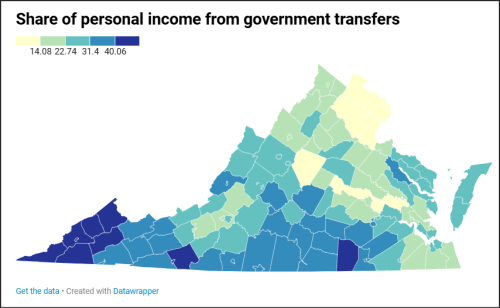
    “Those of us who live in rural areas like to think of ourselves as independent and self-reliant,” he writes. Ironically, the data show that rural American communities are among the most dependent in the country upon government transfer payments.

    Yancey is too stout of an advocate of rural/western Virginia interests to draw the same conclusion that some of our friends on the left do: that such dependence marks residents of “red” flyover country as hypocrites. He notes correctly that the dependence upon federal largesse reflects the fact that rural populations are older than suburban/urban populations and, therefore, a higher percentage qualifies for Social Security and Medicare — which, I might add, they have been paying into their entire lives.

    “This isnโ€™t a case of lazy, shiftless Americans milking the system so they can live on the dole, the classic tale of the โ€œwelfare queen,โ€ Yancey says.

    (more…)

  • Index Taxes for Inflation Before Raising Legislator Pay for Inflation

    By Steve Haner

    Only part of the story, the part that best justifies a big pay increase.

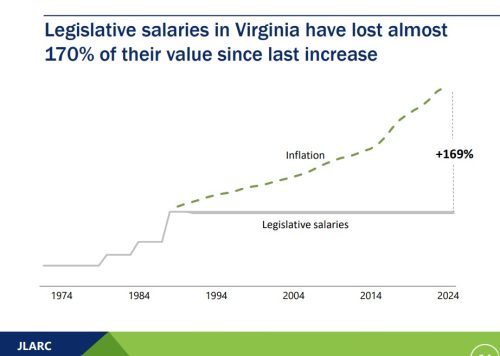
    The Virginia General Assembly is maneuvering to raise its own pay to adjust for decades of inflation.ย To do so without showing similar consideration for the impact of inflation on Virginia taxpayers should be cause for a voter revolt.ย 

    No tax code indexing, no pay raise.   

    To its credit, the staff at the Joint Legislative Audit and Review Commission (JLARC) has been fair in noting the impact of inflation on Virginiaโ€™s frozen tax provisions and bracket amounts, as well as on the frozen legislative salaries. It focused on the tax code first, before producing this weekโ€™s report on legislative compensation.ย ย 

    The report recommended the first pay raise since 1988 and was reported by the Richmond Times-Dispatch as the conclusion of a fiscal โ€œwatchdog.โ€ย JLARC is a creature of the legislature, producing a report commissioned by a legislative resolution.ย The legislators who sit on it, with Democrats now in the majority, cannot hide behind their hired staff on this one.ย ย 

    The report and its accompanying slide deck are short and worthy of review.ย  Most people are aware that legislators are paid a salary, but JLARC gets into the details of the full compensation General Assembly members receive for their services.ย To borrow a phrase from the Bard, there is no reason to sit upon the ground and tell sad tales of the poverty of legislators. Quite the contrary.ย 

    (more…)


  • Is Newer Necessarily Better?

    by James A. Bacon

    Image credit: Bing Image Creator

    Governor Glenn Youngkin will propose $290 million in extra funding for new public-school construction in the 2025-26 fiscal year, the Governor’s Office announced yesterday. That will bring the total amount of construction dollars in the biennial budget to $700 million, and the total allocated since Youngkin took office in January 2022 to nearly $2 billion.

    Naturally, the Virginia Education Association says that’s not nearly enough. According to the Richmond Times-Dispatch, VEA President Carol Bauer said years of underinvestment and inflation mean the backlog of new school construction is increasing about $1 billion yearly. The governorโ€™s one-time funding proposal, she said, โ€œdoesnโ€™t even keep pace with the annual growth of our backlog, let alone make meaningful progress in reducing it.โ€

    Moral of the story: No amount of money is ever enough. The education lobby always wants more.

    No one is asking some basic questions: Could school districts extend the lives of existing buildings by spending more on maintenance? Do new schools even improve academic achievement? If not, what’s the need for them? Could money be spent better in other ways?

    (more…)

  • Shed a Tear for Virginia’s Poor, Persecuted Antisemites

    Image credit: NBC via YouTube

    by James A. Bacon

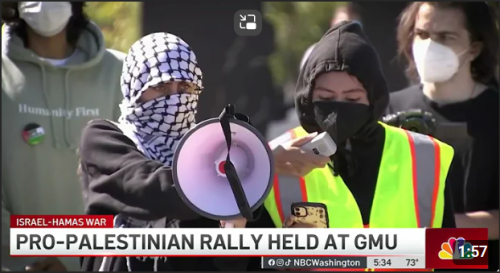
    George Mason University has issued No Trespass Orders against two leaders of the university’s Students for Justice in Palestine (SJP) organization, Jena and Noor Chanaa. In writing about the inevitable controversy, The Washington Post led with the angle that faculty, staff, students, and advocacy groups are accusing the university police of acting improperly in banning the two women and also in searching their family’s home.

    Only by the fourth paragraph does the Post get around to noting that, oh, by the way, here’s what police found in the Chanaa home: four guns, 20 magazines with 30 bullets each, Hamas and Hezbollah flags, and arm patches in Arabic which, when translated, read โ€œKill them where they stand,โ€ and patches that call for “death to Jews and America.”

    The discovery of an arms cache hasn’t stopped self-styled defenders of Muslim rights from bestowing victimhood upon the sisters — see this open letter — and it hasn’t stopped the WaPo from using their claims to distract from news of armed pro-Palestinian militants in Northern Virginia.

    “This case reeks of racial and religious profiling,โ€ said Abdel-Rahman Hamed, the familyโ€™s attorney, in a statement. โ€œThe items found were part of a historical collection, not evidence of any threat. โ€ฆ This is yet another example of the police state targeting American Muslims without cause.โ€

    (more…)

  • Combative CEO of Ballad Health Blames His Own Doctors for Hospital Quality Issues

    Image: Balladโ€™s Johnson City TN Medical Center

    by James C. Sherlock

    Carol Bova and I have written often in this space about the largest government-sponsored hospital monopoly in America, Ballad Health in the Appalachian mountains of Tennessee and Virginia. Ballad is made up of 20 hospitals that exclusively serve 1.1 million people.

    Ballad was established jointly in 2018 by a Tennessee Certificate of Public Advantage, or COPA, agreement and by a Virginia Cooperative Agreement. 

    It was done for three reasons stated by Tennessee:

    it is the policy of this State, in certain instances,

    • to displace competition among hospitals with regulation… and to actively supervise that regulation to the fullest extent required by law,
    • in order to promote cooperation and coordination among hospitals in the provision of health services; and 
    • to provide state action immunity from federal and state antitrust law to the fullest extent possible to those hospitals issued a certificate of public advantage

    Those charters effectively formed an interstate version of Virginiaโ€™s Certificate of Public Need (COPN) law that was created for the same reasons, but is not nearly as honest in declaring its intent.

    On December 6th, Brett Kelman of KFF Health News published an expose of Ballad in the Tennessee Lookout. The article challenges the notion in the COPA that quality of care in Ballad hospitals is actively supervised by the two states and the Centers for Medicaid and Medicare Services (CMS). ย 

    Readers perhaps will find most interesting the combative interview with Ballad CEO Alan Levine.

    In it Levine disclaims Ballad’s responsibility for quality of care in its hospitals.

    (more…)

  • Data Centers: Will Virginia Bend the Knee to the Green Lobby?

    Image credit: ChatGPT

    by James A. Bacon

    Electricity demand from data centers in Virginia potentially could double over the next 10 years if unconstrained by infrastructure limitations, according to an independent forecast produced for the Joint Legislative Audit and Review Commission (JLARC). Billions of dollars of new solar farms, wind farms, gas-fired generators, battery storage facilities, and electric transmission lines would have to be built to meet the demand. Meeting even half the demand, says the JLARC report, would be “difficult to achieve.”

    “The biggest challenge would be building new natural gas plants. New gas would need to be added at the rate of about one large, 1,500 MW plant every two years for 15 consecutive years,” the report concludes.

    Building out the infrastructure would be expensive, and electricity rates would rise. A typical residential customer of Dominion Energy could see inflation-adjusted costs rise by $14 to $37 monthly, the report says.

    The study, “Data Centers in Virginia,” lays out the trade-offs facing Virginia, which has the largest concentration of data centers in the world, as Artificial Intelligence (AI) drives demand for energy-intensive processing power to heights unimagined only a few years ago. Chasing the economic opportunity would dash green dreams of a carbon-free electric grid.

    (more…)

  • Time Is Running Out for Change at UVA

    by James A. Bacon

    Time is running short for Governor Glenn Youngkin to make his mark on the University of Virginia. His appointees to the Board of Visitors now comprise a 13-to-4 majority, yet after almost a half year, they have failed to make a visible dent in the priorities set by President Jim Ryan. Youngkin has little more than a year left in office. If the likely Democratic candidate for governor, Abigail Spanberger, succeeds him, she could easily reverse the little progress he’s made.

    The sand is fast draining from the hourglass. The painfully slow pace of change came into focus during the Board of Visitors’ quarterly meeting last week. Youngkin appointees signaled that they intended to take a closer look at UVA finances. Mind you, they didn’t contest a single administrative proposal. Three building projects totaling more than a half a billion dollars in cost are still moving through the bureaucratic pipeline. Rather, Youngkin board members flexed their majority muscles by expressing their intent to take a closer look in the future.

    As for doing something tangible such as cutting spending and tuition, reining in the Diversity, Equity & Inclusion (DEI) bureaucracy, halting the double standards applied to different student groups, or bringing about intellectual diversity at an institution overwhelmingly dominated by left-of-center faculty and administrators, those conversations haven’t even begun.

    When board member Bert Ellis declared that he would vote “no” on any proposed new spending increase until the administration presented a budget with significant spending and tuition cuts, not a single board member spoke in agreement. The few docile challenges that have taken place amount to tinkering on the margins.

    Why is this so?

    (more…)

  • Racking Up the Fees

    Matan Goldstein, the Jewish student who was subjected to repeated antisemitic treatment at the University of Virginia, has settled his lawsuit against the University. Terms of the settlement were not revealed.

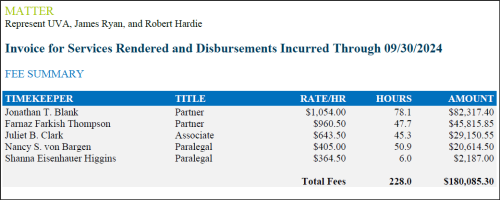
    While the public cannot know how much UVA paid, if anything, to make the problem go away, we can get a sense of how much it spent on legal fees.

    According to billing documents obtained by my Jefferson Council colleague Walter Smith, Richmond law firm McGuire Woods billed $521,000 dollars in July, August, and September, charging as much as $1,054 per hour for partner Jonathan T. Blank’s time.

    (more…)

  • Jeanine’s Memes

    From The Bull Elephant


  • Virginia Education Press Needs Intensive Support

    by Todd Truitt

    If you were expecting any humility after the Virginia education press ran with the false claim for months that 70%+ of Virginia schools would be in the bottom two of four summative categories (Off Track, Needs Intensive Support) of the new accountability systemโ€“-when it was actually in the 30sโ€”think again. The Washington Post is on the case this week with a 1,600+ word article, devoting substantial column space to instead implying that a government conspiracy occurred.

    The Post also, astonishingly, spends most of the other column space implying that the fact that the new system brings much greater transparency to Virginiaโ€™s educational inequality is a negative. However, that transparency is a feature of accountability systems, not a bug. With the new transparent accountability system, weโ€™re going to stop talking about educational inequality in quiet rooms and start talking about it publicly so we can better devote resources to the schools that need assistance.

    Washington Post Sees Government Conspiracy in Press Mistake

    As I detailed five weeks ago now, the Virginia education press ran with a made-up 70% metric that was first speculated at an August Virginia Board of Education (VBOE) meeting in an off-the-cuff estimate from a slide that clearly stated it was based on โ€œpartially modeled data.โ€ State Superintendent Coons even warned at the meeting that the 70% metric was fabricated, โ€œI think weโ€™re making assumptions before we have data, so I caution us to make assumptions without that information.โ€

    But the Virginia education press publicized it broadly anyway, particularly Anna Bryson of the Richmond Times-Dispatch. Once the Virginia Department of Education (VDOE) received almost all outstanding information seven weeks later, the VDOE provided an FAQ, which showed that, in fact, 37% of Virginia schools were in the bottom two tiers.

    (more…)

  • Bacon Meme of the Week


  • Day of Infamy