• Giving Thanks for What Makes America Great

    by Chris Braunlich

    Alexis de Tocqueville

    Alexis de Tocqueville never met Nancy Slater White, but he would have liked her.

    Tocqueville, of course, is the observational author whose 1835 book, Democracy in America, is considered by many to be a seminal work in defining what made America and the American character unique among nations.ย White was a Bethlehem, Pennsylvania businesswoman and community leader whose death in Northern Virginia, at the age of 91, left her with few contemporaries but plenty of devoted friends and family to mourn her passing.

    At a time in which defining what makes America great too often boils down to an election return, they offer a lesson on why we should be thankful this weekend.

    Raised in a time when opportunities were limited for women, Nancy White attended college on a scholarship, becoming a social worker and doing whatever was necessary to protect abused children โ€“ at one point tracking down a judge on the third tee of a golf course to get a court order signed before it was too late to help a particular child.

    But it was in voluntary community efforts that she shone.ย 

    (more…)


  • Happy Thanksgiving!

    by Kerry Dougherty

    Norma Dougherty in 1990. Queen of the casseroles.

    When youโ€™re a mediocre cook, you have to find ways to distinguish yourself at holiday meals.

    My mother, who perked up nearly all of her overcooked dishes with Lipton Onion Soup Mix, was respected widely for her punctuality.

    And her eclectic collection of guests.

    My parents regarded a holiday shared exclusively with family members as a sad sign of social isolation. To avoid that, they always were on the lookout for folks with no place to go. If an acquaintance mentioned that family lived far away, my mother would beam. Spend Thanksgiving with us, she’d suggest.

    No car? No problem. We’ll pick you up. Be ready.

    Holiday invitations were issued early, before anyone else could get to these hapless prospective guests. That is how a rotating cast of oddballs came to arrive every Thanksgiving. Any awkwardness at finding themselves in our misfit midst evaporated in the quick-step timing of our holiday gatherings.

    A bachelor college professor was a fixture at our Thanksgiving and Christmas tables for more than 20 years. So was a widowed steelworker. They sat beside a single nurse, who’d served in the Women’s Army Corps during World War II. I recall several holidays with uniformed soldiers from Fort Dix at the old oak table. And at least one with an Indian family who’d bought a house from my father’s little real estate business and was unfamiliar with American traditions. Prime targets.

    Continue reading.


  • Rules for a Harmonious Thanksgiving

    Note from reader Kim Acquaviva:

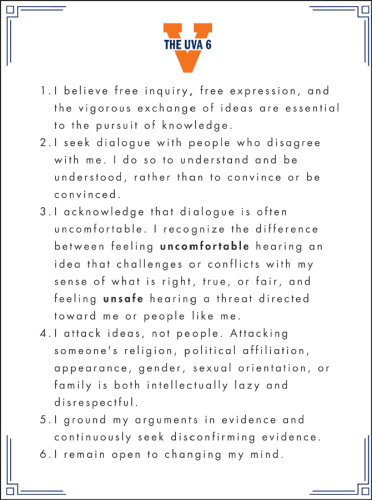
    If youโ€™ll be celebrating Thanksgiving with a politically diverse group of family members and/or friends, consider printing out copies of The UVA 6 for those in attendance. In my experience, dinner conversations are much less fraught with tension when everyone strives to follow the six principles listed in the document.  

    May your Thanksgiving holiday be filled with family, food, and friendly conversation with those you love!   


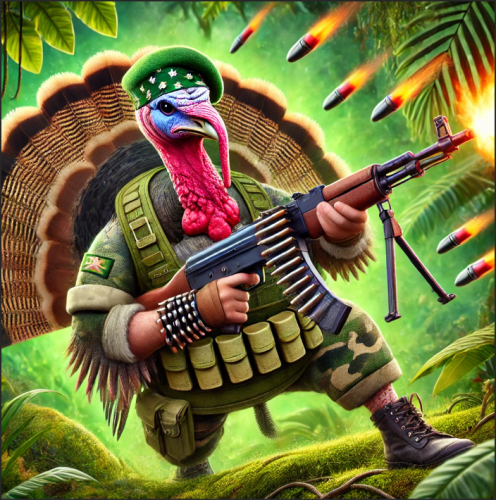
  • Happy Thanksgiving — from the Turkey Resistance

    Image credit: ChatGPT

    Take this, settler colonialists!


  • Finding Common Ground — the Podcast

    Bacon’s Rebellion’s AI podcasters, Lila Maverick and Jaxon Wilder, are back, this time to talk about the Hoos Connected program at the University of Virginia. The avatars use content in the article as a jumping-off point for making their own observations, drawing original conclusions, and waxing philosophical. I love hearing AI avatars talking about what it takes to be human! — JAB


  • Finding Common Ground

    by James A. Bacon

    I’ve written a lot about what’s wrong with “Diversity, Equity & Inclusion”: how it classifies people as oppressed or oppressors, feeds feelings of victimhood and grievance, pits groups against one another, and leaves people, especially minorities, feeling isolated and alienated. But I’ve been challenged by the avatars of Bacon’s Rebellion latest podcast to explore the idea of what inclusion should look like. How do institutions, in particular universities, create a sense of belonging for students, faculty and staff from all walks of life?

    Much of my criticism has taken aim at the Oppression Narrative at the University of Virginia and the DEI bureaucracy that enforces it. But, as it happens, there is an excellent positive example at UVA of how to foster a sense of belonging — the Hoos Connected program.

    Joe Allen

    Hoos Connected is the brainchild of psychology professor Joseph P. Allen, who runs an adolescence research lab at UVA. The program brings together a diverse group of first- and second-year students weekly to get to know one another, share their personal experiences, and hear the perspectives of others. The goal is for young people to explore what they have in common — not what divides them.

    As one Asian-American student in a Hoos Connected a promotional video put it, the best part “was being able to hear other peoples’ experiences and stories, and how different or similar they were to my own.”

    (more…)


  • DEI Training Makes Race Relations Worse — the Podcast

    Lila Maverick and Jaxon Wilder, Baconโ€™s Rebellionโ€™s AI-generated avatars, are back with a new podcast based on my recent post, “DEI Training Makes Race Relations Worse.” For those not inclined to wade through my dense prose, they cover the same ground in an easy conversational manner.

    It’s fascinating to hear the avatars depart from the article about two-thirds of the way through the podcast and head off on their own tangent: If “anti-racism” training is counter-productive, they ask, what should a DEI program look like? It should emphasize peoples’ common humanity, engage in respectful dialogue, and build bridges, they say. That message wasn’t in my post… but it should have been. — JAB


  • DEI Training Makes Race Relations Worse

    Not working as advertised. Image credit: ChatGPT

    by James A. Bacon

    Diversity, Equity, and Inclusion (DEI) training is now an $8 billion-a-year industry. More than half of Americans have been exposed to it. The training varies considerably in rhetoric and content, but programs that emphasize structural racism and White bias engender attitudes that can make race relations worse, not better, finds a new study, “Instructing Animosity: How DEI Pedagogy Produces the Hostile Attribution Bias.

    Remarkably, for all the resources poured into DEI training, the efficacy of the programs has been little studied, contend the authors, who are affiliated with the Network Contagion Research Institute (NCRI) and the Rutgers University Social Perception Lab. The study addressed the research deficit by conducting a randomized, double-blind study that compared attitudes of 423 participants after exposure to the thinking of DEI “anti-racism” popularizers Ibram X. Kendi and Robin DeAngelo.

    The experiments touching on attitudes toward race (and religion and caste as well) assess a crucial question, the authors write. “Do ideas and rhetoric foundational to many DEI trainings foster pluralistic inclusiveness, or do they exacerbate intergroup and interpersonal conflicts? Do they increase empathy and understanding or increase hostility towards members of groups labeled as oppressors?”

    I have been asking the same questions of the DEI programs at the University of Virginia and Virginia’s other public four-year institutions. Do DEI programs do what they are designed to do — increase a sense of inclusion and belonging among traditionally under-represented groups — or, by placing greater emphasis on racial identity, do they accentuate feelings of victimhood and alienation?

    University boards of visitors should pay attention to the NCRI-Rutgers findings:

    (more…)


  • Same Old Ship of Fools

    Image credit: ChatGPT

    by Kerry Dougherty

    Iโ€™ve been asked a number of times why I rarely write about local matters anymore. Particularly, why I donโ€™t write much about Virginia Beach. After all, as a newspaper columnist I made my bones by skewering the corrupt and indescribably stupid โ€œdancing bearsโ€ on the city council.

    Iโ€™ve got to admit it was fun. They provided endless material.

    Why stop now?

    Hereโ€™s why: itโ€™s fruitless. Iโ€™m tired of it. Iโ€™ve thrown in the proverbial towel.

    The faces on the local government change, their party affiliations change,ย  but their feckless policies remain the same.

    This council, like the ones that went before, is a rudderless ship of fools. It matters not the political make-up of the members, they follow the same tax-and-waste path of their predecessors. They shell out hundreds of thousands of dollars for worthless โ€œstudiesโ€ that simply confirm that spending more money will have marvelous results. Frequently a developer waves a shiny object in front of them, the obedient city staff canoodles with the developer before informing the politicians that the project is magnificent and will โ€œpay for itself.โ€ย 

    Next thing you know, the mindless members vote YES!

    Taxes go up, the project flames out and they blame miserly taxpayers for forcing them to cut corners on the cockamamie scheme. If only theyโ€™d sent more money, it would have been a smashing success.

    Continue reading.


  • Hey, Virginia Beach, Acknowledge THIS! — the Deep Dive Podcast

    Image credit: ChatGPT

    Lila Maverick and Jaxon Wilder, Bacon’s Rebellion’s AI-generated avatars courtesy of Google Notebook, conduct an amazing conversation based on my previous post, “Hey, Virginia Beach, Acknowledge THIS.” I hate to admit it, but their chat is better than the column it’s based on. All I can say is, Lila and Jaxon, please, please don’t take over my job! — JAB


  • Hey, Virginia Beach, Acknowledge THIS!

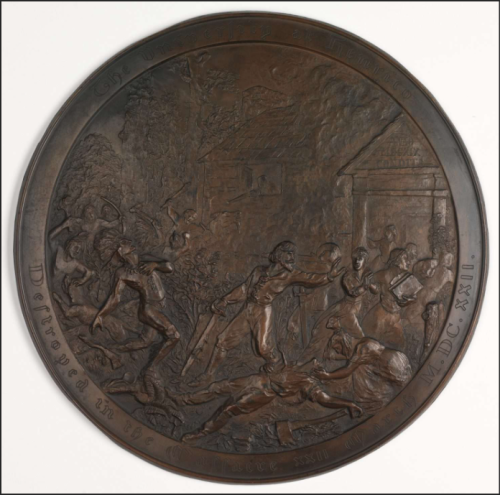
    This plaque, commissioned in 1901, commemorates the coordinated Indian attacks on March 22, 1622, that wiped out a third of the English settlers in Virginia. The bearded settler at center, sword in hand, motions to other Virginia colonists to flee. A woman attends to another settler lying injured on the ground. Image credit: Encyclopedia Virginia.

    by James A. Bacon

    The City of Virginia Beach is crafting a statement to “acknowledge” the Native Americans who lived there before the English settlers. Last week a draft presented to City Council proclaimed: “We, the City of Virginia Beach, acknowledge that the present-day land on which this city exists is situated on lands that have been inhabited by Indigenous peoples since time immemorial.โ€ So reports WHRO.

    You’d think City Council would have better things to worry about, like fixing public schools, making housing affordable, coping with rising sea levels, or making sure taxpayers aren’t ripped off by madcap development schemes. But, no, in modern-day America, such practical matters are of far less interest to educated elites than symbolic issues that will have no discernible impact on anyone’s life.

    So, here I go, rising to the bait, engaging in a symbolic issue of no use to anyone…

    The land acknowledgement plays into the grand narrative that “white settler colonists” displaced the local inhabitants. The implication is that the English presence in these lands was coercive and illegitimate, and by implication that the institutions erected by those who followed are tainted.

    The Native American population in Virginia in 1607 is estimated to have been around 50,000. Of those, 15,000 in the Tidewater region belonged to Algonquian tribes led by Chief Powhatan in what is called the Powhatan Confederation. The logical question is, who occupied the land before the Powhatan Confederation?

    (more…)


  • Will Virginia Universities Stand up for Virginia History? Er… No.

    by Don Smith

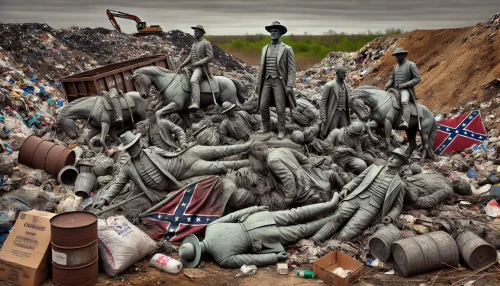
    Image credit: ChatGPT

    Does America have state universities? Or does it have publicly funded universities that just happen to be located in a particular state? Theyโ€™re not the same thing.

    Regular Baconโ€™s Rebellion readers know that I have more than a passing interest in Confederate history and heritage. (Insert rolling-eyes emoji here). In January of 2023, Iโ€™d just read the report of the Naming Commission. The commission chose to opine on the overall worth of Confederate heritage within the Department of Defense, now and in the future. Americaโ€™s military is possibly its most respected institution. If the federal government takes actions or renders opinions that indicate that a certain segment of American society no longer warrants respect from our military, that echoes far beyond the confines of military bases and federal facilities. 

    The Naming Commissionโ€™s judgments on Confederate heritage, and the sweep and totality of their recommendations, are scathing and contemptuous toward former Confederates, their descendants and their communities. For example, its final report said that

    …during the end of the nineteenth century and the start of the twentieth century, the South and much of the nation came to live under a mistaken understanding of the Civil War known as the โ€œLost Cause.โ€ As part of the โ€œLost Cause,โ€ across the nation, champions of that memory built monuments to Confederate leaders and to the Confederacy, including on many Department of Defense assets. In every instance and every aspect, these names and memorials have far more to do with the culture under which they were named than they have with any historical acts actually committed by their namesakes. [Emphasis added.]

    (more…)


  • Jeanine’s Memes

    From The Bull Elephant


  • Bacon Meme of the Week


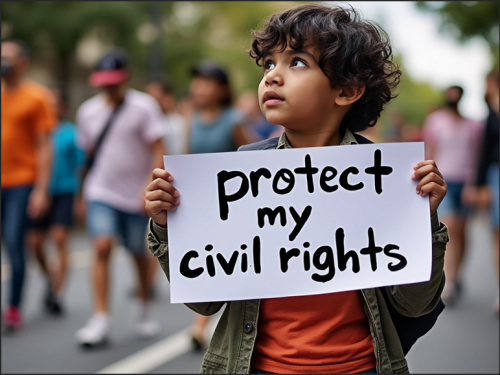
  • NOVA School Districts Attack English Learner Civil Rights

    Photo credit: Grok

    by Todd Truitt

    The eight large Northern Virginia school board chairs have released a joint letter asking for a โ€œdelay of at least one yearโ€ on the new accountability system until a new governor is in office, claiming that a three-year development and implementation period is โ€œrushedโ€ (i.e., they may need five years or more). In fact, this development and implementation period is longer than for the last accountability system, which was implemented in less than nine months.

    The joint letter touts how these districts contain approximately 60% of the stateโ€™s English Learners, but then proceeds to attack 22+ year-old federal English Learner civil rights protections, describing such protections as โ€œunrealistic runways for English Language Learners (3 semesters for Mastery rather than the current Demonstration of Growth)โ€.ย 

    Notably, their resistance to such English Learner civil rights also puts these school systems in opposition to:

    1. Three major national civil rights groups, including two major Latino civil rights organizations, who provided a formal comment in July 2024 supporting Virginiaโ€™s accountability system change to include English Learners consistent with the 2015 U.S. Every Student Succeeds Act (ESSA).
    2. Both major national teachers unions and 40+ national civil rights organizations who all reconfirmed their support this year for the inclusion of English Learners consistent with ESSA in accountability systems.

    As I previously detailed, the 22+ year-old federal civil rights protections include English Learners in school accountability systems after three semesters (vs. after 11 semesters in Virginiaโ€™s old state system). Last week, I also detailed how any further โ€œdelayโ€ of the new systemโ€™s implementation would prioritize the sensitivity to greater transparency of adults who run certain Virginia public school systems over the civil rights of Virginia communities, families and students.

    (more…)