

by James A. Bacon
Electricity demand from data centers in Virginia potentially could double over the next 10 years if unconstrained by infrastructure limitations, according to an independent forecast produced for the Joint Legislative Audit and Review Commission (JLARC). Billions of dollars of new solar farms, wind farms, gas-fired generators, battery storage facilities, and electric transmission lines would have to be built to meet the demand. Meeting even half the demand, says the JLARC report, would be “difficult to achieve.”
“The biggest challenge would be building new natural gas plants. New gas would need to be added at the rate of about one large, 1,500 MW plant every two years for 15 consecutive years,” the report concludes.
Building out the infrastructure would be expensive, and electricity rates would rise. A typical residential customer of Dominion Energy could see inflation-adjusted costs rise by $14 to $37 monthly, the report says.
The study, “Data Centers in Virginia,” lays out the trade-offs facing Virginia, which has the largest concentration of data centers in the world, as Artificial Intelligence (AI) drives demand for energy-intensive processing power to heights unimagined only a few years ago. Chasing the economic opportunity would dash green dreams of a carbon-free electric grid.
Data centers have been one of Virginia’s leading growth industries, annually contributing an estimated 74,000 jobs (many in construction), $5.5 billion in labor income, $9.1 million to Virginia GDP, and hundreds of millions of dollars in tax revenue. Presumably, a doubling of the data-center economy would double those numbers.
Governor Glenn Youngkin sees the potential demand growth as a positive for Virginia.
“Virginia has a simple choice: embrace all of the above [energy sources] and deliver affordable, reliable, and, yes, increasingly clean baseload power to support future economic growth, while taking advantage of the billions of dollars in capital investment, high-paying jobs, and local state tax revenues that come from data centers,” he told The Virginia Mercury. “Or bend the knee to a green energy agenda and give away Virginia’s leadership position.”
I foresee at least three serious obstacles to meeting the data centers’ demand for electricity.
First, any serious effort to meet the growth in demand created by data centers would shred any hope of meeting the goals of the Virginia Clean Economy Act, which calls for a net-zero carbon energy grid statewide by 2050. Solar and wind are not “dispatchable,” meaning they cannot be summoned when needed. Meeting baseload demand and providing back up power when the sun and wind aren’t generating enough electricity will require massive amounts of gas-powered electricity. I expect that environmentalists and their Democratic allies in the General Assembly will willingly sacrifice the economic benefits of data-center growth if that’s what it takes to meet the net-zero targets.
Second, making the environmentalists’ job easier is the fact that the economic benefits of the data-center boom are concentrated overwhelmingly in Northern Virginia: primarily in Loudoun and Prince William counties which sit athwart one of the world’s largest crossroads of fiber-optic trunk lines, while the cost of supplying the electricity will be spread across the state.
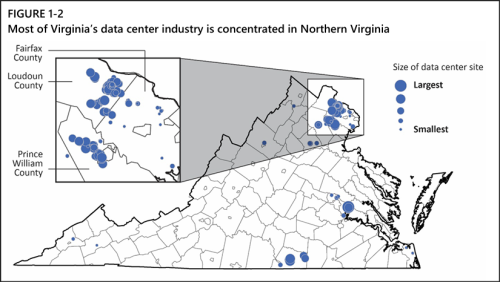
Data centers are lucrative revenue sources for local governments. Depending upon a locality’s tax rates and data-center exemptions, a single data center with $150 million in taxable computer equipment could collect from $0.4 million to $10.8 million in taxes over a five-year period. Although many localities collect some data-center revenue, Loudoun County and Prince William County are the biggest beneficiaries by far. Data-center revenue accounted for 31% of Loudoun’s local tax revenue and 7% of Prince William’s.
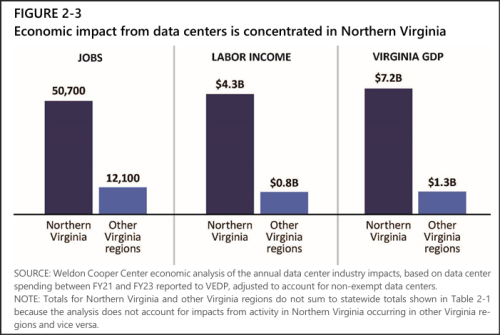
Don’t be surprised if downstate legislators ask, what’s in it for us? Why should we pay higher electric rates to support growth in Northern Virginia?
JLARC does discuss a strategy for circumventing that issue: treating data centers as a separate customer class, which would pay rates based on the costs that class incurs. But loading the full cost of electric-grid upgrades onto the data centers would make Virginia less economically competitive.
Third, regulatory and lawfare obstacles create formidable challenges to building out the infrastructure. Dominion Energy abandoned its Atlantic Coast Pipeline project under a relentless lawfare assault. The Mountain Valley Pipeline prevailed but only after years of lawfare-generated delay and a near tripling of costs. Meeting data-center demand will require a massive upgrade to the state’s electric transmission grid, which will be subject to more lawfare-related delays. Nowhere will that opposition be more intense than in Northern Virginia where Not In My Back Yard sentiments run strong and the citizenry is adept at mobilizing community opposition.
The odds of Virginia seeing JLARC’s “unconstrained” growth scenario are nil. Even meeting JLARC’s “half of unconstrained demand” scenario looks like a Herculean task. To have any chance of reaping an economic-development bonanza, Youngkin will have to find a way to convince a majority of legislators that there are enough benefits for their communities to outweigh the prospect of higher electricity rates.
Economic-development opportunities like this don’t come along very often. For Virginia, data centers will surely prompt one of the great public-policy debates of the 2020s.
Update: AVAIO Digital Partners announced today it had signed an agreement with the Appomattox County Economic Development Authority to build a data center. The $3 billion project will consume 300 megawatts of electric power. No details on how many jobs or how much in tax revenue it will generate. (See Virginia Business.)
“This project in Appomattox County exemplifies our strategy of expanding Virginia’s thriving data center industry beyond traditional hubs, bringing high-tech jobs and significant investment to communities across the commonwealth,” Gov. Glenn Youngkin said in a statement.


Leave a Reply
You must be logged in to post a comment.