

by Todd Truitt
If you were expecting any humility after the Virginia education press ran with the false claim for months that 70%+ of Virginia schools would be in the bottom two of four summative categories (Off Track, Needs Intensive Support) of the new accountability system–-when it was actually in the 30s—think again. The Washington Post is on the case this week with a 1,600+ word article, devoting substantial column space to instead implying that a government conspiracy occurred.
The Post also, astonishingly, spends most of the other column space implying that the fact that the new system brings much greater transparency to Virginia’s educational inequality is a negative. However, that transparency is a feature of accountability systems, not a bug. With the new transparent accountability system, we’re going to stop talking about educational inequality in quiet rooms and start talking about it publicly so we can better devote resources to the schools that need assistance.
Washington Post Sees Government Conspiracy in Press Mistake
As I detailed five weeks ago now, the Virginia education press ran with a made-up 70% metric that was first speculated at an August Virginia Board of Education (VBOE) meeting in an off-the-cuff estimate from a slide that clearly stated it was based on “partially modeled data.” State Superintendent Coons even warned at the meeting that the 70% metric was fabricated, “I think we’re making assumptions before we have data, so I caution us to make assumptions without that information.”
But the Virginia education press publicized it broadly anyway, particularly Anna Bryson of the Richmond Times-Dispatch. Once the Virginia Department of Education (VDOE) received almost all outstanding information seven weeks later, the VDOE provided an FAQ, which showed that, in fact, 37% of Virginia schools were in the bottom two tiers.
In the Post’s article this week (six weeks after the FAQ), there is no mention of the August slide’s clear disclaimer regarding the partially modeled data, nor Coons’ clear warning about it at that same August VBOE meeting. The Post also implies that a subsequent small adjustment after the FAQ from 37% to 35% was some sort of major statistical realignment.
Here’s the slide from August (note the prominent warning):
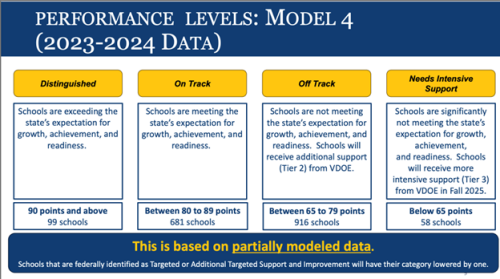
In addition, the Post talks about how the July VBOE presentation projected that 60% of schools would be in the bottom two tiers. What was not mentioned by the Post? That the projection was based off the 2022-23 school year using “partially modeled data,” and that discussed repeatedly in the July meeting was the fact that those numbers were expected to decline substantially for the 2023-24 school year because learning loss from COVID school closures had dissipated.
Moreover, the Post does not mention Superintendent Coons’ statement at the VBOE work session this week that the reason the August slide used “partially modeled data” for the 2023-24 school year was because data was still being collected through September 30th, as is always the case with Virginia accreditation and accountability data.
Other than putting a short quote from the VDOE, the Post devotes substantial column space to lobbyist critics on this issue, but none to any of the numerous supporters of the new system. Notably, the lobbyists do not seem to be informed about the fact that the data was partial in July and August. In their defense though, these lobbyist critics may be misinformed because they don’t read Bacon’s Rebellion and instead rely upon the Post and/or the Richmond Times-Dispatch.
Washington Post Sees Negatives in Exposing Virginia Educational Inequality
The Post also takes a conspiratorial tone to the fact that the new system shows vast demographic differences in Virginia schools’ performance. In fact, there are vast demographic differences in student performance in Virginia, and schools are often segregated by demographics. What is the counterfactual for the Post? To not discuss it? Are these types of discussions “only for quiet rooms,” to use Mitt Romney’s 2012 suggestion for income inequality discussions?
Here are the stark educational inequalities following the opaque, combined accreditation and accountability system that previously provided reporting on Virginia schools (i.e., Virginia’s prior “quiet rooms” system):
The results of the 2022 NAEP 4th grade reading section showed that:
- Virginia’s African American students performed significantly worse than Mississippi’s African American students.
- Virginia’s economically disadvantaged students performed significantly worse than Mississippi’s economically disadvantaged students.
- From 1998 to 2022:
- Large gaps between Virginia’s African-American and White students did not significantly change.
- Large gaps between Virginia’s Hispanic and White students did not significantly change.
- Large gaps widened further between Virginia’s economically disadvantaged students and non-economically disadvantaged students.
The results of the 2022 NAEP 4th grade math section showed that, from 2000 to 2022:
- Large gaps widened further between Virginia’s African American and White students.
- Large gaps widened further between Virginia’s Hispanic and White students.
- Large gaps widened further between Virginia’s economically disadvantaged and non-economically disadvantaged students.
As explained by the civil rights group The Education Trust, accountability systems are designed to show “which schools and districts are struggling to meet students’ needs and have student group disparities, and — most importantly — use this information to target additional resources and supports to address these needs.” The fact the new accountability system shows such stark demographic educational disparities is exactly why civil rights groups are strong supporters of clear, transparent accountability systems. Notably, the old system had been repeatedly criticized by national civil rights organizations for its opacity.
Suggestions to not publicize educational inequality often have fatalistic undertones of: “Those kids are never going to improve so let’s instead try to keep from embarrassing the adults who work at those schools.” George W. Bush famously called such a premise the “soft bigotry of low expectations.” Moreover, the non-evidence-based claim of opponents of accountability that hard-working teachers in those struggling schools will flee them at the drop of a hat is insulting to teachers. In fact, most of such teachers choose to work at those schools in order to have a greater impact on students’ lives, and are well aware of their students’ struggles.
As stated at this week’s VBOE work session by national accountability expert and Democratic VBOE member Andy Rotherham (who was nominated by both Governors Mark Warner and Glenn Youngkin):
“We go around on this again and again. And with respect, I get why the [Northern Virginia school] divisions want to delay. If I was some of those divisions, I would want to delay, too,” Rotherham said. “Because disaggregated accountability [by race, socioeconomic status, etc.] reveals some uncomfortable things about some of the stories we’ve been telling.”
Chollet Statistical Analysis of New System Is Wake Up Call for Virginia
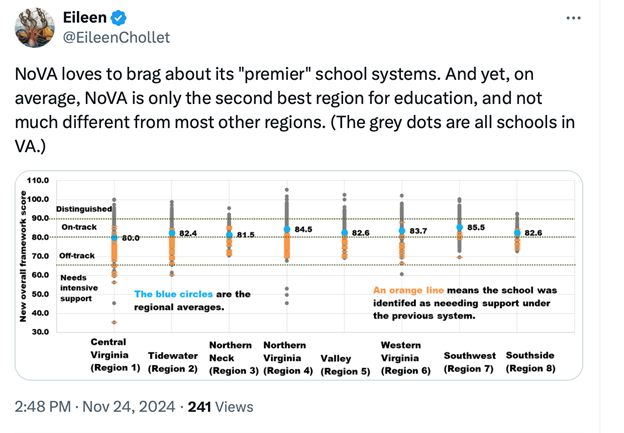
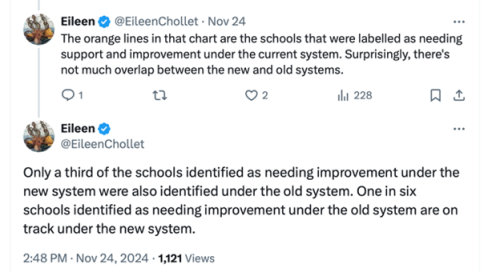
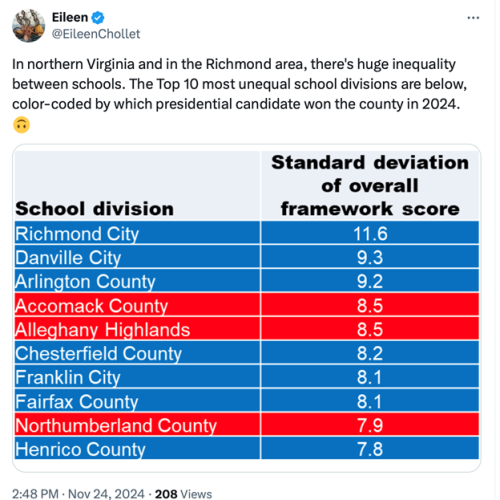
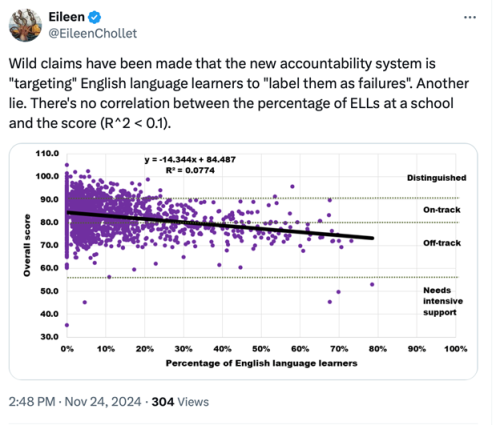
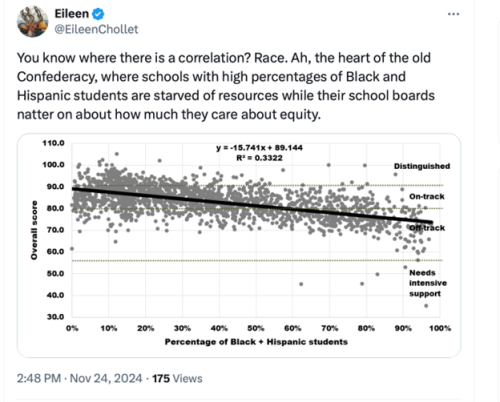
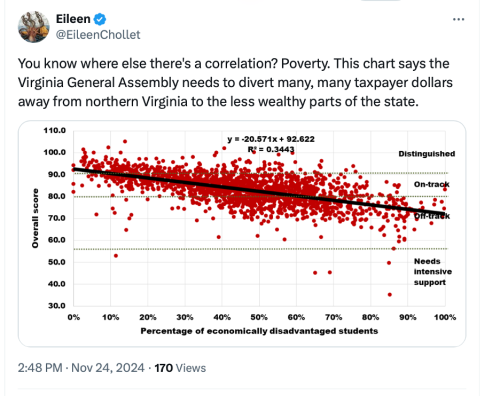
The Post did attempt its own limited statistical analysis to show this demographic correlation. But citizen journalist, Fairfax County Public Schools parent Eileen Chollet, several weeks ago on X (f/k/a Twitter) did her own, much more detailed statistical analysis of the new system, which is likely where the Post obtained the idea.
A few highlights from Chollet’s statistical analysis in such X thread are as follows:
Todd Truitt is a parent of two school-age children in Arlington County, Virginia. He is also the former Chair of the Math Advisory Committee for Arlington Public Schools and active in the Arlington Democrats. He is a business transactions attorney and a Certified Public Accountant.


Leave a Reply
You must be logged in to post a comment.