

by Todd Truitt
The claim that 70%+ of Virginia schools would be in the bottom two of four summative categories of the new accountability system has spread in the press and on social medial for almost two months. One activist group claimed it “makes schools all over Virginia ripe for takeover, reputational damage, and privatization” (never mind that the Virginia Constitution would likely not permit a state takeover of a school). The Washington Post reported on allegations that the new system is a “politically driven decision to paint schools in a bad light.”
In fact, the “up to 70%” claim had been an off-the-cuff estimate by Virginia Board of Education (VBOE) member Anne Holton based on partially modeled data during the VBOE meeting on August 28, 2024. In response, Superintendent Lisa Coons had warned, “I think we’re making assumptions before we have data so I caution us to make assumptions without that information.”
The press ran with such claim anyway, and it was pushed on social media to the extent it became common knowledge. In particular, state politics reporter (not opinion columnist) Anna Bryson of the Richmond Times-Dispatch (RTD) gave the incomplete data such breathless coverage that one has to wonder about her motivations.
The Virginia Department of Education (VDOE) finally debunked this claim in an FAQ last week, clarifying that the amount is 37% based on more complete data (along with debunking other misinformation, like tracking of students into the military and with English Learners). Here is the relevant excerpt:
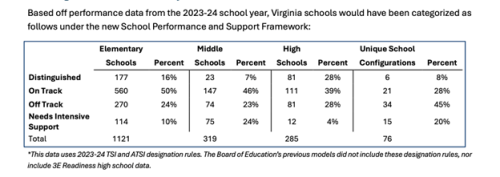
Maryland and Virginia Address Accountability Undercounts to Target Supports
Governor Glenn Youngkin’s office recently highlighted the continued failure of the soon-to-be-retired state accreditation system “to provide parents, educators, and communities timely, accurate and actionable insights into how well their students are actually performing academically.” For what is effectively only a two-category system, the bottom category of Virginia’s old system over its life had:
- 15% of schools, based on data from the 2023-24 school year (the higher percentage was attributed to the expiration of a COVID-era waiver);
- 11% of schools, based on data from the 2022-23 school year;
- 11% of schools, based on data from the 2021-22 school year; and
- 8% of schools, based on data from the 2018-2019 school year.
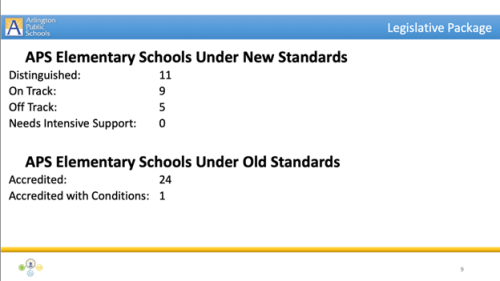
For instance, the below slide is from Arlington Public Schools for the 2023-24SY. Of the schools below, seven have greater than 40% English Learners and eight are Title 1 schools:
Similarly, the administration of Democratic Governor Wes Moore in Maryland is revising its accountability system to identify more schools when only 24% of Maryland schools were in the bottom two of five categories (the equivalent of 30% in the bottom two tiers if Maryland had a four-tier system). Maryland State Superintendent Carey Wright (who is reportedly on the short list of possible nominees for U.S. Secretary of Education in a potential Kamala Harris presidential administration) stated: “I don’t honestly think our accountability system is holding anyone accountable.”
Virginia Adopts Summative Ratings Backed by Civil Rights Organizations
One fundamental difference between Maryland’s and Virginia’s old systems is that Maryland has already been providing a summative rating (5 stars) under the 2015 U.S. Every Student Succeeds Act (ESSA), whereas Virginia has not. The new Virginia accountability system will use four descriptive summative categories based on the federal system.
Virginia’s prior lack of a summative rating under the federal system had resulted in strong criticism from civil rights organizations, who advocate for a “clear overall rating of school performance” under ESSA as a matter of equity. Instead, Virginia’s parallel state accreditation system had used “Accredited” and “Accredited with Conditions” labels as quasi-summative ratings, but based on less rigorous metrics than permitted under ESSA (e.g., excluding English Learners for four years longer, using a combined proficiency and growth academic achievement indicator).
Despite civil rights groups’ advocacy for summative ratings under ESSA, Holton has repeatedly expressed her strong disfavor of them, referring to any summative rating (e.g., stars like in Maryland, descriptive ratings) as equivalent to an “A-F-type system.” Holton, who voted to approve the old system without a summative rating as a VBOE member in 2017, was the sole VBOE member to vote against approving the new system.
Birth of 70%+ Claim at VBOE Meeting
In the modeling at the August meeting, approximately 56% of schools were listed in the bottom 2 tiers, with the disclaimer of “partially modeled data” since, among other things, school divisions had another month to submit complete data, according to the VDOE. The modeling also did not include approximately 20% of schools then among the top three summative categories being federally identified as Targeted Support and Improvement (TSI) schools for having a demographic subgroup performing very poorly (e.g., African American, English Learners).
Holton estimated that, after moving TSI schools down one summative rating, up to 70% of schools would be in the bottom two summative categories (Off Track, Needs Intensive Support), resulting in Coons’ warning about incomplete data. Holton’s estimate boldly assumed that (i) the outstanding data would not be more positive and (ii) up to approx. 75% of TSI schools would from the 2nd summative category (On Track). Last week, the VDOE confirmed via email that both assumptions were false (e.g., most TSI schools were from the 3rd category (Off Track)).
Spread of 70%+ Claim via Virginia Press and Social Media
Bryson of the RTD is one of the leading (and few) Virginia reporters covering state education issues. Her articles are syndicated outside Central Virginia, including to newspapers in the Shenandoah Valley and in Southwest Virginia.
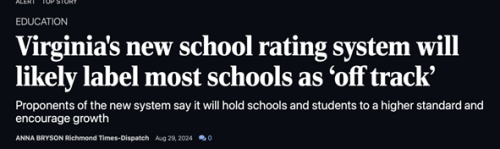
Reporting on the August VBOE meeting, below was the headline of Bryson’s article. Although buried in the article was the clarification that the data was incomplete, Bryson reported on the possibility of 70% of schools being in the bottom two tiers. As we previously covered, Bryson omitted material information in the same article about English Learners’ federal civil rights.
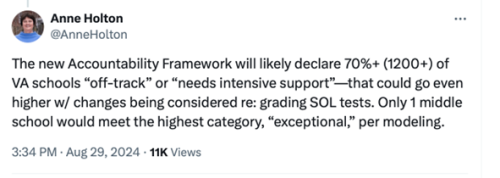
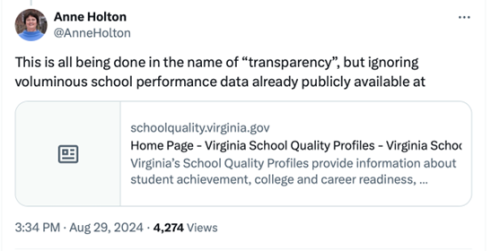
Holton also did a widely read Tweet storm (excerpts below) that included a link to Bryson’s article. One of Holton’s Tweets stated that the new accountability system would “likely declare 70%+” of schools in the bottom 2 summative categories, and “could go even higher.”
Additional media stories reported on this 70% claim with few caveats, which continued to spread via social media throughout September and into October.
WAVY reported that 75% of schools would be “off-track” under the new system. At a Loudoun County School Board meeting, their Chief Academic Officer stated that the “VDOE is anticipating between 60-80% of schools” in the bottom two categories, citing the press.
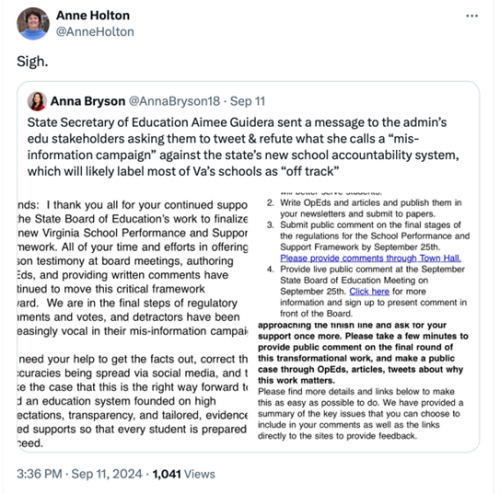
Around mid-September, Virginia Secretary of Education Aimee Guidera sent a private email to certain education stakeholders asking for help to correct inaccuracies being spread via social media. Guidera’s email was leaked to Bryson, who Tweeted it while noting that Guidera referred to “a ‘mis-information campaign‘ against the new school accountability system, which will likely label most of Va’s schools as ‘off track’.” Bryson’s Tweet generated approximately 26,000 views.
This leaked email resulted in a Quote Tweet by Holton:
Moreover, Bryson’s article in the RTD on October 1, 2024 stated, “The majority of schools next year will likely be rated as off track or worse.” The article did not have the precautionary clarification about incomplete data.
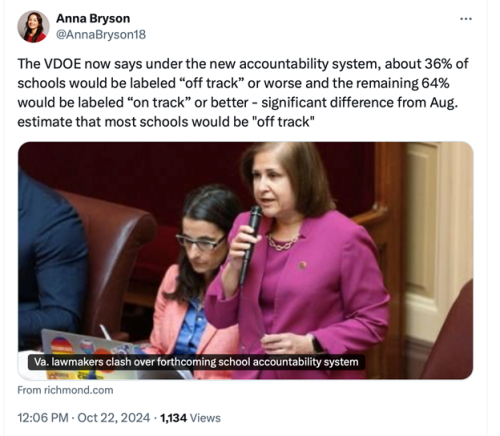
Finally, upon the release of the VDOE’s FAQ to correct with the more complete data and almost 7 weeks after her original story, here was Bryson last week:
Todd Truitt is a parent of two public school students in Arlington County, Virginia. He is also the former Chair of the Math Advisory Committee for Arlington Public Schools and active in the Arlington Democrats. He is a business transactions attorney and a Certified Public Accountant.
Leave a Reply
You must be logged in to post a comment.