
By Steve Haner
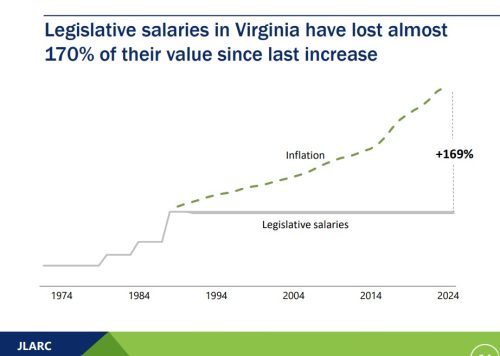
The Virginia General Assembly is maneuvering to raise its own pay to adjust for decades of inflation. To do so without showing similar consideration for the impact of inflation on Virginia taxpayers should be cause for a voter revolt.
No tax code indexing, no pay raise.
To its credit, the staff at the Joint Legislative Audit and Review Commission (JLARC) has been fair in noting the impact of inflation on Virginia’s frozen tax provisions and bracket amounts, as well as on the frozen legislative salaries. It focused on the tax code first, before producing this week’s report on legislative compensation.
The report recommended the first pay raise since 1988 and was reported by the Richmond Times-Dispatch as the conclusion of a fiscal “watchdog.” JLARC is a creature of the legislature, producing a report commissioned by a legislative resolution. The legislators who sit on it, with Democrats now in the majority, cannot hide behind their hired staff on this one.
The report and its accompanying slide deck are short and worthy of review. Most people are aware that legislators are paid a salary, but JLARC gets into the details of the full compensation General Assembly members receive for their services. To borrow a phrase from the Bard, there is no reason to sit upon the ground and tell sad tales of the poverty of legislators. Quite the contrary.
But yes, the salaries have been $18,000 for a senator and $17,640 for House members for a long time. The House gave itself a pay cut of 2% back when Governor Douglas Wilder (D) imposed a similar reduction on state employees, but the Senate refused to join in solidarity.
Along with the salary, legislators receive the full mileage reimbursement allowed by the federal tax laws for legislative use of their cars, they receive a daily per diem for living expenses during the session (no deduction for all the free meals from lobbyists), and extra pay for every legislative meeting they attend while the Assembly is not in session. That can now be $400 per day.
The salaries haven’t gone up since 1988, but the mileage rate, expense per diem and daily extra pay for off session meetings have risen sharply. All have been adjusted over time for inflation. JLARC does note that an additional office allowance has been frozen for years and has also been eroded by inflation. But it makes no effort to report how many legislators have district offices separate from their places or work or residence.
Then there is the sweetest deal of all. The report, in a little sidebar (but not in the presentation slide deck), mentions that legislators are part of the Virginia Retirement System (VRS). Unlike other state workers, they don’t have to pay anything in, and it covers more than just their salary. Presumably, they can also set up an investment account and earn a match amount, just like other state employees on VRS.
Once vested, there will be a monthly pension check at some point, with survivor benefits. And if the legislator goes on to some other state job with a big salary, the time in the Assembly will fatten the eventual pension payout – be they a judge, a statewide officer or an agency head. Does being a legislator increase the chances of that happening? About 1,000 percent, the best perk of all.
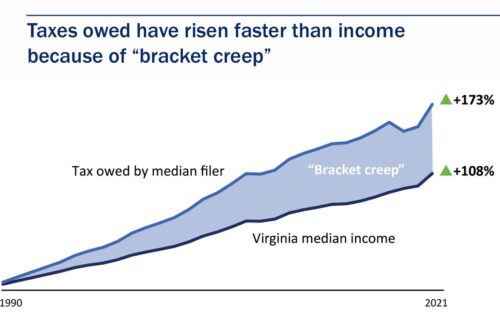
Since the last pay raise in 1988, there has also been no inflation adjustment for Virginia’s tax brackets, which first impose income tax at $3,000 of income and the maximum tax rate on incomes above $17,000. The personal exemption amount and various credits are also unchanged.
The one area of progress, very recent, has been the increases under Governor Glenn Youngkin (R) in the standard deduction for those who do not itemize their deductions. But even those are scheduled to return to the lower amounts come 2026. Worse, the Assembly has resisted proposals to adjust them annually for inflation. Signs are that tax relief in the 2025 session may be limited to one-time rebates from the healthy surplus created largely by inflation.
The gas tax in Virginia now goes up automatically every year to adjust for inflation, as does the state minimum wage. Now JLARC staff has proposed legislative pay go on auto pilot, too, increasing every two years “based on an external benchmark.” This would save legislators the political complication of having to propose and vote on any future pay raises.
Raising the pay for senators every two years would violate the Constitution of Virginia, which says no pay raise can occur during a legislator’s term but must start after the next election. That was a sloppy error, JLARC. But the report is overall one of the weakest JLARC has ever produced. If you want to know just how much legislators really get paid, with all the bells and whistles, you won’t find it in this JLARC document.
To pose one key question, what are the range and median of the annual income amounts reported to the Internal Revenue Service on W-2 forms? What are the ranges and medians for cumulative annual mileage and expense allowance payments, which also get special IRS treatment? JLARC could have easily answered those questions but didn’t.
Should the light bulb come on and the Assembly move forward with a reasonable bill to adjust Virginia’s tax provisions for inflation, making the kind of regular adjustments we see in federal taxes, a salary increase for the legislators themselves would be easier to accept. Otherwise, it should be resisted.
First published by the Thomas Jefferson Institute for Public Policy.


Leave a Reply
You must be logged in to post a comment.