• Tough Talk On SITW

    by Kerry Daugherty

    Mayor Bobby Dyer exploded at Tuesdayโ€™s city council meeting and threatened to scrap the 2025 Something In The Water music festival if overdue contracts with the promoter werenโ€™t signed by the end of business Friday.

    Back in 2019 I was an enthusiastic cheerleader for Pharrell Williamsโ€™ inaugural โ€œSomething In the Waterโ€ music festival.ย 

    For years Virginia Beach had struggled with Aprilโ€™s annual โ€œBeach College Weekendโ€ which drew thousands of kids from historically black colleges and universities to the Beach. Unfortunately, the event also drew local dirtbags and gangs. As a result, the weekend became a crime convention and instead of making money, businesses locked up.

    Along came Pharrell Williams.

    Determined to rescue his hometown, Pharrell worked with city officials to turn the problem weekend into a festival. In 2019 SITW was a roaring success. In fact, there were fewer weekend crimes than usual, despite tens of thousands of festival goers.ย 

    I was there on Saturday night and even though my musical tastes are more Luke Bryan than Pusha T, I loved it. Portsmouthโ€™s Missy Elliott put on a show and Pharrell and Timbaland were terrific. On Sunday morning I rode my bike back to the festival for Pharrellโ€™s beach worship service and inspired gospel music.

    Itโ€™s been a catastrophe ever since. First the covid lockdowns stupidly put an end to outdoor concerts (thank you Ralph Northam, worst governor ever) and then the shooting death of Donovon Lynch – Pharrellโ€™s cousin – by a police officer, led to a bitter battle between the superstar and the city.
    Continue reading.


  • UVA Dissenters Test Limits of the Permissible

    by James A. Bacon

    More than 60 employers showed up to the University of Virginia’s 2024 job fair on Oct. 23 to offer job and internship opportunities to UVA students. They were greeted civilly by most — but not by everyone. The Dissenters, a militant pro-Palestinian student organization, targeted companies deemed complicit with Israel.

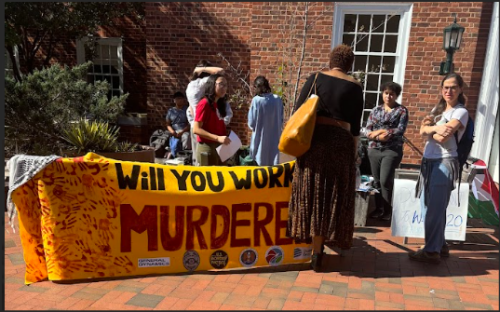
    The Dissenters set up a table outside Newcomb Hall. “Will You Work for Murderers?” proclaimed a banner as activists handed out literature and talked to passers-by.

    Activists have the right to free speech like everyone else. What they don’t have a right to do is disrupt the activity of students looking for employment opportunities. Dissenters submitted fake resumes and promised a $20 reward to students who could waste the attention of corporate recruiters for the greatest length of time.

    (more…)


  • Who Cares?

    by Dick Hall-Sizemore

    FROM THE SOAPBOX

    A New York Times news analysis outlines the sad condition of government and politics in the modern United States.

    Over the last two years, the Republican-led House of Representatives was essentially dysfunctional. A Speaker was ousted and a long, bitter fight ensued before a replacement Speaker could be elected. Along the way, the country narrowly escaped defaulting on its debt payments and skirted government shutdowns over disagreements on the budget. On those critical issues, both Speakers had to turn to Democrats for the necessary votes. Hardly anything of substance was accomplished as Republicans fought with each other for most of the two years. Several Republican members publicly decried the dysfunction and chaos and predicted that the party would pay a political price.

    In the end, they did not pay a political price. It seems that the American people have returned enough Republicans to the House for the party to again have a slim majority. Rep. Patrick McHenry, Republican of North Carolina, and chairman of the House Financial Services committee and interim Speaker, had this observation on the prospect that his party would retain control of the House: Itโ€™s โ€œproof that the American people donโ€™t pay attention to the details of our politics.โ€ He then corrected himself and said, โ€œItโ€™s probably less about paying attention and more about not caring.โ€


  • COVID Still Kicks Flu Butt as Cause of Mortality in Va.

    by James A. Bacon

    In the previous post I criticized Virginia’s response in 2020 and 2021 to the COVID epidemic, particularly the shutdowns that ignored the impact on jobs and the economy, foregone medical procedures, K-12 schooling, mental health and addiction. Let me emphasize: that’s not to say that COVID was not a huge public-health issue then… or that it doesn’t continue to be one.

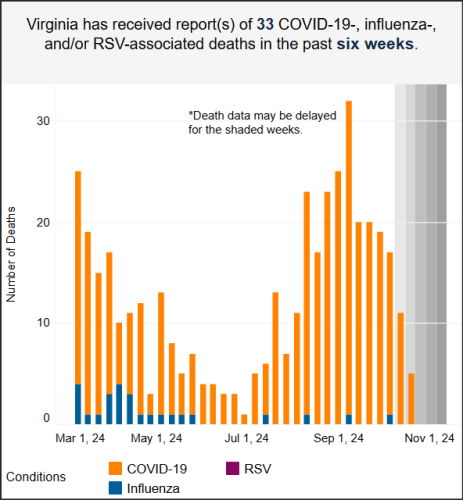
    The Virginia Department of Health (VDH) has revamped the COVID-tracking features on its website, lumping in COVID with influenza and RSV under the heading of “respiratory diseases.” COVID is much diminished as a public health threat from its peak, but according to VDH still far exceeds influenza as a cause of mortality. Here’s a look at the past eight months:

    (more…)


  • Whatever Could Account for the Decline in Opioid Deaths?

    by James A. Bacon

    Hmmm… Whatever could the explanation be? Image credit: ChatGPT

    Opioid deaths in Virginia have declined markedly since the end of the COVID epidemic, reports Virginia Public Media (VPM). The fatalities, many of which were attributable to fentanyl overdoses, peaked at 2,229 in 2021 and have fallen to a predicted 1,552 this year — down 30%.

    That number is still frightfully high, of course. It exceeds the 907 automobile deaths, 520 homicides, 54 workplace fatalities, and 38 child-abuse fatalities all combined in 2023.

    What accounts for the drop, even as the flow of fentanyl across the U.S. border with Mexico continues unimpeded? VPM cites Gov. Glenn Youngkin’s Right Help, Right Now initiative which invests in education, prevention, recovery and treatment efforts. The article also describes at considerable length the increasing availability of naloxone, a medicine that quickly reverses an opioid overdose.

    Those measures have been very helpful, I’m sure. But the account overlooks the obvious: the overdoses peaked during the height of the COVID epidemic, and the numbers began declining as the epidemic receded. Could there be a connection there?

    Hold on… hold on… I’m thinking…

    (more…)


  • Cavalier Kabuki

    Image credit: ChatGPT

    by James A. Bacon

    Once again the University of Virginia Board of Visitors is conducting the ritual of pretending to be involved in setting rates for tuition, fees, room and board, this time for the 2025-26 fiscal year. The board’s Finance Committee met earlier this month for an hour and forty-five minutes to hear presentations by UVA staff. Other than an introduction by Finance Chair Robert M. Blue, the minutes record no comments or questions by any board member.

    Blue framed the purpose of the meeting as, in the phrasing of the minutes, “educating and orienting committee members to some key issues that align with actions on the agenda in December.”

    He then turned over the meeting to Chief Operating Officer J.J. Davis to provide “some useful historical context to set the stage for upcoming actions, and to help committee members make decisions from an informed perspective.”

    Gaining an “informed perspective” did not extend to allowing committee members to ask substantive questions about UVA’s cost structure or high-tuition/high-aid financial model. Several board members appointed by Governor Glenn Youngkin have pushed for cuts to the university’s administrative staff but have been unable to open up the issue in the finance committee, much less in the full board. Finance Chair Blue and Rector Robert Hardie (who functions as chair of the full board) are both holdovers from the Northam administration. With President Jim Ryan, they control the agenda. Divisions among Youngkin appointees and don’t-rock-the-boat guidance from the Governor’s Office have stymied any action by reformers.

    (more…)


  • The Welfare Net

    by James A. Bacon

    Image credit: Bing Image Creator

    The United States has spent trillions of dollars on poverty programs, yet hard-core inter-generational poverty and its attendant social ills remain endemic. Federal and state benefits are not lavish, and they are contingent to some degree upon recipients finding work, or at least looking for work. But anti-poverty programs are doing a terrible job of lifting people out of poverty. While individual programs might make sense, the system of programs is dysfunctional. Ameliorating poverty will require addressing the system.

    That’s my takeaway from a recent report by the Joint Legislative Audit and Review Commission (JLARC), “Virginia’s Self-Sufficiency Programs and the Availability and Affordability of Childcare.”

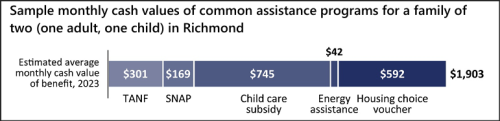
    A mother and child living in the Richmond area and “on welfare” can reap about $1,900 a month ($22,800 a year) in benefits, as seen in this JLARC graphic:

    I cannot imagine trying to support a child on $22,800 a year, which is only a tad above Federal Poverty Level of $20,400. It must be noted, however, that JLARC’s list does not include Medicaid (average spending per enrollee in Virginia of $7,000) or the Earned Income Tax Credit (worth up to $4,000 for a family with one child). Nor does it take into account private charity such as food banks or the vast underground economy, estimated at more than $1 trillion, in which many people (including the poor) take money under the table.

    (more…)


  • Fairfax City Chooses Non-Partisan Council and a Democrat Mayor

    by Ken Reid

    Following up from my article on partisanship in town and city elections…. Voters in Fairfax City opted for the non-partisan slate backed by former State Sen. Chap Petersen (D) and Fairfax County Supervisor Pat Herrity (R), but the Democrat-endorsed candidate for mayor and two of her Democrat-endorsed council candidates won.

    Voters were tasked with choosing six of the 11 council candidates running on the Nov. 5 ballot.ย 

    Mayor Catherine Read and Councilmembers Billy Bates and Stacey D. Hardy-Chandler, the Democrat-endorsed candidates, won. Voters also selected four from the non-partisan slate, but only three were decided because the other race is still too close to call.ย ย  ย ย 

    (more…)


  • Trump Energy Policies Face Hurdles in Virginia

    By Steve Haner

    Once inaugurated, President-elect Donald Trump is expected to immediately mount a major effort to roll back the anti-hydrocarbon fuel agenda of the Biden-Harris years. The positive impact on Virginians will be limited because of our own similar anti-hydrocarbon laws at the state level.ย 

    The centerpiece of Trumpโ€™s multiple energy campaign promises is expansion of production of American oil and gas, with the hope that greater supply will drop the retail cost. World markets might have a say in how much prices change, but should those prices drop, Virginians would benefit.ย ย ย ย 

    Trump has also promised to dismantle the network of interlocking regulations which it took President Biden only three years to jam through a friendly Congress and a compliant federal bureaucracy.ย Many of the key regulations are already fully adopted and repealing them must follow a process.ย Most are subject to litigation seeking to prevent their implementation, and the litigation battle would continue but reverse, with plaintiffs seeking instead to demand their implementation.ย ย 

    A good example is the set of new standards for electric power plants, a 2.0 version of the Clean Power Plan which former president Barack Obama imposed, and which Trump repealed and replaced in his first term. A changed leadership at the federal Environmental Protection Agency would be expected to start to dismantle or dilute the regulations. Lawsuits to stop them will be replaced by lawsuits demanding they remain.ย ย 

    (more…)


  • Why Stonewall Jackson Is Worth Remembering

    by Donald Smith

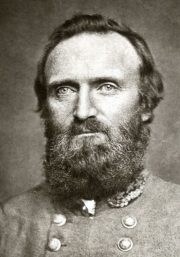
    In early August, the Fredericksburg and Spotsylvania National Military Park (FSNMP) placed a sign inside the Stonewall Jackson Death Site. Known to many people as the Jackson Shrine, it’s a plantation office building where Jackson died after being mortally wounded at the Battle of Chancellorsville.ย 

    The sign said this: “Stonewall Jackson led an army that fought against the United States with keeping slavery as one of their [sic] goals. Why then did this place become a United States National Park Site?” FSNMP says the park โ€œis committed to telling a fuller, more inclusive history of the Stonewall Jackson Death Site.โ€ This sign is part of an FSNMP initiative to “spark conversations and to broaden the story of the site and context for Jacksonโ€™s death and memory.โ€ย 

    If the first things that come to the National Park Serviceโ€™s mind, when it thinks of the most noteworthy aspects of Stonewall Jackson’s legacy, are that he fought for the Confederacy and the Confederacy supported slavery — then we really do need to have a conversation.ย ย 

    FSNMP placed three signs in the Death Site in early August. None mentioned Jacksonโ€™s reputation as one of America’s greatest battlefield generals. (Patton told Eisenhower he would be Ike’s Jackson, and Chesty Puller carried a biography of Stonewall.) No mention of First Manassas, the Valley Campaign, Cedar Mountain, Second Manassas or Chancellorsville.

    (more…)


  • Mortification of the Spirit

    by James A. Bacon

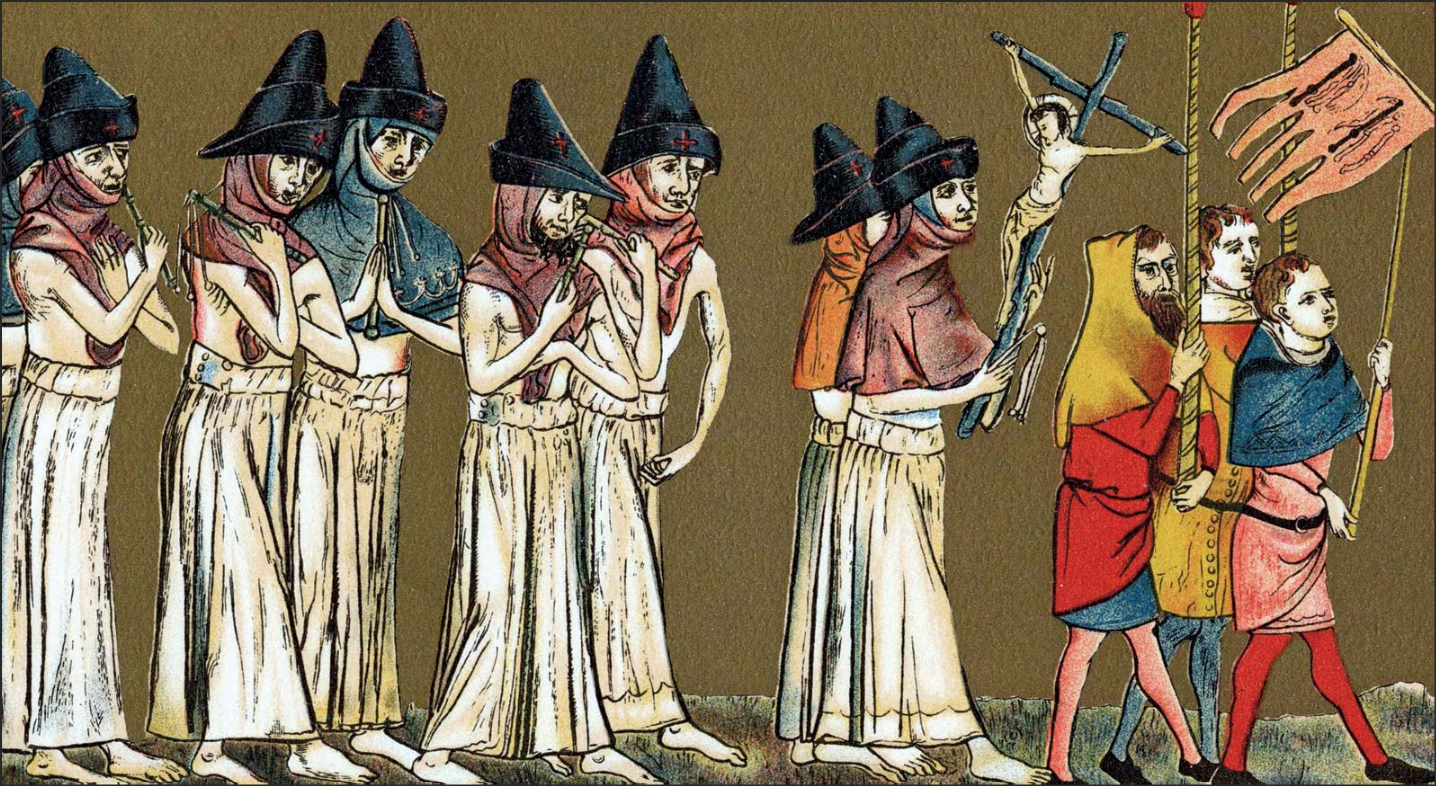
    In the 14th century, a popular movement known to historians as “flagellants” spread across Europe. Followers practiced “mortification of the flesh” by publicly pummeling themselves with knotted whips. By practicing self-denial and imitating the scourging of Jesus, they hoped to hasten the second coming and end of times.

    A similar movement has taken root in the United States today, although adherents don’t inflict physical pain upon themselves. Rather, they flagellate themselves with shame for their sins — or, actually, the sins of their ancestors, such as racism, misogyny, slavery, and the dispossession of native lands.

    John McWhorter, the center-left African-American author of Woke Racism: How a New Religion Has Betrayed Black America, makes the case, as his book title suggests, that wokeism bears all the hallmarks of a religion. Wokeism comprises a closed system of unfalsifiable beliefs and exhibits no tolerance of dissent. Transgressors risk condemnation and ostracism. Practitioners engage in performative rituals such as public acts of contrition and apology.

    As a living, breathing confirmation of McWhorter’s argument that wokeism is a religion, I present to readers a “Prayer for Truth, Reparation, and Healing” composed by the Truth and Reparations Task Force of the Episcopal Diocese of Virginia.

    (more…)


  • Honoring Sacrifice

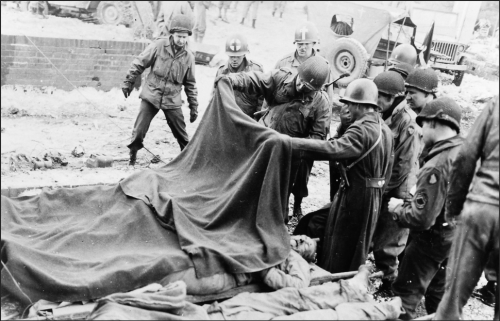
    American G.I.s with the fallen at the Battle of the Bulge.

    The Battle of the Bulge took place almost 80 years ago to the day. (The last-ditch German assault began December 16.) Roughly 75,000 Americans were killed, wounded or went missing. They fought, suffered, and died to defeat the scourge of Nazism and uphold our freedoms. We remember their sacrifices – and the sacrifices of hundreds of thousands of other Americans in countless other battles — once a year on Veteran’s Day.

    While cultural elites wallow in guilt and shame over our past as white settler colonialists, we should remind ourselves of the great things our nation has accomplished. We emerged from a world in which the universal condition of mankind was hierarchy and servitude, in which cruelty and oppression were ubiquitous, and in which kings, princes, potentates and warlords fought ceaselessly with one another.

    Our nation bequeathed to the world the immortal words, “We hold these truths to be self-evident, that all men are created equal, that they are endowed by theirย Creatorย with certainย unalienable Rights, that among these areย Life, Liberty and the pursuit of Happiness.” And we have striven to live up to that ideal.

    (more…)


  • A Salute


  • George Wythe’s Leadership Training School

    by James A. Bacon

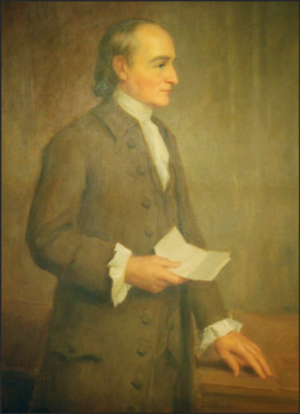
    George Wythe

    American conservatives revere the Founding Fathers of the American republic as exemplars of the classic virtues — for good reason — but our nostalgia for the past does have blind spots (and I’m not talking about just slavery, an evil that everyone acknowledges). We rarely remark upon the fact that leadership of the early republic consisted of a goodly number of ditherers, drunkards, self-dealers and profiteers. As George Washington wrote to Benjamin Harrison, most members of Congress were idle, dissipated, and extravagant, and consumed by “an insatiable thirst” for getting rich.

    That the newly formed United States managed to surmount the inevitable quirks and flaws of human nature Richmond author Suzanne Munson attributes in her new book, “First in Law, First in Leadership,” largely to the labors of one of America’s most insufficiently appreciated founders, George Wythe.

    Wythe, a professor of law at the College of William & Mary, did more than shape the minds and character of luminaries such as Thomas Jefferson and James Monroe, who would become presidents; John Marshall, the most consequential Supreme Court justice in history; Henry Clay, the Kentucky legislator who became Speaker of the House; and senators, governors, judges, and other leaders too numerous to mention. He transformed the practice of law into a learned profession.

    “Wythe taught more American leaders than any other mortal has since or ever will,” Munson quotes Taylor Revely, president emeritus of the College of William & Mary.

    Oh, and by the way, Wythe was an ardent opponent of slavery who impressed his anti-slavery views upon Jefferson and many others. In 1806, as a judge later in life, he ruled in the case Hudgins vs. Wright to free a slave woman, Jackie Wright, and her two children. Drawing upon Virginia’s Declaration of Rights, he argued that that individuals “should be considered free until proven otherwise,” and that “freedom is the birthright of every human being.”

    (more…)


  • Jeanine’s Memes

    From The Bull Elephant