
The Virginia Board of Education on Thursday rejected a last-minute proposal from the Virginia Department of Education (VDOE) to delay implementation of tougher passing standards (“cut scores”) on Standards of Learning (SOL) exams. Board members repeatedly emphasized we have the lowest math and reading cut scores in the country and that Virginia students, especially the least advantaged, have already waited long enough for more accurate measures of academic achievement.
But it’s not dead yet.
Governor Abigail Spanberger’s appointees will control the majority of the Board in August. Two of the three Spanberger appointees yesterday voted to reject the move on cut scores. The other Spanberger appointee abstained for procedural reasons while the fourth appointee was absent. But if the administration continues with this proposal, one can imagine the pressure these new Board members would be under.
Suspicious Timing; Board Members and Public Left in Dark Until Last Moment
Board members noted that even they just learned of the proposal on Thursday, June 24th when it became public. The proposal’s timing—released Thursday afternoon before a holiday weekend and after schools closed for summer—appeared designed to limit public scrutiny. And if the proposal had been approved yesterday for first and final review, it would have been subject to a final vote at the Board’s August meeting—the first meeting that Spanberger appointees would control the majority.
There were no other public hints this was coming. The possibility of delay was not reflected in the VDOE listening sessions report or appendices issued in April. In the Board slides, the VDOE’s references to any support in the April listening session documents for this proposal were scant and indirect.
One notable timing issue is that Spanberger vetoed the collective bargaining bill on May 14. The president of the Virginia Education Association, Carol Bauer, released this impassioned video the same day denouncing the Governor as betraying working people. On June 1, organized labor held a mass protest against Spanberger.
Impassioned Board Speeches
During the Board meeting, six speakers in public comment spoke forcefully about keeping the current timeframe, including me.
Many Board members spoke just as passionately about rejecting any delay because of the effect on children, especially the least advantaged. Board member Ida McPherson, former president of the NAACP Suffolk chapter, delivered some of the most impassioned remarks supporting continuation of the current plan.
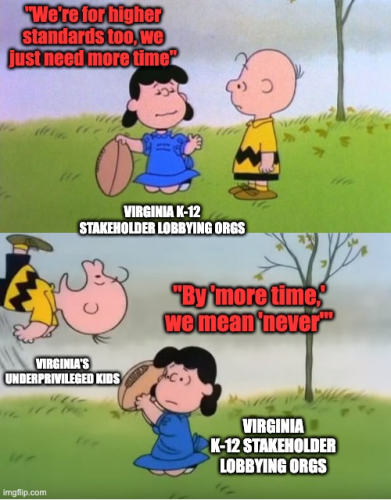
Charlie Brown made an appearance too, which was referenced in the Richmond Times-Dispatch article:
“There needs to be a sense of urgency,” said board member Bill Hansen. “The delay for this … is opening up the opportunity for Lucy to keep pulling out the football from Charlie Brown every time he’s going to kick it.”
More Excuses That Don’t Add Up
We also heard new excuses from the VDOE. For instance, the VDOE claimed that the new law requiring the Board of Education to consider the JLARC report’s recommendations on the new accountability system is what is causing this cut scores delay proposal. But that’s not what the JLARC report recommended. It did say that schools’ summative ratings scores would likely go down as cut scores increased. But the report said the summative ratings thresholds may need to be adjusted, NOT that the implementation timeframe of the cut scores would need to be adjusted.
Another excuse was the districts had never seen the full annual transition cut scores after being approved last year. But as Board member Hansen pointed out, where had the VDOE been since last year since the Board approved it? After the work session on Wednesday, the VDOE was able to produce it in only 3 hours of work that evening. And Hansen pointed out districts already had a good ballpark idea – since last year, they had all the final full implementation cut scores and knew it was a 4-year timeline (i.e., a matter of dividing by 4).
Board discussions also highlighted the glaring inconsistency of school districts and their adult lobbying groups. These groups for at least 3 years had pushed for a multi-year transition period saying the full increase at once is too much, yet suddenly a few months later seek an immediate full rollout—if given a two-year pause—that will coincide with major changes on assessments and modifications to the accountability system. This sudden, self-serving flip-flop doesn’t just fail the smell test—it reeks of rank opportunism.
The most craven example yesterday was with the powerful Virginia Association of School Superintendents (VASS). For years they aggressively lobbied for the slowest possible phase-in, at one point even pushing for an eight-year rollout. Their president was a frequent presence at Board meetings last year, delivering impassioned public comments warning against hasty implementation. Yet yesterday he returned to the microphone to enthusiastically endorse the proposed all-at-once timeline—apparently the “too disruptive” concerns evaporated the moment it suited them.
Leave a Reply
You must be logged in to post a comment.