
Whatever Could Account for the Decline in Opioid Deaths?

by James A. Bacon

Hmmm… Whatever could the explanation be? Image credit: ChatGPT

Opioid deaths in Virginia have declined markedly since the end of the COVID epidemic, reports Virginia Public Media (VPM). The fatalities, many of which were attributable to fentanyl overdoses, peaked at 2,229 in 2021 and have fallen to a predicted 1,552 this year — down 30%.

That number is still frightfully high, of course. It exceeds the 907 automobile deaths, 520 homicides, 54 workplace fatalities, and 38 child-abuse fatalities all combined in 2023.

What accounts for the drop, even as the flow of fentanyl across the U.S. border with Mexico continues unimpeded? VPM cites Gov. Glenn Youngkin’s Right Help, Right Now initiative which invests in education, prevention, recovery and treatment efforts. The article also describes at considerable length the increasing availability of naloxone, a medicine that quickly reverses an opioid overdose.

Those measures have been very helpful, I’m sure. But the account overlooks the obvious: the overdoses peaked during the height of the COVID epidemic, and the numbers began declining as the epidemic receded. Could there be a connection there?

Hold on… hold on… I’m thinking…

I’ve got it! The COVID virus wasn’t contributing to the overdose epidemic. The COVID shutdown was contributing to the overdose epidemic!

The linkage between shutdowns and substance abuse was so obvious that I (and others) warned at the time about the potential repercussions. Throwing people out of work and enforcing their isolation, regardless of their age- and comorbidity-adjusted risk, contributed to stress, isolation, and loneliness. Perhaps most devastatingly, the shutdowns interrupted recovery networks across Virginia — in-person meetings which alcohol and drug addicts counted on to maintain their sobriety. Zoom meetings, it turns out, were a poor substitute. Untold numbers of Virginians fell off the recovery wagon.
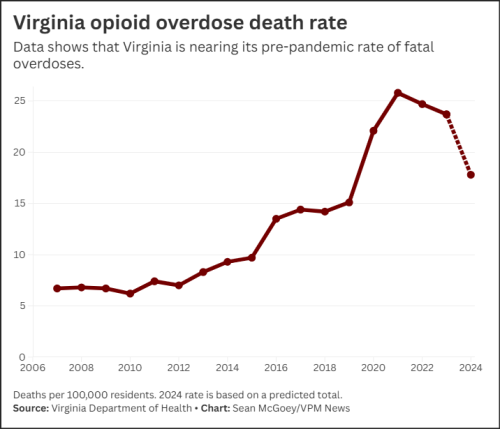
Opioid deaths were high and rising before COVID, so we can’t blame the shutdowns for all of them. But we can suggest that the shutdown indirectly contributed to 600 to 700 opioid-overdose deaths in 2021 and smaller numbers the next two years… perhaps a thousand in all.

That’s a small percentage of the nearly 24,000 COVID-related fatalities reported in the state, so we need to keep the relative magnitude in perspective. COVID was by far the bigger threat. Still, there’s a lesson here: government actions have unintended consequences. Virginia policy makers at the time focused exclusively upon the COVID threat without considering the implications for the economy, foregone medical procedures, disrupted K-12 education, mental health, or addiction.

Hopefully, we won’t make that mistake again.


ADVERTISEMENT

(comments below)


Comments


Comments

7 responses to “Whatever Could Account for the Decline in Opioid Deaths?”

  1. LarrytheG Avatar

    re: " Hold onโ€ฆ hold onโ€ฆ Iโ€™m thinkingโ€ฆ

    Iโ€™ve got it! The COVID virus wasnโ€™t contributing to the overdose epidemic. The COVID shutdown was contributing to the overdose epidemic!

    The linkage between shutdowns and substance abuse was so obvious that I (and others) warned at the time about the potential repercussions. Throwing people out of work and enforcing their isolation, regardless of their age- and comorbidity-adjusted risk, contributed to stress, isolation, and loneliness. "

    Didn't this happen worldwide?

    To the point where supply-chain issues affected virtually everything?

    Why is it so hard to deal with the larger truth here?

    We had a highly-contagious disease that was worldwide and had worldwide impacts to people, their jobs, the economy, etc.

    Why is it so hard to recognize that?

  2. Eric the half a troll Avatar
    Eric the half a troll

    "What accounts for the drop, even as the flow of fentanyl across the U.S. border with Mexico continues unimpeded?"

    Perhaps its doesn't…? No, that doesn't fit the narrative…

  3. Eric the half a troll Avatar
    Eric the half a troll

    "COVID was by far the bigger threat. … Virginia policy makers at the time focused exclusively upon the COVID … Hopefully, we wonโ€™t make that mistake again."

    Walking contradiction…

  4. Nancy Naive Avatar
    Nancy Naive

    Covid killed those in ill health, in chronic pain, and predisposed to addiction. Plus, the Sacklers took their drug money and scurried back under the refrigerator when the light was turned on.

    Or, Narcan maybe. https://www.vdh.virginia.gov/naloxone/

  5. Fauci Admits to Multiple COVID-19 Missteps during Closed-Door Hearing

    In summary, Fauci admitted he pushed COVID-19 protocols that lacked scientific rigor, advocated coercive vaccine policies to disrupt peopleโ€™s lives that likely fueled vaccine hesitancy, and unjustly smeared millions of people as conspiracy theorists for hypothesizing on a COVID-19 origin story that the FBI now admits is likely true.

    These admissions are damning, and hopefully, they mark the beginning of a much larger mea culpa from Fauci and his longtime superior, Dr. Francis Collins, the previous director of the National Institutes of Health.

    In a little-noticed interview last summer, Collins also admitted โ€œmistakes,โ€ explaining that in public health, officials often take a very narrow view of the trade-offs of health policies.

    โ€œYou attach infinite value to stopping the disease and saving a life,โ€ Collins said. โ€œYou attach zero value to whether this actually totally disrupts peopleโ€™s lives, ruins the economy, and has many kids kept out of school in a way that they never might quite recover from.โ€

    Collins is not wrong. This is one of the most basic lessons in economics: There are no solutions to complex problems, just trade-offs. Thatโ€™s why sensible economists raised objections to the โ€œif it saves just one lifeโ€ mantra early in the pandemic.

    โ€œRational people understand this isnโ€™t how the world works. Regardless of whether we acknowledge them, trade-offs exist,โ€ political scientist James Harrigan and economist Antony Davies wrote in April 2020. โ€œAnd acknowledging trade-offs is an important part of constructing sound policy.โ€

    Harrigan and Davies were hardly alone. Many economists and public health officials recognized this truth in 2020. But instead of listening or opening a dialogue to craft sensible solutions, Collins and Fauci plotted a โ€œtake downโ€ of them. This is not how science operates. Nor is it how public policy should be conducted.

    https://fee.org/articles/facui-admits-to-multiple-covid-19-missteps-during-closed-door-hearing/

  6. Irene Leech Avatar
    Irene Leech

    Were those who died of overdoses in the workforce? Many were relatively young and living in areas where employment was already less available. This was going on well before COVID. Many had problems that had been going on for years.

    I wonder how Beth Macy, who wrote "Dopesick," would respond.

  7. Eric the half a troll Avatar
    Eric the half a troll

    Remember when the Conservative position on drug use was all about the lack of personal responsibility and cultural valuesโ€ฆ? Good timesโ€ฆ.

Leave a Reply


ADVERTISEMENT