
by James A. Bacon

The United States has spent trillions of dollars on poverty programs, yet hard-core inter-generational poverty and its attendant social ills remain endemic. Federal and state benefits are not lavish, and they are contingent to some degree upon recipients finding work, or at least looking for work. But anti-poverty programs are doing a terrible job of lifting people out of poverty. While individual programs might make sense, the system of programs is dysfunctional. Ameliorating poverty will require addressing the system.
That’s my takeaway from a recent report by the Joint Legislative Audit and Review Commission (JLARC), “Virginia’s Self-Sufficiency Programs and the Availability and Affordability of Childcare.”
A mother and child living in the Richmond area and “on welfare” can reap about $1,900 a month ($22,800 a year) in benefits, as seen in this JLARC graphic:
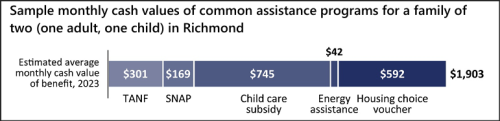
I cannot imagine trying to support a child on $22,800 a year, which is only a tad above Federal Poverty Level of $20,400. It must be noted, however, that JLARC’s list does not include Medicaid (average spending per enrollee in Virginia of $7,000) or the Earned Income Tax Credit (worth up to $4,000 for a family with one child). Nor does it take into account private charity such as food banks or the vast underground economy, estimated at more than $1 trillion, in which many people (including the poor) take money under the table.
Likewise, it is worth noting that the number of Virginians receiving TANF (Temporary Assistance for Needy Families) is small and diminishing — only 16,100. Since the welfare reform of the 1990s when the Virginia number was 66,000, women are restricted to lifetime TANF benefits for five years. Most households “on welfare” are not receiving TANF.
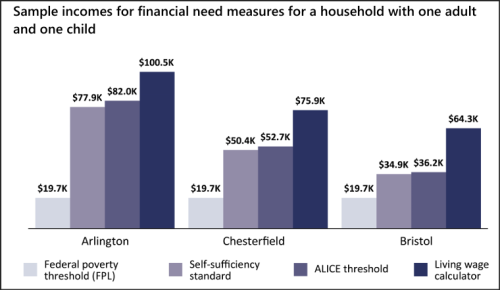
Rather than focusing on the federal poverty level, JLARC is interested in what it calls the “self-sufficiency standard,” a comprehensive measure of what families need to achieve “economic independence.”
This JLARC graphic shows how the federal poverty threshold is much lower than the incomes needed to meet the self-sufficiency standard and other alternative measures of well-being. It also shows how the self-sufficiency measures vary by regional cost of living. Thus, it costs less to live in Bristol than in Chesterfield County, and less in Chesterfield than in Arlington County.
JLARC estimates that 856,000 Virginians live in poverty or have incomes too low to qualify for self-sufficiency. Although TANF and SNAP (food stamps) require recipients to work, pursue education or look for work, only 9,900 households participated in Virginia Initiative for Education and Work (VIEW) — a little more than one percent of those eligible.
The Virginia Department of Social Services describes the VIEW program as helping people “achieve economic independence by removing barriers and deterrents to work while also providing positive incentives to work and supportive services.”
JLARC finds that participation in VIEW has “limited impact” on peoples’ wages. The median wages for participants remained below the poverty line, and only 2% of TANF participants and 7% of SNAP participants eventually earned enough to be considered self-sufficient.
Why did so few welfare recipients enroll in the job programs? One problem, finds JLARC, is high caseloads among social services case workers. Another is that most recipients wind up in low-wage, dead-end jobs that offer no prospect of self-sufficiency. Another is the unaffordability and unavailability of day care for working mothers.
JLARC does note — but in my assessment gives insufficient attention to — the system’s perverse incentives. Benefits decline as incomes rise, significantly undermining the incentive for welfare recipients to improve their condition through work. This graphic shows what happens to TANF and SNAP benefits.
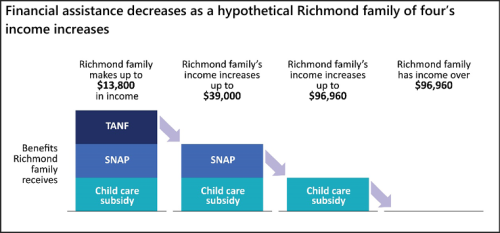
The graphic understates the negative incentives by omitting what happens to housing vouchers, childcare subsidies, energy subsidies, Medicaid and the Earned Income Tax Credit.
If only one percent of TANF and SNAP beneficiaries are participating in the VIEW program, the problem is a lot bigger than social worker caseload. Welfare recipients are making rational economic calculations that expending effort to better their condition offers little payoff. For the most part, JLARC’s recommendations to the Governor and legislators are bureaucratic tweaks that will have no impact on the incentive structure.
Fixing the childcare shortage (if such a thing is possible to do) might have a positive impact on getting poor people to work. I hope to get to that issue in a future post.


Leave a Reply
You must be logged in to post a comment.