
by James A. Bacon
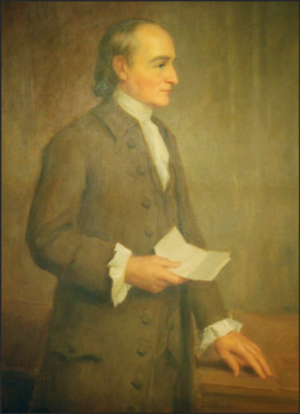
American conservatives revere the Founding Fathers of the American republic as exemplars of the classic virtues — for good reason — but our nostalgia for the past does have blind spots (and I’m not talking about just slavery, an evil that everyone acknowledges). We rarely remark upon the fact that leadership of the early republic consisted of a goodly number of ditherers, drunkards, self-dealers and profiteers. As George Washington wrote to Benjamin Harrison, most members of Congress were idle, dissipated, and extravagant, and consumed by “an insatiable thirst” for getting rich.
That the newly formed United States managed to surmount the inevitable quirks and flaws of human nature Richmond author Suzanne Munson attributes in her new book, “First in Law, First in Leadership,” largely to the labors of one of America’s most insufficiently appreciated founders, George Wythe.
Wythe, a professor of law at the College of William & Mary, did more than shape the minds and character of luminaries such as Thomas Jefferson and James Monroe, who would become presidents; John Marshall, the most consequential Supreme Court justice in history; Henry Clay, the Kentucky legislator who became Speaker of the House; and senators, governors, judges, and other leaders too numerous to mention. He transformed the practice of law into a learned profession.
“Wythe taught more American leaders than any other mortal has since or ever will,” Munson quotes Taylor Revely, president emeritus of the College of William & Mary.
Oh, and by the way, Wythe was an ardent opponent of slavery who impressed his anti-slavery views upon Jefferson and many others. In 1806, as a judge later in life, he ruled in the case Hudgins vs. Wright to free a slave woman, Jackie Wright, and her two children. Drawing upon Virginia’s Declaration of Rights, he argued that that individuals “should be considered free until proven otherwise,” and that “freedom is the birthright of every human being.”
Wythe was overruled by a higher court as the egalitarian spirit of 1776 waned and slave-holders began defending the institution more assertively. But he embodied the philosophy that animated the American Revolution, prevailed after a bloody civil war, and lives today.
His contribution to the study of law had a more immediately positive impact. In the late 1700s, America had no law schools. Harvard and Yale, Munson reminds us, were formed mainly to train preachers, not statesmen. Lawyers learned their craft as a kind of apprenticeship to other lawyers, a system that proved haphazard at best.
The governing board of William & Mary founded the nation’s first law school in 1779 and named Wythe, one of the college’s most respected faculty members, as the school’s first Chair of Law. With great energy, Wythe proceeded to build what Munson describes as America’s first “leadership training school.”
The curriculum instructed students in history, government, philosophy, debate, the heritage of ancient Greece and Rome, and a good dose of ethics, as well as the law. Under Wythe’s guidance, students held forth weekly in Williamsburg’s old Capitol Building. Writes Munson:
Future lawyers debated cases in moot courts. Future statesmen proposed and argued laws in mock legislatures…. Reviving the moot court tradition from London’s medieval Inns of Court, Wythe embraced this kind of forensic training for his students…. Future lawyers were assigned cases to prepare and debate before an audience. Professors from the college served as judges…. [Wythe] taught his students parliamentary procedure and supervised as they formed committees, drew up bills, and the presented, debated and revised the bills.
These public proceedings drew many spectators and provided inspiration for many to enter the fields of law and politics.
Wythe was a man of impeccable character, and he sought to inculcate his students with his principles. Notably, writes Munson, he wrote an oath of office for judges of Virginia’s Court of the Admiralty in the late 1770s that reverberates in Virginia’s Canons of Judicial Conduct.
You shall swear that … you will do equal right to all manner of people, great and small, high and low, rich and poor, according to equity and good conscience, and the laws and usages of Virginia, without respect to persons. … And, finally … you shall faithfully, justly and truly … do equal and impartial justice, without fraud, favor or affection, or partiality.”
Though imperfectly applied, those principles endure today.
For anyone interested in Virginia’s history, First in Law, First in Leadership packs many valuable perspectives into a slender volume that is a short, easy read. It is readily available on Amazon.


Leave a Reply
You must be logged in to post a comment.