
by Donald Smith
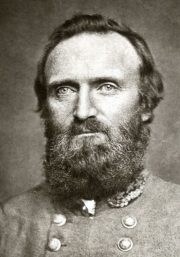
In early August, the Fredericksburg and Spotsylvania National Military Park (FSNMP) placed a sign inside the Stonewall Jackson Death Site. Known to many people as the Jackson Shrine, it’s a plantation office building where Jackson died after being mortally wounded at the Battle of Chancellorsville.
The sign said this: “Stonewall Jackson led an army that fought against the United States with keeping slavery as one of their [sic] goals. Why then did this place become a United States National Park Site?” FSNMP says the park “is committed to telling a fuller, more inclusive history of the Stonewall Jackson Death Site.” This sign is part of an FSNMP initiative to “spark conversations and to broaden the story of the site and context for Jackson’s death and memory.”
If the first things that come to the National Park Service’s mind, when it thinks of the most noteworthy aspects of Stonewall Jackson’s legacy, are that he fought for the Confederacy and the Confederacy supported slavery — then we really do need to have a conversation.
FSNMP placed three signs in the Death Site in early August. None mentioned Jackson’s reputation as one of America’s greatest battlefield generals. (Patton told Eisenhower he would be Ike’s Jackson, and Chesty Puller carried a biography of Stonewall.) No mention of First Manassas, the Valley Campaign, Cedar Mountain, Second Manassas or Chancellorsville.
Here is how S.C. Gwynne, a Pulitzer Prize finalist and author of Rebel Yell, a biography of Stonewall, described Jackson’s exploits in the Shenandoah Valley in the spring of 1862:
Using a combination of speed, deception and sheer audacity, Jackson, with 17,000 men (and often far fewer [due to illness in the ranks and straggling on the march] had taken on and beaten Union forces that, though never united, totaled more than 52,000. He marched his men at a pace unknown to soldiers of the day, covering an astounding 646 miles in 48 days, fighting five major battles and skirmishes almost daily. He made flashing strikes in unexpected places, falling on the enemy force from behind mountain ranges and out of steep passes. With his small force he had driven four Union armies from the greater part of the Shenandoah Valley….He had evaded a massive pincer movement designed by Abraham Lincoln himself to catch him. Then, in the most stunning maneuver of all, he had turned on both jaws of the pincer—-two Union armies—-and beaten them in succession. In a war where the techniques of marching and fighting were being reinvented almost literally hour by hour, Jackson’s intelligence, speed, aggression and pure arrogance were the wonders of North and South alike. They were the talk of salons in London and Paris.
None of the FSNMP signs mentioned the Sunday School for slaves Jackson established, funded and operated. When prominent Lexingtonians threatened legal action if he didn’t close the school, Jackson refused. Jackson had reason to fear he could lose his teaching job at VMI, he and his family could be ostracized, and a brick might fly through his window (or worse). Yet, he operated the school until he died.
Stonewall Jackson was a bona fide American hero. Did he have flaws? Yes! Many of them. David McCullough, one of America’s great popular historians, called Jackson “eccentric” and “a hypochondriac” in the epic The Civil War PBS miniseries. And McCullough wasn’t exaggerating!
But Jackson’s accomplishments WERE great. In 1862 and 1863 he was the dominant field general, Union or Confederate, in the Civil War’s eastern theater. He is a symbol of past Virginians’ battlefield valor. He was a great citizen, too, as his Sunday School for slaves attests.
Gwynne says that there were many public commemorations of Jackson on the Union side following his death.
There were signs everywhere of the immense respect people of the North had for Jackson’s bravery and skill as a soldier. “I rejoice at Stonewall’s death, as a gain to our cause,” wrote Union brigadier general Gouverneur K. Warren, soon to be a hero at the Battle of Gettysburg, “and yet in my soldier’s heart I cannot but see him as the best soldier of all this war and grieve at his untimely end.” Wrote Union veteran and historian Charles Francis Adams Jr., “I am sure as Americans this [Union] army takes a pride in ‘Stonewall’ second only to that of the Virginians and Confederates. To have fought against him is next to having fought under him.”
Northern feelings about Jackson were perhaps best summarized by John W. Forney, editor of the Washington Chronicle. “Stonewall Jackson was a great general, a brave soldier, a noble Christian and a pure man. May God throw those great virtues against the sins of the secessionist, the advocate of a great national crime.” [In Jackson’s defense, the sin of secession wasn’t his—it was Virginia’s. Jackson followed his state.] Lincoln wrote Forney immediately to complement him on the ‘excellent and manly’ article in the Chronicle on Stonewall Jackson.
Stonewall Jackson was an imperfect man who was a product of the times he lived in. We do not think and believe now the way that people thought and believed then. “The past is a different country,” said British author L.P. Hartley. “They do things differently there.” If we judge his legacy fairly, his accomplishments, courage and character outweigh his personal flaws and the many flaws of Southern society in the mid-1800s. He deserves to be commemorated with respect by our National Park Service.
Pictures of some of the signs FSNMP placed in the Jackson Death Site are here. Send your feedback on this Park Service initiative to Ranger Elizabeth Parnicza, at [email protected].
Donald Smith grew up outside Richmond and graduated from UVA. He is the great-grandson of a Confederate cavalryman from the Shenandoah Valley.


Leave a Reply
You must be logged in to post a comment.