• Cut Scores and Lies of Omission

    by Todd Truitt

    Virginia is in the process of raising the minimum cut scores for passing English and math Standards of Learning (SOL) exams — scores that the U.S. Department of Education (USED) declared in 2021 were the lowest in the nation. A USED official publicly testified in 2022 that Virginia’s cut scores were not “reflecting the realityโ€ and were โ€œtoo low.โ€

    Those important facts were missing from Anna Brysonโ€™s “news” article last week in the Richmond Times-Dispatch, which reported that higher cut scores likely will not be in effect until the spring 2026 exams. Bryson wrote that Governor Glenn Youngkin had campaigned on raising standards and, after taking office in 2022, vowed to raise cut scores to the highest in the nation. “But that never happened,” she opined. Instead, “the administration spent much of its time and political capital on history standards and transgender policies.”

    From my personal involvement in education policy as an active Democrat and former chair of the Math Advisory Committee for Arlington Public Schools, I knew there was more to the story. I talked to the Virginia Department of Education (VDOE) to find out what did happen and what the plan is. Brysonโ€™s selective omissions and opinion-based framing, I conclude, fit a pattern of bias in her state education coverage. 

    U.S. Department of Education Tells Virginia to Raise Its Cut Scores

    USED reported in 2021 that Virginiaโ€™s 2019 SOL cut scores for 4th grade math and reading and 8th grade reading were the lowest in the country. Had USED incorporated actions taken under former Governor Ralph Northam further lowering the reading cut scores in 2020, its analysis would have made Virginia look even worse.

    (more…)

  • What the #&%@? A Hamas Advocate on the VMI Faculty?

    by Sal Vitale

    For several years, I, along with other concerned alumni, diligently worked to restore the “Old Corps” leadership and ideals to the management of the Virginia Military Institute Alumni Association. Our efforts faced resistance from those in charge, and now we find ourselves also grappling with issues far beyond governance of the Alumni Agency (VMIAA) and its affiliated organizations, including the Alumni Association.

    A particularly troubling matter involves the selection of Philip Crane as a Visiting Professor under VMIAAโ€™s Peay Endowment, whose public involvement in antisemitic activities and support for Hamas raises serious questions about the Institute’s stance on crucial moral issues. This matter requires immediate attention and full transparency from VMI, its Board of Visitors (BOV) and the VMIAA to preserve the integrity of the Institute and its alumni body.

    For years, our group of alumni worked diligently to ensure the concerns of VMI graduates are heard and acted upon. One of our key goals was to reinstate proxy voting for the VMIAA Board members, to ensure those selected truly represent the alumni body and not just the interests of a small group. We also pushed for better access to alumni contact information to foster meaningful communication and ensure that all viewpoints are considered when important decisions are being made.

    Unfortunately, our efforts were thwarted at every turn. The VMIAA has repeatedly denied us access to critical resources, including alumni contact lists, citing unfounded concerns about personal data usage. We await a ruling from the Virginia Supreme Court on this matter, but a much graver issue demands immediate action: the hiring of Crane, a VMI graduate himself, as a visiting professor.

    (more…)

  • A Voucher by Any Other Name

    by Dick Hall-Sizemore

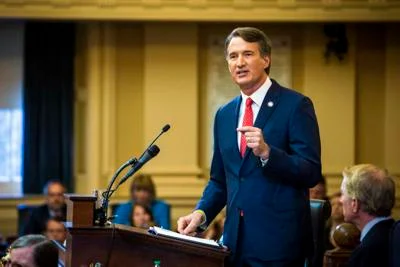
    Governor Glenn Youngkin

    Governor Youngkin has included in his proposed budget $50 million to provide $5,000 “Opportunity Grants” to 10,000 students from low-income families to apply against the cost of attending private schools.

    While this limited voucher program avoids the primary objection of being a subsidy to rich families who send their kids to private school, there are a couple of characteristics of this proposal that need to be noted:

    1. Income level. According to media reports, the grants could be available for a family of four making up to $81,120 annually. This is hardly “low-income.” According to the U.S. Census Bureau, in 2023, the median household income in Virginia was $89,931.

    2. Usefulness. Even with a $5,000 grant from the state, a truly low-income family is not likely to be able to afford to enroll its child in a private school. A quick internet search of private schools in the Richmond area revealed one with a tuition of $6,000. The tuition for others varied on the age of the child, but ranged from the mid-teens to over $30,000 at the high school level.

    There is no doubt that children from low-income families are being slighted in schools throughout the Commonwealth. The governor is to be commended for his efforts to make that fact clear and to strengthen the accountability measures. Improving the educational opportunities for low-income children is going to require a lot of effort and innovative thinking. This “Opportunity Grant” program seems designed more for PR and political purposes than for making a true difference in educational progress for low-income children.


  • Reilly Riffs on the Culture Wars

    Willfred Reilly, author of “Lies My Liberal Teacher Told Me: Debunking the False Narratives Defining America’s School Curricula,” is one of conservatism’s most versatile culture warriors. Slavery, Native Americans, DEI, hippies, colonialism, capitalism, white flight, nuclear weapons, you name it, he takes it on. He touched on several of those topics earlier this month at the University of Virginia in a speech co-hosted by The Jefferson Council. I give a brief introduction, but you can jump ahead to see Reilly himself at the 4:30 mark.

    I felt like I knew Reilly from reading his books and interviewing him for Bacon’s Rebellion but it was a pleasure getting to spend time with him in person. He’s not just a culture warrior — he’s a good fellow who leavens his discussion of serious issues with an easy manner and gentle humor. Conservative readers will love him, liberals will hate him. — JAB


  • Gov. Youngkin’s Priorities Shared by Jefferson Institute

    By Derrick Max

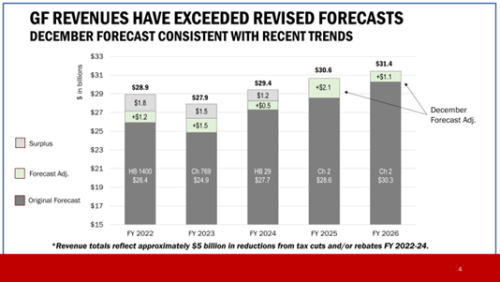
    Governor Glenn Youngkin (R) presented his budget amendments to the the legislature’s money committees yesterday.ย The speech was filled with budget amendments to reduce taxes and fund new or existing programs. These tax cuts and additional spending proposals were made possible by Secretary of Finance Stephen E. Cummings’ report that the Commonwealth was again sitting on massive surpluses.

    Specifically, Secretary Cummings reported that General Fund revenues have reached a record high, well above original forecasts.ย ย 

    When combined with FY24 surplus revenues, year-end agency balances, and other revenue, the Commonwealth has a current and projected surplus of $4.7 billion.ย The forward-looking revenue projections are driven by continued strength in employment and wages.

    Setting aside that this means Virginians have again been severely overtaxed, Governor Youngkin proposed several amendments that have been top priorities of the Thomas Jefferson Institute for a long time. Below is a quick summary of those proposals based on what we know so far.

    (more…)


  • A Nonsensical Proposal

    by Dick Hall-Sizemore

    Governor Youngkin has taken on the car tax again, sorta. Rather than attack it directly, he proposes a Rube Goldberg process for some Virginians to get some relief from the car tax.

    Here is how it would work: Individual taxpayers with a federal AGI of $50,000 or less would get a refundable credit of $150 or the amount of car tax actually paid to the locality, whichever is less. For married couples filing a joint return, the credit would be $300 or the actual amount paid to the locality, whichever is less. https://budget.lis.virginia.gov/get/budget/5050/HB1600/ (p. 731)

    But, there is a catch. An individual would not be eligible for such credit if his or her county or city increased its car tax rate more than 2.5 percent over the rate it imposed the previous year. The governor seems to think this is a cap on the annual increase enacted by localities, but it is not. It is a penalty imposed on the residents of a locality that increases its car tax rate by more than 2.5 percent.

    All this would be paid for over the next three years with a $1.1 billion fund created out of current surplus revenues.

    (more…)

  • The Woke Scare Is Four Times Worse Than the Red Scare

    by James A. Bacon

    More than a third (35%) of tenured and tenure-track faculty at 55 of the nation’s most prestigious colleges and universities say they have toned down their writing for fear of engendering controversy, according to a new survey by the Foundation for Individual Rights and Expression (FIRE). That compares to 9% during the Red Scare of the 1950s.

    More than a quarter (27%) say they feel unable to speak freely for fear of offending someone, and 40% say they worry about damaging their reputations, notes FIRE in its report, “Silence in the Classroom.”

    Sadly, the University of Virginia and Virginia Tech, both covered by the survey were no exceptions to the rule. At Virginia Tech, 22% of faculty members say they hide their political beliefs from colleagues “very often” or “fairly often. At UVA, the figure is 13%.

    Conservatives are most afraid to speak their minds, although reluctance to freely share one’s mind is found across the ideological spectrum.

    (more…)

  • Incoherent, Fact-Free Thinking About Maternal Mortality Disparities

    by James A. Bacon

    Cherry picking data. Image credit: ChatGPT

    Radio IQ, Virginia’s public radio network, is aptly named. It appeals to highly educated people who think of themselves as smarter and better informed than everybody else. Radio IQ listeners may, in fact, have higher IQs than ordinary Virginians — the correlation between education and intelligence is real.

    Whether public radio listeners are better informed, however, is dubious, especially if they rely upon articles like today’s piece previewing the legislative battle over what to do about racial disparities in maternal health outcomes. Radio IQ kicked off its article with this lede:

    With mere hours until Governor Glenn Youngkin announces his budget amendments for the 2025 session, he doubled down on his disinterest in racial bias training for Virginia doctors despite his admission that such biases exist.

    Upon what basis does Radio IQ Richmond Bureau Chief Brad Kutner assert that Youngkin concedes that racial “biases” exist? He tells us in the follow-up paragraph.

    โ€œWe know thereโ€™s a disparate outcome between Black women and white women,โ€ Youngkin said Tuesday morning at a press event to support his new maternal health initiatives ahead of the 2025 session.

    (more…)

  • Details, Please, About the New Nuke

    by James A. Bacon

    Has fusion power finally arrived? Commonwealth Fusion Systems (CFS), a Massachusetts-based developer of high-temperature, superconducting magnets used to jam hydrogen molecules together and release massive amounts of energy, has announced that it will invest “several billion dollars” to build the world’s first grid-scale, commercial fusion power plant.

    โ€œThis is an historic moment for Virginia and the world at large,โ€ said Governor Glenn Youngkin in a prepared statement. โ€œCommonwealth Fusion Systems is not just building a facility, they are pioneering groundbreaking innovation to generate clean, reliable, safe power, and itโ€™s happening right here in Virginia. We are proud to be home to this pursuit to change the future of energy and power.โ€ 

    The power plant, capable of generating 400 megawatts of electricity, enough to power about 150,000 homes, will be located at the James River Industrial Center in Chesterfield County, Virginia, on a site owned by Dominion Energy.

    This is blockbuster news. Fusion power (as distinct from conventional fission power) has been the long-heralded “power source of the future” but for decades has seemed out of reach. Now, it appears, the technology has reached economic critical mass. Even environmentalists should rejoice. Fusion power is clean. It generates no pollutants, and it could provide a source of base-load energy to support the grid’s evolution toward renewable sources like solar and wind.

    Not to look a gift horse in the mouth but I must ask: How much will this electric power cost? And who will pay for it? The press release provides few details.

    (more…)

  • A Cluster Fark of Monumental Proportions

    by James A. Bacon

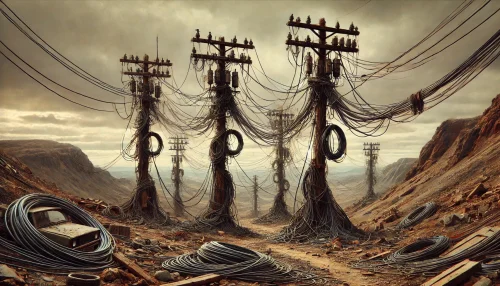
    Broadly speaking, there are two ways to extend broadband Internet service to remote rural areas.

    One way is to sign up for Elon Musk’s Starlink satellite service. Order a Starlink satellite dish, Wi-Fi router, mounting hardware, and cables; the kit arrives within a few weeks and typically can be installed in minutes. Average download speeds are 192 Mbps. Hardware for the residential plan costs $349, and the service costs $120 monthly. Total up-front cost for the estimated 392,000 households in Virginia lacking broadband would run less than $140 million — presumably less if the state negotiated volume discounts.

    Virginia didn’t pick that option.

    Instead, the Commonwealth went with programs cobbled together with $3.2 billion in state, federal and private funds to build a ground-based network of fiber optic lines. Minimum download speeds are 100 Mbps. Service would cost $59 to $99 monthly, depending upon the plan selected. The up-front cost per household amounts to roughly $8,200.

    Oh, by the way, Virginia set a goal have having near-universal broadband connectivity by 2024. Here it is, the end of 2024, and broadband initiatives have fallen way behind. In a report issued a week ago, the Joint Legislative Audit and Review Commission (JLARC) concluded, “Virginia is unlikely to achieve its goal of near universal coverage until 2030 or later.

    (more…)

  • Chesterfield Spending, Taxes Out of Control

    by Doug Bradham

    In early 2024 I received a 10.8% increase in my residential property tax versus 2023 (which now totals a 30.8% increase over the past five years of 2020 thru 2025). Other Chesterfield residents complained that they were seeing dramatic increases in their property taxes as well. Joining forces with other citizens who were working to hold the Board of Supervisors accountable, I began investigating the spending and property tax history of Chesterfield County.

    Using the Freedom of Information Act, we obtained county spending and taxation data 2017 through 2023 actual, the 2024 adopted budget, and pro forma estimated spending from 2025 through 2028. We organized the data, analyzed it, and presented it in Power Point Slides to make it easy to understand.

    As a reference point, the Virginia legislature has specified that:

    • It is the responsibility of each county manager to establish the assessed property value. The real estate assessor’s office in Chesterfield has a 2024 budget of $3.9 million and reports to County Administrator Joe Casey.
    • Each county’s Board of Supervisors sets the tax rate ($ per $100 of assessed value) to be applied to the assessed value. For 2024, the Board set the tax rate at $0.90 per $100. For a property appraised at $500,000, the annual property tax would be calculated as $0.90 X $5,000 = $4,500 ($2,250 to be paid every six months).
    • Keep in mind is that every $0.01 per $100 of assessed value on the property tax rate amounts to $6 million.
    (more…)

  • Weapons Scanners, It Appears, Are Not Enough to Stop School Stabbings

    by James A. Bacon

    Last week a Henrico High School student was hospitalized after being stabbed at school. Needless to say, many students are upset.

    โ€œSeeing the aftermath of it all โ€ฆ the poorly cleaned up crime scene and still seeing the dried-up blood on the pavement and on the door โ€ฆ as I saw this โ€ฆ it spoke something to me: We are not safe,โ€ [first name unintelligible] Burnett told the Henrico County School Board last week.

    “We need stronger, more effective safeguards in place to ensure we feel safe every single day,โ€ echoed senior Mackenzie Nelson.

    Also addressing the school board, freshman Logan Corry saw the problem as an unwillingness to enforce the rules. He has often seen fellow students skip through the weapons scanners without consequences.

    “What use are the rules if people just choose to ignore them?” he asked. “There is obviously a lack of willingness on the part of school administrators to treat rule-breaking seriously and enforce the fullest consequences available because they’re scared it will reflect badly on the school.”

    (more…)

  • Cline Does DOGE

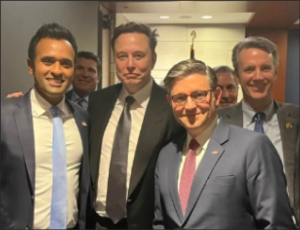
    From L to R: Vivek Ramaswamy, Elon Musk, House Speaker Mike Johnson, Rep. Ben Cline

    by Scott Dreyer

    In his Dec. 9 emailed newsletter, Sixth District Congressman Ben Cline (R) wrote about his government-efficiency planning with Elon Musk that immediately followed the Thanksgiving holiday. Cline wrote:

    โ€œI recently joined Vivek Ramaswamy and Elon Musk (and his son!) to discuss transformative ideas aimed at improving government efficiency and accountability through the new Department of Government Efficiency (DOGE). As a member of the new bipartisan DOGE caucus, I shared insights from the Republican Study Committeeโ€™s Balanced Budget Task Force report, which lays out 150 practical solutions focused on restoring fiscal responsibility, curbing wasteful spending, and cutting through the bureaucratic red tape.

    โ€œWe are fully committed to tackling government inefficiencies head-on. Together, the DOGE and our bipartisan caucus are ready to prioritize legislative efforts that will reduce our federal deficits. With innovative thinkers like Musk and Ramaswamy bringing fresh perspectives to the table, we will fight to create a more effective government that serves the American people.โ€

    (more…)

  • Will Helicopter Dollars Improve Virginia Schools?

    by James A. Bacon

    Governor Glenn Youngkin is dumping money into Virginia’s public education system like a liberal Democrat. He’s not putting the funds to work in the quite same way — there’s more for accountability measures and Lab School Partnerships — but it’s hard to see a big difference.

    I don’t know if he’s just bowing to the political reality that Democrats control the General Assembly and he might as well claim credit for what Dem politicians would compel him to do, or whether he genuinely believes that dropping helicopter dollars onto the K-12 system is the best path to improvement.

    Either way, Virginia is conducting a vast and expensive public policy experiment. We’ll find out if lack of funding is really what ails public schools.

    In a press release issued last week, the Governor boasted that with additional proposals to amend the 2025-26 budget, spending on K-12 education in the Commonwealth will leap to more than $22 billion over this biennium — a 54% increase over pre-COVID levels.

    โ€œTodayโ€™s investments address the real needs of our students and families by delivering on our commitment to unleash opportunity, raise the bar for academic excellence, and keep our children safe,โ€ Youngkin said.

    (more…)

  • Outside Study Confirms Natural Gas Must Remain for Data Centers

    By Steve Haner

    Another analysis of the energy dilemma facing Virginia, this one commissioned by a Democrat-controlled legislative panel, has concluded that the use of natural gas to make electricity is going to have to grow over coming decades, not shrink. Virginiaโ€™s anti-hydrocarbon energy laws are doomed to fail because of the data center industry.   

    The new 150-page report takes its own look at Virginiaโ€™s future energy demand and the best mix of generation to meet it. It reaches the conclusions Dominion Energy Virginia also reached in its most recent integrated resource plan (IRP). Data centers by themselves are driving an enormous future demand curve, as Dominion claimed. The abandonment of coal and natural gas demanded by the Virginia Clean Economy Act (VCEA) creates an energy deficit, even if the data center growth proves slower than the current projections.  

    In fact, this report projects natural gas will remain necessary beyond the mandated retirement dates in the VCEA even if the data center growth doesnโ€™t happen. It plugs the gap in some scenarios by using hydrogen in place of natural gas in thermal energy plants. But that remains an unproven, experimental technology not used at scale anywhere. An entire new very expensive infrastructure would be needed to create and transport the hydrogen to power plants.    

    Only fantasy technology can comply with the fantasy VCEA. The nuclear plants it envisions are somewhat closer to reality, but still years if not decades away. โ€œIn the absence of policy, there is still a significant role for coal and gas generation, comprising another ~30% of demand,โ€ the consultant reports. This on a slide marked โ€œNo Data Center Growth, No VCEA.โ€ Carbon emitting sources are even more prominent on scenarios that include the demand growth. 

    (more…)