
by James A. Bacon
Broadly speaking, there are two ways to extend broadband Internet service to remote rural areas.
One way is to sign up for Elon Musk’s Starlink satellite service. Order a Starlink satellite dish, Wi-Fi router, mounting hardware, and cables; the kit arrives within a few weeks and typically can be installed in minutes. Average download speeds are 192 Mbps. Hardware for the residential plan costs $349, and the service costs $120 monthly. Total up-front cost for the estimated 392,000 households in Virginia lacking broadband would run less than $140 million — presumably less if the state negotiated volume discounts.
Virginia didn’t pick that option.
Instead, the Commonwealth went with programs cobbled together with $3.2 billion in state, federal and private funds to build a ground-based network of fiber optic lines. Minimum download speeds are 100 Mbps. Service would cost $59 to $99 monthly, depending upon the plan selected. The up-front cost per household amounts to roughly $8,200.
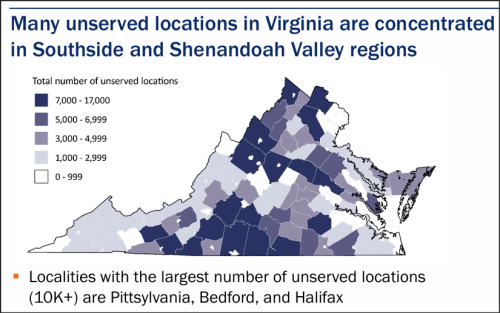
Oh, by the way, Virginia set a goal have having near-universal broadband connectivity by 2024. Here it is, the end of 2024, and broadband initiatives have fallen way behind. In a report issued a week ago, the Joint Legislative Audit and Review Commission (JLARC) concluded, “Virginia is unlikely to achieve its goal of near universal coverage until 2030 or later.“
How did this happen?
Virginia has been working on extending broadband to under-served areas for many years. Rural areas are unattractive to corporate providers of broadband services because low population density makes it impossible to recoup the up-front costs of extending hundreds of miles of fiber. The Commonwealth (wisely) didn’t want to get into the broadband business itself, so it settled on the strategy of creating subsidized public-private partnerships.
State- and federally funded broadband deployment projects
expected to serve 261K,000 locations are underway, but they have been bedeviled by innumerable problems.
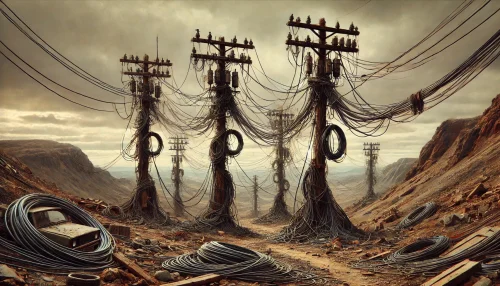
JLARC describes the challenges of the “make ready” process that strings fiber-optic cable on existing utility poles. Poles must be surveyed to ascertain their ability to accommodate the additional line, routes must be planned, utilities must review the proposals, poles must be replaced, reinforced or otherwise adjusted, and only then can the fiber-optic cable be installed.
It’s more than the system can handle. “One large pole owner has a backlog of more than 100,000 pole attachment requests,” JLARC says. ISPs cannot move forward until the owner gives its approval.
JLARC cited an example in which “make-ready” costs were estimated to be $14,500 per mile but ended up at $43,800 per mile.
Pole owners and ISPs (Internet Service Providers) blame each other for the cost overruns and delays, JLARC says.
Another complication is the necessity of obtaining State Corporation Commission approval, which can take up to six months, to piggyback on the infrastructure of investor-owned utilities.
The Virginia Department of Transportation has approved 80% of broadband-related permits within 14 days, but a significant number has taken more than 100 days. One permit took 169 days to approve.
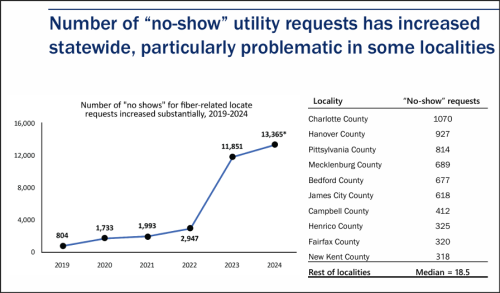
JLARC mentions the challenge of working around underground utility infrastructure. An insufficient number of utility sub-contractors marking the location of underground lines cause numerous “no show” requests.
Compounding all those challenges, JLARC finds, “Some key stakeholders in Virginia’s broadband deployment efforts do not have full knowledge of deployment project locations or project deadlines, and they do not fully
understand financial and other implications of project delays.”
The Virginia Telecommunications Initiative (VATI) has completed projects connecting 147,000 locations but 29 of 57 ongoing projects are running behind schedule. Nine projects have not connected a single location.
“Insufficient contract enforcement mechanisms and hesitancy by localities and DHCD to revoke contract awards have contributed to project delays, jeopardizing some federal pandemic relief funds,” JLARC says.
Under the federal Broadband Equity, Access and Deployment (BEAD) program, Virginia will receive $1.48 billion. In September 2023 Virginia was the first state to submit BEAD planning documents, but the feds didn’t grant approval until July 2024, and funds won’t be released until late 2025. Even if all goes well, work won’t begin until 2026. Applicants must jump through the feds’ own regulatory hoops, but JLARC worries that the federal program has insufficient accountability built in. “BEAD will need strong contracts and management to avoid delays and defaults.”
Starlink is not a perfect solution. Its low-earth satellites have finite spectrum available, limiting the capacity that can be delivered in a given area. It also requires clear lines of sight to its satellites, which can be a problem in dense forests and mountainous terrain. Some observers question whether the company has the financial wherewithal to scale up rapidly. Then there’s the problem that Elon Musk is now the second most hated man in America (after you know who) in the eyes of the Left. The Federal Communications Commission rejected Starlink applications for nearly $900 million in Rural Digital Opportunity Funds.
Surely there must be a way to cancel contracts of under-performers and engage Starlink to fill in the gaps. JLARC never considers the possibility, even as a theoretical option. Too bad.


Leave a Reply
You must be logged in to post a comment.