
by Todd Truitt
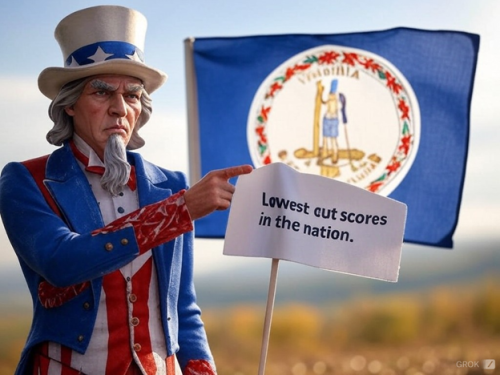
Virginia is in the process of raising the minimum cut scores for passing English and math Standards of Learning (SOL) exams — scores that the U.S. Department of Education (USED) declared in 2021 were the lowest in the nation. A USED official publicly testified in 2022 that Virginia’s cut scores were not “reflecting the reality” and were “too low.”
Those important facts were missing from Anna Bryson’s “news” article last week in the Richmond Times-Dispatch, which reported that higher cut scores likely will not be in effect until the spring 2026 exams. Bryson wrote that Governor Glenn Youngkin had campaigned on raising standards and, after taking office in 2022, vowed to raise cut scores to the highest in the nation. “But that never happened,” she opined. Instead, “the administration spent much of its time and political capital on history standards and transgender policies.”
From my personal involvement in education policy as an active Democrat and former chair of the Math Advisory Committee for Arlington Public Schools, I knew there was more to the story. I talked to the Virginia Department of Education (VDOE) to find out what did happen and what the plan is. Bryson’s selective omissions and opinion-based framing, I conclude, fit a pattern of bias in her state education coverage.
U.S. Department of Education Tells Virginia to Raise Its Cut Scores
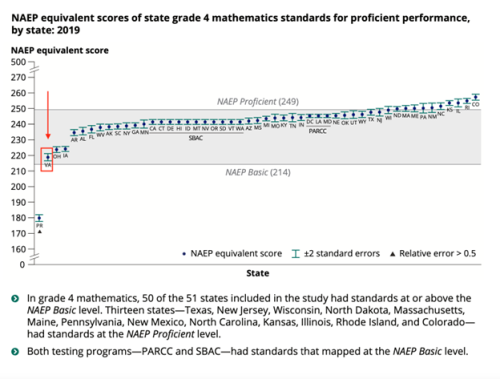
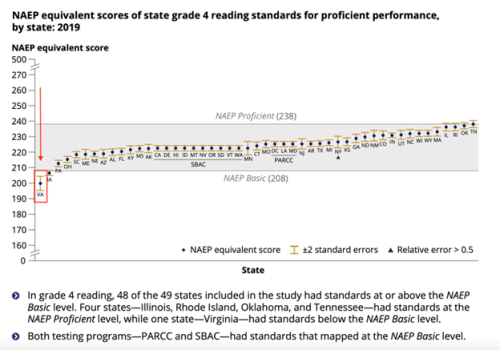
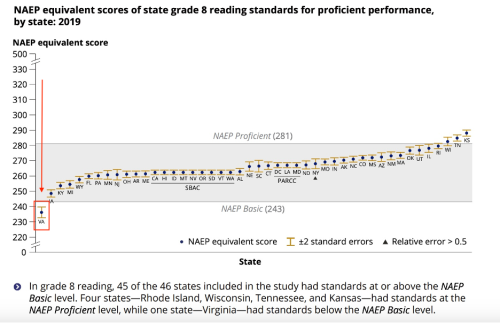
USED reported in 2021 that Virginia’s 2019 SOL cut scores for 4th grade math and reading and 8th grade reading were the lowest in the country. Had USED incorporated actions taken under former Governor Ralph Northam further lowering the reading cut scores in 2020, its analysis would have made Virginia look even worse.
Dr. Mark Schneider, director of the Institution of Education Sciences at the USED, testified at the Virginia Board of Education (VBOE) in October 2022 that Virginia’s cut scores are “so far below where [they] should be.”
The federal government puts a higher priority on academic achievement for math and reading than other subjects. For instance, math and reading are the only subjects for which the U.S. government mandates annual testing in grades 3 through 8 plus one year in high school. The federal government also requires states’ accountability systems to give “substantial weight” to each of achievement and growth on such exams.
To assist states with setting their cut scores for math and reading, USED publishes a report comparing states’ cut scores for 4th and 8th grade math and reading against its National Assessment of Educational Progress (NAEP) levels every few years. Here is the most recent analysis from 2021:
RTD’s Bryson Omitted Significant Facts on Cut Scores
Bryson’s material omissions on NAEP’s analysis and Schneider’s cut scores testimony are all the more notable considering that the Virginia Mercury did report on Schneider’s testimony:
“[Schneider stated] ‘when you tell me that 68% of your students are proficient, and I’m using a national benchmark, and it says 48, that’s a big disconnect.’ Schneider’s remarks are in line with the administration’s claims that Virginia has an unusually wide ‘honesty gap,’ a term used to describe the difference between state-level and NAEP proficiency standards.”
Here was Bryson last week attributing that negative appraisal to the Youngkin administration only:
“Youngkin and his appointees have repeatedly referred to these [lowering of cut scores] as ‘lowering standards’ and creating what they call an ‘honesty gap’ in test score reporting.”
Further, Bryson stated that the 2019 and 2020 VBOE’s cut-score lowering decisions were based on recommendations of the “articulation committee, which is made up of subject matter experts.”
She failed to mention that articulation committees were composed solely of educators (teachers, curriculum experts, instructional specialists, central office staff), raising possible conflict-of-interest issues. To address the systemic failure of previous committees, the VDOE told me the articulation committee is being replaced by a Proficiency Setting Review Committee composed of educators, the business community, higher education and parents.
Her article proceeded to construct a detailed timeline of controversies over K-12 history standards and transgender issues and suggested that only in the past year has the VBOE “moved away from culture war issues and taken on more systemic education reform measures like implementing a new school accountability system.”
The clear implication is that the VDOE was too distracted by culture wars to lay the groundwork for raising the cut scores.
VDOE’s Response – What Happened and Plan Going Forward on Cut Scores
I spoke with the VDOE’s spokesperson, who flatly rejected Bryson’s culture wars opinion. Bryson did ask the VDOE if a focus on culture wars had delayed the cut scores, which the VDOE denied — her article omits their denial.
With the assistance of nationally recognized industry leaders, he explained, the administration has been working arduously since fall 2022 to raise Virginia’s academic standards based on best practices, including updating its accountability system, assessments, and cut scores. For instance, in addition to the two-year process updating Virginia’s accountability system and a working group on assessment reforms, the VBOE adopted more rigorous English and math standards in fall 2023 and spring 2024, respectively, which took effect this school year. Following best practices, students will take assessments on the new standards in spring 2025. Based on those results, the VBOE will revise the cut scores (likely later in 2025) to take effect in the 2025-26 school year to “set best-in-the-nation expectations on par with top-performing states.”
The VBOE is expected to take up the process of setting standards beginning at its February 2025 meeting.
Bryson’s Pattern of Misinforming Virginians on State Education Policy
I identified a similar pattern of selective omissions and opinion-based framing in reviewing a small number of Bryson’s 2024 state education articles:

As I previously detailed, Bryson for months helped push the false claim that 70%+ of Virginia schools would be in the bottom two of four summative categories of the new accountability system –- when the percentage was actually in the 30s.
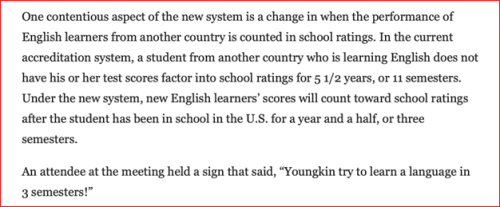
In the passage above Bryson omitted the fact that the year-and-a-half federal standard for English Learner inclusion is a 22+ year old federal civil rights law supported by both major national teachers unions and 40+ civil rights organizations. Bryson also neglected to inform readers that Virginia already complied with that standard for its federal system, but the parallel state report card devised by prior administrations had used a unique 5½ years standard.
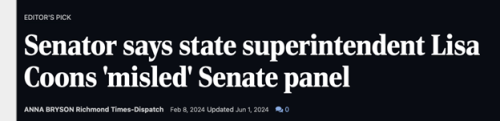
Bryson reported that State Superintendent Lisa Coons had allegedly misled a Senate panel by testifying that no school division requested a certain learning loss program’s contract be renewed. However, a staffer at Prince William County Schools (PWCS) had independently sent an email to a mid-level Virginia Department of Education (VDOE) staffer and Virginia Secretary of Education Aimee Guidera, asking that the state consider renewing its contract. Superintendent Coons did not know about the PWCS staffer’s email when she testified. PWCS’ Superintendent subsequently confirmed that PWCS did not want the program continued.
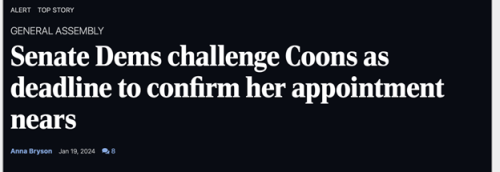
Bryson also reported that Coons wanted the VDOE to focus on customer service. Instead of reporting on her ideas for having VDOE staff work directly with parents and school districts (i.e., customers), Bryson pushed a misleading “customer service” storyline about a disgruntled former VDOE employee’s disagreement with his then-superior about prioritizing fixing links to older VDOE website pages. Bryson concludes with the disgruntled employee insulting Coons’ Chief of Staff for having come from a small school district.
Bryson Continues to Ignore Arne Duncan’s Support for Virginia’s Revamp

Bryson has never reported that former U.S. Secretary of Education Arne Duncan, who served under President Barack Obama and was a Virginia public school parent for six years then, spoke up eight months ago in support of Virginia’s accountability revamp. Conversely, the Virginia Mercury reported on it four months ago (when quoting me at the VBOE).
Duncan’s support was even more notable considering he was commenting on an X (f/k/a Twitter) thread with an RTD op-ed describing how Virginia’s low SOL cut scores—referencing the USED’s analysis and Schneider’s testimony—combined with its then-opaque accreditation system created a false impression of success for Virginia’s “low-income households, Black students, Hispanic students, and those with special needs.”
As I previously detailed, the new accountability system is successfully identifying more schools with struggling students from these demographics.
Bryson Continues to Omit Maryland’s Current Similar Process
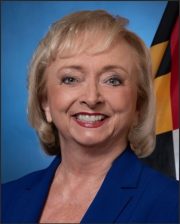
Also never making Bryson’s reporting (or, as far as I know, that of any Virginia education press) is the fact that Maryland Democratic Governor Wes Moore’s administration is going through an analogous exercise in raising its educational standards after its accountability system also significantly under-identified schools needing support.
Widely acclaimed Maryland State Superintendent Carey Wright has received favorable media coverage on her efforts to raise educational standards. For instance, in August, the Washington Post did a (deservingly) glowing profile of Wright, including her successful prior efforts in Mississippi to raise academic achievement with greater accountability and her similar plans for Maryland.
Earlier this month, the Post in its favorable report on process for updating Maryland’s accountability system discussed how Virginia was also updating its system to raise academic standards.
Conversely, the Post’s recent 1,600+ word article on Virginia’s accountability system— whose flawed reporting and conspiratorial tone I detailed—omits any mention of Maryland.
Correction: The original version said Bryson did not ask the VDOE about her culture wars theory. The post has been corrected to clarify that Bryson did ask the VDOE about it but did not print the VDOE’s denial of her theory.
Todd Truitt is a parent of two school-age children in Arlington County, Virginia. He is also the former Chair of the Math Advisory Committee for Arlington Public Schools and active in the Arlington Democrats. He is a business transactions attorney and a Certified Public Accountant.


Leave a Reply
You must be logged in to post a comment.