
by Doug Bradham
In early 2024 I received a 10.8% increase in my residential property tax versus 2023 (which now totals a 30.8% increase over the past five years of 2020 thru 2025). Other Chesterfield residents complained that they were seeing dramatic increases in their property taxes as well. Joining forces with other citizens who were working to hold the Board of Supervisors accountable, I began investigating the spending and property tax history of Chesterfield County.
Using the Freedom of Information Act, we obtained county spending and taxation data 2017 through 2023 actual, the 2024 adopted budget, and pro forma estimated spending from 2025 through 2028. We organized the data, analyzed it, and presented it in Power Point Slides to make it easy to understand.
As a reference point, the Virginia legislature has specified that:
- It is the responsibility of each county manager to establish the assessed property value. The real estate assessor’s office in Chesterfield has a 2024 budget of $3.9 million and reports to County Administrator Joe Casey.
- Each county’s Board of Supervisors sets the tax rate ($ per $100 of assessed value) to be applied to the assessed value. For 2024, the Board set the tax rate at $0.90 per $100. For a property appraised at $500,000, the annual property tax would be calculated as $0.90 X $5,000 = $4,500 ($2,250 to be paid every six months).
- Keep in mind is that every $0.01 per $100 of assessed value on the property tax rate amounts to $6 million.
Recommendations
We have requested that the Chesterfield County Board of Supervisors limit 2025 spending to a maximum increase of 3% and that the maximum property tax increase in 2025 be limited to 3%.
If the county would implement cost reductions in 2025, it would be possible to have no increase in spending and no increase in the amount of property tax collected.
Findings and Conclusions
Important findings and conclusions from this analysis were as follows.
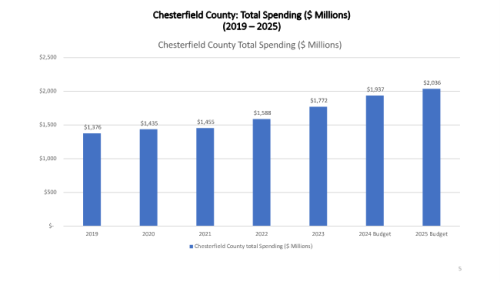
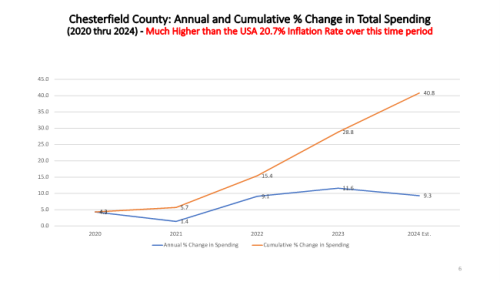
From 2020 thru 2024 (a five-year period), “Total” spending by Chesterfield County increased by 40.8% versus the Consumer Price Index (CPI) inflation rate increase of 20.7% over that same time period. Spending by the county over this time period has been at twice the inflation rate. The amount of property tax collected by the county has increased by 40.7%, again, twice the CPI inflation rate.
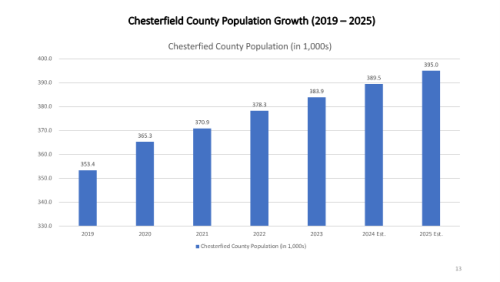
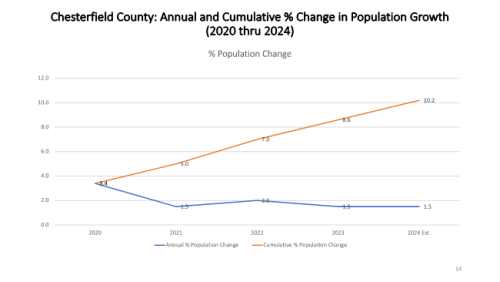
The population of Chesterfield County has only increased by 10.2% over this five-year period. Spending per resident has increased by 27.7% over this time period, more than 2.5 times the CPI inflation rate.
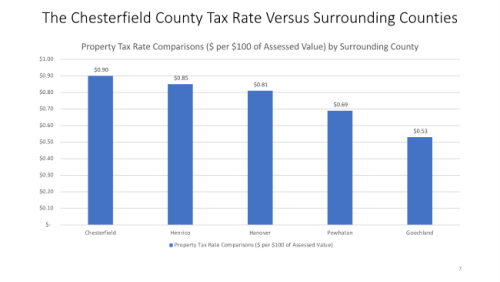
Chesterfield County has the highest property tax rate ($ per $100 of assessed property value) of any of the surrounding counties.
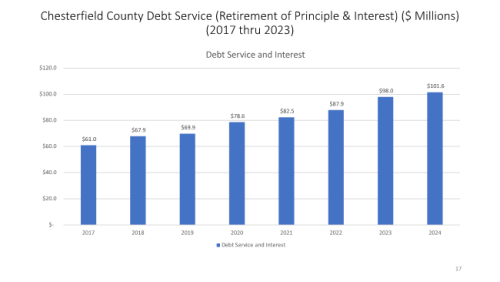
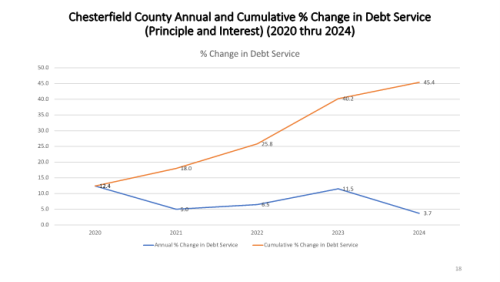
Debt service (payment of principal and interest) over this five-year period has increased by 45.4%, more than twice the CPI inflation rate. This is a result of bond issues and additional borrowing to support more spending over the taxes collected by the county. It appears that most of this additional borrowing is due to the spending on Economic Development projects. The debt service in 2024 amounted to $101.6 million, equal to 5% of the “Total” $2.0 billion in county spending.
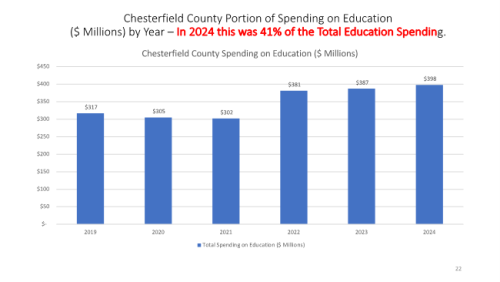
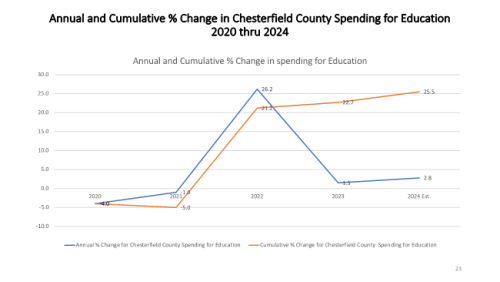
The Chesterfield County portion of spending on Education over this five-year period has only increased by 25.5%, a little over the CPI inflation rate. The standardized test score results for Chesterfield County public schools, when compared to other Virginia public schools, has been deteriorating since 2016. More money needs to be spent on Chesterfield County Education.
The main area of county spending that appears to be “Out-of-Control” is for Economic Development. The county is using county taxpayer revenue to invest in Economic Development projects which have no Return on Investment for county taxpayers. In 2023, the county admitted to spending $40 million on Economic Development. The spending on Economic Development appears to be much more that this amount. It is believed that county spending on Economic Development is exceeding $100 million per year (about 5% of the total county spending).
An investigation is in progress to define the levels of spending that have occurred for Economic Development over the past few years. Requests have been made to county management to provide these numbers and the Return-on-Investment (ROI) calculations for each investment. To date, no reliable information regarding Economic Development has been provided by county management. The County Administrator has stated that the county does not make ROI calculations on Economic Development projects.
The only results seen from the spending on Economic Development are more congestion and higher property taxes. After all of the effort and spending on Economic Development, over the past 17 years, the ratio of property taxes collected has not changed; 80% is from residential property tax revenue and 20% is from commercial (which includes apartments – there are now 122 apartment complexes in Chesterfield County with more on the way).
Spending on Economic Development should be significantly reduced. This would free-up funds for Education and permit property tax levels to be reduced for county residents.
There is no formal Cost Reduction/Continuous Improvement Program in place for county management. This is an essential program used in private industry to keep operating costs as low as possible. A report has been provided to county management and the Board of Supervisors explaining the importance of implementing one of these programs; how to implement it and a form was provided to develop, evaluate and implement projects.
To date, there has been no follow-up from county management or the Board of Supervisors. It does not appear that they have any interest in implementing a Cost Reduction/Continuous Improvement Program to help control cost.
Doug Bradham is concerned citizen of Chesterfield County. His email is [email protected].


Leave a Reply
You must be logged in to post a comment.