
by James A. Bacon
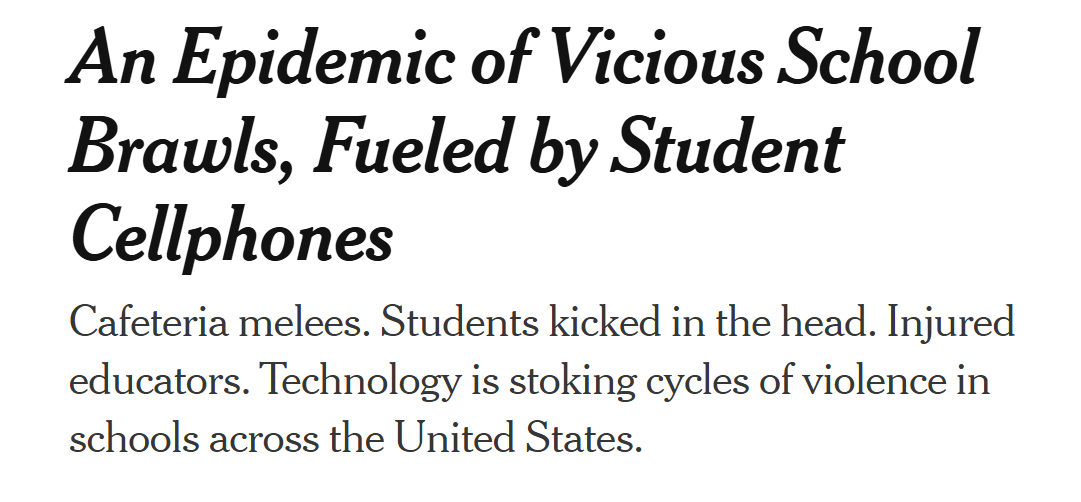
Last week a Henrico High School student was hospitalized after being stabbed at school. Needless to say, many students are upset.
“Seeing the aftermath of it all … the poorly cleaned up crime scene and still seeing the dried-up blood on the pavement and on the door … as I saw this … it spoke something to me: We are not safe,” [first name unintelligible] Burnett told the Henrico County School Board last week.
“We need stronger, more effective safeguards in place to ensure we feel safe every single day,” echoed senior Mackenzie Nelson.
Also addressing the school board, freshman Logan Corry saw the problem as an unwillingness to enforce the rules. He has often seen fellow students skip through the weapons scanners without consequences.
“What use are the rules if people just choose to ignore them?” he asked. “There is obviously a lack of willingness on the part of school administrators to treat rule-breaking seriously and enforce the fullest consequences available because they’re scared it will reflect badly on the school.”
Consider this stabbing and the reaction to it when evaluating Governor Glenn Youngkin’s recent boast about how much he has increased spending for Virginia’s public schools, including an extra $6.8 million increase for School Resource Officers (SROs) and School Security Officers (SSOs).
The Governor is absolutely correct to stress that school safety is a top priority. But is it enough to shovel more money into school districts like Henrico County that are happy to install weapons scanners but apparently are lax in enforcing the rules?
What good are more SROs and SSOs if their hands are tied by administrators committed to maintaining “social justice” in the disciplinary system?
Youngkin has made the raising of academic standards the centerpiece of educational reform in Virginia public schools. As it happens, the administration of the Standards of Learning (SOLs) and the accreditation of schools are things that can be effectively controlled by the Virginia Department of Education in Richmond. VDOE bureaucrats will follow his orders.
But so much of the rest of Youngkin’s largesse filters down through school boards and central district offices, where many educators hold ideological views antithetical to those held by the Governor. Some districts have no-nonsense administrators who can be entrusted to spend money wisely. But many don’t. Indeed, many school districts are committed to thwarting Youngkin’s reforms.
If educational ideologues create dysfunctional school environments, how does it help to dump more money into their laps? Youngkin’s silence about this disconnect makes one wonder if he’s even aware that the disconnect exists.


Leave a Reply
You must be logged in to post a comment.