
News flash: Bacon’s Rebellion has learned that Santa Claus has returned safely to the North Pole after experiencing the most hazardous flying conditions since forever.
News flash: Bacon’s Rebellion has learned that Santa Claus has returned safely to the North Pole after experiencing the most hazardous flying conditions since forever.
by James A. Bacon

David Austin Walsh is a leftist lecturer at the University of Virginia who specializes in the history of conservative and far-right politics. He is also something of a social-media influencer. He has 36,600 followers on his X account. So, when he xeeted (the new verb for tweeting) about the cold-blooded shooting of an insurance industry CEO on the streets of New York City earlier this month, he attracted attention.
“It’s actually kind of touching,” he wrote, “that the one thing that can bring together our fractious and disunited country is celebrating the assassination of a health insurance CEO.”
Was Walsh joining in the celebration of the assassination? Another xeet implied that United CEO Brian Thompson deserved his fate: “Anyway try to live your life in such a way that if you’re murdered the entire internet doesn’t think that you had it coming.”
In reply to a query from Bacon’s Rebellion, Walsh said he does not condone the deeds of accused killer Luigi Mangione. “Let me be emphatic: I do not, for both moral and pragmatic reasons, approve of Mr. Mangione’s actions – the former because I cannot endorse assassination as a legitimate political tactic; the latter because the likely consequence of such actions will be an increase in the repressive apparatuses of both corporations and the state.”
(more…)
by James A. Bacon
Luddites, unite! You have nothing to lose but your fossil fuels!
Concern among environmentalists is growing in Virginia as it dawns upon them that Artificial Intelligence creates demand for data centers, which in turn boosts demand for electricity… which in turn emits carbon dioxide… which in turn drives global warming.
A case in point can be seen in an op-ed, published today in the Daily Progress, by Eric Bonds, a sociologist who teaches human rights, climate change and environmental justice at the University of Mary Washington. Writes Bonds:
There are limits to how much electricity we can produce for data centers without also shattering our commitment to shift away from fossil fuels. Ultimately, a transition to renewable energy will require that we slow or stop the current data center boom in order to get there.
Bonds is absolutely correct that there are limits to the amount of energy that can be economically produced in a Net Zero electricity regime. But has it occurred to him that AI can be part of the solution?
(more…)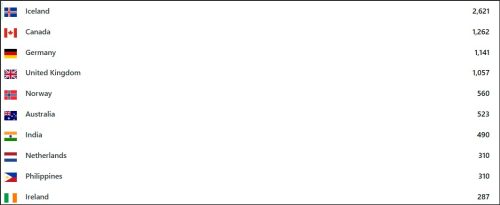
We’re not ones to obsess over our readership statistics. We create the best content we can, and if people choose to read and share, we love it. If people don’t, well, we’ll keep cranking out the blog posts anyway because we don’t have anything better to do with our lives! But as the year winds down, I couldn’t help but notice that Bacon’s Rebellion — a blog dedicated to inherently local content — is viewed around the world. See the number of page views above.
We’re not exactly altering the global conversation, but I couldn’t help but notice that we get a remarkable amount of readership in Iceland. So, here’s a shout-out to our Nordic friends! I don’t know what you get out of Bacon’s Rebellion, but if you’re reading this, please log in to the comments and let us know why on earth you read this blog.

To faithful American readers, this is the only year-end donation pitch I’ll make. We’re profoundly grateful to those who contributed financially this year — you made it possible for us to transition to a more secure, stable, and up-to-date blogging platform. We’re also thankful to those who contribute on a monthly basis, allowing us to pay our recurring bills. If you find value in our mission of maintaining a platform where a civil exchange of views on Virginia public affairs can take place, please visit our “Fund the Rebellion” feature in the left-hand column and throw a few coins into our tin cup.
by Paul Goldman
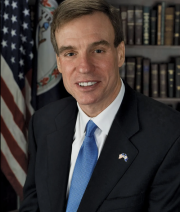
I find the attacks against Senator Mark Warner on this site most hypocritically amusing. It seems you are all afraid to appropriately criticize President-elect Trump, Elon Musk, and the GOP House majority. Despite you all claiming to be such great defenders of fiscal responsibility. Let’s review some facts.
(1) Under his watch, President Trump accumulated more national G.O. debt than all previous one-term Presidents combined. He ran in 2016 saying the national debt is way too high. Then ballooned the national debt even further. Becoming the King of Debt. Despite saying as a candidate he would cut the debt. He repeated his anti-debt rhetoric this year. Let’s see how he compares to all two-term presidents by the end of this second term.
It’s not all on him of course. A bipartisan majority in both chambers has long backed all the new red ink year after year. Senator Warner included. But at least Mark is not pretending like you all on this site to be fiscal conservative Southerners. He’s voted for more deficit spending than any Senator in state history. But again: he’s not denying it. He has voted to raise the debt ceiling. You can debate the wisdom. Accumulating debt for infrastructure needs can be smart. Using debt to cover annual expenses usually dumb. But at least credit his honesty.
(more…)

George Mason is rolling in his grave. An 18-year-old freshman at George Mason University was arrested Tuesday for allegedly plotting a mass casualty attack on Israel’s General Consulate in New York City, The Washington Post reports. Abdullah Ezzeldin Taha Mohamed Hassan, an Egyptian national faced with deportation proceedings, was arrested in Falls Church and, as a bonus, was banned from the GMU campus! (GMU, you may recall, recently issued No Trespass Orders against two Palestinian students after a police raid on their family’s home uncovered a cache of weapons and ammo.) Apparently, some GMU students are failing to absorb the values of the University’s namesake. As the principal author of the Virginia Declaration of Rights, George Mason argued that all men should enjoy full toleration in the exercise of religion. And, yes, the toleration extended even to Jews.
… Oh, a thousand pardons. I forgot. Hassan’s contemplated atrocities weren’t antisemitic, they were only anti-Zionist.
The pause that refreshes. Classes at Alexandria City High School have been canceled for two days after fights broke out leading to injuries to students and staff. Two students were charged with assault and battery after school resource officers (SROs) responded to multiple altercations, according to the Associated Press. In 2021, City Council eliminated funding for the SROs but reinstated the officers after a series of fights and a student was caught bringing a gun to school. Last year, the School Board approved the installation of metal detectors at two unnamed Alexandria schools in a pilot program. I’m guessing, though, that the discipline problem probably runs deeper than SROs and metal detectors.
by Kerry Dougherty
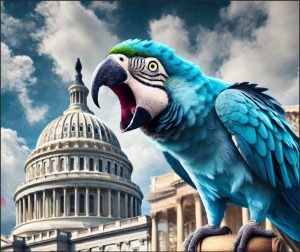
One thing you can say about Sen. Mark Warner: The man knows how to parrot DNC talking points.
Virginia’s beta senator was busy yesterday. No, not trying to get his fellow Democrats in the House to sign on to a clean continuing resolution that would fund disaster relief and the military for the next two weeks.
Nope. Like all dutiful Democrats, Warner was a keyboard warrior, X-ing away. They‘re uniformly indignant that an unelected genius and patriot was able to persuade normal people that the 1547-page stopgap measure that Congress was about to pass was full of pork, simply by telling the folks what was in the bill.
It was packed with the exact kind of waste and abuse of tax dollars that Donald J. Trump was elected to stop.
Pay hikes, free NFL stadiums, repair of the bridge collapse in Baltimore by taxpayers instead of the vessel’s insurance carrier, funding for gain-of-function research, expansion of the emergency pandemic powers of government in case another “pandemic” arrives.
There’s more. Lots more.
by Todd Truitt
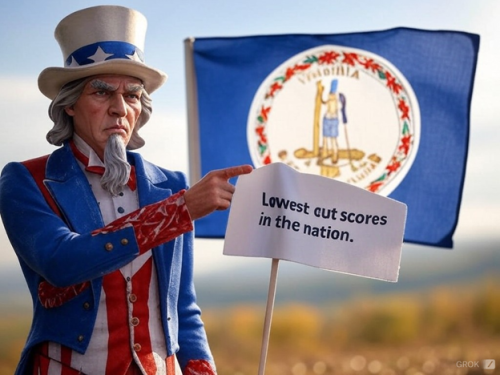
Virginia is in the process of raising the minimum cut scores for passing English and math Standards of Learning (SOL) exams — scores that the U.S. Department of Education (USED) declared in 2021 were the lowest in the nation. A USED official publicly testified in 2022 that Virginia’s cut scores were not “reflecting the reality” and were “too low.”
Those important facts were missing from Anna Bryson’s “news” article last week in the Richmond Times-Dispatch, which reported that higher cut scores likely will not be in effect until the spring 2026 exams. Bryson wrote that Governor Glenn Youngkin had campaigned on raising standards and, after taking office in 2022, vowed to raise cut scores to the highest in the nation. “But that never happened,” she opined. Instead, “the administration spent much of its time and political capital on history standards and transgender policies.”
From my personal involvement in education policy as an active Democrat and former chair of the Math Advisory Committee for Arlington Public Schools, I knew there was more to the story. I talked to the Virginia Department of Education (VDOE) to find out what did happen and what the plan is. Bryson’s selective omissions and opinion-based framing, I conclude, fit a pattern of bias in her state education coverage.
U.S. Department of Education Tells Virginia to Raise Its Cut Scores
USED reported in 2021 that Virginia’s 2019 SOL cut scores for 4th grade math and reading and 8th grade reading were the lowest in the country. Had USED incorporated actions taken under former Governor Ralph Northam further lowering the reading cut scores in 2020, its analysis would have made Virginia look even worse.
(more…)
by Sal Vitale
For several years, I, along with other concerned alumni, diligently worked to restore the “Old Corps” leadership and ideals to the management of the Virginia Military Institute Alumni Association. Our efforts faced resistance from those in charge, and now we find ourselves also grappling with issues far beyond governance of the Alumni Agency (VMIAA) and its affiliated organizations, including the Alumni Association.
A particularly troubling matter involves the selection of Philip Crane as a Visiting Professor under VMIAA’s Peay Endowment, whose public involvement in antisemitic activities and support for Hamas raises serious questions about the Institute’s stance on crucial moral issues. This matter requires immediate attention and full transparency from VMI, its Board of Visitors (BOV) and the VMIAA to preserve the integrity of the Institute and its alumni body.
For years, our group of alumni worked diligently to ensure the concerns of VMI graduates are heard and acted upon. One of our key goals was to reinstate proxy voting for the VMIAA Board members, to ensure those selected truly represent the alumni body and not just the interests of a small group. We also pushed for better access to alumni contact information to foster meaningful communication and ensure that all viewpoints are considered when important decisions are being made.
Unfortunately, our efforts were thwarted at every turn. The VMIAA has repeatedly denied us access to critical resources, including alumni contact lists, citing unfounded concerns about personal data usage. We await a ruling from the Virginia Supreme Court on this matter, but a much graver issue demands immediate action: the hiring of Crane, a VMI graduate himself, as a visiting professor.
(more…)by Dick Hall-Sizemore

Governor Youngkin has included in his proposed budget $50 million to provide $5,000 “Opportunity Grants” to 10,000 students from low-income families to apply against the cost of attending private schools.
While this limited voucher program avoids the primary objection of being a subsidy to rich families who send their kids to private school, there are a couple of characteristics of this proposal that need to be noted:
2. Usefulness. Even with a $5,000 grant from the state, a truly low-income family is not likely to be able to afford to enroll its child in a private school. A quick internet search of private schools in the Richmond area revealed one with a tuition of $6,000. The tuition for others varied on the age of the child, but ranged from the mid-teens to over $30,000 at the high school level.
There is no doubt that children from low-income families are being slighted in schools throughout the Commonwealth. The governor is to be commended for his efforts to make that fact clear and to strengthen the accountability measures. Improving the educational opportunities for low-income children is going to require a lot of effort and innovative thinking. This “Opportunity Grant” program seems designed more for PR and political purposes than for making a true difference in educational progress for low-income children.
Willfred Reilly, author of “Lies My Liberal Teacher Told Me: Debunking the False Narratives Defining America’s School Curricula,” is one of conservatism’s most versatile culture warriors. Slavery, Native Americans, DEI, hippies, colonialism, capitalism, white flight, nuclear weapons, you name it, he takes it on. He touched on several of those topics earlier this month at the University of Virginia in a speech co-hosted by The Jefferson Council. I give a brief introduction, but you can jump ahead to see Reilly himself at the 4:30 mark.
I felt like I knew Reilly from reading his books and interviewing him for Bacon’s Rebellion but it was a pleasure getting to spend time with him in person. He’s not just a culture warrior — he’s a good fellow who leavens his discussion of serious issues with an easy manner and gentle humor. Conservative readers will love him, liberals will hate him. — JAB
By Derrick Max
Governor Glenn Youngkin (R) presented his budget amendments to the the legislature’s money committees yesterday. The speech was filled with budget amendments to reduce taxes and fund new or existing programs. These tax cuts and additional spending proposals were made possible by Secretary of Finance Stephen E. Cummings’ report that the Commonwealth was again sitting on massive surpluses.
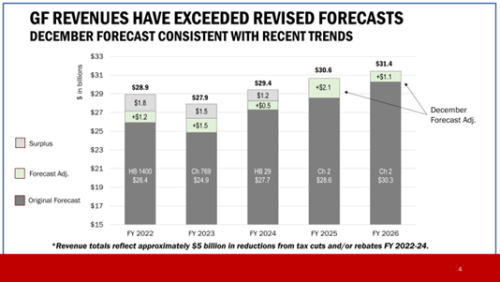
Specifically, Secretary Cummings reported that General Fund revenues have reached a record high, well above original forecasts.
When combined with FY24 surplus revenues, year-end agency balances, and other revenue, the Commonwealth has a current and projected surplus of $4.7 billion. The forward-looking revenue projections are driven by continued strength in employment and wages.
Setting aside that this means Virginians have again been severely overtaxed, Governor Youngkin proposed several amendments that have been top priorities of the Thomas Jefferson Institute for a long time. Below is a quick summary of those proposals based on what we know so far.
by Dick Hall-Sizemore
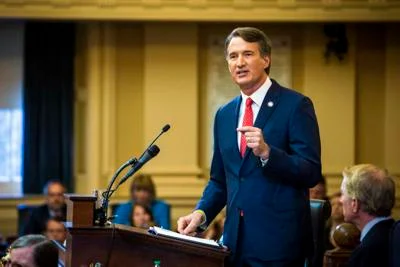
Governor Youngkin has taken on the car tax again, sorta. Rather than attack it directly, he proposes a Rube Goldberg process for some Virginians to get some relief from the car tax.
Here is how it would work: Individual taxpayers with a federal AGI of $50,000 or less would get a refundable credit of $150 or the amount of car tax actually paid to the locality, whichever is less. For married couples filing a joint return, the credit would be $300 or the actual amount paid to the locality, whichever is less. https://budget.lis.virginia.gov/get/budget/5050/HB1600/ (p. 731)
But, there is a catch. An individual would not be eligible for such credit if his or her county or city increased its car tax rate more than 2.5 percent over the rate it imposed the previous year. The governor seems to think this is a cap on the annual increase enacted by localities, but it is not. It is a penalty imposed on the residents of a locality that increases its car tax rate by more than 2.5 percent.
All this would be paid for over the next three years with a $1.1 billion fund created out of current surplus revenues.
(more…)The year: 2075. The American colonies on the Moon are getting restless under Washington’s tyrannical rule….
This second edition of “Dust Mites” has a snazzy new cover, includes helpful lunar maps, and is 5,000 words tighter than the original. The sequel, “Trogs,” is scheduled for publication this summer.
Bacon’s Rebellion is Virginia’s leading politically non-aligned portal for news, opinions and analysis about state, regional and local public policy. Read more about us here.
Shake up the status quo! Your contributions will be used to pay for faster download speeds and grow readership. Make a one-time donation by credit card or contribute a small sum monthly.
Enter your email address to receive immediate notifications of new posts by email.
SUBSCRIBE
Protecting Thomas Jefferson’s Legacy at the University of Virginia

Shoot me an email and I’ll generate a new password for you.