
by James A. Bacon

David Austin Walsh is a leftist lecturer at the University of Virginia who specializes in the history of conservative and far-right politics. He is also something of a social-media influencer. He has 36,600 followers on his X account. So, when he xeeted (the new verb for tweeting) about the cold-blooded shooting of an insurance industry CEO on the streets of New York City earlier this month, he attracted attention.
“It’s actually kind of touching,” he wrote, “that the one thing that can bring together our fractious and disunited country is celebrating the assassination of a health insurance CEO.”
Was Walsh joining in the celebration of the assassination? Another xeet implied that United CEO Brian Thompson deserved his fate: “Anyway try to live your life in such a way that if you’re murdered the entire internet doesn’t think that you had it coming.”
In reply to a query from Bacon’s Rebellion, Walsh said he does not condone the deeds of accused killer Luigi Mangione. “Let me be emphatic: I do not, for both moral and pragmatic reasons, approve of Mr. Mangione’s actions – the former because I cannot endorse assassination as a legitimate political tactic; the latter because the likely consequence of such actions will be an increase in the repressive apparatuses of both corporations and the state.”
But Walsh conceded that he was fascinated by Mangione’s “seeming elevation to the pantheon of American folk heroes.” Indeed, he followed the murder case closely and xeeted more than 30 times.
It’s reassuring to know that Walsh does not endorse assassination as a political tactic, even though, according to an Emerson College poll, 41% of 18- to 29-year-olds believe that Thompson’s murder was either somewhat (24%) or completely (17%) acceptable.
The prevalence of such a worrisome view in American society is in itself worthy of commentary and dissection. But that is not my intention here. My dual purpose is to introduce Walsh to the readers of Bacon’s Rebellion as a (1) a history-department lecturer who teaches an “Engagement” course to 1st-year UVA College of Arts & Sciences students, and (2) a junior faculty member who lives an insecure, peripatetic existence at the bottom of the academic hierarchy.
Engagements with Leftist Thinking Only
The Engagements, explains the Arts & Sciences website, are “small, seminar-style courses that put you face-to-face with many of UVA’s leading scholars and teachers. They invite you to ask big questions, and to think and talk about what you know and value.”
The Engagements seminars fall into four buckets: aesthetics, science, ethics, and “differences.” Walsh’s course falls into the “differences” bucket. The title of his course is, “Hateinnany”: Fascism, Antifascism, and the Global Far Right.”
From the course description:
The 2010s saw an explosion of interest in the growth of the global far right. From the rise to power of right-wing populists like Narendra Modi in India, Viktor Orbán in Hungary, Boris Johnson in Great Britain, Rodrigo Duterte in the Philippines, Jair Bolsonaro in Brazil, and of course Donald Trump in America, to a spate of anti-immigrant shootings across the developed world, to the deadly violence at the Unite The Right rally in Charlottesville, Virginia in 2017, the power and influence of far-right politics has been one of the defining features of the past decade. … We will be focusing primarily on Western Europe and North America, but paying close attention to the concept of “empire,” its importance in the right-wing imagination in imperial states, and the impact of decolonization on far-right politics and what develops into the self-described “white power” movement at the end of the century.
The themes in the seminar are aligned with Walsh’s recently published book (Yale University Press), “Taking America Back: The Conservative Movement and the Far Right,” in which he traces what he describes as the entwined evolution of mainstream American conservatism with a far right comprised of racists, antisemites, and fascists.
“Twentieth-century American conservatism did not equal fascism, but it evolved out of a right-wing popular front that included fascist and quasi-fascist elements,” he writes in the introduction to the book. “This is the key to understanding how American conservatism embraced MAGAism in the twenty-first century.”
You can read more of his bilious views on Professor Watchlist, a conservative website. Among the more extreme comments, expressed in October 2020: “Here’s the thing: if the worst-case scenario happens next week, Americans don’t need to just protest. They need to actively try to topple the government.”
Walsh is not some disheveled, nose-ringed, black-clad Antifa street warrior. He maintains a short-cropped haircut, wears spectacles, and sports such throwback apparel as bow ties and turtlenecks. He is polite; he responded courteously to my email. He is not someone whom students could readily dismiss by appearance and demeanor as a lunatic-fringe radical.
My problem is not that someone like Walsh teaches at UVA. There is ample room in a large university for radically anti-establishment, anti-conservative critiques of society. The problem occurs when those critiques are the only ones that students are exposed to.
Of the 27 “Engaging Differences” seminars, I could readily identify several that were ideological aligned with Walsh, and some that betrayed no overt political bias in the course descriptions, but none — not one — that overtly reflected a conservative, libertarian or classical liberal worldview.
The “big questions” that students are invited to ask do not envision “interrogating” (to borrow a leftist phrase) the Oppression Narrative that dominates intellectual discourse at UVA.
A sampling of Engaging Differences courses taught by other professors:
Africa Is Not a Country: “Topics we will focus on include the intellectual legacies of colonialism, poverty and international aid, “ethnic” and “religious” conflict, portrayals of ‘Africa’ in American and European film and media, the looting and marketing of African art, Pan-Africanism, and Afrocentricity.”
Apocalypse! “In what ways are social, political, racial, or economic structures of difference reflected in various visions of apocalypse?”
Sexual Objectification: “This course will examine the ways in which sexual objectification functions as a primary form of gender-based oppression in American culture.”
The Age of Antiaging: “We’ll brainstorm how a zip code can predict lifespan. In an age where health is wealth, and wealth is health, we will ponder who will benefit from the anti-aging revolution. How do we ensure healthy aging is accessible, not a privilege?”
Sovereignty in the Time of Slavery: “What do we learn by studying [Western legal theories and political philosophies] alongside Indigenous theories and practices from Turtle Island, Mēxihco Tenōchtitlan, and Michoacán? How can we use lessons from history to shed light on current debates like just warfare and Indigenous data sovereignty?
Again, there’s nothing “wrong” with these courses. What’s wrong is the lack of ideological balance. Actually, forget balance. What’s wrong is the lack of any alternative ideological framework.
Elite overproduction
This brings us back to Walsh, whose recent life story sheds an unflattering light on the condition of academia today. I believe he is sincere in his far-left beliefs, and I will not insult him to suggest otherwise. But it is fair to say that enthusiastically hewing to one variant or another of the Oppression Narrative is an essential survival strategy for a white male such as Walsh in a rapidly contracting discipline, history, in which the few opportunities that do exist for advancement are found in identity studies relating to Blacks, LatinX, feminists, and the LGBQT+ movement.
Walsh received his undergraduate degree from the University of Minnesota in 2011, and his PhD in history from Princeton in 2020. He has been living a seemingly precarious academic existence since then. He took on a job as part-time lecturer at George Mason University in the fall of 2019 (overlapping his Princeton studies), moved to UVA as a postdoctoral fellow for three years and four months, which he interspersed with work as an independent consultant. Next came a stint as a postdoctoral associate at Yale. The Yale gig lasted a year and a half, according to his LinkedIn account, which has not been updated to reflect his move back to UVA.
The aim of every scholar is to land a tenure-track job at a prestigious university: starting as an assistant professor and climbing up the ladder to associate and then full professor. At UVA, lecturers and other adjunct faculty get paid only a third on average of what full professors are. They tend to have heavier teaching loads, have less job security and enjoy fewer perks. The university hierarchy is very much the kind of hierarchical and oppressive world that Walsh and other lefty members of the professorial lumpenproletariat imagine American society at large to be.
The reality facing Walsh upon receipt of his PhD is that the supply-and-demand equation for white male history professors was working against him. Students are seeking tangible skills that can launch them on successful career paths, and history (at least today’s version of it) doesn’t deliver. The number of students majoring history is in long-term decline, history departments are shrinking, tenured history faculty are hanging on to their lucrative positions instead of retiring and creating new openings, and institutions such as UVA have expressed a pronounced preference for “marginalized” minorities such as Blacks, Hispanics, women, and LGQBTs… none of which does Walsh appear to be (although you can never tell these days with identities as fluid as they are).

In May, while still with Yale, Walsh was despairing over his future as a college professor. He vented his frustration in a series of xeets.
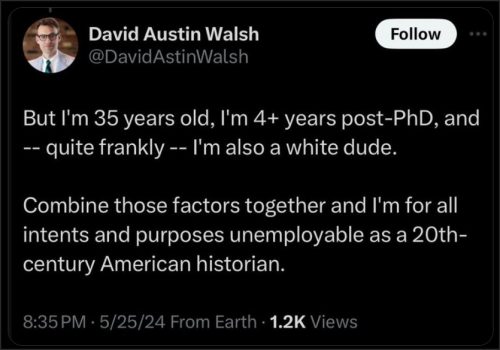
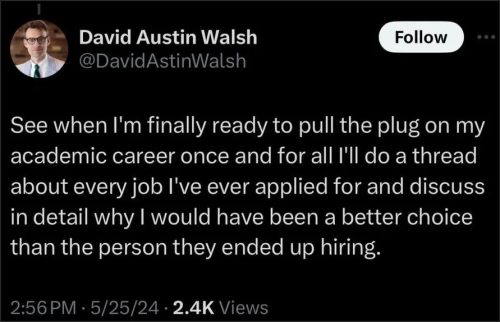
Conservatives on X mocked Walsh as a lefty loser. Progressives criticized him for his White privilege.
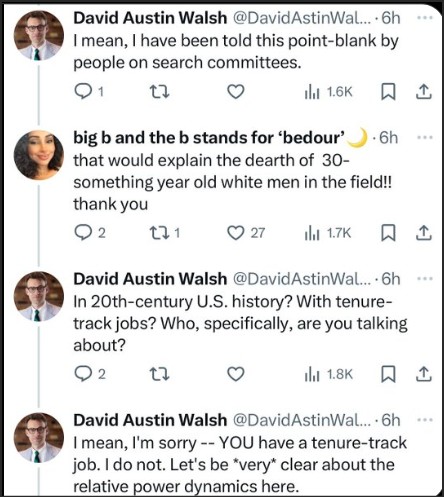
He pushed back a bit but eventually gave up. “I want to apologize for… that thread, which was a bad idea and came from a place of pain, anger, and frustration,” he xeeted. “It was fundamentally a breach of solidarity on my part.”
But he clung to his position that history and the humanities were dying, and that the academy is unjust. “We all know that the university itself is a profoundly unequal and unfair institution — and we had an object reminder of that… with the brutal suppression of the campus protests over the past month.”
He continued: “We all know that the academy is random, cruel, and chaotic and we all know the reasons why: austerity, corporatization, RW assaults on higher education.”
Noah Smith, author of the Noahpinion blog, saw it differently. Walsh, he suggested, is a living, breathing exemplar of “elite overproduction” — higher education cranking out PhDs for which there is no market and likely never will be. What happens to people like Walsh, who are obviously intelligent and could have prospered in a line of work for which there was a demand but live a hand-to-mouth existence?
When jobs in a field are scarce, it can exacerbate fights based on identity and representation. When there’s a glut of applicants all vying for one job, the margin between victory and defeat tends to be very narrow. That gives rise to a natural fear that the person who gets picked had some unfair edge. If a White person is picked, nonwhite people may suspect racism; if a person of color is picked, White people may suspect the influence of DEI. The more competitive the position, the greater the chance that even a small unfair edge will tip the balance.
Of course, Walsh cannot possibly sustain his I-was-screwed argument in an academic environment where the reigning ideology offers no succor to heterosexual white males. To have any hope of gaining tenure-track employment, he will have to suck it up and hope that his impeccable credentials as a progressive outweigh his drawbacks as a white male lacking tenure.
So, he’s back to blogging about social injustice, taking care not to advocate violence against insurance company CEOs yet expressing an understanding of why other people might do so. As he writes Bacon’s Rebellion: “My position consistently has been that the outrage needs to be taken seriously on its own terms, not dismissed and papered over or allowed to fester.” The conversation should focus, he says, on “serious and substantive reform of American healthcare.”
As for opining about social injustice in the academy, Walsh appears to have learned his lesson. He’s as active as ever on X, raising alarums about right-wing extremists in the Trump administration, poking liberal Democrats for their political failures, and deploring Israeli “genocide” in Gaza. Occasionally, moments of self-reflection shine through the blizzard of xeets.
“It’s the end of the year and looking back over 2024, this really was one of the worst years of my life,” he wrote December 15. “And I think that’s how I’ll remember 2024 — as a period of ever increasing dread, as political conditions worsened without any real sense of optimism for the future on a personal or political level. … Here’s hoping against hope that 2025 will be better.”


Leave a Reply
You must be logged in to post a comment.