Just out in time for the election season is a new song by Robin and Linda Williams. The nationally-acclaimed husband-and-wife duo has been writing and recording songs and giving concerts all over the country, as well as abroad, for almost fifty years. They were long-time regulars on Garrison Keillor’s Prairie Home Companion. They live in Staunton. Unlike on some recent posts, this song was written by a real person and sung by real people.
If you were a tenant, who would you rather butt heads with? A slumlord or a public housing authority?
Private-sector landlords have a bad reputation for going to court to evict their tenants. But it’s not clear that government is any kinder or more understanding.
As COVID-era eviction moratoria expire, housing evictions are surging across the country, and Richmond is no exception. In just a nine-dayspan in March and April, more than 130 tenants were summoned to Richmond courts for eviction hearings, mostly for unpaid rent, reports the Post. A Department of Housing and Urban Development (HUD) audit found that 27% of RRHA’s rent was going uncollected in September 2022. About 60% of tenants owe back rent totaling $3 million.
I was saddened to hear of the passing of Roxane Gatling Gilmore of pancreatic cancer. She is best known to Virginians as a former first lady, wife of former Governor Jim Gilmore. She was also known to students of classical history as a professor of classics at Randolph Macon College, where she taught Latin, Women in Ancient Literature, Roman History, Greek History, Epic Poetry, and Roman Britain. Her name, Roxane, suitably enough was that of the Bactrian princess whom Alexander the Great took as a wife.
I knew Roxane at the University of Virginia where we palled around in the Young Americans for Freedom and the Jefferson Society Literary and Debating Society. YAF was no more popular on the Grounds then than it is today, but she was a principled and passionate conservative even as a young woman.
I was shy and terrified of public speaking, which was a major drawback for anyone participating in The Jefferson Society. To become members, probationers had to give an oration to the group. I can’t even recall what I spoke about. I’m sure the speech was terrible — I knew from early on that I had no future as a politician. What I do remember a half century later is Roxane’s speech.
On Sept. 9, 2022, Attorney General Jason Miyares announced the creation of an “Election Integrity Unit” within his office. His press release contains this statement:
I pledged during the 2021 campaign to work to increase transparency and strengthen confidence in our state elections. It should be easy to vote, and hard to cheat. The Election Integrity Unit will work to help to restore confidence in our democratic process in the Commonwealth. [Emphasis added]
As I noted in Bacon’s Rebellion at the time, there was no indication that there had been any widespread or major election fraud in the Commonwealth or that Virginians’ confidence in its election system need restoring or strengthening. It was a political stunt—the “unit” consisted of lawyers already on the AG’s staff who would add election law violations to their list of assignments.
An article in today’s Cardinal News highlights how the recent recount of the votes in the Republican primary for the 5th Congressional District illustrates the security and integrity of Virginia’s election system, a point made by Steve Haner on this blog a few days ago. The article describes all the safeguards in the state’s electoral process and quotes Susan Beals, the director of the Department of Elections and an appointee of Gov. Youngkin, “Once you vote in Virginia, your results are checked three times before the results are certified. Between that and the efforts at security of voting machines, security and custody of ballots, and the training that we provide to our election officials, I believe that Virginians can be confident in our elections.”
In preparing the article, Cardinal News asked the Office of the Attorney General for data on voter fraud. Citing attorney-client privilege, the office declined the request. So much for transparency.
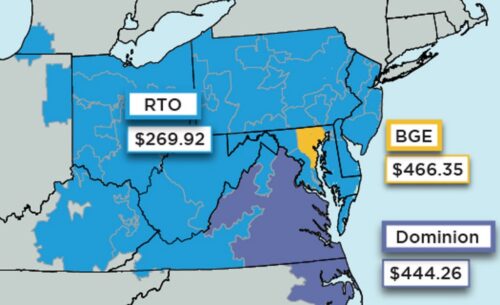
Just how much the huge increase in energy capacity prices within the PJM Dominion Zone next year will cost Virginians depends on a several variables. Do not accept claims of negligible impact on face value.
In its most recent integrated resource plan filed with the State Corporation Commission, Dominion Energy Virginia projected it would need to secure 1,100 megawatts of outside capacity through the PJM regional power market for 2025. At the new price in the most recent auction, should it do that, the cost would be more than $178 million. At the old price it would have been only $12 million.
A report on the issue in Virginia Mercury today quoted Dominion assuring its customers they would not see any impact on bills this year. That states the obvious. The new $444 per megawatt day price doesn’t apply until July 2025. The question is what the rate impact will be, if any, in future years. Especially if the next auction has similar results, the first big variable.
Dominion told the Mercury and Utility Dive its ratepayers will be insulated from this because capacity purchases represent only 1% of its current costs. But that 1% will be up to 14 times more expensive and Dominion’s own IRP projections show growing dependence on outside capacity suppliers, far more than in past years. It shows that need to buy outside capacity despite a parallel buildout of new generation.
Speaker of the House Don Scott, D-Portsmouth, has called for the resignation of Lindsey Burke, a conservative member of the George Mason University Board of Visitors, but Governor Glenn Youngkin is standing by her. Fortunately for Burke, her nomination was approved by the General Assembly earlier this year, and there isn’t much that Scott or anyone else can do about it.
But Scott’s demand sends a signal that Democratic legislators are paying close attention to the shifting balance of power on the boards of Virginia’s public universities and are likely to give greater scrutiny to Youngkin’s nominees than in the past. The stakes are high as Youngkin appointees now comprise majorities on every public university board and are in a position for the first time to shape university policies.
In a letter to Youngkin, Scott cited Burke’s authorship of the “Education” chapter in the Heritage Foundation’s 2025 Project, a document that burst into public view when regime media began denouncing it as a dystopian manifesto for a second Donald Trump presidency, even though Trump disowned the project.
Scott criticized Burke’s arguments that the federal government should play a reduced role in education, which traditionally was the preserve of state and local government. In particular he took issue with what he characterized as her support for eliminating the federal Department of Education, her opposition to student loan forgiveness, and her call to roll back legal protections for LGBQT+ students and sexual assault survivors. Wrote Scott: “Her extreme views are alarming and contradicts [sic] the Commonwealth’s efforts.”
Dominion Energy Virginia is facing about a ten-fold increase in the price it will pay when it must call on generation resources outside its own assets to meet daily demand. The most recent auction for guaranteed capacity within the 13-state PJM Interconnection network set incredibly new high prices, but nowhere as high as within Dominion’s service territory.
Most days Dominion will have enough power produced by its own generation assets, and not have to worry about the extra $444 per megawatt for purchased power. The impact of the new capacity prices, set to go into effect in the summer of 2025, could be more dramatic for Virginia’s rural electric cooperatives or municipal electric companies within the PJM Dominion Zone, most of which rely on purchased power.
But even Dominion’s own planning projections shared with the State Corporation Commission show a need for outside capacity purchases growing over time. This higher price may find its way onto customer bills at some point, when demand is at peak or something disrupts Dominion’s own plants.
The huge jump in capacity prices is just one more flashing red light about the danger in the PJM region from accelerating retirement of reliable thermal generators. The stated goal of the Virginia Clean Economy Act and similar laws in other states – no coal or natural gas plants allowed – has the region rushing toward energy shortages.
Zillow view of Pepper Ave. in the City of Richmond
by James A. Bacon
Everybody hates McMansions, it seems, other than the people who build them.
That certainly seems to be the case in the City of Richmond, where Councilman Andreas Addison and a sympathetic Axios Richmond decry the phenomenon of “teardowns” that is “threatening the historic charm and character of many of Richmond’s most established neighborhoods.”
In the city’s affluent West End, people are snapping up properties in neighborhoods of small single-family dwellings built more than a half century ago and replacing them with houses double the size. The trend is driven by buyers who want to live in one of the more desirable neighborhoods in the Richmond metro area but want larger, more luxurious homes than the unremarkable, Levittown-style dwellings that were a product of a less affluent era.
“Not only are we losing ready-to-move-in homes that are affordable, we’re also fast-tracking the rest of the neighborhood to be unaffordable for everyone else,” Addison told Axios.
Smarter and equitable growth, protecting existing residents’ ability to stay in the city, and reigning in gentrification are the city’s “next chapter challenge,” he added.
Axios tells us why this matters: “The teardown trend is bulldozing some of the city’s affordable housing stock — literally — while threatening the historic charm and character of many of Richmond’s most established neighborhoods.”
The state and federal tax codes don’t do enough to redistribute income and wealth to make “progressives” happy. When 40 percent of U.S. households don’t pay federal income tax, what’s a lefty to do?
The latest initiative: exempt lower-income people from tolls for the Downtown and Midtown tunnels in Hampton Roads.
Sure, the U.S. has a vast array of welfare programs, from Medicaid to the Supplemental Nutrition Assistance program (SNAP), from housing assistance to Temporary Assistance for Needy Families. Yeah, lower-income families enjoy all manner of benefits from free lunches at schools to means-tested financial aid for college. And to be sure, a vast array of nonprofit groups, supported by philanthropy, endeavors to fill gaps in the social safety net.
Then, of course, there’s an enormous black market for goods and services, estimated to run between 6% and 12% of the economy, in which maybe $2.5 trillion a year of income is never declared, which means that many lower-income Americans are less poor than reported.
But no amount of munificence is enough. Lefties can always find enough hardship cases to perpetuate their view that the American democratic-market-welfare state is as inequitable and oppressive as any social system found on the planet, to justify carving out even more preferences for low-income people.
The latest battlefront is transportation. This battle isn’t taking place in Congress. It’s playing out locally.
It is time to retire the term “fossil fuel.” Oil, coal and natural gas (oil is apparently the second most abundant liquid on Earth, after Miller Lite) have nothing to do with the bones of a tyrannosaurus rex or a stone impression of a trilobite. The generic term to describe the class should be carbon fuels.
I am no organic chemist, but my understanding is that the carbon in all of them is the element that provides the energy density and releases the steady heat when burned. So “carbon fuels.” I personally will use that term henceforth.
They were first called “fossil fuels” by a German chemist in the 18th Century, who applied the term mainly because the fuels are extracted from below ground. There is also a story out there that John D. Rockefeller promoted use of the term, as he built Standard Oil, to imply they were as scarce as dinosaur bones and thus justified higher prices.
Why retire this serviceable if incorrect term? Control the language and you are halfway to winning the argument.
Dominion Energy Virginia electricity bills rose August 1 and will rise again September 1, with many of the increases due to various aspects of the Virginia Clean Economy Act, especially ongoing construction of the Coastal Virginia Offshore Wind project.
Photo credit: Richmond Times-Dispatch
The net change is just over $14 more on that prototypical residential bill of 1,000 kilowatt hours per month. That is almost an 11% increase over the July 2024 charge of $129.31 for that amount of energy. As of September 1, that will be $143.36.
The numbers come from a presentation made by the State Corporation Commission staff to the Virginia Manufacturers Association energy summit on July 19. The SCC pointed to other possible increases and decreases from pending Dominion applications and projected the bill would drop back to $141.75 come spring.
That said, what Virginians pay the dominant utility is a revolving door of additions and subtractions impossible for the average citizen to track. For example, in recent weeks Dominion has announced the acquisition of a wind lease area off North Carolina, plans to build a liquified natural gas storage facility, and is moving forward on a planned Chesterfield natural gas plant. No money for those is being collected yet.
Remember, those totals would have been about $4 per month higher if Virginia were still part of the Regional Greenhouse Gas Initiative carbon tax compact, and advocates are seeking to get us back in either through court order or through Democratic victories in 2025 elections. Democrats love RGGI.
Virginia’s institutions of higher education increased in-state undergraduate tuition & fees by 2.6% on average in the 2024-25 academic year, according to data published last week by the State Council of Higher Education for Virginia (SCHEV). That’s a smidgeon less than the 2.8% rise in the Consumer Price Index over the previous fiscal year (July 2023 to June 2025).
When room, board and fees not related to the cost of instruction are added in, however, the total cost of attendance for four-year institutions increased 3.4% on average, or 3.4% for in-state, undergraduate students.
The statewide average masked considerable variability between institutions, and even within institutions as some universities have begun charging different rates for different degree programs. The University of Virginia-Wise campus did not increase undergraduate tuition & fees at all this year, while the UVA main campus in Charlottesville hiked rates by 3.0% on average.
Here’s the obligatory AI-generated Suno follow-up to Jon Baliles’ post (based on Richmond Times-Dispatch reporting) about the latest credit card scandal at Richmond City Hall.
[Verse]City hall is a dark pit Scams runnin’ wild Credit cards gettin’ hit They livin’ like kings in style
Parker began his investigation into the use of the city’s credit card program several months ago and found multiple abuses and questionable spending at the Voter Registrar’s office. The Registrar is appointed (or fired) by a three-person, state-controlled Electoral Board, but the office is funded by the city and the credit cards issued to it are managed by the city’s Procurement Department.
The year: 2075. The American colonies on the Moon are getting restless under Washington’s tyrannical rule….
This second edition of “Dust Mites” has a snazzy new cover, includes helpful lunar maps, and is 5,000 words tighter than the original. The sequel, “Trogs,” is scheduled for publication this summer.
Advertisement
Advertisement
Advertisement
Advertisement
About
Bacon’s Rebellion is Virginia’s leading politically non-aligned portal for news, opinions and analysis about state, regional and local public policy. Read more about us here.
Fund the Rebellion
Shake up the status quo! Your contributions will be used to pay for faster download speeds and grow readership. Make a one-time donation by credit card or contribute a small sum monthly.
Can’t wait until tomorrow
For your Bacon’s Rebellion fix?
Enter your email address to receive immediate notifications of new posts by email.
SUBSCRIBE
Search Bacon’s Rebellion
Categories
Archives
The Jefferson Council
Protecting Thomas Jefferson’s Legacy at the University of Virginia
Forgot Your Password?
Shoot me an email and I’ll generate a new password for you.