
By Steve Haner
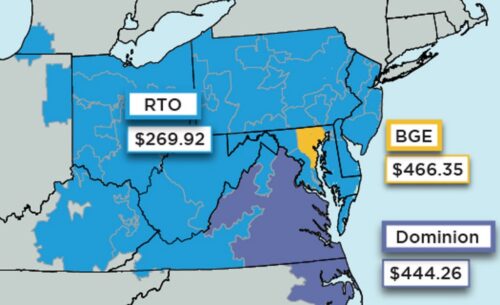
Dominion Energy Virginia is facing about a ten-fold increase in the price it will pay when it must call on generation resources outside its own assets to meet daily demand. The most recent auction for guaranteed capacity within the 13-state PJM Interconnection network set incredibly new high prices, but nowhere as high as within Dominion’s service territory.
Most days Dominion will have enough power produced by its own generation assets, and not have to worry about the extra $444 per megawatt for purchased power. The impact of the new capacity prices, set to go into effect in the summer of 2025, could be more dramatic for Virginia’s rural electric cooperatives or municipal electric companies within the PJM Dominion Zone, most of which rely on purchased power.
But even Dominion’s own planning projections shared with the State Corporation Commission show a need for outside capacity purchases growing over time. This higher price may find its way onto customer bills at some point, when demand is at peak or something disrupts Dominion’s own plants.
The huge jump in capacity prices is just one more flashing red light about the danger in the PJM region from accelerating retirement of reliable thermal generators. The stated goal of the Virginia Clean Economy Act and similar laws in other states – no coal or natural gas plants allowed – has the region rushing toward energy shortages.
At the same time, demand for electricity continues to grow. From the PJM news release:
Meanwhile, the peak load forecast for the 2025/2026 Delivery Year has increased from 150,640 MW for the 2024/2025 BRA to 153,883 MW for the 2025/2026 Delivery Year. Additionally, FERC-approved market reforms contributed to tightening the supply and demand balance by better estimating the impact of extreme weather on load and more accurately determining resource reliability value.
“More accurately determining resource reliability value” means PJM has become more realistic about the actual power generation from intermittent sources such as solar and wind. It lowered their relative reliability values. This week’s coming dark and wet weather from a dying tropical storm will provide more days of low solar generation in Virginia, when gas and nuclear power will carry the load.
The combination of growing demand and shrinking (reliable) supply did to prices what you heard it would in Econ 101. Again from PJM: “The auction produced a price of $269.92/MW-day for much of the PJM footprint, compared to $28.92/MW-day for the 2024/2025 auction.”
But the prices can vary by sub zone, and two zones saw much larger prices: the Baltimore Gas and Electric Zone hit $466 dollars per megawatt-day, and the Dominion Zone was right behind at $444. In those cases, constraints on transmission capacity from other regions of PJM also played a role in driving up the price. For Virginia’s other main utility, Appalachian Power Company, the lower generic PJM capacity price will apply.
What kinds of generation bid into the auction and offered their future capacity for sale at a fixed price? Natural gas provided 48%, nuclear 21%, and coal 18%. Those combine to 87% of the total, with wind adding only 1% and solar another 1%. Generation dependent on sun or wind simply does not offer firm capacity.
Federal Energy Regulatory Commissioner Mark Christie took note of the capacity auction results in a series of posts on X, arguing it supports his position that natural gas and other thermal generation should grow, not shrink: “This is the fourth auction in a row in which capacity supply offered has declined, this time by more than 13 gigawatts from the last auction. And the overall reserve margin declined significantly, from 20.4% to 18.5%.”
Again from PJM:
“The capacity auction has been a valuable tool over time to help PJM competitively secure resources to meet reliability requirements,” said President and CEO Manu Asthana. “The significantly higher prices in this auction confirm our concerns that the supply/demand balance is tightening across the RTO. The market is sending a price signal that should incent investment in resources.”
Right. But what gets built matters. Too many resources are flowing into the wrong kinds of generation, the kinds so unreliable that they will never provide the backbone of a reliable system and draw top dollar in a capacity auction. The political throwaway line about “all of the above” ignores the truth that not all are equally reliable.


Leave a Reply
You must be logged in to post a comment.