New PJM Capacity Costs Likely to Impact Dominion, Coop Ratepayers

By Steve Haner

Just how much the huge increase in energy capacity prices within the PJM Dominion Zone next year will cost Virginians depends on a several variables. Do not accept claims of negligible impact on face value.

In its most recent integrated resource plan filed with the State Corporation Commission, Dominion Energy Virginia projected it would need to secure 1,100 megawatts of outside capacity through the PJM regional power market for 2025.  At the new price in the most recent auction, should it do that, the cost would be more than $178 million.  At the old price it would have been only $12 million.

A report on the issue in Virginia Mercury today quoted Dominion assuring its customers they would not see any impact on bills this year.  That states the obvious. The new $444 per megawatt day price doesn’t apply until July 2025.  The question is what the rate impact will be, if any, in future years. Especially if the next auction has similar results, the first big variable.

Dominion told the Mercury and Utility Dive its ratepayers will be insulated from this because capacity purchases represent only 1% of its current costs.  But that 1% will be up to 14 times more expensive and Dominion’s own IRP projections show growing dependence on outside capacity suppliers, far more than in past years.  It shows that need to buy outside capacity despite a parallel buildout of new generation.

At some point this will impact prices for Dominion and its customers, including federal agencies and municipal providers, and could also raise prices for the rural electric cooperatives within its geographic territory.  To parse all this out, either the State Corporation Commission or the legislative Commission on Electric Utility Regulation or both should hold hearings.

One thing not clear (it may be buried in the fine print of the PJM auction report) is how much outside capacity Dominion actually has or will put under contract.  Again, the IRP called for 1,100 megawatts and actually projected it to start exceeding 2,000 megawatts by 2035. All of this needs a public airing.

In the field of energy regulation and management, this is the hard stuff, the graduate level stuff.  The 13-state PJM Interconnection exists to make sure there is a match between power demand and power supply, with a fixed reserve margin of supply.  As part of PJM, Virginia’s two major utilities are required to have enough power to meet their demand, with reserves, either with their own power plants, with long term power purchase agreements, or by buying “capacity” from other suppliers to PJM.

For the money they receive ($444 per MW next year in the Dominion Zone), the outside supplier promises to provide that power whenever called up.  In effect, the utility is buying a contract for power it may or may not need at any given time, but on its worst days will definitely need.

The first complication:  as an integrated utility that owns generation directly, Dominion provides its capacity into PJM along with buying capacity from PJM. Usually it is a wash, but Dominion seems to be moving toward buying more capacity in excess of its own generation, which is where this monster charge will bite.

To really make things complicated, this was the auction selling future generation capacity.  PJM also manages a daily, even hour-to-hour, marketplace in actual energy.  That price is all over the map as supply and demand shift.  The interaction between those two is something else Virginia’s energy overseers need to understand.

Dominion can also sell energy into PJM and regularly does, which usually more than balances out the cost of its energy purchases.  When it buys more energy than it sells, the customers cover the difference through the fuel factor on monthly bills.  The cost of net excess capacity, on the other hand, is part of the base rates.

Dominion had left the PJM capacity market for a while but rejoined earlier this year.  When not part of the capacity market, it simply used the energy auctions when needed to balance its supply and demand.  The decision to leave and then return to the capacity market was up to the utility and not something reviewed by the State Corporation Commission.

Within the rural cooperatives, apparently those which are part of the Old Dominion Electric Cooperative generation pool have most of their demand needs covered by their own power plants or contracts and don’t rely much on purchased capacity.  One major cooperative, however, is outside that pool and thus more exposed to these higher capacity costs. The Northern Virginia Electric Cooperative (NOVEC) owns very little generation.

There is much absolute nonsense in the Mercury report. For example: “Current rates, which on average are about $128 for a residential customer, are locked in until Dominion undergoes its next rate review next year.”  No, the bills are changing all the time as various rate adjustment clauses change, and as of September 1, the bill will be up 11% to $143, as Bacon’s Rebellion reported.

And, as could be expected, Mercury did its best to assert that these higher capacity costs are the result of “climate change” and “extreme weather.”  No.  To the extent Dominion’s generation and demand do not match, and it needs to buy extra capacity, the higher demand from the burgeoning data center industry is the principal culprit.  The utility, and in fact all of PJM, now have peak demand in the winter, and “global warming” didn’t cause that.

And Mercury sought out an environmental activist and quoted him claiming the reliability issues are being caused by the natural gas and coal plants, not by the wind and solar which are the current focus of Dominion’s capital expansion.  Wrong again.

PJM has a measure of which plants are the most and least reliable called the “effective load carrying capability” or ELCC.  Those numbers are being changed based on growing experience with the renewable sources, and their reliability values are dropping fast.  Here’s a good illustration. Solar plants that move the panels to track the sun are rated at 11%, a gas combined cycle plant at 79% and a nuclear plant at 95%. Which should we be building again?


ADVERTISEMENT

(comments below)


Comments


Comments

47 responses to “New PJM Capacity Costs Likely to Impact Dominion, Coop Ratepayers”

  1. Eric the half a troll Avatar
    Eric the half a troll

    โ€œPJM has a measure of which plants are the most and least reliable called the โ€œeffective load carrying capacityโ€ or ELCC.โ€

    ELCC is more a measure of variability than reliability. Again most renewables are very reliable and predictable. I have had my solar for something like 3 years and it has consistently produced 20.8 – 20.9 MWh per year – exactly as designed. The lower ELCC is due to the intermittent nature of many renewables and approaches 100% when paired with battery storage (as one would expect).

    1. Stephen Haner Avatar
      Stephen Haner

      Indeed, as one would expect, but a solar plant paired with a battery unit suddenly costs a whole lot more, too, and destroys claims these sources are "cheaper." And note on that chart that whatever you think ELCC measures, over time in future PJM reliability determinations their utility is moving in the wrong direction. The secret is out.

      But thank you for being one of the readers to plow through to the end!

    2. Stephen Haner Avatar
      Stephen Haner

      Indeed, as one would expect, but a solar plant paired with a battery unit suddenly costs a whole lot more, too, and destroys claims these sources are "cheaper." And note on that chart that whatever you think ELCC measures, over time in future PJM reliability determinations their utility is moving in the wrong direction. The secret is out.

      But thank you for being one of the readers to plow through to the end!

      1. Eric the half a troll Avatar
        Eric the half a troll

        โ€œโ€ฆbut a solar plant paired with a battery unit suddenly costs a whole lot moreโ€ฆโ€

        I remember when you all used to say that about solar aloneโ€ฆ.

        Aside: if Dominion were really concerned about grid reliability when it comes to renewables, they would support more incentives for distributed generation. In that case, the grid itself acts as the storage battery. They wonโ€™t because they fear that more than anything. So instead they fight to be the only generator in town (including renewables) and are guilty of creating any grid reliability issues due to their own greed. I am hopeful that intelligent legislators see this and push hard for better legislation to build incentives for distributed and community solar generation.

        1. Stephen Haner Avatar
          Stephen Haner

          I have never objected to solar. I agree that it provides juice at low cost and has a role to play. It just isn't baseload and there will be a limit to how much we should have. A different limit in Virginia than in the desert SW.

          1. Eric the half a troll Avatar
            Eric the half a troll

            โ€œIt just isn't baseload and there will be a limit to how much we should have.โ€

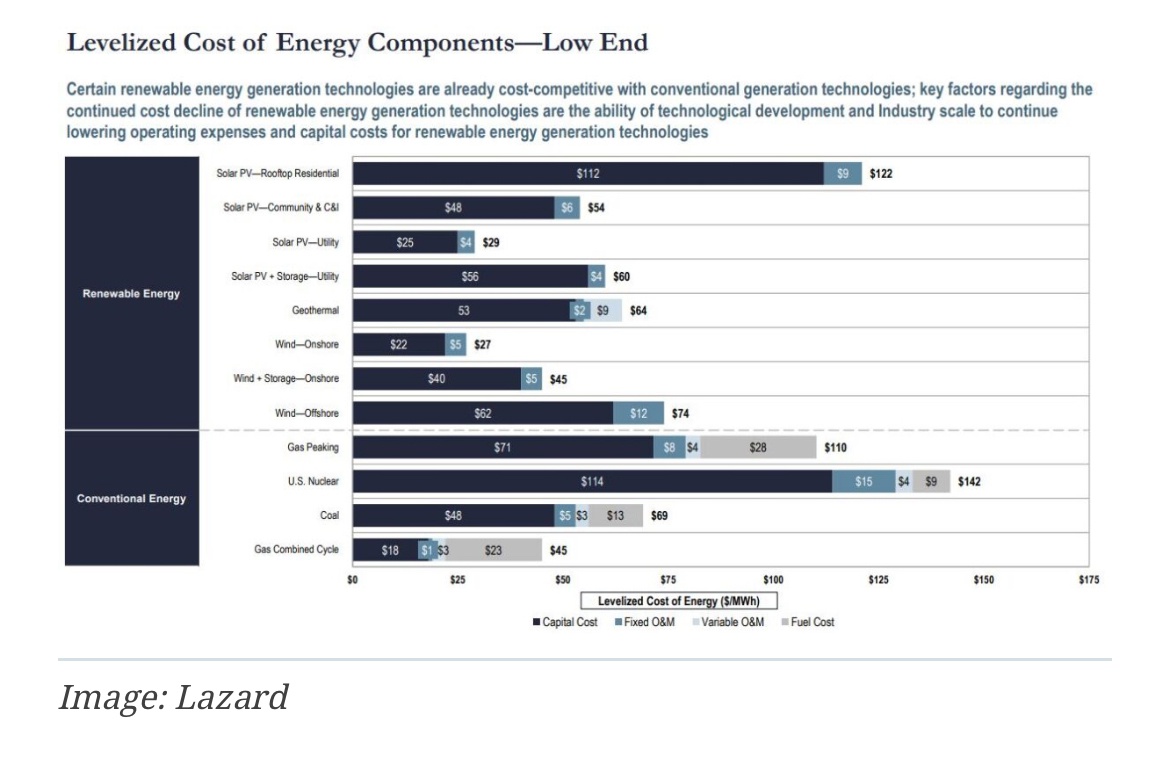
            Iโ€™m not so sure about that. As noted above solar with storage is as (if not more) โ€œreliableโ€ as a baseload than NG and nuclear. According to this (the most recent LCOE comparison I could find), utility-scale solar with storage is now about $60 per MWh (and dropping, Iโ€™m sure) while NG generation is $45 (and very dependent on fuel prices). Nuclear is a whopping $142. You may be right about physical limits of use but cost limits seem to be fading.

            I think the real issue facing PJM and Dominion is not what type of generation but can the generation be brought on line (regardless of type) fast enough to meet demand. That seems to be the real story here.

            https://uploads.disquscdn.com/images/dcc26e57ab642632e0fa1639e6718e7ff9f5f44847d120ca6f111377f11a4b23.jpg

          2. Eric the half a troll Avatar
            Eric the half a troll

            โ€œIt just isn't baseload and there will be a limit to how much we should have.โ€

            Iโ€™m not so sure about that. As noted above solar with storage is as (if not more) โ€œreliableโ€ as a baseload than NG and nuclear. According to this (the most recent LCOE comparison I could find), utility-scale solar with storage is now about $60 per MWh (and dropping, Iโ€™m sure) while NG generation is $45 (and very dependent on fuel prices). Nuclear is a whopping $142. You may be right about physical limits of use but cost limits seem to be fading.

            I think the real issue facing PJM and Dominion is not what type of generation but can the generation be brought on line (regardless of type) fast enough to meet demand. That seems to be the real story here.

            https://uploads.disquscdn.com/images/dcc26e57ab642632e0fa1639e6718e7ff9f5f44847d120ca6f111377f11a4b23.jpg

  2. Reposted from the previous thread as it applies equally here.

    NEWSFLASH: You are all missing the real point. Are there issues with the retirement of fossil fuel powered generation facilities and/or the reliablity of "green" energy, absolutely. But that only accounts for a fraction of the real problem which is the demand side principally from explosive data center load growth and to a significantly lesser degree projections regarding EV demand.

    Wake up folks, our irresponsible elected "leaders" at the state and local level and on both sides of the aisle have been co-opted by the most recent wave of carpetbaggers and snake-oil salesman to plague the Commonwealth, data center operators and spec developers leading to the approval of millions of square feet of data centers with power requirements measured in gigawatts.

    While PJM gets it, Dominion has underestimated the demand forecast by several orders of magnitude and have been damned obnoxious about it. The generation problem is exacerbated by the dearth of existing transmission equipment and substations to supply the increased demand.

    Does Dominion care, absolutely not as the cost of the purchased power not to mention the transmission and substation costs will not be borne by its stockholders but rather by the ratepayers.

    Some of us have seen this coming for a long time but rational consideration falls on deaf elected ears as they have either been bought off by exorbidant campaign contributions or wooed by the bag of magic beans offered by the data center industry in the form of inflated tax revenue projections that any rational elected official should know will never be realized.

    On a closing note, if global warming is truly a thing, those costs and power demands will only increase in direct correlation to every degree of temperature increase, got to keep those servers cool.

    1. Dick Hall-Sizemore Avatar
      Dick Hall-Sizemore

      In Loudoun County, the annual tax revenue from data centers is about $600 million. That constitutes about the local tax base. That's pretty good snake oil.

      1. Eric the half a troll Avatar
        Eric the half a troll

        One thing I understand is at issue here is that local governments can not point to energy demand requirements as a reason to deny project approvals because Dominion is required by law to supply any demand to any user when called to. My laymanโ€™s understanding of the issue. At this point, if they could, I think the Loudoun BOS would deny or delay such projects on that basis (regardless of fiscal impacts) but they simply canโ€™t.

      2. Eric the half a troll Avatar
        Eric the half a troll

        One thing I understand is at issue here is that local governments can not point to energy demand requirements as a reason to deny project approvals because Dominion is required by law to supply any demand to any user when called to. My laymanโ€™s understanding of the issue. At this point, if they could, I think the Loudoun BOS would deny or delay such projects on that basis (regardless of fiscal impacts) but they simply canโ€™t.

        1. Elena Schlossberg-Kunkel Avatar
          Elena Schlossberg-Kunkel

          A locality can deny a rezoning for a multitude of reasons. The impacts to the health and well being of the residents is being completely igorned.

      3. LarrytheG Avatar
        LarrytheG

        Yes, that money is coming from people who are paying money to the data centers of which the locals get a cut.

        So who is paying money to those data centers and why?

        1. Eric the half a troll Avatar
          Eric the half a troll

          Political campaignsโ€ฆ ?โ€ฆ we live in a strange worldโ€ฆ

          1. LarrytheG Avatar
            LarrytheG

            Well, the tax money that data centers generate.

            Where are the revenues that data centers are collecting coming from?

            Are companies paying data centers enormous piles of money for nothing of real value and in the process, the data centers are gobbling up grid electricity – again for no good purpose?

            They're basically gobbling up grid energy but produce nothing of value in doing so?

          2. LarrytheG Avatar
            LarrytheG

            Well, no just plain tax revenues. That's what sold Spotsy on 4 or 5 of them. No donations just the prospect of a lot of tax revenue without having to provide schools and other residential services.

            But again – there seems to be a perception that data centers don't do anything but eat power when clearly they pay millions in taxes which is just a portion of even bigger millions that SOMEONE is paying them for SOMETHING.

            Are NEW businesses that need data centers being created and if so , are they adding to the economy? Where do THOSE businesses get the money to pay the data centers? One presumes those businesses ARE engaged in selling products and services on a for-profit basis and actually do need the data centers to support their business models?

            When we talk about automation and technology increasing the per capita productivity, i.e. we're increasing economic output for less labor – are data centers doing this?

            If you have a dentist office that is doing it's own IT and it decides to go with a company that has written a dentist application that uses a data center for the data for all the dentists offices that have switched to it's app- is that increasing productivity over the idea that all those dentists offices formerly were doing their own IT (badly)?

        2. DJRippert Avatar
          DJRippert

          Jim Bacon pays money to a datacenter to run this blog.

          My company pays money to Microsoft for Office365, which, in turn, runs in a datacenter.

          YouTube charges advertisers money and then uses that money to fund datacenters where user-supplied videos are uploaded and watched by millions (along with the ads).

          1. LarrytheG Avatar
            LarrytheG

            Yep. so there is no monetary benefit to paying a datacenter for their services? Data Centers are
            more like tattoo parlors and CBD shops?

      4. DJRippert Avatar
        DJRippert

        Don't you have to consider the tax base of what would have been built where the datacenters are if those datacenters were never built?

        1. LarrytheG Avatar
          LarrytheG

          like what? more houses that use more in services than they pay in taxes? Doesn't the zoning have to be in place for data centers to propose?

          1. DJRippert Avatar
            DJRippert

            Sure, the zoning has to be approved for datacenters. As for the "more houses" – some generate more in taxes than they consume. Others generate less in taxes than they consume.

            My point is that Dick's $600M can't be compared to $0.

          2. LarrytheG Avatar
            LarrytheG

            Virtually all houses with kids consume way more in services than they pay in taxes, even a lot of the
            high dollar ones. You figure just the kids (one kid for a house) will consume $5000 more in services – not
            counting all the other county services also provided. A data center generates 10 times the tax revenue than
            residential on the same footprint.

          3. Eric the half a troll Avatar
            Eric the half a troll

            On the average (and that is the figure that matters), new residential housing costs more in taxes than it generates. It is a net negative on the county budget. Each additional house (on the average) results in a net increase in RE taxes. No getting around that.

      5. Elena Schlossberg-Kunkel Avatar
        Elena Schlossberg-Kunkel

        What are you thoughts on the 5 billion dollar "extension cord" that is cutting through three states, taking private property from regular citizens like me and you, just to feed the load demand of data centers in Loudon's data center alley?

        Do you think it's fair that ALL ratepayers will see their electric bills increase significantly because that data center industy, in concert with a monopoly utility, foist their buisness model critical need demands on all of us?

    2. LarrytheG Avatar
      LarrytheG

      Well, again. I get the impression that people don't understand what data centers actually do and the implication that they really do nothing but eat enormous gobs of power that is straining the grid, ergo, they should be denied and shut down.

      But I also ask again – just for those who think climate change is real –
      what should we do if not wind/solar ? what SHOULD we do instead of burning more fossil fuels?

      1. Eric the half a troll Avatar
        Eric the half a troll

        Nuclear at $142 per MWhโ€ฆ ๐Ÿคทโ€โ™‚๏ธ

        1. LarrytheG Avatar
          LarrytheG

          with how long a timeframe to build one?

          But I don't hear that from the "maybe climate change is real" folks.

          AND I don't hear it from the deniers if it costs more than fossil fuels (and wind and solar).

          1. Eric the half a troll Avatar
            Eric the half a troll

            I really donโ€™t understand the vehemence against converting the grid to renewablesโ€ฆ climate impacts notwithstanding, it is or at least will be an improvement over our current system. I am hopeful that once solar with storage hits equilibrium costwise with NG generation, the opposition will fade to a whisper.

            Kudos to Haner though for following this stuff. His position notwithstanding, he does a great service digging through the details and smoke Dominion blows.

          2. Eric the half a troll Avatar
            Eric the half a troll

            I really donโ€™t understand the vehemence against converting the grid to renewablesโ€ฆ climate impacts notwithstanding, it is or at least will be an improvement over our current system. I am hopeful that once solar with storage hits equilibrium costwise with NG generation, the opposition will fade to a whisper.

            Kudos to Haner though for following this stuff. His position notwithstanding, he does a great service digging through the details and smoke Dominion blows.

          3. Eric the half a troll Avatar
            Eric the half a troll

            I really donโ€™t understand the vehemence against converting the grid to renewablesโ€ฆ climate impacts notwithstanding, it is or at least will be an improvement over our current system. I am hopeful that once solar with storage hits equilibrium costwise with NG generation, the opposition will fade to a whisper.

            Kudos to Haner though for following this stuff. His position notwithstanding, he does a great service digging through the details and smoke Dominion blows.

          4. LarrytheG Avatar
            LarrytheG

            I concur except for the climate denial part.

            He's upfront about it, no question and the greenies are up front about their opposition to fossil fuels but some of the folks in the middle who say they believe climate change is real seem to not have any real position on how to power the grid , as they say they don't really support wind/solar and they "like" Nuclear but not if it costs more.

          5. Stephen Haner Avatar
            Stephen Haner

            For the umpteenth time, of course the climate is changing but the changes are not a crisis and do not portend catastrophe, and a significant part o what is going on is natural — not caused by us. Every routine forest fire, tornado, hurricane is not now suddenly "climate change!"

          6. LarrytheG Avatar
            LarrytheG

            got it. So what needs to be done in transition? Nothing except more gas?

          7. LarrytheG Avatar
            LarrytheG

            There seems to be little down-side to having as much wind/solar that the grid can safely have and still maintain reliability.

            It's not dispatchable power yet, but whenever it IS available , it means a lower-cost fuel is available – separate and independent of climate change issues. It's pure economics. Why not use a lower cost fuel if you can?

          8. Stephen Haner Avatar
            Stephen Haner

            Awww, now you went and done it and said something nice… ๐Ÿ™‚

          9. Eric the half a troll Avatar
            Eric the half a troll

            Donโ€™t worryโ€ฆ I will make up for it laterโ€ฆ ๐Ÿ˜‰

      2. DJRippert Avatar
        DJRippert

        Somewhere, the WordPress software that drives BaconsRebellion is being executed on a server in a datacenter.

        Somewhere, the video software that runs PornHub is being executed on a server in a datacenter.

        Somewhere, the software that runs Tik-Tok showing a loop of clowns dancing is being executed on a server in a datacenter.

        All of those datacenters consume energy.

        Whether you consider the provision of services provided by BaconsRebellion, PorhHub, or Tik-Tok worth the expenditure of electricity is a matter of opinion.

        1. LarrytheG Avatar
          LarrytheG

          is it a matter of opinion with regard to those who are willing to pay the datacenters the millions they do that the locality gets a portion of for taxes?

          why would anyone pay millions to data centers if it was a dead loss to their own bottom line?

  3. Nancy Naive Avatar
    Nancy Naive

    WWKLD?

    Hint: U of Missouri, Dept. of Economics.

  4. Dick Hall-Sizemore Avatar
    Dick Hall-Sizemore

    Maybe I am being too cynical. Could it be that Dominion is contracting for capacity at these high rates in order to bake that cost into the base rate ahead of next year's base rate review?

    Another question: If a utility can go back and forth contracting capacity, why is that cost considered part of the base rate? It obviously is not part of its base cost if it can be incurred in a discretionary manner. It seems to me that it should be considered as another form of the fuel factor.

    1. Stephen Haner Avatar
      Stephen Haner

      You are paying enough attention to ask good questions. Partly I wrote on this again to deepen my own understanding. I think when these capacity charges were low they were a rounding error in base rates, no big deal. Now a big deal and could justify a base rate hike next time. But yes it could be fuel factor and I was asking around about that yesterday.

  5. energyNOW_Fan Avatar
    energyNOW_Fan

    I am out-of-date on how much elec we import as Virginia? As always I ask what do data centers pay for electric compared to me? I suspect we the rate-payers are subsidizing the Cloud and Loudoun Co, big time. If we only get 1% from PJM, where do we get the rest? Anyways if I was PA OH WV I'd be building nat gas plants and onshore wind for export to Virginia and RGGI Dem states opposed to fossil and without good cost-effective wind resources on shore. I am pretty sure we are headed to high cost electric here…I saw this happen in NJ with nuke build out in the 70's.

    1. LarrytheG Avatar
      LarrytheG

      re: data centers – if you look up and down the I-95 corridor between DC and Richmond, you'll find many, many data centers. We just approved 4 or 5 in Spotsylvania.

      1. energyNOW_Fan Avatar
        energyNOW_Fan

        …I assume because their costs are low, I suggest we are lowest electricity cost for business, but that means we are highest for consumers due the bifurcation of rates. In the future we'll have trifurcation where rate non-middle class do not have to pay either.

        Given our property/BPOE tax and utility cost structure the Cloud is the only business makes sense here. Can you imagine if we fiddled with the ratio to make business pay slightly more like fair share? The whole world would have to pay more for cloud.

        1. LarrytheG Avatar
          LarrytheG

          They're up and down I-95 with different electric companies..

  6. William O'Keefe Avatar
    William O'Keefe

    Dominion's behavior is a perfect example of the Bootlegger and Baptist theory of public choice. It will do whatever seems politically correct as long as it adds to its bottom line.
    As long as it doesn't face competition we will be stuck with higher bills and lower reliability than is feasible and cost-effective.

Leave a Reply


ADVERTISEMENT