Another Year, Another Tuition Hike

by James A. Bacon

Virginia’s institutions of higher education increased in-state undergraduate tuition & fees by 2.6% on average in the 2024-25 academic year, according to data published last week by the State Council of Higher Education for Virginia (SCHEV). That’s a smidgeon less than the 2.8% rise in the Consumer Price Index over the previous fiscal year (July 2023 to June 2025).

When room, board and fees not related to the cost of instruction are added in, however, the total cost of attendance for four-year institutions increased 3.4% on average, or 3.4% for in-state, undergraduate students.

The statewide average masked considerable variability between institutions, and even within institutions as some universities have begun charging different rates for different degree programs. The University of Virginia-Wise campus did not increase undergraduate tuition & fees at all this year, while the UVA main campus in Charlottesville hiked rates by 3.0% on average.

Virginia’s public universities enacted the inflation-matching increases in tuition & fees despite a significant boost to state aid. A long-standing benchmark has been for the state to pay 67% of the in-state undergraduate cost of higher-ed tuition. The state contribution fell to 49% in 2020-21 when the legislature grappled with the COVID-19 recession. But the percentage rose to 54% during the last biennial budget, and to 58% in the current budget, according to the SCHEV report.

University presidents typically have blamed tuition increases on cutbacks to state aid, but they boost tuition & fees even when the state boosts financial support. Bacon’s Rebellion’s analysis of Virginia’s public four-year universities has showed that roughly two-thirds of tuition increases over the past two to three decades can be attributed to higher costs.

Tuition increases were restrained for out-of-state undergraduate students: only 0.2% overall. However, increases varied by institution. UVA, Old Dominion University and James Madison University hiked out-of-state charges by 3.0%, while UVA-Wise and Mary Washington University actually cut theirs.
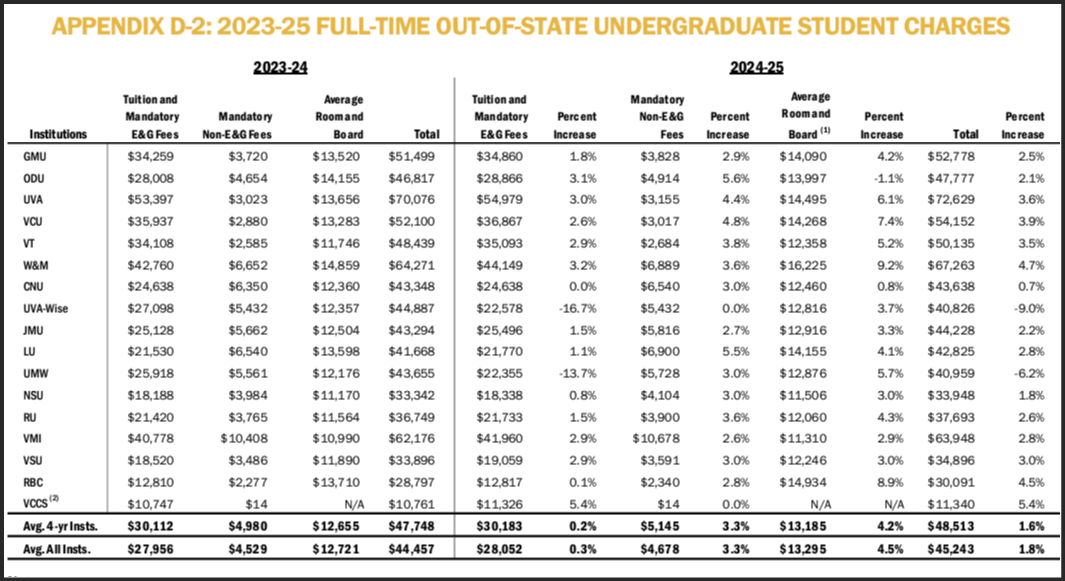
To magnify this image, right click on your mouse and scroll down to “magnify image”

The average increase for in-state graduate students was 2.6%, ranging from 0% for William & Mary and Longwood University to 4.0% for UVA.

The average increase for out-of-state graduate students was. 2.2%, ranging from 0% at William & Mary to 3.9% at UVA.

Virginia tuition and fees are high compared to those of other states, according to SCHEV: 5th highest among doctoral institutions among the 50 states for in-state undergraduates, second highest for "comprehensive" institutions, and 22nd highest for two-year institutions. 
 

ADVERTISEMENT

(comments below)


Comments


Comments

14 responses to “Another Year, Another Tuition Hike”

  1. Chip Gibson Avatar
    Chip Gibson

    Super article, Sir.

    I would submit, however, that rising levels of tuition may be irrelevant in this Socialist State (Nation, not Commonwealth). Get a big loan, go where you wish, cost be derned, don't pay back your loan, laugh at the taxpayers – a most evident path to success and a model for lifelong business prowess.

  2. Nancy Naive Avatar
    Nancy Naive

    Thereโ€™d be no tuition hikes at State schools if there were no tuition at State schools.

  3. Fred Costello Avatar
    Fred Costello

    A corporate recruiter once told me that the undergraduate institution made little difference. The significant difference was the individual student. Is paying a high tuition worthwhile as compared to the tuition at a college with few amenities and low tuition?

    1. LarrytheG Avatar
      LarrytheG

      Yep. If the degree is a solid degree that does demonstrate the ability to critically "think". I've seen many a grad from a small almost unknown college hired with a "B" average and a Math or physics Degree. In today's tech world, the opportunities to amass a degree heavy with tech-oriented knowledge are abundant but we have too many looking for a "college experience" and "easy" degrees and "paper" diplomas which are not worth much and then it DOES boil down to the individual and an assessment by those who might hire.

    2. DJRippert Avatar
      DJRippert

      It seems like the more prestigious universities see their undergraduate students earn the highest starting salaries.

      1. Fred Costello Avatar
        Fred Costello

        Maybe so, but the recruiter implied that top students get high salaries, regardless of the school.

  4. Dick Hall-Sizemore Avatar
    Dick Hall-Sizemore

    That report contains a wealth of data. Rather than the table you showed, you should have shown the table that also included mandatory non-E&G fees and room and board. With those included, the average total cost increase was 3.4 percent.

    1. Stephen Haner Avatar
      Stephen Haner

      Yep. That is closer to total cost. Time to up the 529 donation again. Oldest grandchild maybe seven years out….

    2. Nancy Naive Avatar
      Nancy Naive

      Careful, thatโ€™s the cost of football youโ€™re talkinโ€™ โ€˜bout.

      Room and board? Everybody gotta live somewhere. Those increases are reflective of the cost of living and subject to inflationary pressures. Tuition is a societyโ€™s choice.

  5. James Wyatt Whitehead Avatar
    James Wyatt Whitehead

    It's too bad Virginia's Prepaid 529 plan is permanently closed to new enrollment. I feel very lucky. Locked in the 16 year old kids tuition rate at 2008 prices. That bill is paid for. Big savings.

    For the VT bill don't forget about 13 grand for living on campus and another 3200 bucks for the meal plan.

  6. Nancy Naive Avatar
    Nancy Naive

    I donโ€™t know which is worse, having childless cat ladies with no vested interest in the future running society, or having society run by those who would charge their little vested interests tuition for their future.

  7. DJRippert Avatar
    DJRippert

    The Democrats have launched a crusade against personalized pricing with an FTC investigation underway. Personal information based pricing, also known as personalized pricing, is a strategy where businesses charge different prices for the same product or service to individual customers based on their personal data.

    This is exactly what public colleges and universities do.

    They demand income information about the parents of the adults they admit as students.

    Based on that information, they apply discounts (called scholarships) to those students who the administration deems worthy of a discount based on the personal financial information about the student's parents.

    Maybe the FTC should investigate UVa.

    1. LarrytheG Avatar
      LarrytheG

      Works the same way for Obama care, Medicare, tax credits, etc

    2. LarrytheG Avatar
      LarrytheG

      Works the same way for Obama care, Medicare, tax credits, etc

Leave a Reply


ADVERTISEMENT