
Plumbing the Mysteries of College Application Data
Share this article
ADVERTISEMENT
(comments below)
Comments
Comments
11 responses to “Plumbing the Mysteries of College Application Data”
-
As always, any post about Virginia higher education should not include U.Va. and William & Mary. Both of them operate differently from all other public institutions in Virginia. They are the only selective institutions in the Commonwealth when it comes to admissions.
-
I could not disagree more. They are state-supported schools, built over decades with taxpayer funds and with the taxpayers owning their key facilities and much of their land.
-
I’m just pointing out that when you talk about admissions in higher education, it is ridiculous to compare 2 schools with selective to highly selective admissions with all the other schools in Virginia. The models employed by both schools is very different that the other schools when it comes to admits and yield.
-
-
-
Interpreting these statistics is very tricky business, particularly as regards the selective first tier colleges and universities that have a strong incentive to manipulate the process in accordance with the demands and formulas of the private corporate ratings organizations such as US News & World Report.
One consequence of this is the likelihood that these statistics tell us little about the quality of the education offered at a particular institution, or the “long term quality” of the students in the classroom. In these areas, there well might be an inverse relationship between the statistics and the educational quality of the institution, and the education received by the graduate.
As to the less selective schools, namely the schools where all applicants are accepted, the statistics likely have significantly more relevance to what is happening in the reality on the ground.
So I agree with Jim on his worry about Mary Washington College’s future, although even here this is not necessary an indicator of a problem with the quality of education a student receives there. Indeed, there may be an inverse relationship between those factors, as the statistics might speak only to a financial health in trouble as the institution tries to teach the old fashioned way, that is to truly teach its student, and demand student performance. This can adversely affect its bottom line financially, where the institution has the misfortune to be operating in a corrupt system.
There is much more to explore here.
-
In fairness, many HS grads these days are sending out more applications than their peers in years past. The on-line process makes that easier than when the applications all went out in big envelopes. I suspect that is a national trend that would force the “yield” rate down at most schools. And I suspect in Virginia the selectivity of the most prominent schools (UVA, W&M) increases the pressure to cover your bets. I also suspect, despite your doubts, that these data are tracked very closely by the leadership. Are there signs of stress? Yes. Is a big shakeout coming unless we find a way to stop the rampant cost increases? Yes.
-
Very fair and accurate comment. This is not their father’s application process.
-
Tracked by leadership? Yes.
Shared with boards of visitors? Perhaps, but I’ve seen no sign of it.
-
Bingo. I applied to four colleges and found the process to be a royal pain in the ass. Using a typewriter with pre-printed forms was miserable.
My kids applied to at least 10 colleges each and it was a breeze. Log on, use the “standard” core information registry to pre-populate the basic information. Bang out (or cut and paste) a few short essays and press “enter”.
If you’re going to count applications I think you can’t really measure anything before 2010 or so. That’s when (to the best of my recollection) the process really got easy.
-
-
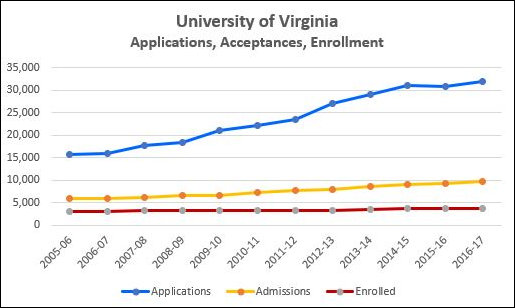
The online Common Application, particularly combined with rankings like USNews, has had a big vicious-cycle-type impact. It is much easier to apply to more schools. This drives down the admission rate of selective universities, which in turn makes them more prestigious through the USNews criteria. Among Virginia publics, only UVA and W&M really play in this category. Note that other schools have really used this to their advantage much more than either of these schools. The University of Chicago had an admission rate higher than UVA and W&M not all that long ago (about 50%) and it is now far lower at about 8%. Vanderbilt had lower SAT scores than UVA and W&M and now has an average about 130 points higher than either.
Out of state applications are what lowers UVA and W&M overall admit rates. In-state, both actually admit closer to 45% of applicants. These can be high-quality applicants, but significantly higher than the overall rates shown in the graphic above.
What I see with some of the other schools in Virginia is that there may be too much capacity at current price with job market and demographic trends. Instead of looking at admission and yield rates, though, I think it would be better to look at this from SAT score trends (and perhaps GPA, but grade inflation and reporting might distort this). Both of these are available on SCHEV. I recall something on this blog that indicated VCU is “digging deeper.” I think this would be a better indicator than yield.
The last point is about debt levels. I imagine a lot of this is tied to trying to have good facilities (gyms, business building, student and dining centers) to attract applicants, low interest rates for state backed debt, and trying to keep up with other universities in research funding in STEM.
-
The last of the Baby Boomers was born in 1965. It seems to me that the last of their babies (Echo Boomers, as I recall) will have already made their applications to college. Isn’t there an inevitable shakeout coming just due to demographics? Immigration may prop up the number of 18 year olds but are young people who speak English as a second language as likely to apply to college (and get in) as those who spoke and learned in English their whole lives?
I think higher ed in America is in for a rough decade.
-
[…] invited me to his office to discuss a blog post I wrote last month examining the college admissions data. I had speculated that the low yield rate — the ratio of […]


Leave a Reply
You must be logged in to post a comment.