
-
Bacon Meme of the Day
-
Expanded PIPP Pulls $360 Million from Power Bill Piggy Bank
by Steve Haner

The expansion of an existing state electricity-bill subsidy program under legislation pending at the 2026 General Assembly could add up to $360 million to the annual cost during its first full year of implementation.
The Department of Planning and Budget (DPB) has produced a detailed fiscal impact analysis for House Bill 884, which revamps the Percentage of Income Payment Program (PIPP), first authorized in 2020. The bill would raise the eligibility threshold to bring in more participants and increase the financial benefit they would receive.
The Department of Planning and Budget left out one little detail in its five-page report. PIPP is funded by ratepayers, not taxpayers. All the money for higher benefits and the administrative overhead would come from the ratepayers of Dominion Energy Virginia and Appalachian Power Company. PIPP is not available to the rural cooperatives’ customers.
House Bill 884 (that link is to the current bill text) has passed the House of Delegates 63-34 and is pending in the Senate Commerce and Labor Committee. The final House vote happened February 17 and the financial estimate is dated February 21, so it may not have been part of the record before the House voted, even though it shows up with the vote on the legislative tracking page.
-
191 UVA Faculty Materially Mislead the UVA Community
by The Jefferson Council
Prejudiced professors fail to do their homework
A letter signed by 191 University of Virginia faculty members accuses the Board of Visitors of running a “sham” process, engaging in “hasty” behavior, and conducting a “secretive” search in selecting Scott Beardsley as UVA’s next President. These are serious charges leveled against serious people. They deserve serious scrutiny.
They don’t survive it.
The letter is a case study in what happens when predetermined conclusions go looking for evidence rather than the other way around. It is riddled with unsubstantiated accusations, embarrassing omissions, and at least one central claim that is provably, demonstrably false, as anyone who bothered to read both Beardsley’s and Jim Ryan’s presidential employment contracts would immediately know.
The UVA community (students, alumni, donors, administrators and faculty who did not sign) deserves to know what this letter actually is: advocacy dressed as scholarship, and sloppy advocacy at that.
The “poison pill” that isn’t — the letter’s most damning error
Let’s start with the claim that should disqualify the letter’s authors from being taken seriously on contract matters: the assertion that Scott Beardsley’s employment agreement contains a presidential “poison pill” making it financially catastrophic to remove him.
This is false. It’s not debatable and not a matter of interpretation.
(more…)
-
Fairfax International Teachers Program Costs More…
… but, hey, it reduces whiteness!
by Stephanie Arora-Lundquist
Republished with permission from IWFeaturesIt’s no secret that Fairfax County Public Schools (FCPS) is trying to socially engineer its hiring practices to reduce the number of white teachers and administrators with the aim of increasing racial diversity. In a December 2025 report, senior leadership proudly displayed pie charts showing a 20% reduction in hiring white teachers from fiscal year 2019 to fiscal year 2026.
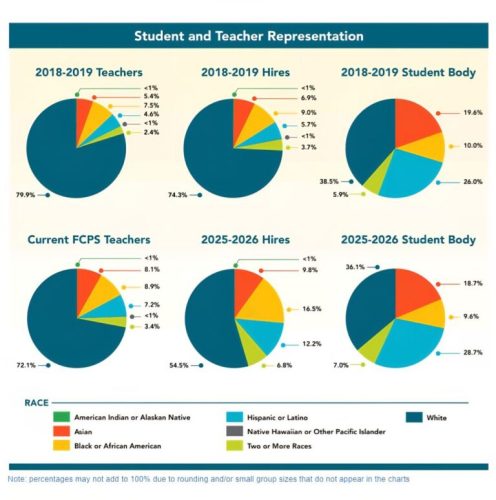
The leadership’s objective of reducing whiteness among administrators and teachers is particularly ironic given that the superintendent, the school board chair, vice chair, and the majority of the school board’s members are themselves white. If they truly practiced what they preach, they would all step down.
Of course, they will not—equity for thee, but not for me.
Nevertheless, these leaders employ a variety of institutional mechanisms and targeted recruitment strategies to increase racial diversity in hiring. In June 2023, FCPS adopted a strategic plan that placed “equity” as its central component, and the school board passed an “equity policy” aimed at addressing “disproportionate outcomes.”
(more…)
-
A Plea to Save Capitol Square Statues

Delegate Lee Ware, R-Powhatan Delegate Lee Ware, R-Powhatan, delivered the following speech on the floor of the House of Delegates yesterday. — JAB
Mr. Speaker, I rise to speak to a bill that will shortly come before us.
Ladies and Gentlemen of the House, please allow me to meditate with you as a student of history and, for over thirty years, a teacher of History to high school students of every complexion. I offer the following observations as a contribution to Black History Month.
My great-great grandfather was a Colonel in the 44th Massachusetts. He led troops in the War of 1861 in both North and South Carolina. After his service in the field, he became Military Advisor to the legislature of his home state.
That Union officer’s comrade and friend was Charles Francis Adams, Jr., who was the grandson and great-grandson of U.S. Presidents John Quincy Adams and John Adams, respectively. Charles Jr. served with distinction at Gettysburg, then was named Colonel of the fabled 5th Massachusetts Colored Volunteer Cavalry.
To add to the drama, Col. Adams’s father was Mr. Lincoln’s United States Minister to the United Kingdom, and he was instrumental in preventing Britain from siding with the Confederacy.
You see, then, that these men were opposed to Virginia in 1861.
Yet it was Charles Adams, Jr., who in 1907 was asked to give the Centennial Address of the birth of none other than Robert E. Lee at Washington & Lee University here in Lexington, Virginia.
(more…)
-
Sanctuary Virginia: How Our Leaders Are Undermining Law, Borders, and Justice
by Jeff Bayard
A question every Virginian should ask
Is Virginia becoming a sanctuary state? The honest answer is yes—and it is happening faster than most citizens realize.
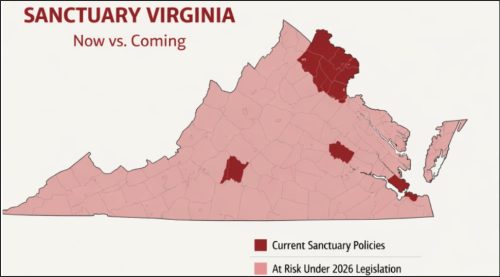
Since January 2026, Governor Abigail Spanberger has signed executive actions terminating Virginia’s cooperation with federal immigration enforcement. Meanwhile, the General Assembly is advancing bills that would prohibit local police and sheriffs from assisting Immigration and Customs Enforcement (ICE) in any meaningful way. Furthermore, across Northern Virginia, local governments have adopted “trust policies” that shield illegal immigrants from federal authorities.
This is not merely an abstract policy debate. Instead, it raises concrete questions that affect every Virginia taxpayer, every community, and every family: What happens when state and local government refuses to cooperate with federal law enforcement? Who bears the cost—financial and otherwise—when authorities release criminal illegal immigrants back into our communities instead of handing them to ICE? And what lessons should Virginia learn from states like Minnesota, California, and Illinois that have gone further down this road?
This analysis examines the facts. We will look at Virginia’s statewide laws, local sanctuary policies, the 2026 legislative push, what the data actually shows about costs and consequences, and what other states’ experiences tell us about Virginia’s likely future.
(more…)
-
A Portrait of Suicidal Empathy
by the Liberty Unyielding Staff
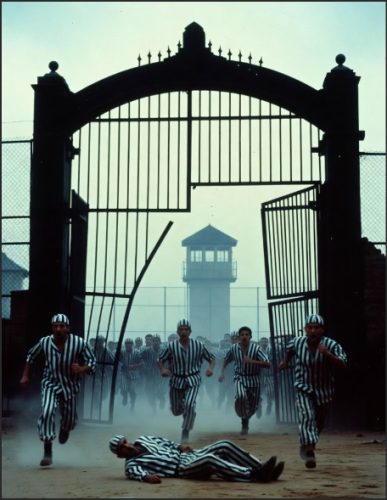
Prison break. Image credit: Grok “In 1996, Travis Lewis broke into the Snowden family home in Arkansas during a burglary and murdered 75-year-old Sally Snowden McKay and her cousin. He was convicted and imprisoned. Years later, Sally’s daughter Martha McKay chose radical forgiveness. She visited Lewis in prison, advocated for his parole, and after his 2018 release, hired him to work at the same historic house she had converted into a bed and breakfast. In March 2020, after being confronted over suspected theft, Lewis attacked and killed Martha inside that very home.”
Criminals often commit more crimes after being released. Nationally, 81.9% of all state prisoners released in 2008 were subsequently arrested within a decade, including 74.5% of those 40 or older at the time of their release. (See Bureau of Justice Statistics, Recidivism of Prisoners in 24 States Released in 2008: A 10-Year Follow-Up Period (2008-2018), pg. 4, Table 4)).
Yet, the Virginia legislature is passing legislation to make it hard for the parole board to keep some dangerous inmates in prison, by telling the parole board not to deny parole based on factors outside an inmate’s “demonstrated ability to change” if the inmate committed his crime as a juvenile. But what if an inmate remains dangerous due to a personality disorder, and claims he lacks the ability to change that? How does the parole board “demonstrate” that the inmate has the ability to change the dangerous personality trait?
(more…)
-
Before Deeds and Zillow
The Arlington-Culpeper Grant Sparked Bacon’s Rebellion and Redefined Virginia Real Estate
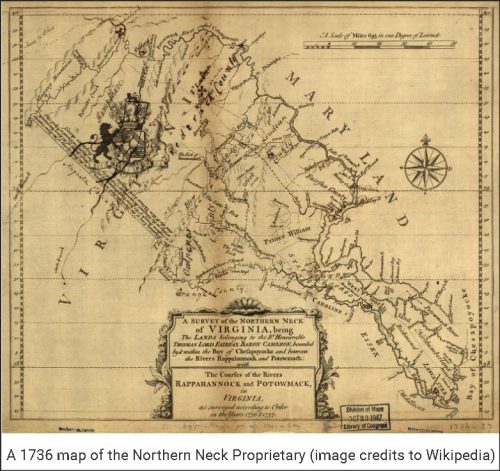
Virginia real estate history does not begin with subdivisions or courthouse deed books. It begins in political exile. In 1649, after the execution of King Charles I during the English Civil War, England’s monarchy collapsed. His son, Charles II, fled Europe and depended on loyal aristocrats for financial survival.
With no treasury and no functioning government, Charles II used land in the American colonies as compensation. In September 1649, he granted a massive tract in Virginia to seven royalist supporters. This territory stretched between the Potomac and Rappahannock Rivers, from the Chesapeake Bay westward into unmapped Appalachian terrain. The grant would become known as the Northern Neck Proprietary.
The scale was extraordinary. More than 5.28 million acres of fertile river valleys, timberland, and frontier wilderness were transferred into private control. The proprietors were given authority not only to sell land but to collect quitrents, establish counties, and manage economic development within the territory.
This was not simply a land deal. It created a privately controlled real estate jurisdiction operating alongside colonial Virginia.
The Restoration and colonial resistance
For more than a decade, the 1649 patent held little practical force. Parliament controlled England and its colonies. Virginia’s colonial government continued issuing its own land patents and organizing counties inside proprietary boundaries.
(more…)
-
Cost of Undergrounding Program is Mostly Profit to Lenders, Stockholders
by Steve Haner

And the winner is…. Dominion Energy Virginia’s ongoing program to place selected neighborhood service lines underground, spreading the bill for the upgrades onto all its 2.7 million customers, will cost another $3.8 billion if the General Assembly blesses its extension for another ten years.
Of that, about $1.6 billion is the cost of the construction work and $2.2 billion (58 percent) will be to pay interest to the lenders or profit to the stockholders who put up the working capital. Those numbers are from an analysis provided to a curious legislator by the State Corporation Commission’s staff in a letter earlier this week.
Almost a third of the money will come from the utility’s commercial and industrial customers (yes, including the scapegoated data centers), the SCC reported. But the upgrades being financed will benefit few if any business customers. An earlier report on Bacon’s Rebellion extrapolating data from an SCC case file had some similar cost projections.
When it is the business customers subsidizing electricity for homeowners, nobody in the legislature squawks at all. Politicians only feign outrage if homeowners think they are subsidizing businesses. And none of them dares admit how much profit their favorite political donor is making from all this. (If half the financing is equity, not debt, more than a billion dollars in profit is a pretty good payoff for $20 million in campaign donations. And this is hardly the only 2026 bill enriching the utility.)
-
New Democratic Districts Invite Republicans to Vote
by Chris Saxman
Proverb
If you can’t beat them, join them
and as George Bailey said in It’s a Wonderful Life:
This is a very interesting situation
Having seen three different polls (one public and two private) that show the constitutional amendment to re-gerrymander Virginia’s congressional districts is under 50%, the odds of its passage on April 21st are clearly in doubt.
No wonder national Democrats are pouring money into the Commonwealth to win this vote.
This is not a done deal. Hence the money.
Okay. Let’s play it out…suppose the amendment passes.
Democrats then have a clear path to a 10-1 federal delegation in the House of Representatives.
The GOP would be on track to losing districts 1, 2, 5, and 6 as none of them would have less than 56% of the vote going to Democrats based on the 2025 gubernatorial landslide victory of Abigail Spanberger.
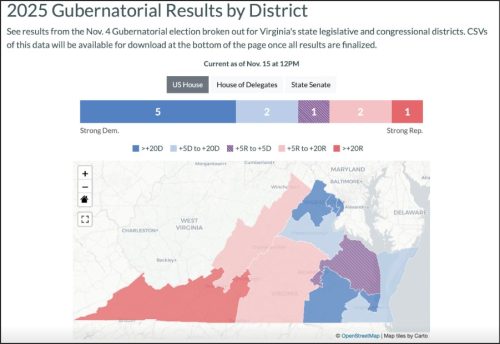
What would Republicans and Independents then do in these new districts if they know the very likely outcome in November is a Democratic representative?
(more…)
-
Cadet Crisis: VMI’s Culture on Trial
Proposed legislation reopens questions into the validity of the state’s investigation into VMI student culture.

he past six years at VMI have been defined by the microscopic look into VMl’s student body culture by the state of Virginia. Photo courtesy of Pikabuu2 via the Creative Commons License by Jackson Doane
It’s commonly said that good fences make good neighbors. Between Washington and Lee (W&L) and the Virginia Military Institute (VMI), nothing separates us but a short walk, yet we have long been good neighbors. So when news broke in January that two bills were introduced in the General Assembly that would limit VMl’s ability to selfgovern, I felt it only right to look into why our neighbors were suddenly under scrutiny.
(more…)
House Bill 1374 and House Bill 1377 were recently introduced, and since then, the complicated and, at times, hostile relationship between the school and the state government – which dates back at least five and a half years – has resurfaced with renewed intensity.
In October 2020, a front-page article in the Washington Post detailed allegations of racially discriminatory incidents at VMI over the preceding years. The story drew national attention, especially in the wake of a summer and fall of race-based political protests, and thrust VMI into the national spotlight.
The article caught the attention of the then-governor at the time, Ralph Northam, who is also a VMI alumnus. He co-signed a letter with the lieutenant governor and attorney general to VMl’s Board of Visitors, the school’s governing body, calling for a “state-funded, independent third-party review” of the student body’s culture, particularly regarding students of nonwhite ethnicities.
Northam’s letter described what he believed to be a “clear and appalling culture of ongoing structural racism at the Virginia Military Institute.” That letter, combined with national media attention and pressure from state officials, led the State Council of Higher Education for Virginia (SCHEV) to commission an investigation by the third-party law firm Barnes & Thornburg, which released a report published in June 2021. The 2021 report
The SCHEV investigation at VMI was conducted from January 7, 2021, to June 1, 2021, spanning a period of 145 days. According to SCHEV, it was done with the purpose of investigating allegations of racism and sexism at VMI.
-
Virginia’s Population Reached 8.88 Million in 2025
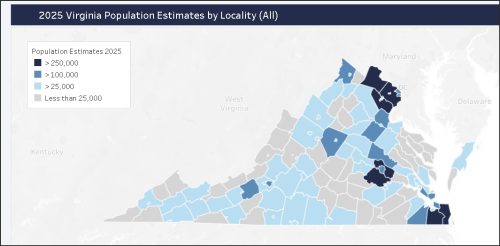
Click here to view interactive map. Credit: Weldon Cooper Center for Public Service The Weldon Cooper Center for Public Service at the University of Virginia has published its mid-decade population for Virginia and its localities. Summary from the Weldon Cooper website:
Virginia’s population reached 8.88 million as of July 1, 2025, an increase of more than 248,000 residents since the 2020 Census. Between 2020 and 2025, the state’s average annual growth rate was 0.5 percent, slightly below the national rate of 0.6 percent. Virginia remains the 12th most populous state and ranked 11th nationally in numeric population growth during this period.
Of the state’s population increase since 2020, natural increase (births minus deaths) contributed 78,388 people (31.5 percent), while net migration (people moving in minus people moving out) added 170,326 people (68.5 percent).
-
The Data Center Scapegoat Led to Two Different Sacrificial Altars
by Steve Haner
Virginia’s world-leading data center industry, once a source of economic pride to our Commonwealth, has become the scapegoat of the 2026 General Assembly. The State Senate and House of Delegates have built different altars for its sacrifice.
The Senate is about to vote to strip away the major sales and use tax exemption which has helped make Virginia the center of this burgeoning industry. This would raise the taxes they pay by more than $1 billion initially and then up to $2 billion annually, an infusion of cash the Senate will happily find ways to spend.
House Democrats have gone a different direction, keeping the exemption but making it conditional upon the industry adopting a fully Green New Deal energy policy. Ending any reliance on natural gas or diesel generation is the stated goal. Companies would be forced to buy renewable energy certificates on an even faster schedule than the Virginia Clean Economy Act requires for Dominion Energy Virginia and Appalachian Power Company.
And both chambers have approved versions of legislation that will allow the State Corporation Commission (SCC) to assign 100 percent of the future costs of Dominion Energy Virginia’s energy capacity purchases and transmission upgrades onto that one industry. There is no reason that approach will not spread beyond Dominion if the SCC goes along, given politicians are already bragging this will lower bills for everybody else.
-
Follow-up on Voter Registration Rolls Suit
by Dick Hall-Sizemore
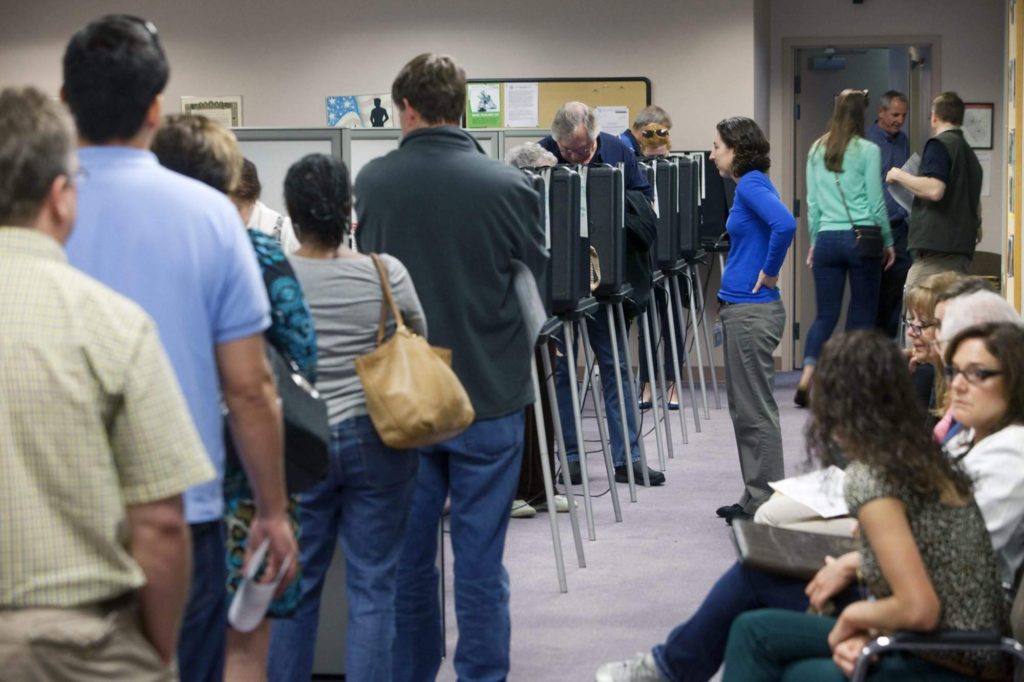
There was considerable reaction to my recent article regarding the U.S. Dept. of Justice suing Virginia for not turning over an unredacted copy of the statewide list of registered voters.
Two comments in particular struck me as needing some response from me. Matt Hurt posed this question: “The National Voter Registration Act of 1993 and the Help America Vote Act of 2002 both require states to maintain accurate voter rolls, and both provide DOJ with the authority to enforce them. If DOJ doesn’t have access to that information, how can it ensure states are compliant with these laws?” After considerable discussion, Nathan had a request of me: “I hope you will follow up, to provide the information necessary for a more complete understanding of this issue.”
These are legitimate questions and requests. I was out of the house for most of the day both Saturday and Sunday and thus not in a position to respond. I have now done some research and can provide some follow-up.
First, my major concern with this request lies with how DOJ said it was going to use it. In its MOU that DOJ asked agencies to agree to is this statement: “You agree therefore that within forty-five (45) days of receiving that notice from the Justice Department of any issues, insufficiencies, inadequacies, deficiencies, anomalies, or concerns, your state will clean its VRL/Data by removing ineligible voters.”
Simply stated, DOJ would examine a state’s voter registration list and identify ineligible voters for the state to remove from its registration list. This would be an extraordinary step. The state would be relinquishing a key component of its authority to administer elections. Identifying “ineligible” voters is prone to many errors, especially for the federal government, which is removed from the details of individual registration statuses. Even state governments, in their effort to purge ineligible voters, inadvertently remove eligible voters in the process. For example, in 2024, the Youngkin administration revoked the registration of approximately 1,600 eligible voters in its effort to find noncitizens who had registered.
Turning to the legal authority for the current DOJ request for unredacted statewide registration data, the federal government cited the following federal legislation statutes:
(more…)
-
It Helps to Have Friends in High Places

