
by Chris Saxman
Proverb
If you can’t beat them, join them
and as George Bailey said in It’s a Wonderful Life:
This is a very interesting situation
Having seen three different polls (one public and two private) that show the constitutional amendment to re-gerrymander Virginia’s congressional districts is under 50%, the odds of its passage on April 21st are clearly in doubt.
No wonder national Democrats are pouring money into the Commonwealth to win this vote.
This is not a done deal. Hence the money.
Okay. Let’s play it out…suppose the amendment passes.
Democrats then have a clear path to a 10-1 federal delegation in the House of Representatives.
The GOP would be on track to losing districts 1, 2, 5, and 6 as none of them would have less than 56% of the vote going to Democrats based on the 2025 gubernatorial landslide victory of Abigail Spanberger.
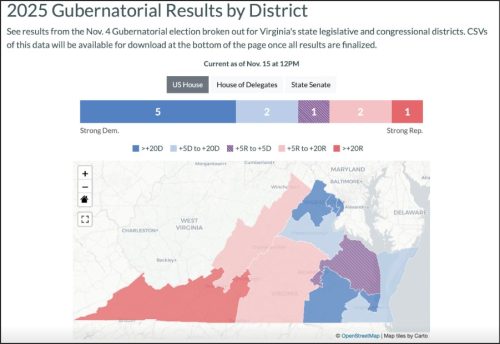
What would Republicans and Independents then do in these new districts if they know the very likely outcome in November is a Democratic representative?
Virginia is an open primary state
Any registered voter can vote in one of the primary of the two main political parties, but not both.
Q – Given the lower turnouts of nominations vs. general elections, mathematically where does your vote matter more?
A – the nomination phase, right?
Could Republican primary turnout in a Democratic primary be part of a candidate’s path to victory?
Would Republicans actually show up in the Democratic nominations and elect either a candidate who truly is more representative of them OR would they vote for the most objectionable candidate which could help the GOP in the fall.
The math is more complicated in lower turnout elections.
Let’s take a look at two congressional nominations for the Democrats in 2024.
The current 7th
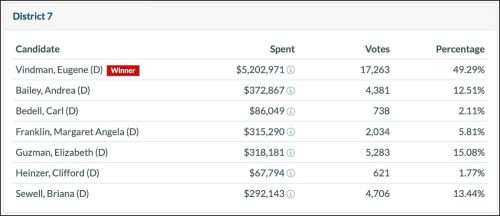
Total votes? About 34,000.
The current 10th
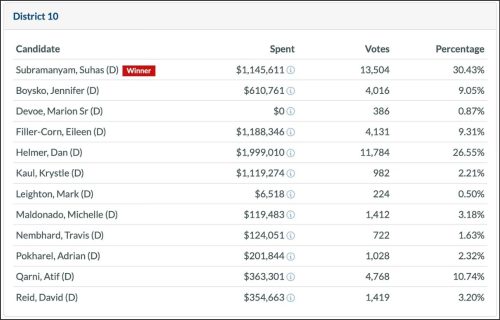
Total votes? About 44,000.
Let’s take a look at the new proposed 7th district — a.k.a.
The Scorpion
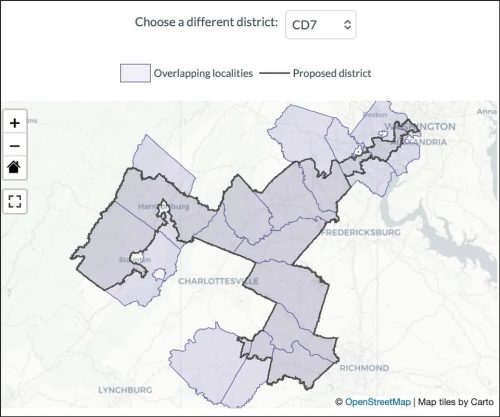
Breakdown by locality

Lots of new voters, right? In lots of GOP strongholds. Match that with Fairfax Democratic voters not knowing a new list of candidates. Tough math. Hard to poll.
Path math
Reminder #2 – Virginia is a plurality or “first past the post state.” Winning candidates do not need a majority in order to win.
The path to Congress for some Democrats this year might mean attracting Republicans willing to vote for someone who represents them better on just one or two issues.
The “complex coalition” that is the Democratic Party might very well include, temporarily of course, some Republicans.
Chris Saxman is executive director of Virginia FREE. This commentary is excerpted with permission from his Substack account, The Intersection.
Leave a Reply
You must be logged in to post a comment.