
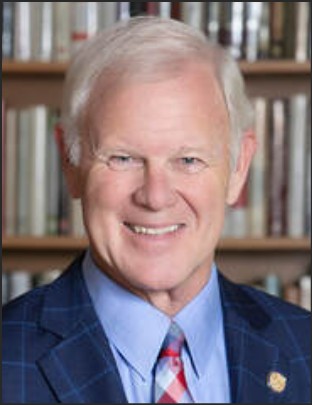
Delegate Lee Ware, R-Powhatan, delivered the following speech on the floor of the House of Delegates yesterday. — JAB
Mr. Speaker, I rise to speak to a bill that will shortly come before us.
Ladies and Gentlemen of the House, please allow me to meditate with you as a student of history and, for over thirty years, a teacher of History to high school students of every complexion. I offer the following observations as a contribution to Black History Month.
My great-great grandfather was a Colonel in the 44th Massachusetts. He led troops in the War of 1861 in both North and South Carolina. After his service in the field, he became Military Advisor to the legislature of his home state.
That Union officer’s comrade and friend was Charles Francis Adams, Jr., who was the grandson and great-grandson of U.S. Presidents John Quincy Adams and John Adams, respectively. Charles Jr. served with distinction at Gettysburg, then was named Colonel of the fabled 5th Massachusetts Colored Volunteer Cavalry.
To add to the drama, Col. Adams’s father was Mr. Lincoln’s United States Minister to the United Kingdom, and he was instrumental in preventing Britain from siding with the Confederacy.
You see, then, that these men were opposed to Virginia in 1861.
Yet it was Charles Adams, Jr., who in 1907 was asked to give the Centennial Address of the birth of none other than Robert E. Lee at Washington & Lee University here in Lexington, Virginia.
Let us take to heart this great man’s pedigree as we remember that he spoke with admiration of the Confederate commander whose army Adams himself had opposed with arms. Indeed, Adams declared that General Lee, in the manner of his surrender at Appomattox, did nothing less than “save the…country,” North and South. Saved us, Adams meant, from further years of bloodshed and division.
At a later speech, Adams confessed that, had he been in Lee’s position in 1861 he would have done as Lee had done—side with his State, in opposition to the federal government. For in its essence, Adams believed, the War was about sovereignty, where it rested, either in Washington or in the capitals of the individual States. This is why to many the tragic conflict still is known as The War Between the States.
But it was also a Civil War. It was a civil war because it was a war between cousins. In this, the teacher in me calls our attention to the English Civil War of the 1640s, when Oliver Cromwell led an army that defeated the Crown and Parliament and executed the very King of England. Not only before, but especially after that terrible conflict, the English who migrated to this country came either to New England, the land of the original Puritans, or to Virginia, the home of the royal supporters known as—think of UVa–“Cavaliers.”
Kevin Philips, in a work entitled “The Cousins’ War,” traces America’s rise to international greatness to the combined effects of the English Civil War, the American Revolution—again, English fighting English—and our Civil War, emphasizing that these wars and their outcomes combined to forge the crucible in which, for example, especially, Black History became possible and has risen to new heights today, in this very chamber.
Soon we will take up Senate Bill 636, proposing to remove the McGuire, Smith, and Jackson monuments on Capitol Square. But have you ever stopped to read the inscription on the Jackson statue? I ask because the Jackson Statue was not paid for by Virginians or Southerners. No, the inscription reads, “Presented by English Gentlemen as a tribute of admiration for the soldier and patriot Thomas J. Jackson.” This was done in 1875, just over 150 years ago.
The story of Jackson becomes even more compelling, because the stained-glass window behind the pulpit of Fifth Avenue Presbyterian Church in Roanoke is a memorial to Jackson and quotes his dying words, “Let us cross over the river and rest in the shade of the trees.” That church is a black church, whose early pastor was the son of parents who were taught the Christian faith, and taught to read, in the Sunday School Class sponsored and often led, in Lexington, by then VMI professor Thomas Jonathan Jackson. As a lady of the church remarked to the press a couple of years ago, “Jackson was a man of Christ,” and as the pastor conceded, the story of Jackson is “complicated.”
The complications, the ironies, the imperfections of every individual, and of all of history, was the central tenet, the “complicated” truth, that I emphasized to students in all my classes—and which I would emphasize to all of us today.
For example, we recently heard much about the year 1619. But what, I asked my students, of 1519, 1419, 1319?
For the answer, let us go to a thousand years earlier. Historians estimate that starting around the year 650 — some seven centuries before Europeans explored Africa and 10 centuries before West Africans were sold across the Atlantic to America — more than 18 million people from east Africa were enslaved by Arabs and taken across the Sahara Desert, Red Sea, and Indian Ocean.
From 1525 onward, “90 percent of [Africans] shipped to the New World were enslaved by Africans and then sold to Europeans…”
That last statistic is from a short commentary by Harvard Professor Henry Louis Gates, Jr., and, as the older among us will know, a distinguished scholar who is black. The title of his principal commentary is “Ending the Slavery Blame-Game.”
Elsewhere, Professor Gates writes, “Perhaps you, like me, were raised to think of the slave experience primarily in terms of our black ancestors here in the United States…Well, think again.
Starting in 1525, 12.5 million Africans were shipped to the New World. 10.7 million survived the…passage. “And how many of these 10.7 million Africans were shipped…to North America?” he asks. “Only about 388,800, …a tiny percentage” [of less than 4 percent].
Professor Gates concludes:
“…the sad truth is that the conquest and capture of Africans and their sale to Europeans was one of the main sources of foreign exchange for several African kingdoms for a very long time.” In other words, he concludes, we must “attribute responsibility and culpability where they truly belong, to white people and black people, on both sides of the Atlantic…”
The patron of the bill soon to be before us has said that he does not want children visiting Capitol Square to see “inappropriate monuments to grotesque people.” But do we remember Oliver Cromwell, the Englishman who defeated Parliament and killed a king? Outside Britain’s very Houses of Parliament in London is a towering monument to that one-time enemy of the Crown, Oliver Cromwell.
So, let us indeed add to Capitol Square a monument to another great Virginian, Booker T. Washington. But let us keep Jackson—and Billy Smith and Dr. McGuire—as the contemporaries of Booker T. Washington himself who provide the very context of the raw and imperfect history of the time in which he lived and went on to his great work.
In a similar vein, the patron of the principal bill concerning VMI has denounced men such as Jackson as traitors. But my friends, in 1860 most Americans considered their State, not the federal Union, to be their country. This was because the average soldier in the War, on both sides, had never travelled more than twenty miles from home. Historians call the War the summit of a “Tragic Era” because it forced men such as Jackson to choose between loyalties—to be a traitor to neither one, but to remain loyal to only one. Studying the era is vitally important for our children—of all races—precisely because it was a complicated and tragic and therefore a great era in our shared history. There are vitally important historical, political, social, and spiritual lessons in this.
It is my suggestion that the only way we can give our children an understanding of history is by eschewing the simplistic slogans of our time and instead teaching our children how to delve into the context of the times that they are studying. Men and women of the past can be understood only in the context of their times. Because history is, to say the least, as the black pastor in Roanoke remarked, “complicated.”
Many years ago, in this very building, I spoke on the complexity of history this way:
“Lee, Jackson, and Martin Luther King, Jr., Christians all, would have appreciated as Providential the proximity of the dates of their birth. And it may well be that even today, or in some great day to come, in the realm where the spirits of the just are made perfect, R.E. Lee, Stonewall Jackson, and Martin Luther King are side by side at the Supper of the Lamb.”
This, my friends, is the understanding that we must bequeath to our children and our children’s children—that there has been greatness and goodness in men and women of every race, even when in opposite circumstances in the long centuries of the past. And, that every human being, every human endeavor, is infected with imperfection, even with evil. To their question, Who is responsible for the evil?, I repeat the answer I gave my students: “Everyone is responsible. There is no innocence in human history. But, grace is everywhere.”
If a simpler lesson would suffice, allow me to cite the refrain of “The Heart of the Matter”—and it is to heart of the matter of our history that I am appealing—in the well-known lyrics of Don Henley:
“I’ve been tryin’ to get down
To the heart of the matter
By my will gets weak
And my thoughts seem to scatter
But I think it’s about
FORGIVENESS, FORGIVENESS,
Even if, even if
You don’t Love me anymore.”
Leave a Reply
You must be logged in to post a comment.