
by Steve Haner
Ignore what they say. Watch what they do. The Virginia General Assembly could cut the bills of Dominion Energy customers a bit, but instead will give the company another ten years to take your money and spend it on someone else (after skimming off its healthy profit).
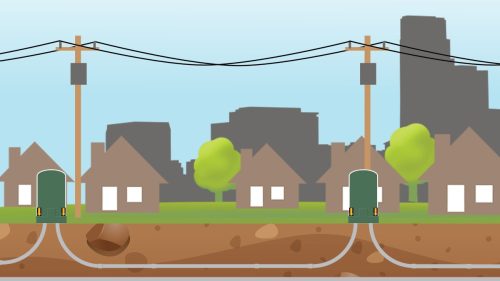
A ten-year program using money from all ratepayers (business customers included) to bury the tap lines of a few of the utility’s (residential only) customers is about to get another ten years to run, through 2038. This happens with an intentionally opaque enactment clause at the end of companion bills House Bill 1393 and Senate Bill 253.
The most recent phase of the “strategic undergrounding program” (SUP), phase eight, cost $318 million and worked out to just under $800,000 for every mile of buried lines and just under $11,000 for each customer served. “Served” includes both the home that got the new lines and any homes down the line which benefit if that one connection fails less often.
Without question the 155,000 houses upgraded or downstream from upgrades have shown a dramatic reduction in outages since. But a cost versus benefit analysis on whether this is a good use of more than $3.4 billion for the other 2.6 million customers is lacking, and the State Corporation Commission staff highlights that void in its comments on the pending phase nine proposal.
Ten more years of this will easily cost ratepayers another $3 billion plus. It is reasonable to assume the utility in the first phases of projects targeted 4,000 miles of homes with the worst reliability records. The lowest hanging fruit is done.
The bill cleared a House subcommittee unanimously Thursday afternoon after a bit of a squabble. The Virginia Poverty Law Center, activist group Clean Virginia and the Virginia Manufacturing Association all had lobbyists at the podium challenging the wisdom of extending this program.
Along with the hue and cry over affordability this session, legislators are suddenly very concerned whether residential energy customers are subsidizing large users. On another bill in the subcommittee, a Democrat member asked, “is this a shifting of the cost burden to others?” She was dead silent on this bill, because on this bill the answer would be yes, about half the money comes from business customers and the spending is targeted at residences.
The cost versus benefit analysis hasn’t really mattered until now. In 2018, the General Assembly basically ordered the SCC to approve all these expenses as being reasonable and prudent, including the company’s profit margin, if the amount requested worked out to be less than $750,000 per mile upgraded. Now that ceiling is being breached and the SCC might have the power to trim Dominion’s sails.
The SUP program has been a regular topic on Bacon’s Rebellion before, most recently in 2024. At the time of that article the SUP was being paid for with its own rate adjustment clause Rider U of about $2 for every 1,000 kilowatt hours of electricity used. Now it is rolled in with other grid upgrade expenses, and the Rider DIST (for distribution) is currently $6.24 per 1,000 kwh. That would drop by at least a few dollars if the SUP program were to sunset as originally planned.
It is a classic example of the kind of meddling the bad old General Assembly used to engage in regularly to protect the utility from SCC questions. Why does this cash-funded construction project earn the same risk-based profit as a nuclear plant? Doesn’t the utility keep profiting annually because the new lines remain part of its overall capital rate base? If this is helping reliability so much, are we seeing overall maintenance savings?
The new good General Assembly is supposed to respect the independence and judgment of the SCC. Not if this passes, it doesn’t.
The SUP provision is tucked at the end of a bill setting targets for Dominion and Appalachian Power Company to spend company money – not ratepayer money for once – on energy efficiency home upgrades. But the Virginia Poverty Law Center lobbyist noted that the energy efficiency expense for Dominion of $13-17 million per year is lower than the company’s annual profit on the tap line upgrade program. “We should be having the debate about undergrounding on its own merits,” said the lobbyist for Clean Virginia.
The expansion could have moved through the discussion with no notice. This is the provision in the bill in question:
- That a Phase II Utility, as defined in subdivision A 1 of § 56-585.1 of the Code of Virginia, may recover costs associated with any petition for cost recovery made pursuant to clause (iv) of subdivision A 6 of § 56-585.1 of the Code of Virginia that has been previously approved by or is pending with the State Corporation Commission as of December 1, 2038, notwithstanding any time limitations on such cost recovery under subdivision A 6 of § 56-585.1 of the Code of Virginia.
The summary of the bill on the Legislative Information System is just as obscure, as is the fiscal impact statement from the State Corporation Commission, which mentions none of those cost figures above, readily available in the pending application it is now considering.
Clear or not, that language indirectly (but effectively) extends the program beyond the original 2028 sunset for another ten years. It extends the automatic “is reasonable and prudent” protection. And its direction that the company “may recover costs” on applications “pending” at the Commission may override efforts to hold the company to the $750,000 per mile threshold in the 2018 bill.
Why not just put in a bill that clearly extended the program and increased the spending cap in plain language? You have heard all the posturing about affordability this year, right?
Leave a Reply
You must be logged in to post a comment.