
The Arlington-Culpeper Grant Sparked Bacon’s Rebellion and Redefined Virginia Real Estate
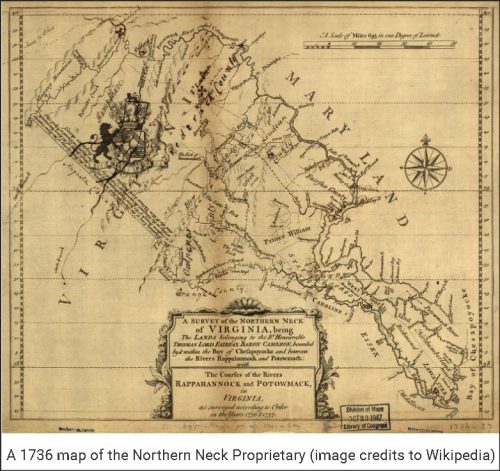
Virginia real estate history does not begin with subdivisions or courthouse deed books. It begins in political exile. In 1649, after the execution of King Charles I during the English Civil War, England’s monarchy collapsed. His son, Charles II, fled Europe and depended on loyal aristocrats for financial survival.
With no treasury and no functioning government, Charles II used land in the American colonies as compensation. In September 1649, he granted a massive tract in Virginia to seven royalist supporters. This territory stretched between the Potomac and Rappahannock Rivers, from the Chesapeake Bay westward into unmapped Appalachian terrain. The grant would become known as the Northern Neck Proprietary.
The scale was extraordinary. More than 5.28 million acres of fertile river valleys, timberland, and frontier wilderness were transferred into private control. The proprietors were given authority not only to sell land but to collect quitrents, establish counties, and manage economic development within the territory.
This was not simply a land deal. It created a privately controlled real estate jurisdiction operating alongside colonial Virginia.
The Restoration and colonial resistance
For more than a decade, the 1649 patent held little practical force. Parliament controlled England and its colonies. Virginia’s colonial government continued issuing its own land patents and organizing counties inside proprietary boundaries.
When Charles II was restored to the throne in 1660, the proprietary claims gained renewed strength. Yet conflict simmered. Colonial leaders in Williamsburg viewed the grant as an intrusion into local governance and land administration. A dual structure emerged: the colonial government retained political authority, while the proprietary claimed economic control over land sales and quitrents.
This uneasy arrangement laid the groundwork for instability that would explode in the 1670s.
The Arlington-Culpeper Grant of 1673: revenue, power, and land control
In 1673, King Charles II executed a decision that reshaped Virginia’s economic landscape. Facing mounting debts, he issued a sweeping charter granting Thomas, 2nd Lord Culpeper, and Henry Bennet, Earl of Arlington, control over Virginia’s quitrents and escheats.
This move went beyond the Northern Neck territory. It redirected key revenue streams from the colonial government to private aristocrats.
- Thirty-one-year lease on quitrents
- Control of escheated lands
- Authority to confirm or void land grants
- Power to appoint colonial officials
In practical terms, this charter threatened property security across Virginia. Colonists feared that imperfect land documentation could result in confiscation. The diversion of revenue forced the General Assembly to raise poll taxes to maintain government operations.
The reaction was immediate and furious.
Quitrents, escheats, and colonial outrage
Quitrents were annual payments owed by landholders to the proprietor. In theory, they were modest. In practice, they were deeply resented in a tobacco-based economy where cash was scarce.
Escheats allowed land to revert to the proprietor if an owner died without heirs or lacked clear title. In a colony with inconsistent recordkeeping, this created widespread anxiety.
The Arlington-Culpeper charter consolidated these mechanisms into a powerful tool of control. Planters who had carved farms from wilderness felt reduced to tenants paying rent to absentee lords.
Land insecurity became political volatility.
Bacon’s Rebellion: real estate pressure turns violent
Bacon’s Rebellion in 1676 is often framed as a frontier conflict, but land economics were central to its eruption. Poll taxes increased. Tobacco prices collapsed. Frontier settlers demanded expanded land access and military protection.
Nathaniel Bacon mobilized discontented farmers and indentured servants. The rebellion culminated in the burning of Jamestown and exposed deep fractures in colonial governance.
The financial destabilization linked to the Arlington-Culpeper Grant acted as a catalyst. Disputes over land control, taxation, and proprietary authority fueled unrest that reshaped colonial politics.
Thomas Lord Culpeper’s strategic consolidation
After the rebellion, Thomas Lord Culpeper adjusted course. He surrendered his broader claims under the 1673 charter but secured a substantial pension. His attention focused entirely on consolidating ownership of the Northern Neck Proprietary.
By 1681, he controlled five-sixths of the 5.28 million-acre estate. In 1688, his ownership was formally confirmed. The result was one of the largest private landholdings in the British Empire.
What began as a speculative royal promise became a consolidated real estate empire.
The Fairfax Dynasty and structured land administration
Through inheritance, the proprietary passed to the Fairfax family. Thomas Fairfax, 6th Lord Fairfax, eventually relocated to Virginia to oversee operations directly.
The Northern Neck Land Office operated independently from the colonial land office. Its process was structured and disciplined:
- Purchase of a land warrant
- Professional survey of metes and bounds
- Submission of survey plat and documentation
- Issuance of a proprietary grant
Unlike Virginia’s headright system, which rewarded settlement, the proprietary required direct purchase. This encouraged land speculation and the development of large estates throughout Northern Virginia.
The Fairfax Line and geographic precision
Boundary disputes required formal resolution. In 1745, the Privy Council ruled in favor of Lord Fairfax’s expansive claim. In 1746, surveyors carved a 76-mile boundary across the Blue Ridge Mountains, marking it with the initials FX.
The Fairfax Line still influences county and state boundaries today. Its survey reflects the increasing importance of precision in land law and property delineation.
George Washington’s early career in colonial surveying
The proprietary provided opportunity for a young George Washington. Beginning at age sixteen, he surveyed frontier lands within the Northern Neck.
Between 1749 and 1752, he mapped nearly 200 tracts. This access allowed him to purchase valuable acreage early, launching a lifetime of land investment that would exceed 52,000 acres.
The connection between Washington’s rise and Virginia land speculation underscores the economic power of the proprietary system.
The American Revolution and Virginia Confiscation Acts
During the Revolution, Virginia sought to confiscate British-owned lands. After Lord Fairfax’s death, his estate passed to a British heir. The state attempted to seize unappropriated proprietary lands.
However, federal treaties protecting British property created a constitutional conflict between state authority and national obligations.
Martin v. Hunter’s Lessee: federal judicial supremacy defined
The dispute culminated in Martin v. Hunter’s Lessee in 1816. The U.S. Supreme Court held that federal treaty obligations superseded conflicting state court decisions.
The ruling affirmed the Supreme Court’s authority to review state court decisions involving federal law. It established a foundational principle of American constitutional federalism.
A seventeenth-century land grant had produced a defining moment in constitutional law.
Modern Virginia property titles and enduring legal impact
Today, property in counties such as Fairfax, Loudoun, Prince William, and Shenandoah can trace title back to proprietary grants. The chain of title validated in 1816 remains legally significant.
Historic deeds issued under Lord Fairfax’s seal form the root of many modern land records. The proprietary’s administrative discipline preserved documentation that continues to shape property law.
The foundations of Virginia real estate development are inseparable from the Northern Neck Proprietary and the Arlington-Culpeper Grant.
This article was published on the Devon & Dustin Fox Homes blog and republished here with permission.
Leave a Reply
You must be logged in to post a comment.