Yesterday I spoke to a Republican women’s group in Virginia Beach and during the Q and A someone mentioned that State Sen. Aaron Rouse of Virginia Beach was sponsoring a bill that would give tax credits to employers who hire convicted felons.
What would we do without Democrats and their relentless love of law breakers?
When I got to my computer I checked out the information. I found this on X:
My first reaction: Just what we need, people convicted of violent felonies working construction around our houses unbeknownst to us, driving for Uber, working in our homes for exterminating companies.
In a myriad of small ways, the City of Richmond’s water woes have spilled into neighboring Henrico County where I live. The County is on water-boil alert, making cooking meals a hassle. One of my favorite restaurants, which is normally half full on Wednesday nights, was so jammed with diners when I stopped by to pick up a pizza that nary a spare table was seen. With no water service in their city apartments, my son and his girlfriend dropped by last evening for hot showers. (It’s always good to see them, so I’m not complaining.)
Needless to say, in the city itself, where service last night had been restored to a mere trickle, the water shutdown is not a minor inconvenience, it’s an all-consuming preoccupation. As city officials inch closer to getting taps and toilets flowing, people are looking beyond the immediate crisis and asking how to make sure a shutdown never happens again.
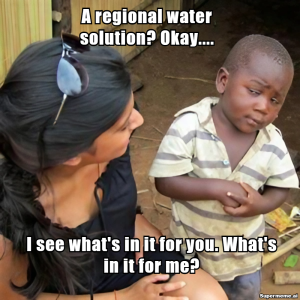
One line of thought, advanced by the Richmond Times-Dispatch editorial board yesterday and by RTD columnist Michael Paul Williams today, is to seek a regional solution.
“Nothing works without water. Simply put, this cannot happen again,” writes Williams. “Once we move from crisis mode to assessment mode, there needs to be honest dialogue on what went wrong, how to prevent it, and whether our current water setup makes sense if it doesn’t protect the entire region from an unforeseen catastrophe. Rather than our patchwork network, how about a truly regional framework for water delivery?”
Let’s unpack this. It is true, the failure of the City of Richmond’s water system had regional consequences because Henrico and Hanover Counties depend in part on Richmond for their water supplies. But as a Henrico resident, I have a very different reaction than Williams.
Meanwhile, Republicans plan to return a $1.2 billion surplus back to taxpayers.
by Victoria Manning
Virginia Democrats are wasting no time proposing a huge tax increase on Virginians by slapping a 5 percent tax on virtually every service in the commonwealth—despite the state’s budget surplus. The massive increase, proposed by longtime Democrat Vivian Watts, would land squarely on small businesses and tradesmen such as plumbers, electricians, landscapers, and barbers.
If HB 1755 passes, Virginians will be required to pay more for dry cleaning, vehicle repair, sporting events, nutrition services, animal boarding, digital services, and much more.
Virginia is already ranked an abysmal 28th on the State Tax Competitiveness Index, which sorts states’ taxation competitiveness in different areas such as income tax, property tax, and sales tax. If Democrats get their way, Virginia will certainly decline further in the rankings. The state income tax is one of the worst in the nation and Virginia is one of the few states that taxes its citizens through a personal property tax on vehicle ownership.
Restoration News spoke to Tim Anderson, a former Virginia Delegate who is running for reelection in Virginia’s 97th House District. He weighed in on HB 1755, saying, “Services have never been taxed in Virginia and despite Virginia having record surpluses each of the past 3 years, Democrats have the audacity to try to take more money from Virginians to fund progressive causes such as the electric vehicle mandate.” Anderson also shared his concerns regarding the impact a tax increase would have, “with inflation crushing Virginians pocketbooks at the grocery store, out of touch Democrats think the best thing to do is take more of your money.” Continue reading.
What an embarrassment. The City of Richmond’s water system shut down Monday, just as the General Assembly was scheduled to convene in the state Capitol. With no working toilets, legislators decided to delay deliberations until next week. As the city struggled to restore service, restaurants closed, a waterless VCU Medical Center turned away ambulances, and citizens were put on a boil-water advisory. Mere days after assuming office, Mayor Danny Avula found himself scrambling to get the water flowing again.
City officials were able to provide only sketchy details about how a two- to four-inch snowfall knocked out the city’s water system. Media reports suggest a cascading effect involving a snow-related interruption in power to the century-old water-treatment facility, a malfunctioning component that caused flooding, and electrical devices shorting out and rendering pumps inoperable.
How could this have happened? Avula undoubtedly will launch a probe to explain what went wrong. The inevitable post mortem assuredly will lay out the proximate causes of the fiasco from an engineering perspective. Whether the investigation explores underlying fiscal and management issues depends upon how Avula frames the scope of the inquiry.
Yet another effort will be made in 2025 to get Virginia’s two major electric utilities deeper into the business of building and maintaining charging stations for electric vehicles, with their ratepayers – even those who have no interest in such vehicles – having to pay the tab. Given they are supposed to be the no-brainer wave of the future, electric vehicles sure need a whole lot of expensive subsidies and legislative boosting.
This version of the idea comes in a bill from Delegate Irene Shin, D-Fairfax, who is a member of the House Labor and Commerce Committee, which is likely to first hear the bill.
It would repeal a 2021 statute that prohibited the utilities from building out such a network and creating a rate adjustment clause, or RAC, to raise the capital from their customers. Such rate “adders” hitting all customers have become the go-to method for funding most other utility investments, from new power plants and transmission lines to a subsidy program for low-income customers.
If the utilities seek to develop their own charging network, the bill requires they be barred from building the stations too close to existing private chargers. The State Corporation Commission would be tasked with developing the exclusion zone. But even if utilities build none of their own stations, other elements of the bill guarantee higher costs for their customers to subsidize electrified transportation.
The 2025 General Assembly will be taking up constitutional amendments on three hot button issues—abortion, voting rights of felons, and same-sex marriage.
In Virginia, to amend the state constitution, the General Assembly must agree to the proposed amendment twice, with an intervening election for the House of Delegates. If the proposal is approved the second time, it is then submitted to the voters for approval. A majority vote in the referendum is needed for the change to become effective. The Governor has no veto power over proposed constitutional amendments.
HJR 1—Abortion. The proposal would add a “fundamental right to reproductive freedom” to Virginia’s Bill of Rights. “Reproductive freedom” is defined as including the “ability to make and carry out decisions relating to one’s own prenatal care, childbirth, postpartum care, postpartum care, contraception, abortion care, miscarriage management, and fertility care.” The amendment prohibits one’s reproductive freedom from being “directly, or indirectly, denied, burdened, or infringed upon unless justified by a compelling state interest achieved by the least restrictive means.” The amendment defines a state interest as being compelling “only if it is for the limited purpose of maintaining or improving the health of an individual seeking care, consistent with accepted clinical standards of care and evidence-based medicine, and does not infringe on that individual’s autonomous decision making.”
The amendment does allow the state to regulate abortion in the third trimester of pregnancy, but it may not prohibit an abortion in the trimester which, in the professional judgment of a doctor, is needed to protect the life or physical or mental health of the mother or when a physician deems the fetus is not viable.
The Virginia General Assembly convenes tomorrow for its 2025 session among the usual laments that bipartisan solutions to the Commonwealth’s biggest challenges are not possible nowadays.
But there should be one big issue upon which members of both parties in both houses can agree: Virginia uses more electricity than it creates. With more data centers coming on-line, with more to follow, the situation is only going to get worse. And businesses and consumers are the ones who’ll be paying the bill for the imported electricity required to run them.
Fixing this problem is no longer just a “challenge” but has become a business imperative for the Commonwealth of Virginia if we are to maintain our position as the best state in the nation for business.
Energy policy is at a crossroads. We can no longer wait for more studies and study commissions. We mustidentify solutions that will reduce the amount of expensive electricity that must be imported from other states, and we must do it now.
To do that, Artificial Intelligence is our friend!
Broadly speaking, there are two types of strategies for making housing more affordable: demand-side strategies and supply-side strategies.
The demand-side approach makes it easier for people to buy houses — lower down-payments, interest-rate subsidies, outright grants. Such tactics might help the lucky individual households that qualify, but only by allowing Homeowner A to outbid Homeowner B, effectively displacing Homeowner B. There’s no net gain in the housing stock, thus no net gain for the population as a whole.
Supply-side strategies address the root cause of unaffordability: regulations that drive up the cost of construction and restrict the number of new lots. In a market economy, building more housing doesn’t benefit just those moving into the newly constructed dwelling units, it benefits all potential homeowners by altering the supply-demand calculus that determines housing prices.
Typically, Democrats go for demand-side solutions, aiming to boost the buying power of lower-income households. It hasn’t worked out very well. One would think that Republicans would have leaped into the breach with supply-side solutions, but they haven’t been very imaginative in crafting new legislation.
But there’s hope in the 2025 General Assembly session. State Senator Schuyler VanValkenburg, D-Henrico, is introducing a set of supply-side bills that could do more to move the needle on housing than anything else I’ve seen in Virginia.
While Democrats in the Virginia General Assembly appear unanimous in their opposition to the Governor’s new School Performance and Support Framework, there is near unanimous support among registered voters for enhanced educational standards that measure both growth and accountability by student subgroups according to a new poll.
In a survey conducted on behalf of the Thomas Jefferson Institute for Public Policy by Mason-Dixon Polling & Strategy between December 17 and 20, 625 registered voters were asked:
QUESTION: Virginia has approved a new framework for school accountability that utilizes comprehensive data, including academic proficiency and academic growth measures by student subgroups. This data would be made easily available and understandable, so parents know how well their child and local school are performing. Do you support or oppose this new framework?
The poll shows that 86 percent of registered voters in Virginia support a new accountability framework – with almost no variation in support by race, age, gender, region, or even political party. This data should be a wake-up call to Democrats in the General Assembly.
Democratic legislators in the General Assembly want to delay implementation of the state’s school accountability system that is scheduled to go into place next school year. Critics have called the rollout of the new system “rushed.”
The new standards would identify failing schools in “need of intensive support.” Although the Youngkin administration would never be so impolitic as to use the “f” word (failure), reasonable people can infer from the deplorable Standards of Learning pass rates of their students, that these schools are educational disaster zones.
Youngkin’s plan is to provide $50 million of targeted funding to these schools. Remarkably, Democratic legislators, for whom the answer to every ill usually is “more money,” are spurning this gesture. Sen. Ghazala Hashimi, D-Chesterfield, says the sum is “a drop in the bucket” compared to what’s needed.
The question arises: Since when do Virginia Democrats turn down more money for schools?
Here’s my take: “Progressive” lawmakers hate the new system because it will expose the massive failure of school districts run by uber-woke school boards and administrators.
In its lobbying efforts to try to kill the new school accountability system, the Virginia Education Association (the state-level “teachers union” organization, or VEA) has produced a report that strongly supports the new system.
In what would be described as an “own goal” by soccer parents, the key findings from the VEA’s report (inadvertently) validate how the new accountability system is effectively (i) showing Virginia’s educational inequality, including significant funding differences and staffing problems, (ii) demonstrating that Virginia needs to better direct resources to these struggling schools and (iii) distinguishing among schools at all levels.
The next step for the new accountability system is for the legislature to appropriate additional funds for those struggling schools to be identified as needing support when the new system takes effect next school year. The governor’s budget proposed $50 million in additional funds for such schools. I expect that Virginia’s legislative Democrats will propose to increase this amount.
Virginia registered voters are strongly in favor of allowing utilities to build new natural gas generation plants, a key issue facing Virginia because current state law mandates the complete elimination of that fuel source for electricity generation in 15 years.
On another key energy issue likely to face the 2025 General Assembly starting Wednesday, Virginians are also opposed to the creation of a new state oversight process that would be empowered to override local objections to the construction of large solar farms. In that case, however, the division is closer — with about half of the Democrats and even one third of the Republicans polled in favor of such a bill.
The survey was conducted on behalf of the Thomas Jefferson Institute for Public Policy by Mason-Dixon Polling & Strategy. Between December 17 and 20, 625 registered voters were questioned. The Thomas Jefferson Institute questions were part of a larger survey conducted by Mason-Dixon on multiple other issues.
Republican leaders and legislators are getting a clear message on both of these question from their base voters. The message is more mixed for Democrats, and their leadership clearly should at least reconsider the “no way, no how” approach on using natural gas for electricity in the future. But the political analysis always must focus on the Independents, and there Virginia’s Democrats are clearly out of step, while Republicans are in line with the voters both sides need to win the 2025 election contests.
On the bitter cold morning this was being written, the vast majority of the electricity being generated along the eastern seaboard came from natural gas or coal, both fuels Democratic Party orthodoxy and state law insist must go away. Dominion Energy Virginia is pushing back in its latest integrated resource plan, proposing instead to add up to 6,000 megawatts of additional gas plants in coming years. The idea is being bitterly opposed.
Richard Bland College, in Dinwiddie County just outside the city of Petersburg, is an anomaly among Virginia higher ed institutions. It is the only public residential two-year college in the state.
As its formal title, Richard Bland College of William and Mary, indicates, it is affiliated with the College of William and Mary. By law, Richard Bland is “under the supervision, management, and control” of the William and Mary Board of Visitors.
For some time, Richard Bland has chafed at this governance arrangement. Recently there has been this sequence of actions:
The 2022 Appropriation Act included language originally proposed by then-Del. Emily Brewer (R-Smithfield) directing the college to provide a plan “on the steps necessary to transition to an innovative model for higher education that prepares citizens for jobs in high-demand fields and in industries critical to the economic development of the Petersburg area, Virginia Gateway Region and Commonwealth of Virginia.”
A 2022 report , in response to the Appropriation Act language, from the college recommending the establishment of “a board of visitors dedicated to sole governance of [Richard Bland College].”
Legislation introduced in the 2023 General Assembly, SB 1077 (Ruff, R-Mecklenburg) and HB 1415 (Brewer, R-Smithfield) to provide Richard Bland with an independent board of visitors. The Senate bill passed unanimously, but both bills died in the House Appropriations Committee.
The 2023 Appropriation Act directed the Secretary of Education to evaluate “a new governance model building upon the November 2022 report issued by Richard Bland College.”
The Secretary of Education released her report in mid-August 2024. The Richmond Times-Dispatch reported on the recommendations here. The actual report can be found here.
“As long as she thinks of a man, nobody objects to a woman thinking.” ― Virginia Woolf
Sweet Briar College. It’s a unique place. Inimitable, really. Rich in women’s history. The College was built on the will of its founder, Indiana Fletcher Williams, in memory of her deceased 16-year-old daughter. Indeed, it’s a women’s college in the most integral sense.
Over the past decade, though, this small women’s college located in Amherst, Virginia, has been afflicted. Plagued by the same blight that has spread through virtually every province of society.
Gender ideology. It has settled in at Sweet Briar where large segments of the student body stand in defense of admitting the “gender diverse,” including men who think they are women. In fact, many faculty and board members have been swindled into thinking that people can change sex. That men who imagine themselves women should receive special empathy. That we should give into their delusions and call them “women” because they tell us to.
Women must be gracious. Isn’t this what we have been told since antiquity? Be kind, dear! And isn’t this the same admonition we are given now, in tacit and overt fashion when a man or boy claims womanhood? Be kind, dear, be kind!
The year: 2075. The American colonies on the Moon are getting restless under Washington’s tyrannical rule….
This second edition of “Dust Mites” has a snazzy new cover, includes helpful lunar maps, and is 5,000 words tighter than the original. The sequel, “Trogs,” is scheduled for publication this summer.
Advertisement
Advertisement
Advertisement
Advertisement
About
Bacon’s Rebellion is Virginia’s leading politically non-aligned portal for news, opinions and analysis about state, regional and local public policy. Read more about us here.
Fund the Rebellion
Shake up the status quo! Your contributions will be used to pay for faster download speeds and grow readership. Make a one-time donation by credit card or contribute a small sum monthly.
Can’t wait until tomorrow
For your Bacon’s Rebellion fix?
Enter your email address to receive immediate notifications of new posts by email.
SUBSCRIBE
Search Bacon’s Rebellion
Categories
Archives
The Jefferson Council
Protecting Thomas Jefferson’s Legacy at the University of Virginia
Forgot Your Password?
Shoot me an email and I’ll generate a new password for you.