
by James A. Bacon
What an embarrassment. The City of Richmond’s water system shut down Monday, just as the General Assembly was scheduled to convene in the state Capitol. With no working toilets, legislators decided to delay deliberations until next week. As the city struggled to restore service, restaurants closed, a waterless VCU Medical Center turned away ambulances, and citizens were put on a boil-water advisory. Mere days after assuming office, Mayor Danny Avula found himself scrambling to get the water flowing again.
City officials were able to provide only sketchy details about how a two- to four-inch snowfall knocked out the city’s water system. Media reports suggest a cascading effect involving a snow-related interruption in power to the century-old water-treatment facility, a malfunctioning component that caused flooding, and electrical devices shorting out and rendering pumps inoperable.
How could this have happened? Avula undoubtedly will launch a probe to explain what went wrong. The inevitable post mortem assuredly will lay out the proximate causes of the fiasco from an engineering perspective. Whether the investigation explores underlying fiscal and management issues depends upon how Avula frames the scope of the inquiry.
Richmond’s water and sewer infrastructure is ancient, dating to the late 1890s. The water-treatment plant was built literally a century ago. Once upon a time, the system was state of the art. That’s no longer the case. The deficiencies of the city’s combined-sewer overflow system, which spills raw sewage into the James River during heavy rains, have been known for decades. However, the water-treatment facility has received scant attention. Maybe it’s time that it does.
Let us start with a couple of general observations.
First. as essential as it is to have a reliable water supply, water-treatment is among the least glamorous functions of city government. Everyone takes it for granted that clean water will flow from the tap. People pay attention only when (1) water doesn’t flow, (2) the water isn’t clean, or (3) water rates go up. Otherwise, the public could not be bothered. And if the public couldn’t be bothered, mayors and councilpersons couldn’t be bothered.
Second, the Virginia state constitution may require local governments to balance their budgets each year, but politicians routinely engage in surreptitious deficit spending by means of short-changing repairs and maintenance. It’s an easy way to conserve cash and keep taxes/rates lower. The harm typically won’t become evident until years later. When that day comes, it will be on someone else’s watch.
Any investigation into water-gate (if we may be allowed to refer to the fiasco as such) should inquire into whether the City of Richmond has been under-funding repairs and maintenance of its water-treatment plant and for how long. Could the fiasco have been prevented had the city been upgrading, repairing and maintaining the plant in line with industry standards?
If it turns out that the city has been short-changing maintenance, the inquiry needs to ask why. Do the city’s utility rates generate sufficient revenue to fund what needs to be done? If not, why not?
Some clues can be found in the City of Richmond’s 2023 Comprehensive Annual Financial Report (CAFR). (The 2024 report is not yet available. As usual, the city has failed to meet the legislated deadline.)
The City lists depreciating capital assets of $699 million for the water system and $913 million for the wastewater system — a depreciating asset base totaling $1.6 billion.
The CAFR says that water pumping, treatment, and distribution equipment has useful lives, for purposes of depreciation, of 20 to 50 years. That implies that the city’s water and wastewater systems are depreciating at the rate of $32 million to $80 million yearly, at least on paper. I could find no mention of replacement costs, which due to inflation of 22% in the past five years is considerably higher.
According to the annual report, the City listed expenditures for “maintenance and repairs” of $9.4 million for water and $9.6 million for wastewater, a total of $19 million. The City also invested $31 million in “upgrades” to water utility infrastructure and $54 million in wastewater utility infrastructure.
I am not qualified to determine whether those expenditures are adequate to maintain the city’s water/wastewater infrastructure. But these are the kinds of numbers that any investigation should be looking at.
Richmond’s water and wastewater operations are supposed to be self-supporting financially. That is, rates should generate revenue sufficient to support ongoing operations and anticipate future needs. The last time the City increased utility rates was in 2021 — 2.5% for water, 4.0% for waste, and 8.75% for stormwater.
As the city website explains, “Cost of service increases are necessary to help protect the City’s financial health and its ability to ensure the delivery of quality services. They also ensure the ability to maintain and replace aging infrastructure, complete capital projects, meet regulatory requirements and maintain the ability to leverage [the Department of Public Utilities’] strong bond rating.”
Setting rates is one thing. Collecting revenues is another. The city website states explicitly that “equity” considerations inform its policies. “We provide equitable delivery of services to residents, including access to safe and clean water,” it says.
How is the commitment to “equitable delivery” of water put into practice? Perhaps one way is to not lean too hard on poor people who have fallen behind on their utility payments.
A City Auditor’s Office report on billings and collections in 2023 gives a sense of the challenge. As of June 2022, the department’s accounts receivable had grown to more than $60 million. The city had sourced collection activities to a third party but, the auditors noted, “there is not a process in place to ensure accounts are correct or to track and oversee the remaining outstanding accounts still with the agency.”
After the George Floyd shooting, the nation (and Richmond) was in an uproar over structural racism and intersectional oppression. Despite billions of dollars in emergency federal aid, people were falling behind on their rental payments… and utility payments. Cutting off water and gas service to poor people during the COVID pandemic would have created a furor.
Utility accounts receivable older than 90 days had been trending slowly upward in the 2010s, then shot sharply higher during the epidemic.
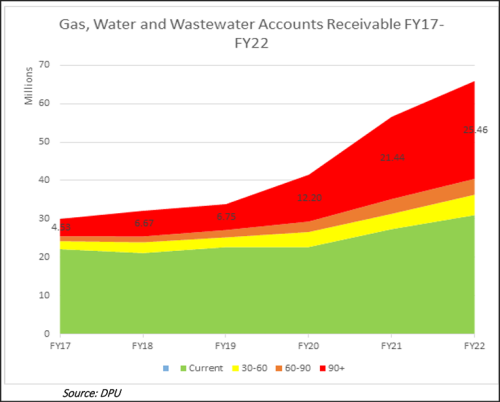
The auditor’s report does not discuss how the accumulation of bad debts impact utility revenues and operations. However, an increase of $35 million in uncollected revenue — some portion of which was for water/sewer service — was bound to impact water/wastewater operations generating $200 million a year in revenue.
Based on the limited information presented here, it is reasonable to hypothesize that Richmond utilities have suffered from chronic under-investment in maintenance, repairs and routine upgrades for years, and that the shortfall intensified during the COVID epidemic. Assuming that theory holds water, so to speak, there is no quick, painless fix for the city’s water utility.
If there were any cosmic justice, water-gate would have taken place while former Mayor Levar Stoney, whose sole accomplishment over eight years was tearing down Richmond’s Confederate statues, was still in office. As luck would have it, the crisis occurred days after he stepped down, and responsibility was thrust upon Danny Avula.
By most accounts, Avula has handled himself creditably, although he has received criticism for making excessively optimistic predictions of when service would be restored. Sooner or later, the taps will start flowing again. Then, I expect, Avula’s true test of leadership will be telling people what they won’t want to hear: that their water-utility rates will have to rise and, most contentious of all, everyone has to pay their bills.


Leave a Reply
You must be logged in to post a comment.