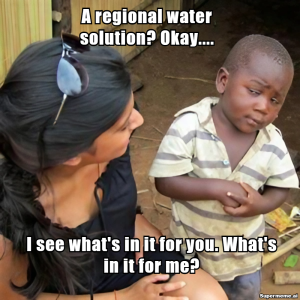
How About a Regional Solution to Richmond’s Water Woes? No Thanks.

by James A. Bacon

In a myriad of small ways, the City of Richmond’s water woes have spilled into neighboring Henrico County where I live. The County is on water-boil alert, making cooking meals a hassle. One of my favorite restaurants, which is normally half full on Wednesday nights, was so jammed with diners when I stopped by to pick up a pizza that nary a spare table was seen. With no water service in their city apartments, my son and his girlfriend dropped by last evening for hot showers. (It’s always good to see them, so I’m not complaining.)

Needless to say, in the city itself, where service last night had been restored to a mere trickle, the water shutdown is not a minor inconvenience, it’s an all-consuming preoccupation. As city officials inch closer to getting taps and toilets flowing, people are looking beyond the immediate crisis and asking how to make sure a shutdown never happens again.

One line of thought, advanced by the Richmond Times-Dispatch editorial board yesterday and by RTD columnist Michael Paul Williams today, is to seek a regional solution.

“Nothing works without water. Simply put, this cannot happen again,” writes Williams. “Once we move from crisis mode to assessment mode, there needs to be honest dialogue on what went wrong, how to prevent it, and whether our current water setup makes sense if it doesn’t protect the entire region from an unforeseen catastrophe. Rather than our patchwork network, how about a truly regional framework for water delivery?”

Let’s unpack this. It is true, the failure of the City of Richmond’s water system had regional consequences because Henrico and Hanover Counties depend in part on Richmond for their water supplies. But as a Henrico resident, I have a very different reaction than Williams.

Far from regarding regional integration as a good idea, I’m thinking that Henrico should do everything possible to insulate itself from Richmond’s dysfunctional government. Any hard-and-fast conclusion is tentative until we know more, but that’s my instinct at this moment.

As I detailed in my post yesterday, Richmond’s water foes may have been triggered by a 2- to 4-inch snowfall, but the meltdown of the water treatment system was hardly an act of god. Brief interruptions of electric power are inevitable and must be planned for. Critical systems like water plants must be designed with redundant systems to maintain service under all but the most extreme events.

Will an in-depth inquiry find out that the city has been chronically underfunding maintenance, repairs and upgrades for years, as I suggested yesterday? If so, no one would be surprised. City accounting is a shambles. Unpaid utility bills doubled between fiscal 2017 and fiscal 2022. Credit-card controls are abysmal. The City can’t complete its Comprehensive Annual Financial Reviews on time. For years under former Mayor Levar Stoney, City Hall was far more preoccupied with “equity” than sound, effective government.

Meanwhile, CBS Channel 6 News has dug up a 2022 Environmental Protection Agency audit that confirms my maintenance-underfunding theory. The EPA report cited the utility department with “dozens of violations of federal regulatory standards including multiple corroded and deteriorated pumps at the main treatment plant, filters that were aged and cracked, inspections not regularly being performed, and limited preventive and corrective maintenance.”

I have plenty of disagreements with Henrico County’s spending priorities, but at least the apparatus of county government is well run.

If Henrico joined Richmond in a regional governance structure for water and wastewater, whose municipal culture would prevail, Henrico’s or Richmond’s? If Richmond ceded total authority to Henrico, I might be fine with a regional approach. But if Richmond’s municipal culture prevailed, I’d be stocking my garage with pallets of bottled water.

I’m hoping that Richmond’s new mayor, Danny Avula, will bring about what Stoney promised but never accomplished: reforming City Hall. But I’m not willing to bet the security of my water supplies on a prayer.

If it can be documented that Richmond has been chronically underfunding its water- and waste-treatment facilities and racking up millions of dollars in deferred maintenance, there is an even more compelling reason for Henrico citizens to be skeptical of a regional water system. A merger of the two systems could saddle Henrico with a share of the potentially multimillion-dollar burden of working off Richmond’s accumulated liabilities.

In what world should Henrico citizens get stuck financially for the manifest failures of the city’s political class and the willingness of city voters to tolerate them?

Those are my concerns. I’m willing to withhold final judgment until we get more definitive assessments of what went wrong and why. Unless a thorough study reaches unexpected conclusions, though, I’m not inclined to endorse a regional solution to Richmond’s water-wastewater problems.


ADVERTISEMENT

(comments below)


Comments


Comments

13 responses to “How About a Regional Solution to Richmond’s Water Woes? No Thanks.”

  1. James Wyatt Whitehead Avatar
    James Wyatt Whitehead

    The curse of Davis, Lee, Jackson, Stuart, AP Hill, and Maury. Those Monument Avenue statues at one time were stored at the waste water plant. Who knows they might still be there? Give the monuments back and the curse shall be lifted.

  2. Chip Gibson Avatar
    Chip Gibson

    "Far from regarding regional integration as a good idea, Iโ€™m thinking that Henrico should do everything possible to insulate itself from Richmondโ€™s dysfunctional government." Roger that.

  3. WizeMaxcy Avatar
    WizeMaxcy

    If one analyzes the course of Henrico's political direction since the last supervisor election and the course they are taking, Henrico is trying to become Richmond.

  4. LarrytheG Avatar
    LarrytheG

    I'm confused. If Henrico has been affected by Richmonds water, doesn't that mean it's ALREADY regional?

    re: " Meanwhile, CBS Channel 6 News has dug up a 2022 Environmental Protection Agency audit that confirms my maintenance-underfunding theory. "

    so you're depending on govt to tell you when govt has issues?

    ๐Ÿ˜‰

  5. LarrytheG Avatar
    LarrytheG

    I'm thinking about EPA and DEQ and "regulations" and at the same time "govt ineptitude".

    I'm thinking conservatives like JAB getting wrapped around the proverbial "anti-govt", "govt is bad" axle.

  6. James Kiser Avatar
    James Kiser

    It is called by honest democrats an income redistribution plan. Those rich suburbs can pony up for those hard working oppressed peoples of VA.

  7. DJRippert Avatar
    DJRippert

    Sometimes, it's helpful to think about what other cities and counties in the United States have done. The city-county merger of Nashville and Davidson County in Tennessee is one such example.

    In the early 1960s, Nashville, Tennessee, and the surrounding Davidson County existed as two distinct entities with overlapping functions. Nashvilleโ€™s city population hovered around 170,000 people, while Davidson County at large housed closer to 400,000 residents. The racial composition across both areas was predominantly White, although African Americans represented a significant minorityโ€”roughly a quarter or more of the total population. In terms of income, the city center showed a lower average household income compared to suburban parts of the county, reflecting national urban-rural economic divides of that era. This demographic mix set the stage for ongoing conversations about how best to provide public services like education, infrastructure maintenance, and public safety.

    A heated debate emerged in the years leading up to consolidation, fueled by concerns about taxation, duplication of services, and the desire for a more streamlined government. Critics of the merger worried that taxes might rise without guaranteeing improvements, while others feared that the interests of suburban areas would overshadow those of the city center, potentially reducing resources for more economically challenged neighborhoods. Proponents, on the other hand, argued that a single, unified government would eliminate inefficiencies, cut down on bureaucratic red tape, and ensure more equitable distribution of services. Both sides presented passionate arguments in town halls and in the media, reflecting a broader shift in American urban policy at the time.

    The eventual consolidation, approved by voters in 1962 and implemented in 1963, brought about a new Metropolitan Government of Nashville and Davidson County. This merger combined administrative functions, streamlined departments, and aligned policies under a single mayor and council structure. Public service agencies, such as the police and fire departments, were merged to eliminate overlapping jurisdictions. The reorganization demanded extensive legal and logistical planning, including redistricting, budget alignment, and the creation of new rules to govern the Metropolitan governmentโ€™s scope and authority. Although the process was complex and sometimes contentious, the unified government aimed to provide consistent services and a uniform tax structure for all residents.

    In the decades following consolidation, Nashvilleโ€™s growth and economic performance exceeded many expectations, outpacing the American average in key indicators such as population expansion, job creation, and median household income increases. Fueled by the rise of the country music industry, an expanding healthcare sector, and robust tourism, the metropolitan area attracted both businesses and new residents. This economic and cultural vibrancy helped Nashville become one of the faster-growing cities in the United States, even during periods when other regions struggled. While not all areas of Nashville have benefited equallyโ€”some neighborhoods still lag in investment and opportunityโ€”the overall effect of the city-county merger has been seen by many as a catalyst for more efficient governance and long-term development.

  8. Outrecidant Avatar
    Outrecidant

    There is precedence for this type of arrangement in Virginia and it's called a water authority. Basically a group of water and wastewater system owners and operators get together and petition the state legislature to permit them to incorporate as a private company. Then the house of delegates passes a bill to the senate for approval, and then the interested parties can then create their own water and wastewater company. All the parties would then turn over their assets to the new entity. The new entity create it's own bonds for funding capital investment projects, too, so all existing debt bonds would become the responsibility of the new water authority.

    The two hurdles are getting local governments to relinquish control of their water and wastewater systems, as they are significant revenue generators for them. And then there is the prickly issue of requiring the legislature to provide for the incorporation of a water authority. It is a "unique" arrangement to say the least, stemming from our status as a commonwealth.

  9. Dick Hall-Sizemore Avatar
    Dick Hall-Sizemore

    This is the sort of attitude that has hindered regional cooperation in the Richmond area. If there were to be regional cooperation, it could be done through a regional authority, which would be an independent entity, with a governing body made up of representatives of all participating localities. A model and example would be the Western Virginia Water Authority, which provides treated water for the city of Roanoke and the counties of Roanoke, Franklin, and Botetourt, along with several towns. https://www.westernvawater.org/

  10. One of my favorite restaurants, which is normally half full on Wednesday nights, was so jammed with diners when I stopped by to pick up a pizza that nary a spare table was seen.

    Where were they getting their water?

  11. Paul Sweet Avatar
    Paul Sweet

    The Bedford Regional Water Authority (BRWA) and Western Virginia Water Authority (WWVA) jointly own and operate the Smith Mountain Lake Water Treatment Plant. The BRWA also draws water from the Bedford reservoir and the Lynchburg water department. The multiple sources of water provide redundancies for all these water departments. Fortunately these jurisdictions are run better than the city of Richmond.

  12. William O'Keefe Avatar
    William O'Keefe

    Another example of dysfunctional city government. There will be more examples until the mayor and city council demand excellence. This is a clear challenge for the new mayor. He should set high standards and enforce the demand for excellence.

  13. energyNOW_Fan Avatar
    energyNOW_Fan

    Aside from the immediate Richmond water problem, there are new EPA regulations for PFAS that may impact some (eg; NoVA). Perhaps some planning or bond issues at state level might be considered. Also the explosion of cloud computing in Virginia, brings up potential water issues that I presume might require infrastructure improvements.

Leave a Reply


ADVERTISEMENT