

by Todd Truitt
In its lobbying efforts to try to kill the new school accountability system, the Virginia Education Association (the state-level “teachers union” organization, or VEA) has produced a report that strongly supports the new system.
In what would be described as an “own goal” by soccer parents, the key findings from the VEA’s report (inadvertently) validate how the new accountability system is effectively (i) showing Virginia’s educational inequality, including significant funding differences and staffing problems, (ii) demonstrating that Virginia needs to better direct resources to these struggling schools and (iii) distinguishing among schools at all levels.
The next step for the new accountability system is for the legislature to appropriate additional funds for those struggling schools to be identified as needing support when the new system takes effect next school year. The governor’s budget proposed $50 million in additional funds for such schools. I expect that Virginia’s legislative Democrats will propose to increase this amount.
Meanwhile, the VEA proposes that the legislature provide the additional funds without accountability. The VEA describes the new system’s transparency to better provide support to struggling schools — a principal goal of effective accountability systems as intended by President Barack Obama and the U.S. Congress — as “flawed.”
In particular, the VEA wants the additional funds now, and the legislature to “delay” the new system to “halt” its implementation until a new governor is in office. As detailed below, the VEA also asks that any future accountability system to restore significant defective components that had been identified by national accountability experts as fatal flaws and had caused the prior system to mis- and under-identify struggling schools.
Virginia’s Education Gaps Are Wide
Virginia has stark educational demographic results that have not moved or worsened over the decades, as demonstrated in the 2022 National Assessment of Education Progress (NAEP):
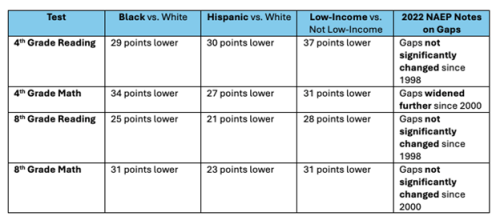
Moreover, as detailed in the Richmond Times-Dispatch, “students in Virginia remain largely separated by race and economic class. While segregation is no longer mandated by public policy, it is reinforced by school attendance zones and segregated housing patterns.”
Lastly, Virginia is one of the 10 wealthiest states in the nation, but is 41st for per-pupil spending at the state level. As noted by The Commonwealth Institute:
“Virginia places a relatively high burden out of all states on localities to pay for a majority of K-12 costs, and the local share is primarily funded through property taxes. The historical and contemporary racial inequities in housing leads to disparities in funding among school districts across the commonwealth…School divisions that are either located in rural areas, have a majority of students of color, or are in communities with a high share of poverty often have less resources to invest in schools, leading to less resources for students.”
Effective Accountability Systems Show Struggling Schools to Provide with Support
As explained by the leading education civil rights group The Education Trust, accountability systems should show “which schools and districts are struggling to meet students’ needs and have student group disparities, and — most importantly — use this information to target additional resources and supports to address these needs.”
Accountability is governed by a detailed federal law, the 2015 U.S. Every Student Succeeds Act (ESSA), as well as Virginia state laws and regulations. Virginia’s prior system was more complex than most other states as Virginia did not produce school ratings under ESSA, but instead produced ratings under a parallel state system called “Accreditation” using much less rigorous metrics than allowed under ESSA (while burying the stricter federal data in confusing tabs).
National Experts Identified Old System’s Fatal Flaws, VEA Wants Them Restored

The new system was built by subcontractors Chad Aldeman and Anne Hyslop, who are both top national accountability experts, Obama U.S. Department of Education (USED) alumni and Virginia Democrats. Hyslop also worked as a Special Assistant to the Virginia Secretary of Education under then-Governor Tim Kaine.
As part of their review of the old system, Aldeman and Hyslop identified the following fatal flaws that are relevant to the VEA report:

Fatal Flaw #1: “Combined Rate” Disregarded Proficiency or Growth or Both
The old accreditation system’s unique parallel state report card used a much criticized “combined rate” for rating students’ academic achievement with math and reading:
- First, if a child Passed the standardized test (SOL exam), the child met the accreditation standard. But as I detailed, Virginia’s SOL exam cut scores for math and reading are the lowest in the United States. Thus, if a child met the low bar of Pass, then their Growth was disregarded.
- Next, if a child did not Pass the SOL exam, the child met the accreditation standard if he or she achieved Growth. If so, that child’s lack of Proficiency was disregarded.
- Lastly, if a child did not pass the SOL exam for reading and did not Grow, but was an English Learner, the child met the accreditation standard for reading if he or she achieved English Learner Progress. If so, that child’s lack of Proficiency and Growth was disregarded.
Virginia proposed to use this “combined rate” for its federal accountability system in its initial ESSA application in 2017, but was denied by USED. The “combined rate” conflicts with ESSA, which requires each of those indicators (Proficiency, Growth, English Learner Progress) be given “substantial weight.” Nonetheless, the administration of Governor Ralph Northam still proceeded to use it as part of the parallel state system.
The new accountability system scraps the parallel state report card and its “combined rate,” and separately looks at Mastery, Growth of all students, and English Learner Progress consistent with ESSA. The new system will overweight Mastery to Growth at the Elementary and Middle School levels, but less than Massachusetts does. Massachusetts has been touted for decades for the quality of its public schools, and Dr. Mark Schneider, the Director of the Institution of Education Sciences at USED, testified at the VBOE in October 2022 that Virginia should look to Massachusetts as it updates its educational standards.
The VEA objects to a Massachusetts-like Mastery vs. Growth weighting, and wants the accountability system to “focus on growth.” Thus, the VEA appears to advocate for Virginia to give little to no weight to Mastery (e.g., the “combined rate”), which would require standing up a separate state system to effectively override the federal standards.
Fatal Flaw #2: Overrode English Learner Civil Rights
The old accreditation system’s parallel report card excluded English Learners for 5.5 years, whereas English Learners are included in accountability systems after three semesters based on 22-year old federal civil rights laws.
In July 2024, the civil rights groups The Education Trust, Migration Policy Institute and Unidos US provided a formal comment endorsing Virginia’s accountability system change to scrap the parallel state report card and use the federal system’s three semester standard on English Learner inclusion.
In its report, the VEA attacks the three-semester federal civil rights protection on English Learner inclusion. Paradoxically, the VEA is part of the National Education Association, which is a strong supporter of the three-semester federal standard (as is the American Federation of Teachers, the other major national teachers union).
Virginia applied for exemptions from the three-semester standard in 2005 and 2006, which the USED denied. Notably, ESSA provides an alternative method to use academic Growth in the second year after arrival in place of Proficiency, but that method requires additional testing of English Learners in their year of arrival.
The VEA’s report proposes to instead use English Learner Progress like the old system did in place of Proficiency and Growth, which would require standing up a separate state system to effectively override the federal civil rights law.
Fatal Flaw #3: Identified Few Schools for Support or Distinguishment
The old system had been repeatedly criticized by national civil rights organizations for its opacity. For what was effectively only a two-category system, Virginia’s old accreditation system produced the following ratings based on the school years set forth below

For comparison, the administration of Democratic Governor Wes Moore in Maryland is revising its accountability system to identify more schools when only 24% of Maryland schools were in the bottom 2 of 5 categories (the equivalent of 30% if Maryland had a 2-tier system).
Moreover, in the old Virginia accreditation system, approximately 85-90% of schools were lumped into the top category, with no distinguishment among those schools.
If the new accountability system had been in effect for the 2023-24SY, the system would have produced the following ratings:
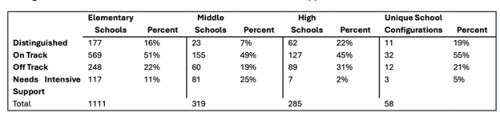
The VEA also proposes that the new system’s ratings return to the old accreditation system’s use of a three-year rolling average for data, instead of a rating based on that prior year’s data. That proposal would likely require standing up a separate state system to effectively override the federal standards, and the result would be the mis- and non-identification of schools needing support immediately.
VEA Report: New Transparent System Accurately Shows Virginia’s Educational Divide
The VEA’s analysis showing the new system’s effectiveness is consistent with the statistical analysis by Fairfax County Public Schools parent Eileen Chollet, as well as the analysis by the Washington Post.
The VEA’s first Key Findings are as follows:
Disparities in Resources. Schools labeled as Distinguished spend over $1,000 more per student on average in state and local funding than schools labeled as Needs Intensive Support. This financial disparity directly affects the opportunities and support available to students, and is upside-down from what all policymakers know is needed.
Concentration of Students Facing Most Barriers to Education:
- One-third of studnts in Needs Intensive Support schools are Black — 150% higher than their statewide representation.
- Nearly 7 in 10 students in Needs Intensive Support schools are students of color.
- The share of Enligh Leaner (EL) students in Needs Intensive Support schools is more than double that of Distinguished schools, yet those schools are held to unrealistic expectations by including EL students’ scores for accountability purposes after just three semester of enrollment, regardless of students’ proficiency levels.
Staffing Shortages.
- Teacher vacancy rates in Needs Intensive Support schools are five times higher than in Distinguished schools.
- Nearly 1 in 5 teaching positions in Needs Intensive Support schools are either vacant or filled by provisionally licensed teachers, compared to just 1 in 15 Distinguished Schools.
The VEA’s other Key Finding is notable as it shows how the prior system was misidentifying schools that needed support—the VBOE’s Continuous Exemplar Awards were based on the old system with its fatal flaws noted above:
Undermining Recognized Schools: More than half of the schools recently celebrated by the VBOE with Continuous Improvement Exemplar Awards would be labeled as Off Track or Needs Intensive Support under the performance Framework. This sends conflicting messages about what success truly looks like.
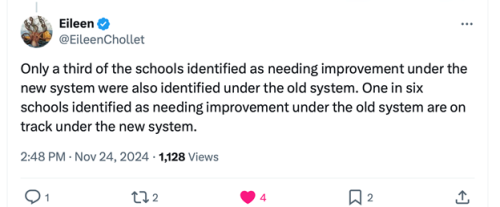
Chollet’s analysis had also noted the old system’s misidentification of schools:
Todd Truitt is a parent of two school-age children in Arlington County, Virginia. He is also the former Chair of the Math Advisory Committee for Arlington Public Schools and active in the Arlington Democrats. He is a business transactions attorney and a Certified Public Accountant.


Leave a Reply
You must be logged in to post a comment.