
by Dick Hall-Sizemore
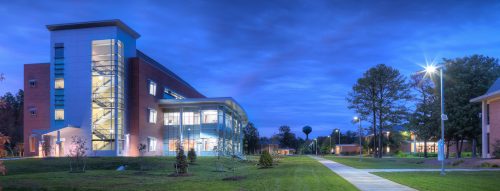
Richard Bland College, in Dinwiddie County just outside the city of Petersburg, is an anomaly among Virginia higher ed institutions. It is the only public residential two-year college in the state.
As its formal title, Richard Bland College of William and Mary, indicates, it is affiliated with the College of William and Mary. By law, Richard Bland is “under the supervision, management, and control” of the William and Mary Board of Visitors.
For some time, Richard Bland has chafed at this governance arrangement. Recently there has been this sequence of actions:
- The 2022 Appropriation Act included language originally proposed by then-Del. Emily Brewer (R-Smithfield) directing the college to provide a plan “on the steps necessary to transition to an innovative model for higher education that prepares citizens for jobs in high-demand fields and in industries critical to the economic development of the Petersburg area, Virginia Gateway Region and Commonwealth of Virginia.”
- A 2022 report , in response to the Appropriation Act language, from the college recommending the establishment of “a board of visitors dedicated to sole governance of [Richard Bland College].”
- Legislation introduced in the 2023 General Assembly, SB 1077 (Ruff, R-Mecklenburg) and HB 1415 (Brewer, R-Smithfield) to provide Richard Bland with an independent board of visitors. The Senate bill passed unanimously, but both bills died in the House Appropriations Committee.
- The 2023 Appropriation Act directed the Secretary of Education to evaluate “a new governance model building upon the November 2022 report issued by Richard Bland College.”
- The Secretary of Education released her report in mid-August 2024. The Richmond Times-Dispatch reported on the recommendations here. The actual report can be found here.
The Secretary’s report laid out five governance options that were considered for Richard Bland:
- Continue to be governed by the William and Mary Board of Visitors (status quo);
- Report to the Board of Visitors of a different Virginia public higher education institution;
- Join Community Colllege System;
- Integrate with a Virginia four-year institution, combining management under a single Board of Visitors; and
- Create a newly constituted Board of Visitors to govern Richard Bland.
Conspicuous by its absence is another option: Close Richard Bland College.
Perhaps Secretary Aimee Guidera did not include that last option because the language in her directive referenced only “governance”, thereby excluding any other options. However, the metrics considered in the report’s evaluation of the college, as well as the interviews with “stakeholders” and national experts, could certainly lead one to the conclusion that the college’s days are numbered and the Commonwealth should consider closing it
Here is a summary of those metrics:
- Enrollment—According to the State Council of Higher Education in Virginia, Richard Bland had 2,947 students enrolled for the 2023-2024 school year. However, the bulk of those students were dual enrollment (high school) students, most of them part-time students. As the Secretary’s report notes, as a proportion of Richard Bland’s headcount, dual enrollment students have grown from 21 percent in 2012 to 68 percent in 2023. The report goes on to note, “Excluding dual enrollment [high school] students, Richard Bland enrollment has fallen 2.8 % annually (25% total), from 1,105 students in Fall 2015 to 833 in Fall 2023.” Its “core enrollment declines have been more severe than almost all four-year public institutions in the Commonwealth.” Furthermore, according to the U.S. Dept. of Education College Scoreboard, the number of undergraduate students had decreased again in the fall of 2024 to 728.
- Retention—“Retention rates of full-time freshman cohorts at Richard Bland are at the lowest level in 10 years, with fewer than half of students retained in 2022.” Retention declined from 60 percent in Fall 2012 to 45 percent in 2022. In contrast, retention rates in community colleges increased over that period to 64 percent.
- Graduation—“Fewer than 30% of Richard Bland students graduate from Richard Bland within two years, with 40% graduating within four years.
- Degree conferral—“Richard Bland now confers 20% fewer degrees per year, from 239 degrees in 2014 to 190 in 2023.” In 2024, the number of degrees ticked up to 194.
- Transfer outcomes—“Richard Bland’s transfers to public four-year institutions [in the most recent cohort] graduated within four years 59% of the time.” That is lower than the 66% graduation rate of community college transfers.
- Affordability—Richard Bland’s tuition and fees cost (excluding room and board) are 80 percent higher than those for the nearby community college and only 10 percent less than the nearby four-year higher ed institution.
- Expenditure growth—“Richard Bland’s Education & General expenditures more than doubled from $9.4M in 2011 to $18.9M in 2022.” Its E&G appropriation for the current fiscal year is $21.3 million, of which $14.6 million is from the state general fund.
- Reliance on state funding—“In 2022-23, the Commonwealth spent $66,641 in general fund appropriations for each associate degree awarded by Richard Bland, which is triple the $22,202 spent for each degree or credential awarded by VCCS [Virginia Community College System].”
As part of her study, the Secretary interview numerous local “stakeholders”, as well as two national experts. Those interviewed included the presidents of the three four-year colleges in the immediate area—William and Mary, Virginia State University, and Virginia Commonwealth University, as well as the Chancellor of the Virginia Community College System. She reported, “Interviewees unanimously asserted that the current governance model, with the William and Mary Board of Visitors overseeing Richard Bland, is not effectively serving the needs of either institution or the Commonwealth.”
Some of those interviewed implicitly questioned why Richard Bland should continue to exist. One person went so far to say:
“Richard Bland has lurched to find an identity. It can’t be a four-year college, and it doesn’t want to be only a feeder college. It is constantly reinventing itself to find some unique need. It says it does so many things that it can’t do.”
One national expert made it clear that “there are very few, if any, remaining public colleges like Richard Bland in all of the U.S.” After comparing Richard Bland with its nearest peers in the nation, the report concluded, “This points to the inherent challenge of continuing to stand alone as a junior college when the rest of the higher education ‘market’ has adjusted.”
The Secretary concludes her report by saying, “This evaluation has made it clear that merely establishing a new Board of Visitors will not necessarily lead to the resolution of Richard Bland’s strategic challenges.”
Despite all the evidence in favor of closing the school, she abdicated and handed the problem to someone else. The report “recommends that the General Assembly constitute a new, independent Board of Visitors for Richard Bland and simultaneously charge the Board with a three-year directive to both hold Richard Bland accountable for progress in performance against key metrics, while doing further diligence in parallel on potential strategic alternatives surfaced during this evaluation.”
Does anyone think that a newly constituted Board of Visitors would turn around and recommend that they and the institution be disbanded?
Sen. Mamie Locke (D-Hampton) has pre-filed legislation that would implement the Secretary’s recommendations. The bill notes that the patron is introducing it “by request.” That is a sign that the legislator is not necessarily taking ownership of the bill but is filing it as a courtesy for someone else. It is reasonable to assume that the Governor’s office asked her to introduce the bill.


Leave a Reply
You must be logged in to post a comment.