
Many participants on this blog will welcome a provision Governor Youngkin included in his proposed budget bill that has received little notice in the press: a cap on college tuition and fees for Virginia students. The provision would impose an absolute cap for FY 2026 and limit increases in succeeding years to 2.5 percent or the inflation rate, whichever is lower.
-
One Way to Get Higher Ed to Cut Expenses
-
SB 805 Tries to Squeeze Blood from Turnip
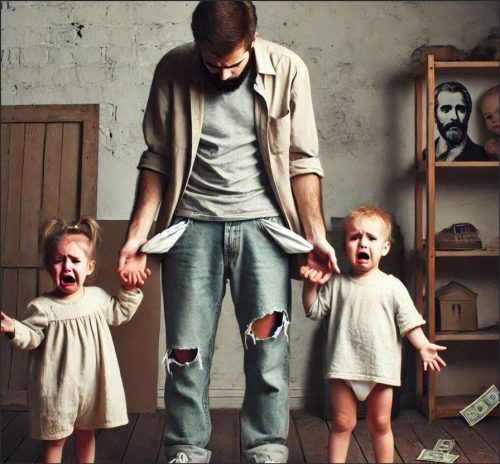
Image credit: Bing Image Creator by Hans Bader
Legislation has been introduced in the Virginia legislature to increase child-support obligations a lot, even for parents with very low incomes. The legislation, SB 805, violates federal child-support regulations, such as 45 CFR § 302.56(c)(1), by imposing excessive child support obligations on thousands of parents that they will be unable to pay, and leave them unable to meet their basic needs. 45 CFR § 302.56(c)(1) requires state child-support guidelines to take into account the “ability to pay” and “the basic subsistence needs of the noncustodial parent.”
To comply with that federal regulation, adopted in 2016, Virginia’s neighbors, such as North Carolina, Maryland, and Tennessee, do not impose significant child support obligations on parents making less than $1,300 per month, because parents that poor cannot afford to pay much child support while housing and feeding themselves. Moreover, the Maryland “child support obligation” is reduced by a “self–support reserve” to enable noncustodial parents to subsist.
Under this Virginia bill to increase child support (SB 805), the basic child support obligation will be an unaffordable $264 to $665 per month for households making $1,300 per month (depending on the number of kids they have). For parents making $550 per month, basic child support is between $114 and $287 per month, which is well beyond their ability to pay.
(more…)
-
Hokum, History and Harm: Gender Ideology at Sweet Briar College (Part 1)
by Margot Heffernan

Image credit: Sweet Briar College “Only men could oppress women for thousands of years, then turn around, put on a dress, and complain that they are the most marginalized group in society.” — Kara Dansky
Remember the Seven Sisters – the original prestigious and renowned women’s colleges that dot the Northeast? Mount Holyoke College, Vassar College, Wellesley College, Smith College, Radcliffe College, Bryn Mawr College, and Barnard College were designed to replicate the elite educational experience that the Ivies provided for men. By the 1960’s there were 200 all-women’s colleges, many having evolved out of the abolitionist cause.
Women’s colleges have, in fact, shaped generations of females, including Katherine Hepburn, Emily Dickinson, Sylvia Plath, Martha Stewart, Joan Rivers and Meryl Streep.
Over time, the number of women’s colleges dwindled – there are fewer than 40 in the US now – and the concept seems quaint; antiquated. An anachronism, some say, or an unnecessary hold-off from a bygone era. Fewer and fewer of these colleges are now dedicated solely to the education of women.
But the major assault on historically women’s colleges was yet to come with the seeming arrival of another species of woman, one so put upon and marginalized by a cruel society that an entire civil rights movement was required to level the playing field for “her.”
(more…)
-
Suspended UVA Tour Guides Return to Besmirch Jefferson’s Legacy
This post is republished with permission from The Babbling Beaver, a website that satirizes wokeness at MIT and has branched out to other universities. It’s as entertaining as The Babylon Bee. Bacon’s Rebellion readers should check it out! JAB
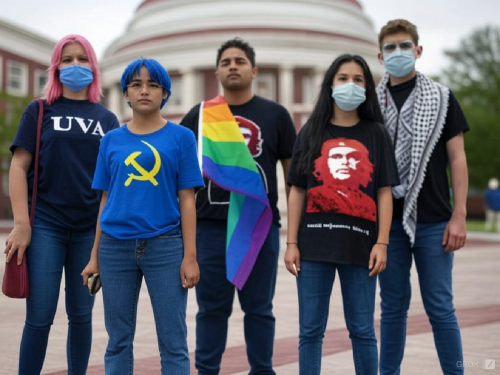
Image credit: The Babbling Beaver The University of Virginia’s student-led guide service was a fixture on campus, giving historical and admissions tours for half a century until it got suspended for daring to expose the loathsome history of this disgraceful slave-holding institution. The University Guide Service (UGS) has now returned as an independent, unsanctioned advocacy operation.
“Learning to loathe the founder of the oppressive university you attend is a critical rite of passage for budding student activists,” explained UGS president Sui Odium. “It’s the first step toward hating everything from your country to your own body to Western Civilization itself. Until you shed your false consciousness you can never be free.”
Disgruntled alumni upset by reports of UGS depredations have been advised to seek psychological intervention to help rid them of the systemic racism that underlies all southern values.
(more…)
-
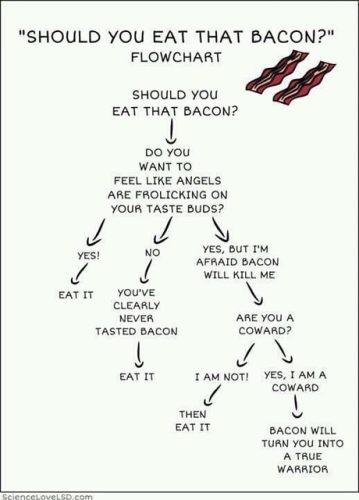
Bacon Meme of the Week
-
How Will VCU Pay for Student Athletes?

Image credit: Bing Image Creator by James A. Bacon
Opting into an NCAA settlement that professionalizes college athletics, Virginia Commonwealth University has decided it will pay its student athletes a total of between $4 million and $5 million a year, reports the Richmond Times-Dispatch.
“Amateurism as we know it is dead,” Athletic Director Ed McLaughlin told the school’s Board of Visitors. “There is a new collegiate model.”
How to divvy up those funds between different men and women’s track, soccer, tennis and basketball teams is one big question. Another is where the money will come from. The VCU athletics budget was roughly $45 million in fiscal 2023, according to the RTD. A big chunk of that sum comes from students who pay a $1,400 athletic fee.
VCU will ask donors to make gifts, and the athletic department will review its revenue and costs, McLaughlin said. VCU is not planning to add a surcharge to ticket prices like the University of Tennessee’s 10% “talent fee.” It won’t be easy, McLaughlin conceded. “We have to make the financial jigsaw puzzle fit together.”
(more…)
-
At Least They’re Culturally Competent!
by James A. Bacon
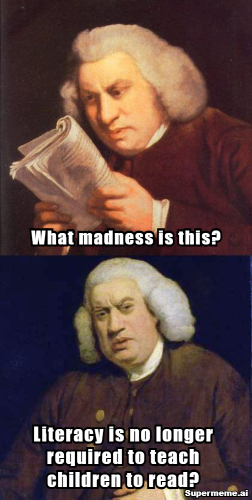
A couple of days ago I skewered New Jersey for enacting a law, effective Jan. 1, that removes a requirement for teachers to pass a reading, writing and mathematics test for licensure. Noting that Virginia teachers seeking initial licensure must pass the Virginia Communication and Literacy Assessment (VCLA), I expressed the hope that the General Assembly “progressives,” who have done everything in their power to make Virginia more like New Jersey, didn’t get any ideas.
Too late.
It turns out that Virginia beat New Jersey to being New Jersey. In April the General Assembly passed — and Governor Glenn Youngkin signed — a similar bill, HB 731, introduced by Del. Briana Sewell, D-Prince William.
That bill requires the Board of Education to eliminate the requirement “for any individual to take and receive a passing score on the Virginia Communication and Literacy Assessment as a condition of the initial award or renewal of a renewable license as a teacher in the Commonwealth.”
You can’t make this up.
Update: Read the comments. Readers make the case that the VCLA test was duplicative and unnecessary.
(more…)
-
Does a Hedge Fund Want to Buy This House?
by Dick Hall-Sizemore

State Sen. Glenn Sturtevant (R-Chesterfield) plans to reintroduce his bill to prohibit investment firms worth more than $50 million from purchasing homes in Virginia, reports the Virginia Mercury.
The bill is a reaction to the perception that investment firms are buying a disproportionate share of houses on the market, particularly houses that have traditionally be seen as “starter” homes. Many feel that the presence of these large financial firms in the market has been a major factor in pushing real estate prices beyond the reach of many first-time home buyers. “It’s ultimately not fair for them to be competing with regular people,” Sturtevant explained.
It is not clear how big this “problem” is. Sturtevant cites research that shows that “around 4,300 single-family homes in the Richmond area are owned by investors.” A study of real estate sales in Richmond, Henrico, and Chesterfield during 2018-2021 showed that the three areas in which investor activity was the highest also experienced the highest increase in the median price of a house. However, in neither of these instances is “investor” defined. It could be a large hedge fund or it could be an individual buying a house with the intention of flipping it or a couple buying a house as a long-term rental investment. Sturtevant says that the two latter types of investors are not the target of his bill.
(more…)
-
Color Us Unsurprised: Something In The Water Festival Missed Another Deadline.

Something nasty in the water… Image created by ChatGPT by Kerry Dougherty
Happy New Year, fellow suckers.
I’m speaking only to residents of Virginia Beach where Pharrell Williams apparently has the city by the short hairs.
After staging a hugely successful music festival on the beach in 2019 – one I supported and attended – it’s been one disaster and delay after another as the Beach native pronounced the city “toxic” then reversed his opinion once city officials traveled to New York City and kissed his ring – or something else – in a secret meeting.
Still, no festival in 2024 and 2025 is looking iffy.
Who will ever forget when Pharrell cancelled October’s Something In The Water festival in September after tickets went on sale?
The excuse? Blah, blah, blah, something about the concert not being ready.
I’ll say.
Instead of saying goodbye to the city’s favorite son and wishing him well after that fiasco, the Beach politicians with spines of jellyfish signaled that despite their stern warnings they were willing to put up with endless shenanigans to toss hundreds of thousands of tax dollars at a billionaire.
All to keep a rap festival in the city. Continue reading.
-
The Sordid Reality of “Great and Good”
by James A. Bacon
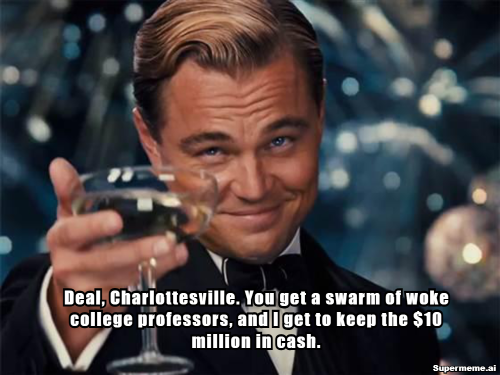
The University of Virginia’s 2030 Plan for creating “a great and good university” lists ten key initiatives, one of which is its “good neighbor program.” The description reads in its entirety:
In partnership with our neighbors in Charlottesville and surrounding counties, we will work toward being a just and sustainable community. We will work collaboratively, and with all due humility, with our community partners to address key challenges, including housing, living wages, local educational opportunities, and access to health care. We will set ambitious sustainability goals and develop a realistic plan to meet them, including an improved transportation system. We will launch the Center for the Redress of Inequity, which will support community-engaged scholarship to model how public
research universities can help reduce racial and socioeconomic inequities in our local communities. To make it easier for our neighbors to interact with the University, we will create a community engagement office in an easily accessible location in town.Charlottesville city leaders would settle for $10 million a year in lieu of property taxes.
(more…)
-
TSA Harrisonburg
by Joe Fitzgerald
Deb and I, encouraged by someone who’d lost a spouse to Covid and assisted by those who wanted to help share information, created TSAHarrisonburg on Facebook a few years ago to report on infection and mortality statistics in the Shenandoah Valley. We’re pivoting the site to respond to another community crisis, just as dangerous in a different way: the disappearance of media resources and resulting drop in coverage of local news.
In order to effectively own and operate your local government, you have to know what it’s doing.
To that end, we’ll be reporting on Harrisonburg government discussions and decisions, specifically City Council, School Board, and Planning Commission meetings, to be published simultaneously on Substack and Facebook, as soon as feasible after the meetings conclude.
We view this work as a complement to local sources such as The Citizen, WHSV, WSVA , WMRA and the DNR – not a substitute. They provide breakfast, lunch and dinner; we’re the vitamin supplement to make sure you get all your trace nutritional requirements.
(more…)
-
Bacon Bits: The “What Is Reality?” Edition

Lunacy down on the farm… The FBI has arrested Brad Kenneth Spafford following a raid at his 20-acre Isle of Wight County farm and charged him with possessing an unregistered short-barrel rifle. Law enforcement overreach? Well, FBI agents discovered more than 150 pipe bombs and other explosive devices, reports The Virginian-Pilot. They also found a backpack upon which Spafford, who is White, had printed the hashtag #NOLIVESMATTER. A neighbor said he used Joe Biden’s picture for target practice and, after a failed assassination attempt on Donald Trump, told the neighbor he hoped the shooter “doesn’t miss Kamala.” Spafford also espoused the bizarre conspiracy theory that “missing children in the news had been taken by the federal government to be trained as school shooters.”
And in a desperate attempt to salvage reality… I disagree with Senate Majority Leader Scott Surovell, D-Fairfax, about many things, but I think I’m with him on his latest concern. The use is spreading of AI-generated voices and images in campaign ads to create fake celebrity endorsements and other deceptive content. According to WUSA, Surovell wouldn’t ban the use of AI, but he would make campaign ads run conspicuous disclaimers. “AI generated material is extremely dangerous in a political environment and by the time anybody realizes it’s AI, it’s too late,” he told the broadcaster. Humans are predisposed to conspiratorial thinking as it is — the feds are kidnaping our children (see above), the moon landing was faked, Obama was born in Kenya, 9/11 was an inside job, Trump colluded with Putin to steal the election. AI will pour jet fuel on fake news and conspiracy mongering. We need to give serious thought on how to rein it in while protecting free speech.
Teach kids to read by hiring teachers who can’t read. AI disclaimers can’t save us from pure stupid, however. A law has gone into effect in New Jersey that purports to address the Garden State’s teacher shortage by removing a requirement for teachers to pass a reading, writing and mathematics test for certification. Here in Virginia teachers seeking initial licensure must pass the Virginia Communication and Literacy Assessment (VCLA), which creates a barrier to the hiring of a historically marginalized group commonly known as incompetents. (How long until the i word is banned?) Here’s hoping that the General Assembly’s so-called “progressives,” who have done everything in their power to make Virginia more like New Jersey, don’t get any ideas.
-
Happy New Year

Image credit: ChatGPT It’s going to be a wild ride, baby!
-
Crunching the Numbers on Elite Overproduction
by James A. Bacon
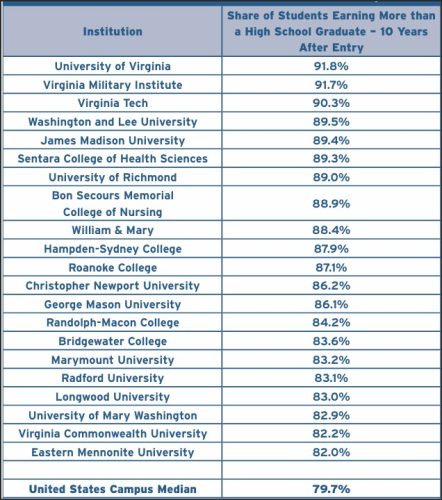
Wonder why young Americans are souring on the higher-ed value proposition? The Old Dominion University Strome College of Business’s “2024 State of the Commonwealth Report” supplies data that provides the answer.
Ten years after leaving high school, one in five bachelor’s degree recipients earned less than the median income of high school graduates here in Virginia.
The aggregate numbers hide a lot of variability between institutions, degree programs, and students’ socioeconomic background, the report cautions. But the bottom line is clear.
“Substantial proportions of college graduates end up earning less than the members of their high school graduating classes who did not attend college,” states the report in its chapter entitled, “Does It Still Pay to Attend College in Virginia?”
Even at the University of Virginia, the state’s flagship university with arguably the most selective admissions standards, nearly one in twelve graduates earned less than the median income for Virginia high school grads.
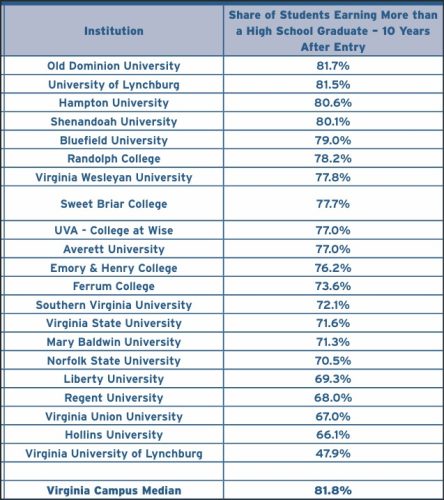
Worse yet at the opposite end of the spectrum, at the Virginia University of Lynchburg only 47.9% of graduates earned the high school average. By that measure, a majority of VUL grads were worse off than if they’d just entered the workforce after graduating high school! (The report did not examine for-profit colleges where the comparative earnings numbers for most institutions are even worse.)
Correction: In the paragraph above, I had mistakenly referred to the University of Lynchburg, a different institution than the Virginia University of Lynchburg.
(more…)
-
Another Reason to Avoid the Virginia Lottery
by Dick Hall-Sizemore
One of the top selling points made for approval of the establishment of the Virginia Lottery was that lottery profits would be dedicated to public education in Virginia.
That is still the message that the Virginia Lottery peddles. Scroll to the bottom of its website home page, past all the current offerings, and you will see, in large font, the “total Virginia Lottery profits generated for Virginia’s K-12 public schools since 1999.” The message: “Buy a lottery ticket. If you don’t win, your money goes to Virginia schools.”
Anyone familiar with the Virginia budget knows this is specious. The lottery profits are used to supplant general fund support for K-12. If there were not the lottery profits, the amount of state money for K-12 would likely be the same but would come entirely from the general fund. The explanatory bullets in Governor Youngkin’s budget document provides clear proof of that relationship. The estimate of lottery profits increases by $73.3 million for the biennium. However, that does not mean that the amount of state funding for K-12 increases by that amount. Instead, the existing general fund appropriation for K-12 is reduced, almost dollar for dollar, by the amount of the increase in lottery profits. The result is a $3.00 net increase in funding for K-12 due to the increase in lottery profits.

