Bacon’s Rebellion covers a wide range of public policy issues in Virginia with a special emphasis on the state budget, taxes, infrastructure, land use, transportation, energy, the environment, K-12 education, higher education, and community health. Our mission is to provide Virginia citizens with the ideas and news they need to build more prosperous, livable and sustainable communities.
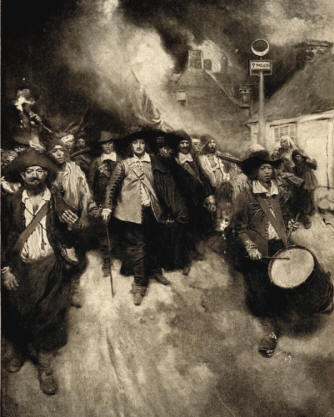
“Nathaniel Bacon and his Followers Burn Jamestown” — from the lithograph by Howard Pyle
The Original Bacon’s Rebellion
In 1676, a Henrico farmer by the name of Nathaniel Bacon led a series of expeditions to defend the frontier against Indian attack. Raising his own militia, he acted in defiance of the colonial governor, Sir William Berkeley, who preferred to deal with the Indians more diplomatically. Elected to the House of Burgesses, Bacon also pressed the interests of the small farmers and common people in the colonial assembly. In a “Declaration of the People” — the first expression of popular sovereignty in the English colonies — he accused Berkeley of raising unjust taxes, elevating his cronies to positions of high office, exercising a monopoly in the beaver trade and interfering with his campaigns against the Indians. The power struggle between Bacon and Berkeley led to a series of armed skirmishes culminating with the siege and burning of Jamestown, the colonial capital. Bacon’s death of “bloodie flux” and “lousey” disease put an end to the first rebellion against English authority in the North American colonies.
The 21st Century Bacon’s Rebellion
Jim Bacon, publisher of Bacon’s Rebellion, has no known relationship to Nathaniel Bacon, and he bears no malice towards Virginia’s Indian tribes. However, he does live in Henrico County, and he does share his namesake’s predilections for shaking up the established order.
Starting his journalistic career in 1976 with the Martinsville Bulletin, Bacon worked at the Roanoke Times for five years and Virginia Business magazine for 16 years, where he rose to the rank of publisher and editor-in-chief. In 2002, he , launched Bacon’s Rebellion as an electronic newsletter. Three years later, he added the Bacon’s Rebellion blog as an affiliated but stand-alone project. The blog has gone through several permutations as blogging platforms have evolved
Bacon’s Rebellion is rare among Virginia’s leading political blogs in having no partisan affiliation. Although the blog skews conservative and libertarian in philosophy — read more about the blog and its contributors here — we are happy to entertain a wide range of ideological viewpoints from guest columnists. We believe strongly in the value of maintaining a civil dialogue.
You can contact Bacon at jabacon[at]baconsrebellion.com.
Guiding Principles of the Rebellion
The philosophy articulated by Jim Bacon in the 21st-century Bacon’s Rebellion is based on the following guiding principles, which have endured without significant modification since 2002:
■ Free markets and the individual pursuit of enlightened self-interest are the most efficient means of allocating resources and creating wealth – most of the time.
■ The vitality of the economy and well being of a community also require collective action, either in the civic realm or in the governmental realm.
■ Government is a necessary evil which requires constant oversight. Even at the state and local level, it falls prey to organized special interests seeking to acquire funds, influence regulations or curry some other favor.
■ Governmental institutions are slower to adapt to changing circumstances than are business institutions. Governments lack the discipline of the marketplace – failure does not result in bankruptcy, liquidation or takeover by a stronger entity.
■ Governmental institutions also have no clear “bottom line.” Governments have nothing comparable to sales, profits, return on investment and other vital measures – as defined by Generally Accepted Accounting Principles – that investors use to evaluate corporations.
■ The managers of all institutions, whether business, educational, civic or governmental, tend to shun accountability. The rules of governance, by which citizens hold these entities accountable, must be constantly updated. And leaders of these institutions must be subject to continual scrutiny.
■ Any proper accounting of the general welfare must include the health of the environment.
■ The proper focus of social justice is to create equal rights under the law and to open up economic opportunities for all citizens — not to mandate equal outcomes.