In the 1980s, two University of Pennsylvania criminologists published a research study on the impact of mandatory arrests in cases of domestic violence in Minneapolis, Minn. They found that the arrests led to lower rates of domestic violence. Based on that one study, police departments across the country began instituting mandatory arrests. But experiments conducted in other cities found mixed results. In Omaha and Charlotte, violence increased.
Therein lies a cautionary tale. The logic is slowly sinking in among legislators that it’s a good idea to base public policy on the evidence. It’s good to ask the question, “Does this policy do what it’s supposed to do?” But not all systems for measuring results are created equal.
A new paper by David D. Muhlhausen with the Heritage Foundation argues that Congress should invest a bit more not only to measure results of its programs but to measure them according to the precepts of methodologically sound social science. His logic applies equally to the General Assembly.
Mulhausen advocates the “gold standard” of evaluation designs: Setting up control groups, randomizing the assignation of individuals to those groups, and conducting experiments in multiple locations. To do otherwise, is to risk reporting ambiguous results and nullify the whole purpose of conducting the experiment. He recommends the following: (1) New or reauthorized programs should specifically mandate experimental evaluation of the program; (2) the experimental evaluations should be large-scale, multi-site studies; (3) legislators should specify the types of outcome measures to be used to assess effectiveness.
To do otherwise is to base public policy on anecdotal evidence — typically in a political context in which self-interested parties are usually the ones generating the anecdotes. Testimony orchestrated by special interests simply cannot be trusted to provide an accurate depiction of reality.
A less well-known ratings agency, Egan-Jones, has downgraded the federal government’s debt from AAA to AA+. The report explaining why can be found here. If you’re not a client, Zero Hedge has the press release, complete with charts, which gives you a solid understanding of the report’s contents:
We are taking a negative action not based on the delay in raising the debt ceiling but rather our concern about the high level of debt to GDP in excess of 100% compared to Canada’s 35%. Nonetheless, since the US’s debt is denominated in dollars, a hard default is unlikely.
So the mummery behind the debt ceiling talks has little to do with the government’s fundamentals, which are only getting worse. This additional item is worth remembering as doomsday (or at least doomsday as it is preached in the press) approaches:
Egan-Jones does not view a country’s ability to print its own currency as a guarantee against default. Additionally, Egan-Jones generally views cases of excessive currency devaluation as a de facto default.
Based upon that last bit, one could argue that the Federal Reserve’s mass printing of money over the last several years has effectively rendered the United States a larger version of Zimbabwe.
File this under the heading of Fundamental Governance Reform. In a recent edition of the “Utne Reader,” Kirkpatrick Sales makes the case that the optimal size of a successful independent state is somewhere between 3 million and 5 million. By his logic, the United States is massively dysfunctional. Even Virginia is too big for its own good. (Maybe we’d all be better off in Northern Virginia did secede from the commonwealth!)
Were it not for the problem of national defense, I’d be all in favor of breaking up the country into smaller pieces. Fifty independent states would not do a very good job of keeping world sea lanes open for global trade. Otherwise, Sales’ argument reminds me of one that the urbanist Jane Jacobs once made (as I best recollect it), that maintaining a unitary currency, fiscal policy and monetary policy for a nation as diverse as the United States cannot possibly benefit all regions equally. Each region would be better off, she contended, it if could optimize its own mix of economic policies. Inspired by fiscal crises in the PIIGS countries, much the same debate is taking place in Europe today.
(Hat tip to EMR, who is too engaged in his “Enough?” project to do much blogging himself.)
Polish workers in London waiting on street corner for casual work
by James A. Bacon
I have long maintained that the flood of unskilled immigrants (whether documented or not) into the United States has had the effect of depressing the wage rates for unskilled American workers. It’s a matter of simple supply and demand: More competition for the same number of jobs drives down the compensation that unskilled laborers can demand.
But a new study of European labor markets suggests the analysis should be more nuanced, especially when viewed over a decade-long time horizon. I hate as much as the next guy to admit that I might be wrong, but I also try to remain open to new evidence and new logic. This study, “Immigration, Jobs and Employment Protection: Evidence from Europe,” compels me to question my earlier position.
By way of background, Western Europe saw a surge of immigration in the decade preceding the Global Financial Crisis that pushed the foreign-born population from 8% to 12% — very comparable to the impact of immigration in the U.S., where the percentage rose from 10.6% to 13.6% over the same period.
The authors, Francesco D’Amuri and Giovanni Peri, scrutinized the employment data to see whether the inflow of immigrants to 14 Western European countries decreased employment rates and/or if it altered the occupational distribution of natives with similar education and age. They found no impact upon native employment rates but significant evidence of a shift in occupations. Immigrants took “simple” (manual-routine) occupations and natives moved toward more “complex” (abstract-communication) jobs. Overall, the authors write, “immigration stimulated job creation, and the complexity of jobs offered to new native hires was higher relative to the complexity of destructed native jobs.”
They added one important addendum: The reallocation of natives to new, more complex occupations was significantly larger in countries with
more flexible labor laws. The tendency was particularly pronounced among less educated workers.
The question then arises: Could the same trend have held true in the United States? Did the flood of immigrants into unskilled and semi-skilled jobs act as an impetus for native-born Americans to raise their levels of educational achievement, engage in more training, and/or move up the occupational ladder? If the European pattern prevailed here, then immigration could have goaded native-born Americans to improve themselves. From a metaphysical standpoint, the implication is even more startling: It could mean that I was… wrong.
In support of the idea that immigration had the a similar impact here as in Europe, the U.S. has very flexible labor markets, making easier here than in some European countries for workers to move from one job sector to another. On the other hand, there are important unknowns. Does the uneven quality of the U.S. education system mean that some Americans are equipped to make the occupational transition while other Americans, the product of under-performing schools, lack the requisite skills to migrate to more “complex” jobs?
For the moment, we have to leave the question unanswered. The study did not analyze the U.S. data. So, I am not yet prepared to concede that my previous analysis was wrong. However, I must confess, D’Amuri and Peri identified a critical variable that I had overlooked.
The New York City school system performed a fascinating experiment over the past three years. The goal: to see if paying bonuses to school teachers and staff might spur educators to change how they teach enough to improve students’ educational achievement. There are some object lessons for Virginia, where legislators bandy about the idea of performance bonuses as an option for school reform.
The city set aside a $50 million pot of money to be distributed over three years to 200 or so schools (the precise number varied from year to year). The goal was to test the proposition that an incentive pay system would motivate educators to change their practices to ones more likely to improve student achievement, explains the Rand Corporation in a report, “A Big Apple for Educators,” summarizing the program.
Three years and $50 million years later, the measured effect on student achievement was indiscernible. But that doesn’t mean the experiment was a failure — it yielded knowledge on how not to structure a performance plan.
Given the egalitarian ethos of educators in New York City schools, roughly two-thirds of the schools chose to divvy up their bonus, if they won it, between all teachers and staff, regardless of individual performance. Thus, the bonus amounted to roughly $3,000 per person. Even schools that differentiated between individuals on the basis of absences or unsatisfactory staff ratings “generally remained cautious about deviating from egalitarian awards,” Rand reports, and slated 74% of the staff for the modal award amount. In other words, nearly all the bonus money was paid for collective performance.
Here’s the real kicker: While teachers and staff expressed a strong desire to win bonuses, “many winners reported that, after taxes, the bonus seemed insignificant. In fact, almost one-half of the teachers … indicated that the bonus was not large enough to motivate extra effort.” Consequently, Rand reports, the bonuses had no effect on teacher-reported attitudes, perceptions and behaviors, and they had no effect on student standardized test scores.
Bacon’s bottom line: If you want to improve performance by motivating teacher to intensify their individual effort, you need to make the bonuses big enough to matter. Spreading around the bonuses to everyone in the school is plain idiocy if you don’t have a clear alternative model you’re coaxing them to buy into. Just handing out money and hoping for the best doesn’t work.
How Disadvantaged Schools Use Title I Funds Government Accountability Office
School districts mainly use their federal Title I funds for improving student-teacher ratios, extending instructional time, professional development and the purchase of technology.
Putting Washington Money to Work for Washington Demos
Parking state tax revenues in a Washington Investment Trust, not the big money center banks, will underwrite the expansion of business in the state of Washington.
I’m normally not one for sermonizing. Hellfire-and-damnation preachers have been lamenting the moral decline of America for the past, oh, 300 years, and yet we survive. But sometimes I wonder. Could our country be experiencing a moral decline? It certainly feels so.
Let me make one point really clear. I don’t equate “moral” decline with a decline in god-fearing religion. I am, after all, an atheistic-leaning agnostic. But one can be an atheist-agnostic and still lament the disparagement of the old bourgeois virtues as enshrined in the University of Virginia’s honor code — you shall not lie, cheat or steal — and find despair in the normalization of depraved behavior. Let me offer four data points from the headlines of today and yesterday that inspired this jeremiad.
Teachers in Atlanta, Baltimore, Philadelphia and Houston stand accused of boosting standardized test scores by such means as correcting student papers and even helping students cheat themselves. As scary as the cheating itself is the excuse-making that followed. Said one Robert Schaeffer, public education director of the National Center for Fair and Open Testing, as quoted in the Washington Times: “The teachers and principals who changed test scores did something unethical and probably illegal, [but they were] caught between a rock and a hard place. We’ve created a climate that corrupted the educational process. The sole goal of education … became boosting scores by any mean necessary.”
That’s right — the cheaters are really victims of society’s unreasonable expectations. It comes as little surprise, then, that the American Association of School Administrators decided not to retract the “Superintendent of the Year” award given to Atlanta school superintendent, Beverly Hall, in 2009. “No charges have been brought,” said an AASA official. “There’s no conclusive evidence that she’s been found guilty of any kind of unethical behavior.”
A related phenomenon is the spread of plagiarism, which happens to be the topic of an essay by Thomas Bertonneau, a professor of comparative literature:
Plagiarism is one more index of the long- heralded Decline of the West. More and more students go to college; fewer and fewer of them are actually capable of rising to the higher learning. Colleges and universities, operating by the enrollment economy, actively seek students and bend or ignore admissions criteria to recruit them in numbers. Aggressively cynical and uncivilized, the popular culture promotes crass self-interest and narcissism.
The sitting vice president of the U.S.A. once, when a senator, plagiarized a campaign speech from his British member-of-Parliament counterpart, but he is the sitting vice president of the U.S.A. … Rampant plagiarism is an alarming moral problem. The destruction of shame makes theft and fraud thinkable options for an increasing number of students.
Ah, the destruction of shame. I think Bertonneau is on to something. The trait of being “non-judgmental” is widely deemed a prime virtue today. But when no one judges another’s behavior, shame disappears. When shame disappears, society loses its main sanction against all manner of vice.
Now, let’s move on to the normalization of depravity. The Huffington Post‘s “weird news” carries a story about the arrest of three brothers in a small Minnesota community for allegedly murdering their mother. States the account: “Jacob Cobb, 17, allegedly strangled mom Tamara Lee Mason on the living room floor when she suggested that her sons play the board game [Yahtzee] … last Christmas.” The boys hid their mother’s remains in a garbage can in a shed until the frozen ground softened enough to bury her in the backyard.
“It is very strange,” said Stevens County Sheriff Randy Willis. “She wanted to play Yahtzee and they didn’t. That seemed to be, in their minds, what expedited her sudden demise.”
Weird? Strange? It strikes me that we have raised a generation of sociopaths. These weren’t urban youth raised in a single-family household with a crack whore for a mother, whose despicable behavior would inspire all manner of excuse-making and cries for forgiveness. They were (to all appearances) small-town, middle class kids.
One final story, this one also from the HuffPo: A Southern California woman was arrested for cutting off the penis of her estranged husband. Catherine Kieu Becker allegedly prepared dinner for her husband and drugged him to make him drowsy. While he slept, she tied him to the bed. When he awakened, she cut his penis off with a knife — and here’s the piece de resistance — “threw it into the garbage disposal, turning it on as she did so.”
It has been nearly 20 years since the infamous Lorena Bobbitt chopped off her husband’s penis in a fit of spontaneous rage. A jury found her not guilty due to insanity arising from sexual, physical and emotional abuse. Her husband, Wayne Bobbitt, had his penis surgically reattached and proceeded to take a feature role in two porn movies. His brief porn career lead to a stint on World Wrestling Federation’s Monday Night Raw television program in the company of another porn star who had almost had his penis dismembered.
The Bobbitts gave us a two-fer — (1) a jury could not hold Lorena responsible for her action on the grounds of temporary insanity, and (2) the absence of shame in our culture enabled her violent, philandering husband to trade on his notoriety. After two decades of therapeutic blame avoidance, Ms. Becker’s case has not inspired anywhere near the shock and controversy that the Bobbitts’ did. Indeed, where Lorena threw her husband’s penis out the car window, she at least felt remorseful enough to later retrieve it. By contrast, Ms. Becker, tossed the offending organ in the garbage disposal, flipped the switch and then, when the police arrived, told them that her husband “deserved it.”
In mining the rich vein of dishonesty and corruption, I would be remiss not to mention Wall Street, a moral cesspool if ever there was one. The new ethic in America’s financial sector today: “If it’s not illegal, it’s OK.” Even if it is illegal, serve your time in jail, give a portion of your ill-gotten gains to charity and hire a publicist to get you on television. We are, after all, a country without shame. We will eagerly rehabilitate anyone’s reputation (unless the offender is a politician of the opposing party, in which case the old rules still apply).
What, then, becomes of a country in which educators set the most reprehensible example for our youth, in which the most successful know no bounds in their quest for the accumulation of wealth? What becomes of a society in which no one can be trusted and, therefore, no one trusts one another? What becomes of a country that has not only defined deviance down, but has all but abandoned the idea that deviance even exists? Is there any hope for us?
Standard & Poors takes Moody’s threat to downgrade U.S. debt if there’s no deal and goes a step further, saying, in effect, that while it believes the political class will come to some sort of deal, not all deals are created equal:
Congress and the Administration might also settle for a smaller increase in the debt ceiling, or they might agree on a plan that, while avoiding a near-term default, might not, in our view, materially improve our base case expectation for the future path of the net general government debt-to-GDP ratio. U.S. political debate is currently more focused on the need for medium-term fiscal consolidation than it has been for a decade. Based on this, we believe that an inability to reach an agreement now could indicate that an agreement will not be reached for several more years. We view an inability to timely agree and credibly implement medium-term fiscal consolidation policy as inconsistent with a ‘AAA’ sovereign rating, given the expected government debt trajectory noted above.
That would seem to indicate that if all parties concerned adopt Mitch McConnell’s “Plan B,” which would shift responsibility for debt ceiling increases to the President and avoid any serious changes to either spending or the tax code, S&P will likely downgrade U.S. debt within 90 days.
But one thing that has gotten lost in all the hand-waving, petulance and posturing over the debt ceiling is that none of the plans past, present or future would really cause spending to go down. As the Richmond Time-Dispatch reminds us this morning, even that draconian, world-ending plan from Rep. Paul Ryan would see federal spending continue to increase, though at a slower rate than that proposed by the President:
You might not have heard this from the president’s cheerleaders in the establishment media, but nobody in power has proposed to shrink the federal budget. Nobody. The current federal budget totals about $3.8 trillion. The Republican proposal, from Rep. Paul Ryan, would raise spending to $4.7 trillion over the next decade. Obama wants to raise it to $5.7 trillion. The fight is not over whether to raise spending — but by how much.
Mind you, those increases would come on top of the already staggering recent growth of the federal budget — which stood at $2.9 trillion just three years ago. Spending has ballooned 30 percent, and Republicans agree to grow it more.
In short, no one in Congress or the White House is talking about using honest math.
TANF Block Grants No Model for Entitlement Reform Center for Budgetary and Policy Priorities
Conservatives have lauded Temporary Assistance for Needy Families (TANF) block grants to the states as a model for entitlement reform. But the program has failed to keep up with needs during the recession and its aftermath.
For long-time followers of the Rebellion, Norm Leahy needs no introduction. But in case you’re relatively new to the blog, Norm is one Virginia’s longest-running and most illustrious bloggers, and the Rebellion had the good fortune to have him contribute columns in the days of yore. As part of our re-launch, we are expanding the number of contributors, and I invited Norm to join our stable of authors to add some libertarian heft to the commentary.
Along the way, Norm has blogged for One Man’s Trash and Tertium Quids before striking out on his own at The Score Radio Network. He will cross-post some of his posts from The Score.
(Norm, when you take a new photo of yourself with your hair combed…. let us know.)
States Will Save Money Under Obamacare Urban Institute
The Affordable Care Act is a good deal for the 50 states. Overall, they could save $90 billion over five years. But the specifics vary by state and region. Virginia will spend more $0.9 billion on Medicaid while savings from uncompensated care could range from $500 million to $1.1 billion.
Update on Documenting Violence against Women Government Accountability Office
You thought combating violence against women was hard? Just try coordinating the gathering of statistics about violence against women!
Peter Orszag, President Obama’s former Office of Management and Budget (OMB) chief, has finally come around to my way of thinking. His new thesis, explicated on Bloomberg.com, is almost identical to one of the core arguments I made in Boomergeddon, to wit, that the economy has entered a business cycle marked by tepid economic growth and that an anemic expansion will push budget deficits higher than forecast over the next several years.
Too bad he didn’t think that way back when he was running OMB and had some influence over President Obama, the stimulus package and health care reform. Oh, well. Better late than never.
Pardon me while I gloat. After all, gloating is really all I have. I’m not influencing national policy like Orszag did, nor am I making zillions of dollars on Wall Street, like Orszag, now vice chairman of global banking at Citigroup, is now doing. I have to take my pleasures where I can find them.
In Boomergeddon, I critiqued the economic-growth assumptions embedded in the 10-year budget forecast that accompanied Obama’s proposed FY 2011 budget. I compared the projected growth rate of the United States economy, prepared by Orszag’s team, with that of previous business cycles under Reagan, Clinton and Bush. The Obama forecast assumed a business cycle that would almost equal those of the super-heated Reagan/Bush I and Clinton, Internet-era expansions. While most mainstream economists found that to be perfectly plausible at the time, I did not.
It was clear to me that the collapse of the real estate boom marked the end of massive consumer borrowing — the end of the era of mass overconsumption, to use a phrase bandied about this blog. Consumer spending, which had fueled the previous three economic expansions, would be a drag. It was equally clear that there was a massive overhang of bad debt in the real estate markets, both residential and commercial. Those critical sectors also would be laggards. I also foresaw that state/local government spending would remain depressed for longer than normal during the business cycle, and I predicted that inflation in commodity prices (energy, raw materials, food) would exercise a dampening effect on expansion earlier in the business cycle than in the past. Finally, as any doofus could have foretold, federal fiscal and monetary stimulus would have to end, and when it did, the economy would lose even more momentum.
That doesn’t sound especially prescient today — those are basically the factors that anyone would cite to explain the economy’s lackluster growth. Trouble is, back when I was writing Boomergeddon a year to a year-and-a-half ago, only a handful of gold bugs and other gloom mongers were paying attention to those indicators. Looking toward the longer term, I noted that slower population growth, the steady drift of corporate America toward rent-seeking behavior (competing in the political sphere by seeking subsidies, loan guarantees and favorable regulations instead of through market innovation), the uncertainties created by massive government indebtedness and turmoil in European sovereign bond markets also would depress growth.
What I underestimated, although I did allude to it, was the negative impact of Obama economic policies. For the most part, however, I left Obama’s policies out of the equation because I knew that advancing that argument would ignite the partisan passions of those who would defend the president to the death. It was enough to know, I said, that economic growth would remain depressed no matter who was in charge, and no matter what economic policies they pursued.
So, how did my analysis play out? Listen to Orszag: “If we are in for sluggish growth over the next few years, the labor market won’t be the only aspect of the economy that does worse than official projections; the budget deficit will be significantly bigger as well.” He continues:
The CBO paints a surprisingly auspicious picture of the fiscal shortfall, averaging 3.4 percent of gross domestic product over the next decade and dipping to about 3 percent by 2020. … [The Center for Budgetary and Policy Priorities] predicts a more realistic deficit for the next 10 years of 5.7 percent of GDP under current policies, and hovering around 6 percent toward the end of the decade. The dollar amount of the cumulative deficit over the next decade is projected to exceed $11 trillion.
But the actual picture could be even worse. Just as I asked Chmura Economics & Analytics, a Richmond-based consulting firm, to calculate the fiscal impact of slow economic growth and a late-2010s recession on the budget, Orszag asked Richard Kogan with the CBPP to run a similar exercise.
The CBO assumes economic growth will exceed 3 percent per year from 2012 to 2016 before gradually declining to a bit more than 2 percent in 2021. What if, instead, growth remains at 2 percent to 2.5 percent for the next decade? I asked Kogan to recalculate the budget numbers assuming a constant growth rate of 2.25 percent per year, which seems a plausible hard-slog scenario.
He found that the deficit then averages more than 7 percent of GDP. By 2021, it is more than 8.5 percent of GDP and increasing.
There you have it. All Orszag’s analysis now lacks is an understanding of what happens when interest rates start pushing higher than he was predicting a year and a half ago. That’s when the deficit really goes through the roof. All things considered, the economic thesis of Boomergeddon is holding up remarkably well. If you want to understand the economic dynamics driving the budget crisis today, try reading the analysis of someone (me) who saw what was coming. Order Boomergeddon today. It is incisive yet written in language that any well-read layman can understand.
Has the wave of illegal immigration into the United States crested? Is the flood of undocumented workers one of those problems that, if you wait long enough, just fades away? Michael Barone with the Washington Examiner makes a fascinating case that maybe, just maybe, this contentious matter has run its course.
Consider… The great American job machine is sputtering, which lessens demand for unskilled labor from across the border. Even if it picks back up, spreading use of the federal e-Verify system is cutting down on the hiring of undocumented workers. Meanwhile, the birth rate in Mexico has fallen from seven children per woman on average in 1971 to two in 2010, and living standards in Mexico are rapidly improving. Both trends tend to dry up supply.
Another factor, not noted in Barone’s article, is the increasing cost associated with crossing the Mexico-U.S. border. As violent criminal syndicates take over the business of smuggling workers across the border, Mexicans and Central Americans passing through Mexico run increasing risk of being robbed, kidnapped, extorted or even killed. The criminals create a fear factor that the U.S. Border Patrol never could.
It is entirely possible that more illegals are leaving the U.S. than entering it. The Pew Hispanic Center estimates the 2010 illegal population at 11.2 million, down from 12 million at the peak in 2007.
Legal Hispanic migration to the U.S. undoubtedly will continue, and that’s just fine. Hopefully, the declining number of illegals will ease the financial strain on schools, health care facilities and social services. Even better, a shifting supply-and-demand nexus for labor will open up more job opportunities, and perhaps even higher wages, for unskilled Americans.
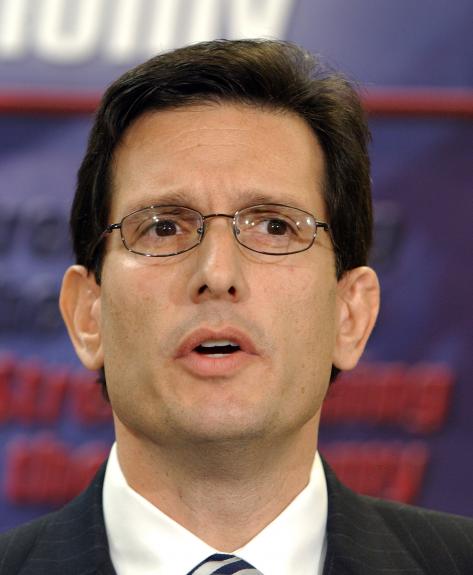
The budget drama in Washington is bringing out some disturbing character flaws, namely that of Richmond Golden Boy Eric Cantor.
Cantor, the House Majority Leader and a Main Street Republican from Henrico County, has been playing a dangerous game of chicken with Barack Obama and the Democrats over budget deals that would allow the absolutely necessary raising of the federal debt ceiling.
Yet Cantor seems so self-absorbed by his rising political clout, he’s pissing a lot of other people off, too, including, the media says, Speaker of the House John Boehner, a fellow Republican and Cantor’s senior who seems more willing to compromise, which is exactly what is needed at this point.
Cantor seems to love to play Peck’s Bad Boy. He walked out of critical meetings, saying they have to go to the Obama level. Then he declares that “Obama’s thinking is unfathomable to me.” As Washington Post columnist Dana Milbank notes, Cantor has gone so far as to adopt the Cantor snarl, in which he raises his upper lip in disgust and snaps out, “That is laughable on its face.”
Boy Wonder is working hard to play to the Tea Party crowd that had dissed him in last year’s elections as a mere toadie to the big business interests which is exactly what he is. So, our “Young Gun” is trying to out-Tea Party the Tea Party by stubornly refusing any tax hikes which will be need to resolve the budget crisis. You can’t solve the problem through cuts along. That’s like denying a dying man blood.
What we’re now getting is Young Eric, the Spoiled Little Rich Boy of Richmond who was raised in such sheltered, privileged environments as Richmond’s private Collegiate School that oozes entitlement and provincial power. Cantor has never had to face a critical media — The Richmond Times-Dispatch is in his pocket. His wife is on the board of directors of Media General.
Apparently, back when he was graduating from Collegiate, Cantor chose for his yearbook quote: “I want what I want when I want it.”
His district, Virginia and the nation deserve a lot better than this behavior. The stakes are way too high.
The year: 2075. The American colonies on the Moon are getting restless under Washington’s tyrannical rule….
This second edition of “Dust Mites” has a snazzy new cover, includes helpful lunar maps, and is 5,000 words tighter than the original. The sequel, “Trogs,” is scheduled for publication this summer.
Advertisement
Advertisement
Advertisement
Advertisement
About
Bacon’s Rebellion is Virginia’s leading politically non-aligned portal for news, opinions and analysis about state, regional and local public policy. Read more about us here.
Fund the Rebellion
Shake up the status quo! Your contributions will be used to pay for faster download speeds and grow readership. Make a one-time donation by credit card or contribute a small sum monthly.
Can’t wait until tomorrow
For your Bacon’s Rebellion fix?
Enter your email address to receive immediate notifications of new posts by email.
SUBSCRIBE
Search Bacon’s Rebellion
Categories
Archives
The Jefferson Council
Protecting Thomas Jefferson’s Legacy at the University of Virginia
Forgot Your Password?
Shoot me an email and I’ll generate a new password for you.

 by James A. Bacon