• The Wonk Salon, July 7, 2011

    Stalemate in the War on Poverty
    Brookings Institution
    Forty-seven years and trillions of dollars later, Americans haven’t come close to winning the war on poverty. Unemployment, low wages, dissolving families, mediocre education and an influx of ill-educated immigrants keep poverty rates high.

    Want Better Schools? Deal with the Bad Teachers
    Hoover Institution
    Replacing the worst 5% to 10% of school teachers would dramatically lift educational the achievement level of American students.

    Let States Opt Out of the Dysfunctional Highway Trust Fund
    Heritage Foundation
    Let states opt out of the federal highway trust fund, from which a third of the revenue is pillaged for non-road projects, and hand over the money in a block grant.

    The Impact of Job Losses on Student Achievement
    National Bureau of Economic Research
    When you’re rating school systems by their ability to show Adequate Yearly Progress under No Child Left Behind, just remember that high unemployment among parents and in the community has a deleterious effect on student achievement.

    Tort Reform Won’t Halt Rising Health Care Costs
    Century Foundation
    Conservative arguments that capping awards on medical malpractice lawsuits can contain health care costs are totally bogus.

    Time to Get Cracking on Setting up Health Care Exchanges
    Center for American Progress
    Obamacare requires states to set up health care exchanges by 2014, or Uncle Sam will do the job for them. States have a lot to think about before they get started.


  • The Wonk Salon, July 6, 2011

    Kentucky Medicaid: Expensive and Ineffective
    Bluegrass Institute
    Obamacare will suck people people out of private health plans and accelerate the rising cost of Medicaid. Program incentives thwart sound medical practice, and participants show little improvement in their health.

    Maternity Leave Has Little Impact on Childrens’ Cognitive Development
    National Bureau of Economic Research
    Paid maternity leave is often justified on the grounds that stay-at-home moms foster babies’ cognitive development. Turns out that, at least among Canadians, that’s not true.

    Cut Driving to Reduce Greenhouse Gas Emissions and End Oil Imports
    World Resources Institute
    In 2008 transportation accounted for 71% of U.S. oil consumption and 31% of carbon dioxide emissions. Transportation spending should be targeted to projects that reduce both.

    Making Transit-Oriented Development Equitable and Inclusive
    Urban Land Institute
    Transit-Oriented Development is a glorious thing but planners must take care not to price out the poor.

    Meeting the Infrastructure Challenge
    Urban Land Institute
    The United States lags its global competition in investing in the infrastructure needed to support economic prosperity. Among the recommendations: Maintain what you’ve got, prioritize gateway regions, and institute user fees to generate sustainable revenue streams.

    Most Local Government Pension Plans in Better Shape than State Funds
    Center for Retirement Research
    Despite some prominent exceptions, local governments are doing a better job overall than state governments in keeping their employee pension funds in sound actuarial condition.


  • Stop Shortchanging Road Maintenance!

    The General Assembly had the right idea in 2007 when it passed legislation to enable Virginia’s urban counties to take over responsibility for secondary roads from the Virginia Department of Transportation. Accountability for road-building decisions should be seated at the same level of government as accountability for land use decisions.

    But as Jonathan Gifford, a public policy professor at George Mason University, explained in a report to Transportation Secretary Sean T. Connaughton, there was one little problem: There weren’t any takers. “County officials,” he wrote, generally agreed that state payments, as currently set under the Virginia Code, will not cover all the costs of a local road program for maintaining secondary roads.”

    Gifford then explored a range of options for secondary road policy, from sticking to the current policy, which effectively means doing nothing, to raising budgetary allowances for secondary roads, implementing performance-based maintenance contracting, empowering localities to raise revenues and imposing devolution upon the counties.

    Ultimately, it all boils down to money. There’s not enough of it, and county supervisors don’t want to impose new taxes upon their citizenry. What’s the solution? Here’s my proposal. VDOT should jack up maintenance payments to levels that approximate costs. Where does VDOT get the money? By fully funding its maintenance budget, even if it means sacrificing new road construction.

    Remember, the state’s top should be to maintain the existing road network. Allowing the system to deteriorate will not save money — it will only postpone expenditures. Because roadways deteriorate at an exponential rate over time, the postponed expenses will increase exponentially over time. Such a policy is incredibly short-sighted and stupid.

    How, then, do we fund new construction? Through mechanisms like tolls, time-of-day pricing, tax increment financing and a Vehicle Miles Driven tax in which the users (drivers) and beneficiaries (property owners) of roadway improvements are the ones who pay for new infrastructure, not the general public. For details, I refer the reader to any number of past articles and blog posts.


  • The Wonk Salon, July 5, 2011

    The Disconnect Between Government Supply and Private Demand in Highway Infrastructure
    Heritage Foundation
    The private sector manufactures cars; there is no shortage of cars. The public sector owns and operates most transportation infrastructure; there is a chronic shortage of roads, highways and bridges. Connect the dots.

    Public-Private Finance Tools for Energy Efficiency
    World Resources Institute
    Financing has long been a barrier to investment in energy-conservation projects, but a variety of public-private financing tools can help unlock capital flows.


  • Planters, Merchants, Speculators, Rebels

    Upon the 4th of July, one’s thoughts naturally turn to the founders of this great country who risked everything to protect their liberties. As 21st-century Americans, we look back upon the people and events of 1776 from a vantage point that views the struggle for independence as entirely natural. Of course Americans wanted their freedom! What else would we expect?

    In chronicling the American Revolution, historians tend to focus on the causes of the rift between the colonies and England. As a consequence, they dwell upon the factors that separated us. Overlooked in such a perspective are the ties that bound us to the mother country. I have a new-found sense of those links from reading “The Fabulous History of the Dismal Swamp Company.

    Author Charles Royster follows the fortunes of the men who in 1767 founded the Dismal Swamp Company. Investors included George Washington, William Byrd and several lesser-known though no less fascinating personalities. The purpose of the venture was to drain the swamp and create land that could be sold to settlers. The enterprise floundered from the lack of strong on-the-spot management and never succeeded in its primary aim, but it did manage to cut and sell a lot of timber. Tangible remains of the company can be seen in the Dismal Swamp Canal, which has since been incorporated into the Intracoastal Waterway.

    The commerce between the colonies and mother country was lively. Ambitious young Englishmen came to the colonies to make their fortunes, then returned to live a more cosmopolitan life in London. English financiers and merchants extended large amounts of credit to Virginia planters. The planters, while aspiring to aristocratic lifestyles and often living beyond their means, were far a far more entrepreneurial bunch than I had imagined. Tobacco cultivation was merely a sideline for many. Investors in the Dismal Swamp company also were merchants and land speculators. (George Washington was one of the great land speculators of American history.) They would pursue profit wherever it took them, be it growing wheat and hemp, cutting timber, mining iron or shipping produce to the West Indies sugar plantations.

    Business was organized around a nexus of trade and credit built upon relations of trust. Economically and financially, Virginia spun in the orbit of London. The planters, always financially overextended, were beholden to the bankers, lenders and insurers in the great metropolis. One of those described in the book was Anthony Bacon (no relation), a ship’s captain turned colonial investor and arms contractor to the English government. Just as Bacon had his agents in Virginia to look after his interests, Virginians had their agents in London. In the world of business, Virginia and England were joined at the hip.

    In 1776 the Virginia signers of the Declaration of Independence risked everything. As modern-day pundits commonly observe in their obligatory July 4th columns, the revolutionaries put their property, their lives, their sacred honor, at risk. Less commonly recognized are the mundane risks they took. In war, their goods would be shut out of English markets. Their ships would be subject to seizure. Their lines of credit would be cut off. Vital business relationships would be severed. Their livelihoods would be put in jeopardy. Yet they rebelled anyway.

    As we celebrate our independence with hotdogs and fireworks, we would do well to remember the men and women who, however short they fall from our 21st-century ideals, risked much so we could enjoy our freedoms.


  • Broadband: Who’s Got It, and Who Doesn’t

    The state Office of Telework Promotion and Broadband Assistance has published a map showing broadband penetration in Virginia. There is a broadband “gap,” as one would expect. But I would argue that it’s nothing to worry about — a gap exists only because the bar for what constitutes cutting-edge broadband service is always getting raised.

    Personal cell phone coverage blankets nearly the entire state. Even the most lightly populated counties in the the Old Dominion have pockets of cell phone coverage. Broadband wireline is a little patchier but nearly every community of any size is connected. The gap today is between those who have access to “advanced” wireless mobile broadband and those who don’t. That service is still limited, for the most part, to the state’s largest metro areas. (Click on map for more legible image.)

    But never fear. If the past is prologue, the telecom companies will first penetrate the densest most populated markets because that’s where the biggest revenue gains and profit margins are. Then they will move into smaller communities. To ask them to do otherwise would be foolhardy. It’s the cash generated by the early investments that make possible to make the later investments. Living in the countryside has its advantages and disadvantages. You get to see the stars at night. But, then, you have to wait for access to the latest broadband technology.


  • Virginia Secondary Roads — Bad and Getting Worse, with No Remedy in Sight

    Strap on your seat belts, folks, it’s going to be a wild ride. The condition of Virginia’s secondary road system is deteriorating. State funding available for road maintenance is shrinking. And not a single county has accepted the option to take over responsibility for their own secondary roads because they are worried that the state won’t provide them enough money to do the job.

    Those are among the conclusions of a new report commissioned by Secretary of Transportation Sean T. Connaughton and authored by Jonathan L. Gifford with the George Mason University School of Public Policy, “Policy Options for Secondary Road Construction and Management in the Commonwealth of Virginia.”

    A defining characteristic of Virginia’s road system is that it is overwhelmingly controlled by the state. The state owns 94.62% of all “rural” (non-urban) roads, the highest percentage in the country. Secondary roads comprise nearly four-fifths (78%) of all lane miles maintained by the Virginia Department of Transportation. Only West Virginia, Delaware and North Carolina are remotely close. By contrast, the state of New Jersey owns only 6.23% of rural roads.

    There are two very big problems with the current arrangement. First, there is a disconnect between land use planning at the county/city level and transportation planning by VDOT. As Gifford writes, “There is a large and growing recognition that successful development is inextricably tied to transportation facilities and services at every spatial scale, from the parcel level, to the block level, to the neighborhood level, to the corridor level, to the regional level.”

    The transportation and urban design community is increasingly focused on street design and traffic operations that accommodate a wide range of users, including not only motorists and trucks, but also pedestrians of all ages and levels of able-bodiedness, cyclists, and transit. “Complete Streets,” as they are sometimes called, involve a complex set of design elements, including pro visions for parking, bicycle lanes, transit stops and stations, sidewalks, street furniture and other appurtenances.

    Legislators tried to address the disconnect during the Kaine administration through new regulations for accepting of new secondary streets into the state system, managing access (curb cuts, driveways) to state roads, and requiring VDOT review of traffic impact for major rezoning and redevelopment plans. But some local governments and developers regard the added layer of review as needlessly intrusive and time-consuming.

    The second very big problem is VDOT’s inability to properly maintain the roads. With each passing year, revenue from the gasoline tax becomes less and less adequate to pay for maintenance and new construction. Although Virginia supposedly prioritizes maintenance, funding for secondary road maintenance has dropped over the past six years from $483 million in FY 2007 to $345 million in FY 2011.

    The consequence has been deteriorating road conditions. Between 2007 and 2009, Gifford says, “the prevalence of deficient pavement on the secondary system increased from 25% to 31% — that’s just two years. In some districts, the pavement deficiency rate approaches 50%. VDOT estimates total needs for secondary pavements of $1.3 billion.

    Now, here’s the part that should scare everyone. As the condition of roadway assets deteriorates, the cost of returning them to a state of good repair increases exponentially. “The basic science of pavement deterioration recognizes that the cost of restoring a pavement to a state of good repair rises rapidly as the pavement deteriorates,” Gifford writes. “Poor pavements also impose a social cost on users in the form of discomfort, increased vehicle operating and repair costs, and compromised safety.”

    The longer we delay repairs, the more expensive they will get. One day we will rue our short-sightedness.

    It makes economic sense to turn over responsibility of the secondary road system to county governments, which can then prioritize road improvements to mesh with their land use plans and supplement with local funds. But that’s a losing proposition politically. In 2007 the General Assembly passed a law that would allow several higher-density counties to establish Urban Transportation Service Districts that would allow them to assume maintenance and operation of the roadway network within the district. So far, there have been no takers. No one had faith that VDOT would be able to pay them sufficiently to offset their costs.

    Clearly, the status quo is a mess. Gifford advances a range of options for rectifying these problems, which I hope to discuss in a future post.


  • The Wonk Salon, July 2, 2011

    A Decade of Change in Virginia’s Population
    The Virginia Newsletter
    Northern Virginia dominated state population growth in the 2000s while many non-metro localities lost population. Racial minorities, Asians and Hispanics especially, gained population share.

    California Enacts “Amazon” Tax on Online Sales
    Tax Foundation
    California is the latest of seven states to tax sales of in-state affiliates of online retailers. If its experience follows that of the first six states, the Golden State won’t yield much gelt — just chase business away.


  • How to Succeed in Economic Development: Create a Positive Business Climate

    Anyone who still equates economic development with recruitment of manufacturing investment ought to read a new report by the Brookings Institution, “Responding to Manufacturing Job Less: What Can Economic Development Policy Do?”

    The report takes a close-up look at eight metropolitan areas — Charlotte, Cleveland, Grand Rapids, Hartford, Indianapolis, Louisville, Rochester and Scranton — over the period of 1980 to 2005 to see what policies and strategies the regional leaderships adopted in the wake of manufacturing job loss. The conclusion is not terribly comforting. While some initiatives might have perked up investment in particular manufacturing sectors, few of the policies pursued appeared to change a region’s economic trajectory.

    Louisville’s airport expansion in the 1980s and Indianapolis’ strategy to boost amateur athletics did shape economic growth in those two regions but the impact of most other initiatives was too limited to affect metropolitan regional economies. What seemed to have the most impact was (a) successful business strategies of major corporations and (b) basic economic characteristics of the region, such as access to transportation, quality of the labor force, state business regulations and the like.

    A logical conclusion of the Brookings report is that regional civic and political leaders are better off focusing on economic fundamentals than pursuing the economic development chimera of the day, be it semiconductors (the 1990s), biotech (the 2000s) or green energy (the 2010s). Local leaders are not very good at predicting what hot company in their region will take off, creating a new ecosystem of vendors, partners and buyers in its orbit. Rather than picking winners and losers, they should create an all-around business climate in which a wide array of industries can succeed.

    That happens to be something that Virginia is good at. In the latest CNBC ranking of the Top States for Business, the Old Dominion scored No. 1, edging out Texas, which had snagged the top spot last year. CNBC bases its rankings on the basis of cost of doing business, workforce, quality of life, infrastructure, economy, education, technology and innovation, business friendliness, access to capital and cost of living. Virginia moved up this year thanks to improvements in the tax burden, education and cost of doing business. (It lost ground in quality of life, due mainly to an increase in the percentage of uninsured.)

    States CNBC: “Virginia did what it does best — and has done in each year of our study: It turned in a solid all-around performance, with top ten finishes in five categories.” Virginia’s metropolitan regions could benefit from the same philosophy.


  • The Wonk Salon, July 1, 2011

    Time for the MWATA Board to Look in the Mirror
    Government Accountability Office
    The Metropolitan Washington Area Transit Authority needs to proceed with its proposed self-evaluation. The hoped-for result: A stronger focus on strategic planning and less time spent micro-managing the organization.

    New York’s Middle Class Under Attack
    Demos, Drum Major Institute
    New York’s rich are getting richer. The middle class is shrinking. Mind-blowing statistic: The top 1% of New York City’s income earners make 44% of the income.

    CHIP Children Have Hard Time Getting Physician Referrals
    Government Accountability Office
    Eighty-three percent of primary care physicians have CHIP-funded children enrolled as patients. But only 78% accept new CHIP patients. And only 47% of specialists take new CHIP patients.

    Minority Districts Make Congress More Liberal, Not Less
    National Bureau of Economic Research
    Forget the conventional wisdom: Creating majority-minority districts, both for blacks and Hispanics, makes states’ congressional districts more liberal.

    Race to the Top Needs to Share Best Practices
    Government Accountability Office
    The Obama administration invested $4 billion in 12 Race-to-the-Top initiatives. It would be a good idea for participating states to share best practices with each other and non-participating states as well.

    U.S. Needs to Train More Electrical Workers
    National Commission on Energy Policy
    An estimated one-third of the 400,000 employees of the nation’s electric power sector will retire in the next 10 years, and another 60,000 will be needed for renewable energy sources. A concerted effort is required to educate and train the workforce of the future.

    New Jersey Wind Initiative Will Cost Billions

    Beacon Hill Institute
    New Jersey’s Offshore Wind Economic Development Act aims to build 1,100 MW of generating capacity from offshore wind power. This study concludes that the net cost (cost, not benefit) to New Jersey will be $3.2 billion.


  • Not “Virginian” Enough? Dial Buford

    How do you make a company seem more “Virginian?” One way could be to hire an old-school, molasses-voiced, aristocracy wannabee who likes to wear bow ties and runs a Richmond brokerage.

    The problem is that Virginia Uranium, the Chatham-area company, wants the General Assembly to get rid of a two-decades-old moratorium on uranium mining so they can exploit the radioactive mineral’s wealth found underneath two farms owned by the principals of the firm. The chairman is Walter Coles Sr., a former Agency for International Development official who recently gained notoriety by taking a dozen or so legislators on an expenses-paid trip to visit Paris and an abandoned uranium mine also in France.

    Virginia Uranium, however, has been absorbed by a Canadian firm that used to be called Santoy Resources and has the new moniker, after its 2009 merger, of Virginia Energy Resources. So, it’s “Virginia” this and “Virginia” that for a firm that is actually based in Vancouver, British Columbia, 3,000 miles away and whose stock is traded on the Toronto bourse, not in the
    U.S.

    This is embarrassing because the Coles and their ilk are promoting the uranium mining plan as “Virginian.” Opponents to the mining, who fear it will ruin the rolling hills of Southside and the water supplies of several Tidewater cities, like to point that out.

    What to do? Call in S. Buford Scott, according to Richmond Times Dispatch columnist Jeff Schapiro. Scott, the chairman of the Richmond brokerage of Scott & Stringfellow, is apparently recruiting high-asset investors in this state to pony up at least $25,000 each to help with the mining effort. The goal is $2.4 million and to use these anonymous investors to lobby the
    General Assembly behind closed doors and, of course, anonymously, to lift the uranium ban, according to Schapiro.

    I was curious about the Canadian background aspect, so I called up Tony Perri, the investor relations man of Virginia Energy Resources in Vancouver. Perri was pleasant. His voice has a Canadian lilt and not a “Virginia” drawl. He told me that the firm has raised about $17 million. He works out of an office with just a few people. They are trying to get some uranium mining started in Canada, too. Why Vancouver? “Because it’s the home of thousands of publicly-traded mining companies,” he says. Publicly-traded in Canada, that is.

    Virginia Energy Resources’s stock symbol is “VAE” and the stock was going for about 17 cents (Canadian) today. Back in 2007, when global uranium prices were skyrocketing and the plan was hatched, the stock, then that of Santoy, was around $8 a share (Canadian).

    So one can see why there’s still another reason to drum up Old Dominion investors — the recent nuclear disaster in Japan, coupled by Germany’s decision to shut down its nuclear reactors in the future has gutted the world market for uranium. In Virginia, France’s Areva nuclear service firm will not be hiring hundreds of workers in Newport News as planned and Dominion still is nowhere on plans for a third reactor at its North Anna plant.

    It could be that S. Buford Scott’s investors could lose their shirts. Could be. But using Old Money Virginians to work behind the scenes to push this questionable and possibly environmentally disastrous project stinks just as much as the freebee trips to Paris. And it’s all so “Virginian.”

    Peter Galuszka


  • The Renaissance in Inter-City Buses

    Given all the bad news about safety problems with the Chinatown buses and all the billions of dollars being pumped into high-speed rail projects, you might be tempted to conclude that it’s just a matter of time before inter-city buses become as extinct as chariots. And you’d be wrong. Inter-city buses are undergoing a renaissance — and with virtually no assistance from the government. Indeed, one gets the impression from reading Randal O’Toole’s new paper, “Inter-city Buses: The Forgotten Mode,” that they represent the future of inter-city transport.

    Until 2006, it did appear that inter-city buses were going the way of the stage coach. That year, scheduled, inter-city traffic reached a nadir not seen in decades. Transportation planners had all but written off inter-city bus travel as a viable transportation mode.

    Then something remarkable happened: an entrepreneurial revolution transformed the stodgy old business. The old inter-city bus model, epitomized by Greyhound and Trailways, required people to visit central bus “stations,” akin to train stations, where they would buy a ticket and wait for their bus. The system required a lot of overhead. Today, upstart bus lines allow passengers to book and pay over the Internet, and they provide curbside loading and unloading. Furthermore, bus lines differentiate themselves by price: If you want cheap transportation with no frills, you can get it. If you are willing to pay more for bigger seats, leather upholstery, Internet connectivity and even meals and drinks, you can get it. Inter-city buses now appeal to a broader audience than ever before.

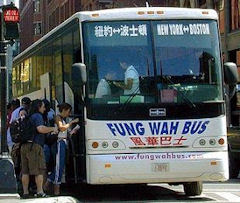
    As O’Toole describes it, the entrepreneurial vitality came from two sources, both from abroad. In 1998, a Chinese immigrant named Pei Lin Liang began offering bus rides between the Chinatowns in Boston and New York for $25. The business boomed and before long the Fung Wah (Magnificent Wind) bus line was providing seven trips daily. Competition grew as tour bus operators, many of Chinese heritage, crowded into the business. The rivalry got so fierce that a Chinatown bus war, complete with vandalism and two deaths, broke out.

    Meanwhile, across the pond, the United Kingdom had privatized and deregulated the government-owned bus service. Those moves lead to the creation of dozens of bus companies, which consolidated under the names of FirstGroup and Stagecoach. In 2006, Stagecoach established a U.S. presence and began expanding service.

    Buses have no trouble competing with government-subsidized Amtrak. Many bus lines charge lower fares (although those that provide superior comfort and service might charge more), their trips take no longer than high-speed rail for the most part, and bus lines offer a wide variety of pick-up and drop-off points. Between 2007 and 2010, inter-city bus travel increased by 27%.

    I would like to report that bus entrepreneurs accomplished all this with no government assistance whatsoever. That’s not quite true. Bus lines benefit from a lower fuel tax than automobiles (which means they still pay more taxes than Amtrak) as well as federal grants to help them comply with the Americans with Disabilities Act — equivalent to about $17 million a year. But that’s about one one-hundredth of the money dumped into Amtrak, O’Toole says.

    The one downside of the buses is safety. Most bus companies have an exemplary safety record, and inter-city bus travel compares favorably with automobile and rail traffic. But a number of high-profile crashes involving the Chinatown buses — see the Gooze’s treatment of this issue in an earlier post — suggest that tighter enforcement of existing safety rules is in order.

    If state, local and federal government wanted to help this transportation mode, which pays its own way and contributes less per passenger-mile to greenhouse gas emissions than either automobiles or trains, they don’t need to throw around a lot of money. What they need to do is get out of the way. O’Toole suggests ending Amtrak and high-speed rail subsidies. He also suggests that cities could encourage more bus competition by leasing curbside locations for loading and unloading passengers. (As much as I would like to see inter-city buses flourish, I would end the gasoline tax break. Put all transportation modes on a level playing field!!)

    The big takeaway here is what an entrepreneurial revolution can accomplish. If we want to end the dominance of what EMR calls the “autonomobile,” we need to systematically evict government from the shared ridership business, chase out the social engineers, end monopolies and franchises, and turn the entrepreneurs loose. If governments would only stick to the one thing it does well, setting and enforcing safety standards, shared ridership in Virginia, and America, would flourish.


  • The Wonk Salon, June 30, 2011

    State Budget Cuts Slow Economic Recovery
    Center on Budget and Policy Priorities
    State and local governments have slashed payroll by 535,000 since the beginning of the recession. The loss of jobs, combined with cuts to vendors and nonprofits, has slowed the economic recovery.

    The Lake Wobegon Effect: All Schools Are Above Average

    Demos
    Americans have a dim view of the quality of the nation’s schools. But more than three out of four think that their child’s school is just dandy.

    Teacher Bonuses Work in North Carolina
    American Enterprise Institute
    North Carolina’s teacher work-for-performance program delivers more bang for the buck than reduced class sizes and most other nostrums for improving education.


  • The Age Wave Is Coming

    The nation’s population is aging, as everyone knows. But it is aging at an uneven pace, reports a new Brookings Institution study, “The Uneven Aging and ‘Younging’ of America.” In 36 of the 100 largest metro areas the population below the age of 45 declined between 2000 and 2010. But in 29 metro areas, the under-45 population grew by 10% or more.

    Even though retirees continue to migrate in large numbers to the Sunbelt, most prefer to “age in place,” meaning that they don’t move anywhere. The people most likely to move are young. As a result, the areas areas with the greatest concentration of seniors are located primarily in Florida, the Northeast and the Midwest. The areas most likely to see gains in the number of young people are in the South (including Florida) and the West.

    Virginia saw fairly rapid growth in the over-45 population — in the 25% to 33% range. And it saw modest growth in the under-45 population, in the 0% to 5% range. (Click on map to see a national comparison.)

    As my former colleagues at the Boomer Project like to remind us, the age wave is coming — and Virginia is ill prepared. Unless the topic is pensions or entitlements, there is zero discussion of age wave-related issues in Virginia political campaigns. Fortunately, the Older Dominion Project, a public-private consortium, is doing yeoman’s work to highlight the issues.

    One of the questions asked in a recent statewide survey is whether Virginia’s transportation systems will become “age ready.” Currently, one in seven drivers is 65 or older. By 2030, the number will be one in four. As people age, their sight and hearing increasingly fail them and they process information more slowly. Safety analysts predict that by 2030, when all Boomers have turned 65, they could be responsible for 25% of all fatal crashes. What will seniors do when the keys are taken away?

    About 10% of the 65-and-over population, or 90,000 Virginians, report that lack of transportation made it difficult or impossible to conduct one or more daily tasks listed to the left during the past month.

    How will seniors get around? Will we have made our roads easier for seniors to navigate? Will we have built more walkable communities? Or will seniors have to depend increasingly upon neighbors, churches and social services to perform basic daily tasks?


  • Bioenergy Villages in Virginia? No way.

    As a follow-up to EMR’s post, “Job Creation in the Countryside,” which highlighted how German villages are adapting to contemporary economic challenges, I would point readers to a Wall Street Journal article, “In Bioenergy Villages, Power to the People.”

    Dozens of villages across Germany have begun generating their own heat and electricity from biofuels such as liquid manure, wood and locally grown energy crops. “We don’t want to be getting 3,050 liters of oil off some ship from Saudi Arabia,” one villager told the Journal. This way, “the money stays here in the community.”

    In Oberrosphe, villagers voted that residents would pay a flat rate of โ‚ฌ6,000 (about $8,500) to link to the new heating grid. While the central government did subsidize the project by โ‚ฌ1 million, the villagers came up with the rest. They estimate they will save โ‚ฌ400 to โ‚ฌ500 annually on heating costs, and even more when oil-heater maintenance costs are included. As a bonus, the village makes โ‚ฌ1.1 million annually by selling electricity from the solar panels atop the wood-chip burner back to the local power grid.

    Buried in the article is a key point: German villages can consider communal projects like this because the buildings are clustered close together. Thanks to the density and compactness of development within a clear edge, these urban enclaves (to borrow EMR terminology) can connect every residence to the heating system at relatively modest expense.

    Given differentials in energy costs, it’s not clear that small bioenergy plants would make sense in the United States. Unfortunately, Virginians in the countryside will never get a chance to evaluate the potential. Because they live in scattered residences with nothing resembling a clear edge, the high cost of creating a collective bioenergy facility is a non-starter.

    Likewise, scattered, low-density human settlement patterns in the Virginia countryside make it exceedingly expensive to install and upgrade high-bandwidth Internet connections. And don’t get me started about the cost of driving between scattered U.S. countryside locations as opposed to the cost of walking around in compact German villages.

    I don’t credit the Germans with any special prescience when it comes to their preference for clustering in villages (although I’m guessing that EMR will tell me otherwise), but there can be little doubt that the village form of human habitation, however it arose historically, is superior to the scattered, frontier-farm form of human habitation for purposes of leap-frogging into a globally connected economy. When Virginians think about economic development in the countryside, they need to think about fundamentals like human settlement patterns. If they are unwilling to evolve, I cannot see how they can create viable communities.

    (Photo credit: Wall Street Journal.)