• Drunk on Tea

    by Peter Galuszka

    In early October, Virginiaโ€™s tea party movement was on a roll. Hundreds of supporters crowded the Greater Richmond Convention Center for what was grandly called a โ€œPatriots Convention.โ€ Hallways and auditoriums were chockablock with budget hawks, Patrick Henry re-enactors, booksellers hawking Ayn Rand and middle-aged men packing .45-caliber Colt pistols in Velcro holsters with stickers that said โ€œGuns Save Lives.โ€

    Basking in the glow of the grass-roots protest movement against big government and taxes, Jamie Radtke, a 30-something former Republican political operative, was emerging as a bright new star. Sheโ€™d pulled together about 300 volunteers and as many as 8,000 sympathizers for the movement. Their clout was felt the following month when Republicans took the House of Representatives in a stunning defeat for President Barack Obama and his Democrats, forcing such congressmen as liberal Tom Perriello out of office.

    Fast forward to today. For weeks, the nation has been on a dangerous roller- coaster ride while the GOP-dominated House of Representatives has stubbornly refused to approve raising federal debt limits unless a budget with huge spending cuts goes with it. A breakthrough agreement on raising the federal debt limit appeared imminent Aug. 1 that would cut $2.4 trillion in spending with no tax increases. But the damage has been done in terms of diminishing Americaโ€™s reputation abroad. Chinaโ€™s Xinhua news agency trashed the United States for โ€œdangerously irresponsible conductโ€ that could tank not only its economy but also that of the rest of the world.

    So how did we get to the precipice? The major reason is the tea party, which seems to have surfaced the day Obama was inaugurated. Eight years of George W. Bushโ€™s blowout spending were forgotten. Jobs to help pull the country out of the worst recession were painted as evil. Government workers became lazy freeloaders. Washington was the focus of everything wrong. Freshmen Republican congressmen elected with tea party backing in 2010 did whatever they could to marginalize Obama and hold the nationโ€™s finances hostage while they pursued their stubborn dogma.

    Radtke, whoโ€™s running against former Gov. George Allen for the Republican nomination for U.S. Senate in 2012, is partly responsible for the tragedy of the past few weeks although sheโ€™s not in office, at least not yet. Like the rest of her gang, she was most willing to trash any chance at compromise. In the words of Washington Post columnist Kathleen Parker, Tea party members like her stood ready to โ€œfragโ€ responsible leaders in her own party just to appear tough.

    Itโ€™s not the only time Radtke has shown her political immaturity. She made noise over the Metropolitan Washington Airports Authority, which oversees Dulles and Reagan National airports, as well as the expansion of the Metro rail line to Dulles. The authority has come under fire from conservatives because former Democratic Gov. Tim Kaine gave it power over the Dulles rail extension and the Dulles toll road that helps pay for it. Kaine also was blamed because the authority wants to allow labor rules to prevail for rail construction, as they do in most big U.S. cities.

    Radtkeโ€™s solution was unworkable: to abolish the authority and turn jurisdiction for the Dulles rail line and the airports over to Virginia. Fat chance there. Some of her other positions are also questionable. She opposes Gov. Robert F. McDonnellโ€™s plans to spend $4 billion on the stateโ€™s well-worn roads and bridges and opposed having business pay insurance for families with autistic children.

    Meanwhile, the no-spending mantra that she espouses presents dangers of a more immediate type. Thanks to House Republicans under the influence of the tea party, funding hasnโ€™t been provided to the Federal Aviation Administration. Some 4,000 furloughs have resulted and plans to upgrade the nationโ€™s overworked air-traffic-control system with badly needed upgrades have been suspended. If your jetliner collides, you may know who to blame. Closer to home, McDonnell was shocked to learn that Virginia could lose its AAA credit rating if there was no deal on the debt ceiling because the state has so many federal workers — a dependence that may be news to Radtke.

    In fact, more average voters are catching on to the fatuousness of the tea party. A new Public Policy Poll reports that of 500 Virginians asked this month, 79 percent didnโ€™t have an opinion on Radtke and 16 percent didnโ€™t like her. Only 5 percent supported her. If the upcoming Senate race were between Kaine and Radtke, Kaine would easily win. It would still be pretty much a toss- up if Kaineโ€™s opponent were Allen.ย  Congress is coming off far worse in polls with 77 percent of Americans polled saying they behaved like spoiled children in the run up to the debt deal.

    The upshot seems to be that for all of Radtke’s promise at political organizing, Radtke just isnโ€™t ready for prime time. Washington needs mature, thoughtful leaders — not kids on an ego trip. The global stakes are just too high for a bunch of people running around packing heat and playing Patrick Henry.

    (first published in Style Weekly)


  • Another victory like this and we are undone

    The great debt deal, which will save the Republic from… something… increasingly resembles a sad joke. Your morning chart, courtesy of Tad DeHaven, offers a sobering look at what the political class and its pilot fish consider a win on spending:

    Somewhere, Pyrrhus of Epirus is smiling.

    Now here’s another chart to ponder: It plots the price of gold versus hikes in the federal debt ceiling limit since 1994:


    There are any number of reasons why gold has risen over the last 17 years — wars, uncertainty, demand, etc. The barbaric relic’s rise, though, does seem to fit neatly with the debt ceiling’s rise. Notice the long, flat period during the late 1990s for both gold and the debt? Those were the salad days, when the feds were running near or in the black. Not surprisingly, those were also the days of divided government, hyper-partisanship and the Clinton impeachment. And a tech bubble.

    Oh Pets.com, how could you have gone so wrong?

    It all falls apart during the Bush years, particularly in his second term, and becomes almost parabolic during the Obama years… which also coincide with the fed’s furious currency debasement.

    Is it all a coincidence? Possibly. But this is the sort of chart that should make you wonder just how long the era of fiat currencies will last. Coupled with the first graph, it makes me wonder if that moment has already arrived.

    (Cross-posted at Score Radio Network)


  • Did Obamacare Short-Circuit Virginia’s “Mandate Lite” Insurance Option?

    I hate it when my pet theories don’t work out. But in the cause of evidence-based punditry, I re-evaluate my thinking in light of the latest information available. The latest data compelling an attitude adjustment on my part is a report from the state Bureau of Insurance detailing the pitiful market performance of “mandate-lite” insurance policies.

    In 2009 the General Assembly passed legislation allowing insurance companies in Virginia to sell โ€œbasic health insurance coverageโ€ to small employers in Virginia. The hope was that exempting these insurance plans from most of Virginiaโ€™s mandated health benefits would make medical insurance coverage more affordable and accessible — an idea that I have endorsed for a long time. Displaying extraordinary foresight for a government body, the Assembly asked the Bureau of Insurance to report back on how the idea was working.

    Well, the results aren’t anything to write home about. In fact, they’re pitiful. In the report just released, the Bureau of Insurance surveyed 33 insurance carriers offering coverage in the small employer market. Of those, only four had approved mandate-lite plans. As of March 2001, only one insurer had actually sold a mandate-lite plan, and that was to a mere three groups covering 10 employees. That carrier ended sales on July 1, 2011. A second carrier, having sold not a single plan, said that it will stop marketing them as well.

    In other words, “mandates lite” has been a total bust.

    Some readers of this blog will chortle with satisfaction at the idea that this timid step toward a more free-market approach in health insurance is such an obvious failure. This is proof, they will likely argue, that more government intervention in the insurance marketplace is the solution. They may be proven right, but it’s too early to jump to conclusions.

    The passage last year of the Patient Protection and Affordable Care Act, otherwise known as Obamacare, likely undercut the market for the insurance policies. As the Bureau of Insurance report concludes, โ€œThe potential conflict between federal legislation and subsequent regulations with current state legislation is a deterrent to the development of mandate-lite plans at this time.โ€

    The federal law requires the states to set up health insurance exchanges by 2013 to provide coverage for those who can’t get it from their employer. The legislation requires “essential benefits” that include hospitalization, ambulatory care, emergency services, maternity and newborn care, mental health and substance-abuse, prescription drugs, rehab, laboratory services, preventive and chronic-disease-management, and pediatric services including oral and vision care.

    In 2013, in other words, federal insurance requirements will trump state law, putting the “mandate lite” insurance products out of business. I would conjecture that Virginia insurance carriers concluded that there is no point in investing resources into developing the “mandate lite” market knowing that it is scheduled for extinction. What we don’t know is why the preliminary experience was so disappointing. Was it due to a lack of demand… or a reluctance of insurance carriers, seeing Obamacare coming down the line, to invest meaningful resources? It’s too bad the Bureau of Insurance report didn’t address that question.

    Here’s one thing we do know: Obamacare has extinguished any competing vision in Virginia for how health insurance should operate. Marketplace experimentation will cease. Lawmakers, regulators and the special interests who influence them will make the decisions for us.


  • State Sets aside $500 Million for New Route 460

    by James A. Bacon

    The McDonnell administration is putting the Route 460 project on fast forward.ย  The state has dedicated up to $500 million to support a public-private partnership to rebuild the four-lane road to interstate quality between Suffolk and Petersburg, a job that could run between $1.44 billion to $1.8 billion, reports the Virginian-Pilot.

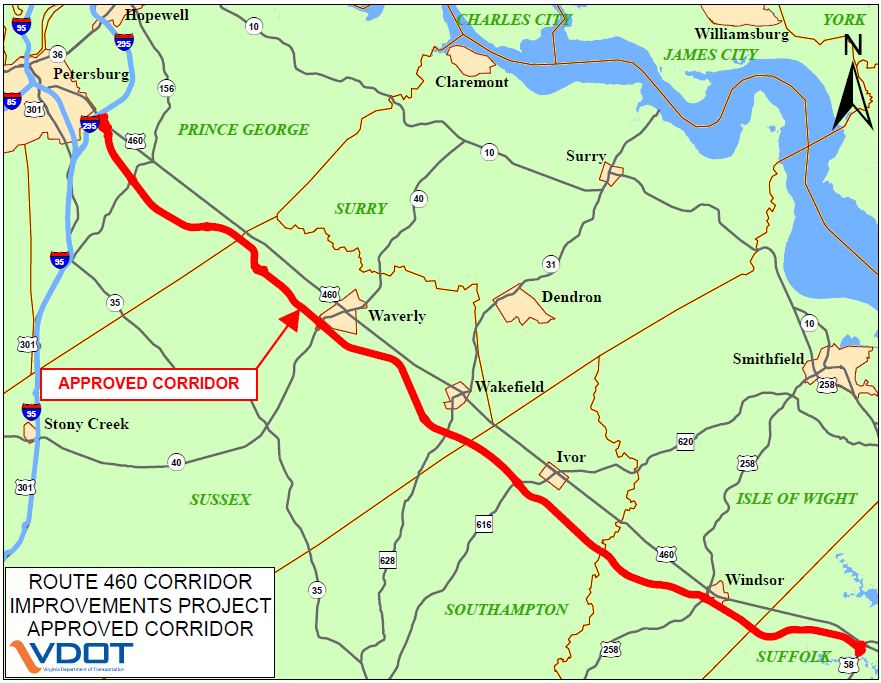
    Meanwhile, the Virginia Department of Transportation has issued a request for detailed proposals from Cintra Infraestructuras S.A.U., 460 Partners, Inc. and Multimodal Solutions LLC, the two firms that have presented conceptual proposals. The project entails the design and construction of 55 miles of new tolled roadway south of the existing Route 460 with seven interchanges to project access to communities along the corridor. (Click on map for more legible image.)

    The project will be financed through a combination of public subsidy, private investment and user fees.

    “This project is a top priority of the Commonwealth and will provide substantial benefits related to emergency evacuations and enhance the movement of freight to and from the ports,” said VDOT Commissioner Greg Whirley in making the announcement. โ€œAdditionally, the new Route 460 will provide greater connectivity between the Richmond/Petersburg and Hampton Roads regions increasing economic development opportunities and job creation.โ€

    I don’t want to pre-judge the value of this project. My only comment at this point is that this massive public investment requires much closer public scrutiny than it has received so far.


  • A deal only a politician could love

    by Norm Leahy

    The news readers on the financial networks this morning were almost giddy. The political class has reached a debt ceiling deal! The futures are up! Now we can get back to the serious business of letting fund managers talk their books!

    This mindless cheerleading will go on for most of the day, or at least until the closing bell. But for those of us who look upon almost anything that oozes out of DC with contempt, there are a few hard facts to know about this “deal.” Fortunately, Cato’s Chris Edwards, again, does the dirty but essential work:

    Spending isnโ€™t being cut at all. The โ€œcutsโ€ in the deal are only cuts from the CBO โ€œbaseline,โ€ which is a Washington construct of ever-rising spending. And even these โ€œcutsโ€ from the baseline include $156 billion of interest savings, which are imaginary because the underlying cuts are imaginary.

    No program or agency terminations are identified in the deal. None of the vast armada of federal subsidies are targeted for elimination. Old folks will continue to gorge themselves on inflated benefits paid for by young families and future generations. None of Senator Tom Coburnโ€™s or Senator Rand Paulโ€™s specific cuts were included.

    The federal government will still run a deficit of $1 trillion next year. This deal will โ€œcutโ€ the 2012 budget of $3.6 trillion by just $22 billion, or less than 1 percent.

    There are those, including many folks I respect, who will call even such lilliputian cuts as these a victory. And they have something of a point: for the last decade, the political class has cut nothing, so even the most modest of cuts, even if they are chained to the ever-rising baseline budget, are at least rhetorically significant. And even more, these pin-pricks have been achieved despite a Democrat-controlled Senate and a Democratic President, both of which were counting on, and campaigning for, higher taxes as part of any deal.

    Fair enough.

    But there’s an old, colorful saying: “Don’t piss on my boots and tell me it’s raining.” This deal is not a solution. Entitlements, war spending, even grants for cowboy poets…they will continue unabated. And far sooner than almost anyone is willing to admit, the bills will come due and the shambling fiscal wreck that is the United States will find itself unable to pay.

    Over the weekend on “The Score” radio show, Jim Bacon and I discussed the debt ceiling follies and what might really be required to set the nation on a sound fiscal course. You can listen to that wonky goodness here.


  • The Wonk Salon, August 1, 2011


    From Plow Horses to Race Horses – the Equine Contribution to Virginia’s Economy

    Weldon Cooper Center for Public Service
    Horse racing and horse shows have spurred the revitalization of Virginia’s equine industry.

    Is Policing Racially Biased? No Easy Answer
    Rand Corporation
    Police agencies are collecting more data than ever on the stops made by their officers. But there is still no definitive way to determine if they engage in racial profiling.

    The Most Effective Schools Excel… at Recruiting Good Teachers
    National Bureau of Economic Education
    Want to improve educational performance at your school? Put into place personnel policies that enable you to recruit the most effective teachers.

    Constraints to Increased Biomass Generation
    Rand Corporation
    Using biomass to generate electricity and reduce greenhouse gas emissions makes the most sense when used in conjunction with coal-fired power plants. But significant constraints limit biomass’ appeal.

    Seven Questions to Ask the People Who Run Your Schools
    Von Mises Institute
    The mass standardization of American public education and the mass of regulation that supports it has been a miserable failure.


  • More Job Destruction Courtesy of Washington, D.C.

    Jim Bacon logging in from Wilkesboro, N.C…. People in the hill country of North Carolina may be forgiven if they don’t believe that the recession is over. Omtron USA, a poultry processing plant, is shutting down its Townsends’ Crestwoods Farms division, eliminating 680 jobs in Siler City and 476 more in Mocksville, reports the Winston-Salem Journal today. That announcement comes on the heels of news that unemployment in the Winston-Salem metropolitan region remained stuck right around 10.0% in May.

    The poultry industry, which has a big presence in the Shenandoah Valley and the Eastern Shore here in Virginia, is hurting right now. Pilgrim’s Pride has announced its intention to close a poultry processing plant in Dallas in September, killing another 1,000 jobs. Google “poultry layoffs” and you will find more stories of a similar nature.

    To some people, the loss of jobs for blue-collar jobs like these represents a failure of the free-market economy that can be fixed only by government intervention such as tariffs, government stimulus spending or the imposition of higher tax rates on greedy “millionaires and billionaires” who “aren’t paying their fair share.” Such commentary is blind to the real causes of job destruction, which in many cases can be traced to some other government intervention designed to solve some other problem.

    In the case of the poultry industry, the primary culprit is the rising price of corn, the food source for chicken, which has shot from $3.41 per barrel in June last year to $6.58 in June this year. That added $1 million a month to the Mocksville plant’s operating expenses. And why has the price of corn shot so high? Rising global demand spurred, in part, by the voracious demand for corn as a feedstock for ethanol. In other words, North Carolina poultry workers are among the victims of the rent-seeking ethanol industry which uses its clout in Washington to create a market for a fuel that cannot compete with gasoline without government support and consumes so much energy in production that environmentalists deem a detriment in the campaign against greenhouse gas emissions.

    In an interesting twist, the two North Carolina plants would have closed earlier this year were it not for the intervention of Ukrainian billionaire Oleg Bakhmatyuk, who purchased the business out of bankruptcy and spent $10 million on plant upgrades. Bakhmatyuk had hoped to import corn from the Ukraine at less than half the price paid in the U.S. but regulatory changes there eliminated the price differential. Bakhmatyuk’s entrepreneurial gamble failed, but you can be sure that if it had paid off, someone would be attacking him for his profits and his greed.

    If we want to jump-start the American economy and reduce the “wealth gap,” much of it caused by rampant unemployment, a good place to start would be to stop bestowing subsidies, tax credits and market preferences upon politically connected corporate interests like the ethanol lobby and stop talk of foisting higher taxes upon risk-taking millionaires and billionaires.


  • The Wonk Salon, July 29, 2011


    Mapping Released Prisoners
    Urban Institute and the Providence Plan
    The police map crime. Why shouldn’t probation officers map the whereabouts of released convicts?

    Cut Federal Red Tape to Improve School Performance
    American Enterprise Institute
    Reforming federal compliance rules could lead to better educational outcomes than throwing more federal money at schools.

    State Education Secretaries as Agents of Change
    Center for American Progress
    The heads of state education agencies have more responsibility than ever before but they are hindered by state and federal regulations. It’s time to cut them loose.


  • Repeal the Mortgage Interest Deduction

    by James A. Bacon

    The deduction of mortgage interest from the federal income tax reduced the United States tax base by about $470 billion in 2008. The tax break is justified as a tool to promote home ownership but, by overwhelmingly favoring upper-income Americans, it mainly encourages them to buy more, or more expensive, houses than they otherwise would. Renters with lower incomes who would like to become homeowners derive minimal benefit because they tend to be in lower tax brackets. So argues “Unmasking the Mortgage Interest Deduction: Who Benefits and by How Much?” published by the Reason Foundation.

    As Congress wrestles with balancing the budget and restructuring the tax system, it should consider eliminating, or at least phasing out, this loophole. Zeroing out the mortgage interest deduction (MID) is certainly preferable to raising general tax rates, as some would like to do. Closing the loophole also would have the salutary effect of reducing the unproductive over-investment in residential real estate.

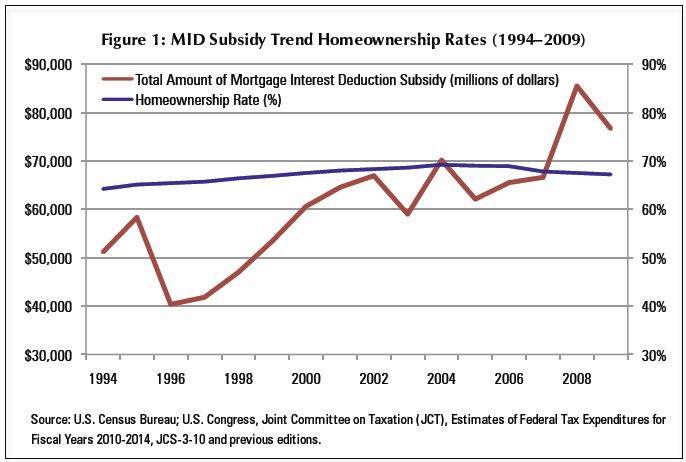
    Authors Dean Stansel and Anthony Randazzo make several important points. The MID does little to promote home ownership. The chart to the left shows virtually no correlation between the MID subsidy and the home ownership rate since 1994. (Click on chart for more legible image.)

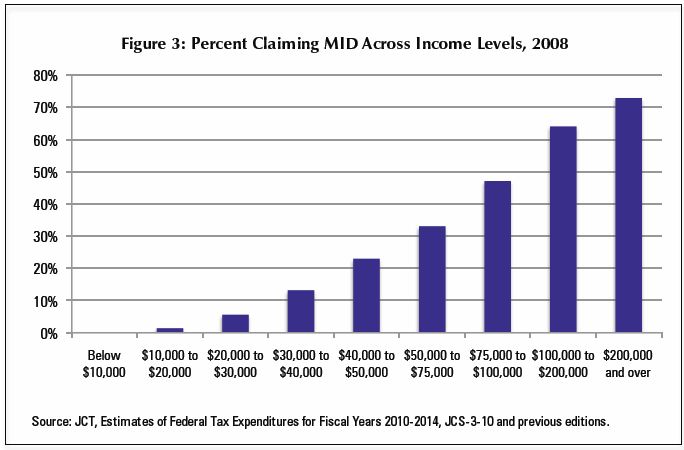
    The reason is that non-homeowners, who tend to be Americans in lower tax brackets, would derive no benefit from the MID if they bought a home. The authors explain: “Lower-income taxpayers are far less likely to itemize deductions because the sum of those deductions would be lower than the standard deduction, and even when they do itemize, the incremental benefit over and above the standard deduction is often quite small. Furthermore, for those who do claim the MID, higher income taxpayers tend to benefit more because they face higher marginal tax rates and tend to have larger mortgages.”

    The chart to the left shows how the benefit from the deductions goes overwhelmingly to the most affluent Americans. (Click on chart for more legible image.)

    Realtors and home builders will defend the MID to the death because the loophole does stimulate the construction of bigger, more expensive houses as well as vacation homes. But no one has yet explained the social benefit of subsidizing the installation of Pella windows, granite counter tops and four-car garages. Nor has anyone articulated a compelling national interest for building more second homes in ecologically fragile beach fronts and wilderness areas.

    Talk of raising the general federal income tax rate on “the rich” without eliminating the MID is just obscene. Such a policy would increase the value of the MID to the wealthiest Americans, encouraging even more over-investment in high-end housing and second homes.

    In Bacon’s ideal world, Congress would figure out how to balance the budget without increasing the overall tax burden of the American people. Elimination of the MID would be offset in a revenue-neutral way by lower general tax rates. If people want to buy million-dollar McMansions or ski chalets in Vail, they’d still be free to. They just wouldn’t be subsidized anymore.


  • Promises, Promises

    The Charlottesville Bypass is a go, thanks to approval by the Charlottesville-Albemarle MPO. But itโ€™s unclear when the money for other promised U.S. 29 corridor improvements will be forthcoming.

    By James A. Bacon

    Duane Snow (left) and Rodney Thomas. Photo credit: Charlottesville Tomorrow

    The Charlottesville region will get $197 million for a western bypass plus $33 million to widen a stretch of U.S 29 north of the city, but citizens may have to wait years before funds come available to build other priority projects in the U.S. 29 corridor.

    In a split decision, the Charlottesville-Albemarle Metropolitan Planning Organization voted to amend its Transportation Improvement Plan to include the two projects but did notย make the approval contingent upon state funding for the other projects, as two MPO board members hadย hinted they might. Instead, the board attached a letter from Transportation Secretary Sean Connaughton that outlined his promise to โ€œrecommendโ€ the improvements to the Commonwealth Transportation Board (CTB) for incorporation into the stateโ€™s Six Year Plan next year.

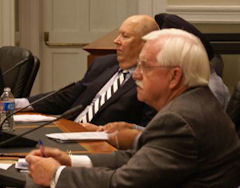
    The value of the promises in Connaughtonโ€™s letter became the object of contention between MPO board members. โ€œIโ€™ve got the letter that I sought,โ€ declared Albemarle County representative Duane Snow, who also serves on the Albemarle County Board of Supervisors. โ€œWeโ€™ve got two major projects funded. I think Connaughtonโ€™s letter is sufficientโ€ for the rest.

    But Charlottesville representative Kristin Szakos said the letter โ€œdoesnโ€™t offer any concrete assurances.โ€ Moreover, she said, she didnโ€™t like the fact that the letter had been delivered the day of the hearing, giving neither board members nor the public time to examine it carefully.

    Having received approval by the Albemarle County Board of Supervisors, the CTB and the regional MPO, the Charlottesville Bypass is now on the fast track after languishing forย  20 years. But the project has not seen the end of controversy. Before construction begins, the Virginia Department of Transportation (VDOT) will have to conduct an extensive environmental impact study, complete the design, acquire more right of way and bid out the construction contracts. Continue reading.

    (Read related story published by Charlottesville Tomorrow.)


  • The Wonk Salon, July 27, 2011


    Do Gun Law Awareness Campaigns Work?

    Rand Corporation
    In a controlled experiment in Los Angeles gun markets, sending letters to gun purchasers resulted in an increased rate of reporting stolen guns.

    Toward Data-Driven Pediatric Care in Washington, D.C.
    National Academy for State Health Policy
    The District of Columbia medical establishment has an opportunity to improve the quality of pediatric care by adopting electronic health records and the measurement of quality data.

    Impact of School Improvement Grants Uneven
    Government Accountability Office
    The federal School Improvements Grants (SIG) program spent $3.5 billion in the 2010-2011 school year.ย  Short time-frames and differences in local administrative capacity meant that states varied in their ability to implement the program.

    States’ Budget Cuts Harm Education, Health Care, Economy
    Center for Budget and Policy Priorities
    Cumulative state budget cuts over four years have devastated funding for schools and health care, and have harmed state economies.


  • The Terror of Elephants in “Must”

    By Peter Galuszka

    As minutes tick by, the behavior of Republicans in Congress, especially Virginia’s ultra-rogue junior elephant, Eric Cantor, becomes increasingly fascinating.

    They have become, suggests ย David P. Barash, psychology professor at the University of Washington, elephants in “must,” meaning that the usual rules of rationality and brinksmanship have become moot. Mind you, the elephant has long been extremely accurate symbol of the GOP (I don’t go for the “clan” nonsense Risse dishes out any more than I respect his “vocabulary,” hah!)

    It does seem that elephants fit the bill. They are big, ungainly and overfed. They like tax breaks, especially for the fatter elephants. And, from time to time, they get a little ditzy and when they do, brother, watch out!

    This is what has happened. After years of blowing out the federal budget under their Chief Elephant George W. Bush, the herd went nutzy in January 2009 when Barack Obama was inaugurated. We were entering a terrible recession and suddenly, overnight, the elephants got the religion of fiscal discipline. It all became Obama’s fault, the elephants agreed.

    So now comes the debt ceiling. The Elephants want to link that to all kinds of spending cuts. They do not care that by doing so they may well crash our anemic economy back into recession. They forget that the late King of Elephants, Ronald Reagan, raised the debt ceiling 18 times.

    Oh no. They want to stampede. Rationality doesn’t apply. And here’s what psychologist Barash reports will happen. The elephants have reached a state of “must.” It isn’t a pretty picture:

    “It’s a tactic that works surprisingly well, because male elephants can be in fact temporarily “crazy.” One of the most terrifying sights in the animal world is an elephant in a state of must: Huge bulls, oozing a weird, foul-smelling greenish glopย from glands near their eyes, behave with violent abandon, taking risks, and defying the basic rules of pachyderm propriety(and also giving rise to the term “rogue elephant”). Facing an elephant in must, other elephantsย  –not to mention people — are well advised to get out of the way.ย ”

    So you have it from the animal world.


  • A Bridge Too Near

    Thereโ€™s a new wrinkle in the Charlottesville Bypass controversy. The bridge across the Rivanna River may prove to be far more expensive than anyone anticipated.

    By James A. Bacon

    U.S. 29 north of Charlottesville

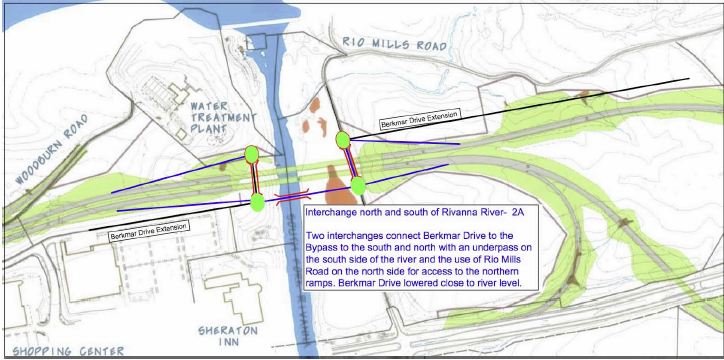
    The Charlottesville Bypass could cost a lot more than the $197 million approved by the Commonwealth Transportation Board (CTB) last week, contends the Southern Environmental Law Center (SELC) in a statement released earlier today. The preliminary design work for the controversial road project, undertaken years ago, did not take into account the fact that the Bypass would cross the Rivanna River at the same spot as a proposed extension of Berkmar Drive.

    SELC based its claim of potential cost overruns on an analysis by Michael J. Wallwork, a professional engineer with Florida-based Alternate Street Design, P.A. Design considerations will be more complex than originally envisioned because the Bypass and the Berkmar extension have to pass through the same chokepoint, threading between U.S. 29, a water treatment plan and a major subdivision. โ€œThe three main options โ€ฆ face significant cost, engineering, and other challenges due to the number and length of bridges and under or overpasses needed,โ€ Wallwork wrote. โ€œThese challenges underscore the need for careful consideration of the costs and impacts of the proposed Bypass on the planned Berkmar Drive Extended.โ€

    Wallwork’s analysis complicates the decision-making of the Charlottesville-Albemarle Metropolitan Planning Organization, the approval of which is needed for the project to proceed. The report highlights the need for additional information rather than rushing the controversial 29 bypass through the approval process, the SELC argues.

    “This is further evidence that the [Albemarle County] Board of Supervisors and MPO are lacking key pieces of information about the bypass and its impacts,” said Morgan Butler, director of SELC’s Charlottesville-Albemarle Project. “The public has been promised that the bypass would help advance Berkmar Drive Extended, a top priority in the county’s Places29 master plan. But today’s report indicates the opposite may be true, even if the two projects share a bridge. Our local leaders need to get a much better grasp on how the bypass would impact Berkmar Drive Extended before they vote on it, not after.”

    The MPO is scheduled to meet Wednesday night to address the western bypass issue.

    One of the bridge scenarios in the Wallwork report.

    The Bypass long existed as a line item in the stateโ€™s Six-Year Plan, but no money was allocated to it and nearly everyone had written it off. Partial rights of way, acquired more than a decade ago, are due to revert to the original owners if construction doesn’t get underway by 2012 — effectively killing the project. But the McDonnell administration surprised the project’s foes by resurrecting the Bypass earlier this month, persuading the Albemarle County supervisors to reverse their previous opposition earlier this month and then gaining the approval of the state transportation board last week.

    Rodney Thomas and Duane Snow, two of the Albemarle supervisors who voted in favor of the project, also sit on the five-person MPO board. A third member is James Utterback, Culpeper district administrator for the Virginia Department of Transportation, answers ultimately to Secretary of Transportation Sean Connaughton, who has worked extensively behind the scenes to move the project forward. The two other board members, who serve on Charlottesville City Council, are widely presumed to oppose the Bypass.

    Between Thomas, Snow and Utterback, the pro-Bypass forces would seem to have a majority on the MPO board. But thereโ€™s a complication. Thomas and Snow say that they switched their opposition to the project only because Connaughton promised them funding for four key U.S. 29 projects โ€“ a widening of the highway north of the proposed Bypass terminus; a new ramp at the interchange of U.S. 29 and U.S. 250 (widely referred to as the Best Buy ramp); completion of Hillsdale Drive, a road running parallel to U.S. 29; and the Berkmar extension, another road running parallel to U.S. 29 โ€“ in addition to the Bypass.

    โ€œWhen Duane Snow and I started on this, we were called by Sean Connaughton to have a meeting,โ€ Thomas explained. โ€œWe were asking for money to widen U.S. 29. He threw the idea of the Bypass on the table. Duane and I looked at each other, โ€˜Hmm, whatโ€™s this?โ€™โ€ Read more.


  • Two More Years of Fiscal Hardship

    by James A. Bacon

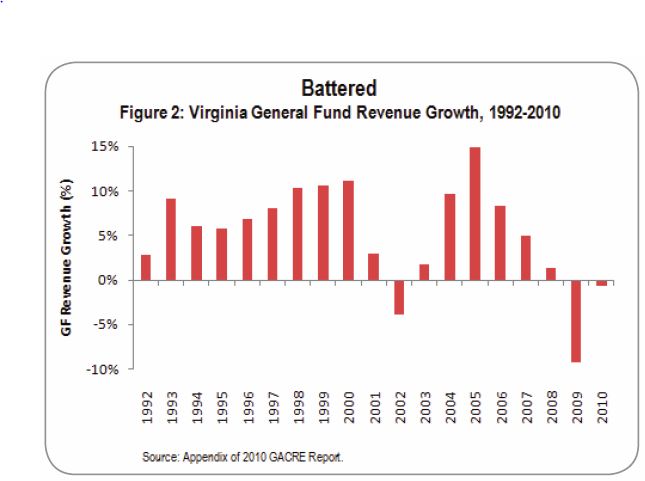
    The Commonwealth Institute has peered into Virginia’s fiscal future and doesn’t like what it sees. The state faces another $500 million budget gap next year, and a $300 million gap the year after that, meaning that the prospects of restoring cuts to education, health care and public safety are bleak.

    Although tax revenues are recovering, they remain below pre-recession levels, write Sara Okos, Laura Goren, and Michael Cassidy in “In the Red: Early Warnings About Virginia’s Fiscal Outlook.(Click chart for more legible image.) Meanwhile, prolonged joblessness and poverty require more spending on social services such as food stamps, Medicaid and Temporary Assistance for Needy Families (TANF).

    Not only is the economic recovery anemic, the state has significant obligations like replenishing the Rainy Day Fund, repaying the Virginia Retirement System funds it borrowed, and repaying the federal government for unemployment-insurance money it borrowed. Also, funds from the federal stimulus package (the American Recovery and Reinvestment Act) will have expired. Write the authors:

    Inadequate revenue growth, coupled with the loss of Recovery Act funds, and increasing other demands on state resources will likely place Virginia on red alert unless action is taken. This could hinder much-needed investments and innovation in public education, health care, public safety, and economic and workforce development.

    I share the Commonwealth Institute that Virginia’s conviction that the fiscal situation looks dire, and I believe the think tank deserves credit for bringing the issue to the public’s attention in a more authoritative way than I have been able to do. However, I do take issue with conclusions it draws from its fiscal analysis.

    The Institute contends that state and local spending cuts and accompanying layoff of 6,000 employees have “impeded” the economic recovery. Not so. Given the reality that state and local governments must balance their budgets, the only alternative to layoffs would have been increasing taxes. Higher taxes would have killed jobs. Moreover, higher taxes kill private-sector jobs, not public jobs. As some commentators on this blog need reminding, private-sector jobs are more valuable fiscally than public-sector jobs because private-sector employers pay taxes — property taxes, BPOL taxes and corporate income taxes — that governments do not. Offsetting the loss of private-sector jobs with public jobs is a sure-fire way to erode the tax base.

    Likewise, the Institute argues that a “cuts-only approach” to balancing the budget will hurt economic recovery. Maybe, but it would hurt less than raising taxes a like amount. The fact is, Virginia is in a fiscal jam and there is no easy way out. Instead of adopting a strategy of spending more money to meet core responsibilities, we should prioritize spending on programs that offer the greatest economic, fiscal and social return on investment.


  • The Wonk Salon, July 25-26


    How to Hold Higher Ed More Accountable
    National Governors Association
    States need to insistย  upon greater productivity at public colleges. A starting point is to track basic data like how many students are graduating, and how well are colleges meeting industry’s needs for an educated workforce?

    How Much Is that College Degree Really Worth?
    National Bureau of Economic Research
    Parents would like to know, and policy makers should know, how much a college education contributes to a students’ future earnings. This study finds that the earnings premium of prestigious state universities is close to zero.

    How Community Colleges Can Help Build a STEM-Savvy Workforce
    National Governors Association
    At least eight million of the jobs available to college graduates in 2018 will be in the science, technology, engineering and mathematics (STEM) professions. States should look to community to colleges to help build that workforce.

    Reengaging College Dropouts
    National Governors Association
    Nearly 400,000 kids drop out of school every year. States need to set goals to reduce the dropout rate, track the data and provide more options for recovered dropouts.

    A Demographic Portrait of Charlottesville
    Weldon Cooper Center for Public Service
    The Demographics and Workforce Group at the Weldon Cooper Center has published a demographic profile of Charlottesville. It’s worth a look to see the analysis of rising housing prices and gentrification.

    The Latest Effort by Wine Wholesalers to Thwart Competition
    Competitive Enterprise Institute
    Recent court rulings have challenged anti-competitive state laws regulating alcohol wholesalers. Now wholesalers are trying are lobbying Congress to allow states to discriminate against out-of-state wineries.

    Tax Holidays Are Poor Public Policy
    Tax Foundation
    Tax holidays like Virginia’s yearly sales tax exemptions for the purchase of back-to-school and hurricane supplies are an ineffective gimmick that distracts lawmakers from fundamental tax reform.

    Should States Exempt Groceries from the Sales Tax?
    American Enterprise Institute
    Virginia is one of 43 states that provides a full or partial exemption for groceries from the sales tax. There are more efficient ways to help the poor.

    Local Law Enforcement Needs to Do a Better Job of Reporting Missing Children
    Government Accountability Office
    Missing children who are not found quickly are at increased risk of victimization. Local law enforcement efforts to report missing children to the national database are patchy.