• Two More Years of Fiscal Hardship

    by James A. Bacon

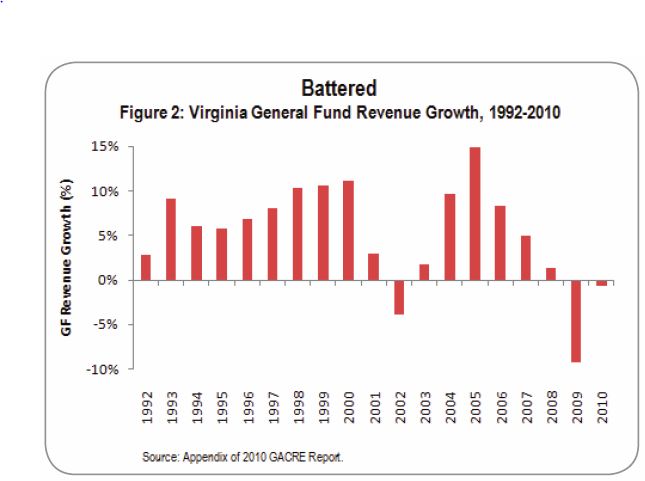
    The Commonwealth Institute has peered into Virginia’s fiscal future and doesn’t like what it sees. The state faces another $500 million budget gap next year, and a $300 million gap the year after that, meaning that the prospects of restoring cuts to education, health care and public safety are bleak.

    Although tax revenues are recovering, they remain below pre-recession levels, write Sara Okos, Laura Goren, and Michael Cassidy in “In the Red: Early Warnings About Virginia’s Fiscal Outlook.(Click chart for more legible image.) Meanwhile, prolonged joblessness and poverty require more spending on social services such as food stamps, Medicaid and Temporary Assistance for Needy Families (TANF).

    Not only is the economic recovery anemic, the state has significant obligations like replenishing the Rainy Day Fund, repaying the Virginia Retirement System funds it borrowed, and repaying the federal government for unemployment-insurance money it borrowed. Also, funds from the federal stimulus package (the American Recovery and Reinvestment Act) will have expired. Write the authors:

    Inadequate revenue growth, coupled with the loss of Recovery Act funds, and increasing other demands on state resources will likely place Virginia on red alert unless action is taken. This could hinder much-needed investments and innovation in public education, health care, public safety, and economic and workforce development.

    I share the Commonwealth Institute that Virginia’s conviction that the fiscal situation looks dire, and I believe the think tank deserves credit for bringing the issue to the public’s attention in a more authoritative way than I have been able to do. However, I do take issue with conclusions it draws from its fiscal analysis.

    The Institute contends that state and local spending cuts and accompanying layoff of 6,000 employees have “impeded” the economic recovery. Not so. Given the reality that state and local governments must balance their budgets, the only alternative to layoffs would have been increasing taxes. Higher taxes would have killed jobs. Moreover, higher taxes kill private-sector jobs, not public jobs. As some commentators on this blog need reminding, private-sector jobs are more valuable fiscally than public-sector jobs because private-sector employers pay taxes — property taxes, BPOL taxes and corporate income taxes — that governments do not. Offsetting the loss of private-sector jobs with public jobs is a sure-fire way to erode the tax base.

    Likewise, the Institute argues that a “cuts-only approach” to balancing the budget will hurt economic recovery. Maybe, but it would hurt less than raising taxes a like amount. The fact is, Virginia is in a fiscal jam and there is no easy way out. Instead of adopting a strategy of spending more money to meet core responsibilities, we should prioritize spending on programs that offer the greatest economic, fiscal and social return on investment.


  • The Wonk Salon, July 25-26


    How to Hold Higher Ed More Accountable
    National Governors Association
    States need to insistย  upon greater productivity at public colleges. A starting point is to track basic data like how many students are graduating, and how well are colleges meeting industry’s needs for an educated workforce?

    How Much Is that College Degree Really Worth?
    National Bureau of Economic Research
    Parents would like to know, and policy makers should know, how much a college education contributes to a students’ future earnings. This study finds that the earnings premium of prestigious state universities is close to zero.

    How Community Colleges Can Help Build a STEM-Savvy Workforce
    National Governors Association
    At least eight million of the jobs available to college graduates in 2018 will be in the science, technology, engineering and mathematics (STEM) professions. States should look to community to colleges to help build that workforce.

    Reengaging College Dropouts
    National Governors Association
    Nearly 400,000 kids drop out of school every year. States need to set goals to reduce the dropout rate, track the data and provide more options for recovered dropouts.

    A Demographic Portrait of Charlottesville
    Weldon Cooper Center for Public Service
    The Demographics and Workforce Group at the Weldon Cooper Center has published a demographic profile of Charlottesville. It’s worth a look to see the analysis of rising housing prices and gentrification.

    The Latest Effort by Wine Wholesalers to Thwart Competition
    Competitive Enterprise Institute
    Recent court rulings have challenged anti-competitive state laws regulating alcohol wholesalers. Now wholesalers are trying are lobbying Congress to allow states to discriminate against out-of-state wineries.

    Tax Holidays Are Poor Public Policy
    Tax Foundation
    Tax holidays like Virginia’s yearly sales tax exemptions for the purchase of back-to-school and hurricane supplies are an ineffective gimmick that distracts lawmakers from fundamental tax reform.

    Should States Exempt Groceries from the Sales Tax?
    American Enterprise Institute
    Virginia is one of 43 states that provides a full or partial exemption for groceries from the sales tax. There are more efficient ways to help the poor.

    Local Law Enforcement Needs to Do a Better Job of Reporting Missing Children
    Government Accountability Office
    Missing children who are not found quickly are at increased risk of victimization. Local law enforcement efforts to report missing children to the national database are patchy.


  • Time For McDonnell to Call Cantor

    By Peter Galuszka

    Moodyโ€™s Investorโ€™s Service has rained on Virginia Gov. Robert F.
    McDonnellโ€™s parade.

    On the day the Republican governor was proudly announcing a $311 million budget surplus with the prospect of being even $40 million more in the black, the ratings service announced that Virginia could be one of five states to see its pristine AAA credit rating tarnished if Congress and President Obama donโ€™t reach a budget deal and raise the federal debt limit by Aug. 3. The news came just as McDonnell was beaming about the surplus, some of which comes such schemes from deferring payments to the state pension system.

    โ€œIโ€™m very unhappy. In fact, weโ€™re furiousโ€ about the ratings problem, he said at a news conference. I guess I can understand why. Virginia has had the best possible credit since 1938. McDonnell has come on strong, rightly or wrongly, as a paragon of fiscal responsibility. This is his party credo and raison dโ€™รชtre. If he goes down in history as the governor on whose watch the stateโ€™s credit rating was downgraded, despite plenty of Democrats having been in the governorโ€™s mansion over the years, well, it wonโ€™t look good.

    Another issue is McDonnellโ€™s stubborn refusal to acknowledge that, whether he likes it or not, Virginia is a major locus of federal jobs. The Old Dominion is chock-a-block with defense and intelligence installations, along with other units such as the Federal Aviation Administration, and so on. This is one of the reasons Moodyโ€™s served notice on such high-government-worker states as Maryland, South Carolina and Tennessee. If the feds lose their AAA credit rating, so, too, will the places where they employ a lot of people.

    In his quest for jobs, McDonnell always puts special emphasis that the ones heโ€™s helped create are โ€œprivate,โ€ as if thatโ€™s somehow more politically correct than having more public-sector jobs. Government work doesnโ€™t fit with current GOP dogma. Apparently, federal workers are less desirable and certainly greedier than their private-sector counterparts.

    Of course, thatโ€™s nonsense, and McDonnell ought of to know it. He grew up in Northern Virginia, a haven for the civil service, and was educated in defense-saturated Hampton Roads. Federal money has saved Virginia from having a much higher unemployment rate than it does.

    If McDonnell is worried about what Moodyโ€™s might do, he does have a
    remedy at hand, though. Itโ€™s simple. Call up his fellow Republican,
    House Majority Leader Eric Cantor, and tell him to stop acting like a
    spoiled kid and work for a bipartisan way out of the federal budget
    mess. Itโ€™s a win-win thing they both should understand.

    (Previously posted and printed in The Washington Post)


  • If the U.S. Defaults, What’s Virginia’s Plan of Action?

    by James A. Bacon

    Gov. Bob McDonnell is chapped that the inability of the buffoons in the nation’s capital to reach a budget deal and raise the debt ceiling could impact negatively on Virginia’s AAA credit rating. He made the comments last week in response to news that Moody’s Investor Service had put the state rating on a review downgrade list because of its reliance on federal funding. (See the Times-Dispatch article.)

    I am sympathetic to a degree. Democrats and Republicans in Washington, D.C., are playing a game of chicken — the car is heading toward a precipice and the first guy to take his hand off the wheel loses. Unfortunately, the American economy is in the back seat. There could be a lot of collateral damage, including Virginia’s AAA rating.

    On the other hand, Virginia’s dependence upon the federal government is no secret. I’ve been harping upon it for a long time on this blog. I’ve also argued, on the grounds that federal default on its debt is highly likely within the next 15 to 20 years as I explained in my book Boomergeddon, we need to get our fiscal house in order while we still can. The first order of business is increasing the strength of the commonwealth’s balance sheet — paying down long-term debt, not adding to it. The second order of business is de-coupling the Virginia economy from its excessive reliance upon federal spending for economic growth.

    What has McDonnell done? Well, he championed a transportation-funding plan built around the borrowing of $3 billion, thus pushing state indebtedness to the limit of what it can handle without jeopardizing its AAA rating. Also, his economic development strategy has emphasized attracting more federal investment in the state, thus making our economy even more dependent upon the fiscal health of the federal government.

    It’s fine to lecture Congress — we all do it! But that’s no substitute for crafting sound fiscal and economic development policy. If the debt ceiling talks do crash, pointing a finger of blame at Congress won’t cut it. Moody’s won’t be impressed. One thing Moody’s will want to know is what contingency plan the governor is developing in case Uncle Sam does run off the cliff. Do we have a plan? If we do, the governor hasn’t made it public. I have submitted an email request to McDonnell spokesman Jeff Caldwell for details.

    Here is Caldwell’s response: “Because we do not know a) if a deal will come together to mitigate the impact, b) what that plan would entail or c) what cuts will be made and how they will be made if no deal is reached, we really cannot ascertain the size or scope of any impact to Virginia. We have been examining areas where we think there could be impacts, but cannot make any firm contingency plans because of the uncertainty of what impacts we may see from the federal government.”

    Fair enough. The uncertainties are massive.


  • Rocking the Supertanker

    by James A. Bacon

    Love ’em or hate ’em, you have to say one thing about Gov. Bob McDonnell and his Transportation Secretary Sean Connaughton: They’re willing to crack heads. The latest evidence is the Friday announcement that the governor had announced the replacement of 10 of the 12 board members of the Virginia Port Authority as well as its chair, John Milliken. Citing the port’s lagging economic performance, McDonnell installed his own slate of board members, all of whom are seasoned business people, many with backgrounds in transportation and logistics… and a track record as contributors to Republican candidates and causes.

    The appointments will take effect at a swearing-in ceremony at Tuesdayโ€™s board meeting. โ€œWeโ€™re the only port on the East Coast that has not recovered to pre-recession levels,โ€ said Connaughton Friday, as quoted by the Virginian-Pilot. “We are in real strong competition, and we need people on that board who are proven business leaders with experience in trade and in transportation and with finance and business practices thatโ€™ll help us recover and take us to the next level.โ€

    “We were looking at the numbers and they’re very clear. Every other port on the East Coast has gotten back to pre-recession (cargo) volumesย  with the exception of one, and that’s us. This is not meant to be negative on the current port board members, but most of them just don’t understand” the business, theย Daily Pressย quoted Connaughton as saying. The Secretary expects new board members “to question everything, to be aggressive and really, really challenge the [port authority] staff.”

    I have not had a chance to analyze theย performance of Virginia’s ports ,ย so I will take Connaughton at his word that the VPA has been under-performing competitors like Savannah and New York. And, for purposes of argument, I will accept the governor’s appraisal that the ports need a change of direction that only a new board can bring about. Give McDonnell and Connaughton credit for being willing to rock the supertanker in order to spark change.

    However, the move does set a potentiallyย dangerous precedent. It has been traditional practice in Virginia for one governor to retain the appointees of previous governors until their terms expire. In a state with a one-term governor, the practice encourages continuity between administrations and minimizes disruption. As a Democratic business executive friend of mine pointed out, if Democrats perceive McDonnell’s action as a partisan maneuver, they might institute their own clean sweep the next time a Democrat takes the governor’s office. And why stop at the VPA? Why not clean house at other key institutions like the Virginia Economic Development Partnership, say, or … the University of Virginia.

    My friend also wondered if there is a hidden agenda. Is McDonnell looking mainly to improve the performance of the VPA, or does he want a board that will prove cooperative should he try to privatize the ports? Others will be asking the same question.

    Update: Doug Koelemay, the Northern Virginia district member of the Commonwealth Transportation Board, added some insight into Connaughton’s action while I was interviewing him for another story. Connaughton served as director of the Maritime Administration in the Bush administration, Koelemay noted. The transportation secretary knows maritime and port issues as well as anyone on the VPA board. “He feels comfortable with what he knows. He doesn’t have the hesitancy to act that someone else might.”


  • What, Medicaid Fraud in Virginia?

    A couple of days ago I caught some flak for daring to suggest that some Virginians drawing public benefits might be committing fraud — failing to report under-the-table income in order to qualify for food snaps, Medicaid, rental assistance or whatever. How beastly of me to cast such aspersions! What proof did I have? (See “Poverty Does Not Mean Destitution.”)

    Heh! The timing couldn’t be better. James O’Keefe, the conservative investigator of ACORN-busting fame, has released a video of one of his accomplices posing as a Russian drug dealer filing for Medicaid benefits for his sister and father. When he asked if he would get in trouble for reporting income from his illegal drug and prostitution businesses, he was instructed, “Just leave that off your application.”

    The fact that an undercover investigator with a preposterous story is given license to cheat doesn’t prove that other people cheat. But the incident certainly does raise issues about how effectively the Medicaid eligibility rules are enforced. Do Medicaid case workers see themselves as advocates for applicants, or as stewards of the taxpayer’s dollar? In this one case, at least, the answer is very clear.


  • McDonnell Unveils Performance Bonus forTeacher Pilot Project

    Gov. Bob McDonnell has the right idea with a new pay-for-performance system the state will be piloting in 25 schools across the commonwealth in the next school year. It would be foolhardy to expect miraculous results, but if the results are even mildly encouraging, Virginia public schools will have a new tool for recruiting and retaining the best teachers.

    Participating schools must implement performance standards and a teacher-evaluation system that bases 40 percent of a teacher’s evaluation on student academic growth. The General Assembly set aside $3 million for the program, which will provide bonuses of up to $5,000 for teachers who win exemplary ratings.

    “There is a growing consensus,” said McDonnell in a prepared statement, “that public schools must move beyond a compensation model that equally rewards mediocrity and excellence and is rooted in a past when our young people did not face fierce global competition. Bipartisan support โ€“ at both the state and federal levels โ€“ is allowing Virginia to implement performance pay in some of the Commonwealth’s most hard-to-staff rural and urban schools. I look forward to this program getting underway. It will benefit our students, parents and teachers.”

    It’s a good idea in theory. Teacher quality is the single-most important in-school factor influencing student achievement. Research consistently shows that students learn more from the best teachers. It especially makes senseย  for schools in the inner city and the countryside to reward their best teachers. As Roanoke Superintendent Rita D. Bishop said in the press release, “We have had some success with signing bonuses but still lose too many teachers to surrounding divisions. By participating in the performance-pay pilot, we are able to provide additional incentives for talented teachers to remain in four of our schools where they can make a real difference in the lives of students.”

    If designed properly, the pilot programs should answer some important questions. Is the uncertain prospect of a $3,000 to $5,000 bonus enough to motivate teachers to do better? Will teachers buy in to the validity of the methodology for calculating gains of their students’ educational achievement? Should teachers even be rated on individual performance when teaching is increasingly team driven? New York City has just announced that it was dropping its three-year performance-bonus program, noting that it had no discernible effect on student achievement.

    Virginia’s program is designed very differently than New York’s, which was geared to rewarding the collective performance of teachers and staff. Still, it would be remarkable if Virginia got all the details right on the first try. Before rolling it out statewide, the McDonnell administration should be prepared to tinker with the program for three or four years in order to get it right.

    One last point: Ideally, the pilot project would follow the social-science protocol described in “Evidence-Based Social Policy” to ensure that the findings, whatever they are, leave no ambiguity. Otherwise, the politicians and educrats evaluating the results will revert to their default positions and little useful knowledge will be gained.


  • The Wonk Salon, July 22, 2011


    Out-of-Wedlock Births and the Culture of Despair
    National Bureau of Economic Research
    Out-of-wedlock births among women in low-income households arise from a culture of hoplessness and despair that is more likely to take hold in communities marked by inequalities in wealth.

    Oregon Boosts Health Coverage Despite Recession
    Oregon Center for Public Policy
    Despite adverse fiscal conditions, Oregon has been able to expand its health care coverage for children and low-income households.

    The Changing Demographics of Head Start Kids
    Urban Institute
    Head Start programs are comprised of increasing numbers of Hispanic and Asian kids. Time for Head Start professionals to start brushing up on their Spanish and Cantonese.

    Neighborhood Early Warning Systems
    Urban Institute
    Neighborhood Early Warning Systems (NEWS) are valuable statistical and analytical tools for groups working to revitalize neighborhoods.


  • Limousine Liberals

    Secretary of State Hillary Clinton exits a limousine in this AP photo

    It’s one small data point but it says so much about theย aggrandizement ofย the political class under the Obama presidency: According to General Services Administration data, the number of limousines in the federal fleet increased from 238 in fiscal 2008, the last year of the Bush administration, to 412 in 2010. Read the details at the Center for Public Integrity website.

    The people can’t afford to buy cars? Let them drive limousines?

    — James A. Bacon


  • Moving Freight in Virginia

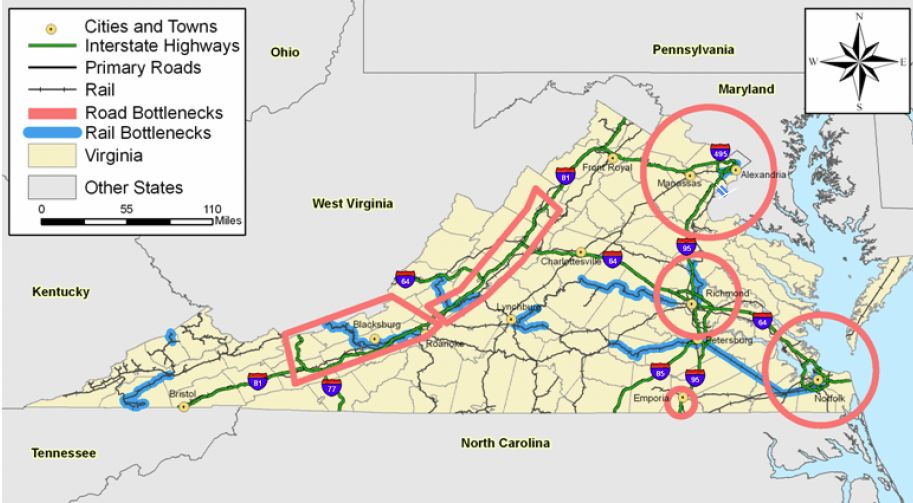
    Click on map for more legible image of freight bottlenecks in Virginia.

    by James A. Bacon

    If Virginia finishes funding a slate of highway, railroad and port mega-projects designed to eliminate transportation bottlenecks and shift freight from highways to rail, some of which are already completed and all of which are underway, the state could reduce truck Vehicle Miles Traveled in congested conditions by 30%, creating more than $20 billion direct and indirect savings to the economy through 2035. So says Cambridge Systematics in a report presented to the Commonwealth Transportation Board (CBT) Wednesday.

    The report identifies the following benefits:

    • Avoidance of potential future transportation and environmental impacts: pavement damage, safety, emissions ($4.7 billion)
    • Travel time savings due to reduced highway congestion ($6.6 billion)
    • Direct shipper cost savings from reduced highway congestion and increased use of lower-cost transportation modes ($6.4 billion in direct savings, $5.4 billion in indirect and induced savings, accruing inside and outside VA)

    Unfortunately, the report does not list the cost of the improvements, much less a Return on Investment. Until the commonwealth begins ranking transportation projects by ROI — and makes transparent the method for calculating ROI — there is no way to rationally allocate public transportation funds.

    I did have a chance to speak briefly to David Tyeryar, deputy secretary of transportation, who told the CTB that the Office of Intermodal Planning and Investment does perform ROI calculations on proposed projects. While OIPI can rank ROI for projects within each transportation mode — roads, ports, aviation, rail, mass transit, etc. — it does not maintain a master list ranking all projects.


  • The Tide Rolls In

    by James A. Bacon

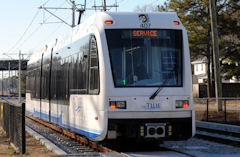
    Finally some encouraging news from Norfolk’s scandal-plagued light rail project, The Tide. Philip A. Shucet, the former VDOT commissioner who was drafted to bring order to the mismanaged project, gave a project overview yesterday to the Commonwealth Transportation Board. The good news: The 7.4-mile rail line is in the final phases of testing and is scheduled to open August 19.

    The bad news — and this was news that Shucet revealed only in response to a question — is that the project will continue to be a drain on taxpayers. Based on current ridership projects, fare box revenues will recover only 8% of operating costs. Not only will taxpayers never get a dime back from the $338 million they paid in up-front capital, Norfolk citizens will be on the hook for millions of dollars yearly… basically for ever.

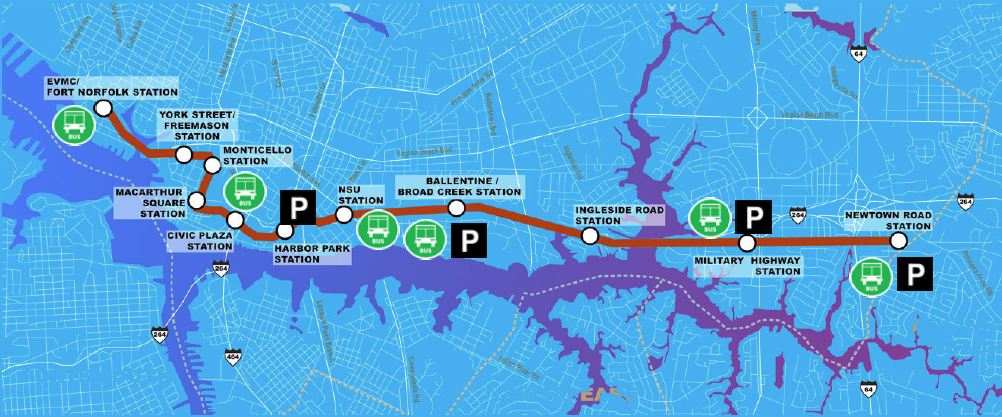
    But, hey, the project is a cool one. The rail line begins near the Sentara hospital complex, runs through downtown and terminates at Newtown Road. The trains, powered by overhead electric lines, will traverse the distance in 24 minutes, stoppling at 11 stations along the way. (Click on map for more legible image.)

    According to traffic estimates, there will be 2,900 weekday passenger boardings initially, and the number should grow to 7,000 by 2030. Shucet dangled the possibility, based on the experience of some other light rail systems, that those estimates could be low. Presumably, rail ridership will relieve some congestion on Norfolk’s streets and will spur transit-oriented development around the rail stations, which could further reduce automobile dependency in the years and decades ahead. Whether the project will generate a positive Return on Investment, even including the social and environmental benefits, is an open question.

    Shucet said the City of Norfolk’s final tab for the project, which has been subject to some $50 million in cost overruns, is $66 million. The feds are chipping in $201 million, and the state $71 million. None of the CTB members asked the logical follow-up question to Shucet’s revelation that fares would cover less than one-tenth of operating costs: What will operating losses amount to? How much will Norfolk taxpayers be asked to cover on an ongoing basis? Inquiring minds would like to know.


  • MWAA Reverses Stance on Underground Station

    Succumbing to public pressure, the Metropolitan Washington Airports Authority (MWAA) has back-peddled on its plan to build an underground rail station as part of the Rail-to-Dulles Metro rail extension. That will chop about $300 million off the $3.8 million price tag for Phase 2 of the project. But negotiations continue between federal, state and local authorities on what still needs cutting and how to pay for what remains. (See the WaPo account here.)

    The MWAA board endorsed the framework of a deal brokered by U.S. Transportation Secretary Ray LaHood. It’s not clear from any of the reporting that I’ve seen whether that includes pushing for maximum competition in the construction bids by eliminating the requirement for a union-shop Project Labor Agreement. That move could potentially save another $300 million.

    — James A. Bacon


  • The Wonk Salon, July 20-21, 2011


    Maine Leads the Way in Market-Driven Health Care

    Heritage Foundation
    Maine tried Obama-styled health insurance reforms and found they didn’t work. Now the Pine Tree State is trying market-based reforms.

    Time for Progressives to Think Natural Gas
    Progressive Policy Institute
    Want to get a fast, cheap, 10-20% reduction in U.S. greenhouse gas emissions? Back out oil- and coal-fueled electricity by fully utilizing existing natural gas power plants with excess capacity.

    States Fail to Report Many Clean Water Violations
    Government Accountability Office
    States can do a better job of reporting clean drinking water violations.

    Public Sector Unions Influence Wages More than Pensions
    Center for Retirement Research
    Pension benefits are legislated, not bargained, putting a premium on lobbying influence, not union membership numbers. But union clout does seem to influence bargaining outcomes for wages.


  • Bypass Surgery

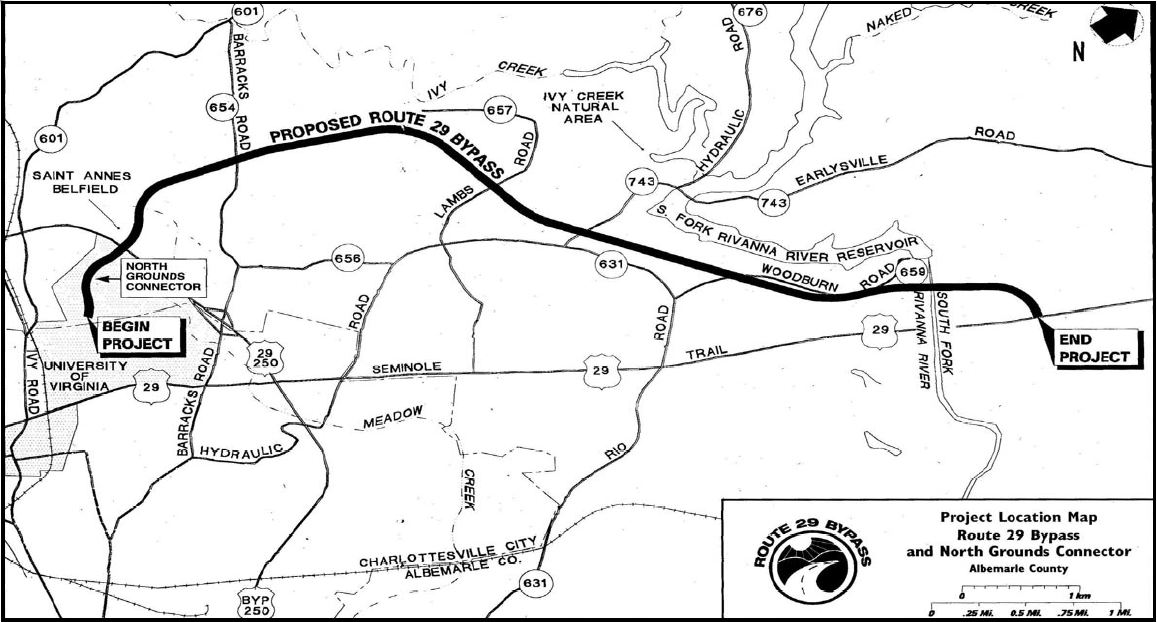
    The McDonnell administration has pushed through $200 million in funding for the Charlottesville Bypass over strenuous local opposition. The big question: Will the bypass need a bypass five years from now?

    by James A. Bacon

    The Commonwealth Transportation Board (CTB) voted today to provide $197 million in funding to build the 6-mile Charlottesville Bypass and another $33 million to widen a 1.6-mile stretch of U.S. 29. The controversial bypass project is almost certain to receive final approvalย in August by the Charlottesville-Albemarle Metropolitan Planning Organization.

    The vote represents a significant victory for the McDonnell administration, which lobbied Republican board members on the Albemarle County Board of Supervisors earlier this month to reverse its previous opposition to the project, thus creating an opening for the CTB deliberation. After years of transportation funding cutbacks across Virginia, the Charlottesville Bypass is likely just the first in a series of mega-projects likely to receive funding as the administration dispenses the proceeds from $3 billion in transportation bond issues leveraged, in many instances, by public-private partnerships.

    Ironically, the project received its strongest backing from CTB board members from outside the Charlottesville area, while James Rich, representing the Culpeper transportation district of which Albemarle County is a part, spoke passionately against it. Business and civic leaders in Lynchburg and Danville deem U.S. 29 to be an economic lifeline for the regionโ€™s manufacturing sector, and they regard the severe congestion north of Charlottesville as a hindrance to their economic development.

    Opponents accused the administration of moving too fast, with too little transparency, in doling out the money. The Charlottesville Bypass will be funded at the expense of other more pressing projects. “Virginia has many transportation needs competing for limited money, and shifting these funds will shortchange other projects statewide,โ€ said Trip Pollard with the Southern Environmental Law Center. โ€œThat’s not sound planning, especially when there are far more effective and less costly alternatives to reduce congestion.โ€

    (Click on map for more legible image.)

    The controversy highlighted an irreconcilable contradiction that plagues many of Virginiaโ€™s transportation corridors. On the one hand, U.S. 29 is a classified as a โ€œcorridor of statewide significance,โ€ meaning that it plays a role in providing connectivity between urban centers. It is also a U.S. highway stretching from Pensacola, Fla., to Baltimore, Md. One stretch between Danville and Greensboro, N.C., is touted as โ€œfuture Interstate 785.โ€ On the other hand, the highway doubles as the primary development corridor in Charlottesville-Albemarle County. It is the location of 20,000 jobs, most of the regionโ€™s retail business and its largest residential real estate developments, accounting for 40% of the regionโ€™s tax base. Peak traffic reaches roughly 50,000 cars per day.

    The lack of access controls along the U.S. 29 corridor means that anyone can build a strip mall, subdivision, office park or even a single-family home and connect directly to the highway. That practice, combined with Albemarle Countyโ€™s decades-long policy of making it the countโ€™s major growth corridor, has created nightmarish congestion. As one of the Albemarle dissenters summed up the dilemma in the public hearing, โ€œIt is not possible for a road to function as a highway and a commercial main street.โ€

    In voting to fund the Charlottesville Bypass, the CTB board made clear its policy preference for maintaining the system integrity of the stateโ€™s corridors of statewide significance. “No one project is the solution,” said Doug Koelemay, representative of the Northern Virginia transportation district. “We need to look at all projects as a whole. We’re trying to make a system work.”

    โ€œThis has gone on too long,โ€ said Lynchburg district representative Mark Peake, alluding to the on-again, off-again history of the Bypass. โ€œThis is a United States highway, not the City of Charlottesvilleโ€™s main street. โ€ฆ Weโ€™ve studied this for 20 years. We have the money now. Letโ€™s do it!โ€

    Because U.S. 29 is classified as a U.S. highway, it must be approved by the Charlottesville-Albemarle Metropolitan Planning Organization, but that should prove to be a formality. Two of the five MPO board members are Albemarle County supervisors who voted to rescind the county’s previous objection to the Bypass. A third is a VDOT official who answers ultimately to the Secretary of Transportation.

    The 6-mile Bypass will run from Rt. 250 in the south to just north of the Rivanna River, bypassing about a 3 ยฝ-mile stretch of U.S. 29 with 14 traffic lights. In a 1997 study, traffic was forecast to reach 24,400 vehicles per day by 2022, said James Utterback, Culpeper district administrator for the Virginia Department of Transportation. Utterback offered no estimate of how much travel time the Bypass would save.

    Although there is a broad consensus that the $33 million allocated to widening a section of U.S. 29 is worthwhile, foes predicted that the $197 million spent on the Bypass will be largely wasted. The โ€œbypassโ€ is not even a bypass, they argued. Itโ€™s better labeled a โ€œconnector,โ€ for it circumvents only half of the congested area. The โ€œbypassโ€ will dump travelers onto U.S. 29 just past the Rivanna River, where they will encounter many more miles of stop-and-go traffic. In the years ahead, congestion will only worsen as development continues to crowd the highway as far north as Ruckersville in Greene County. โ€œIn another five years, weโ€™ll need to build another road to bypass the bypass,โ€ predicted Albemarle resident Denny King during the public hearing.

    Read more.


  • Moody’s Reality Check

    By Peter Galuszka

    Moody’s Rating Service is about to pull the rug from under U.S. Rep. Eric Cantor and Gov. Bob McDonnell. It’s about time they had a reality check but too bad it will be so expensive.

    Moody’s says that Virginia is one of five states whose credit it might downgrade if the federal government misses its deadline to raise the debt ceiling and go into default. A primary reason is that Virginia depends very much on federal jobs given its proximity to Washington and its many military bases.

    This may be news to Eric Cantor, the House Majority Leader, who is pushing a childish campaign to demolish any negotiated deal forย raising the debt ceiling while addressing federal spending.

    After voting for just about every budget hike George W. Bush presented, Eric the Boor, is now playing Tea Party by insisting on huge federal cuts while playing chicken with our future.

    He seems to think that it is good politics to run head of the Tea Party parade while also servicing his biggest campaign donors, namely Goldman Sachs, Bank of America, Capital One Financial, and others. Theyย all stand to pay more if some of Grand Bargains go through. Managers of billion dollar and largely unregulated hedge funds might have to (sniff, sniff) pay 15 percent extra in fees. The ultra-rich might have to pay more taxes. Imagine!

    Bob McDonnell is trying hard to be our Jobs Governor. He says he’s created thousands of private sector jobs while balancing the budget.

    He seems to forget just how dependent Virginia is on the evil federal government which might not be able to write checks after Aug. 3.

    Both Cantor and McDonnell have made careers playing the anti-tax, anti-spending, anti-Washington game. It is make believe given the reality of the state’s true employment picture and who pays the bills.

    Want to see how it affects you and me? If Moody’s takes us down a peg, then we’ll all be paying more for Transportation Secretary Sean Connaughton’s billions in bonds for questionable roads. Virginia’s years-old reputation will be squandered.

    And who will have done it? The very people who claim to be the most fiscally responsible.