Has the wave of illegal immigration into the United States crested? Is the flood of undocumented workers one of those problems that, if you wait long enough, just fades away? Michael Barone with the Washington Examiner makes a fascinating case that maybe, just maybe, this contentious matter has run its course.
Consider… The great American job machine is sputtering, which lessens demand for unskilled labor from across the border. Even if it picks back up, spreading use of the federal e-Verify system is cutting down on the hiring of undocumented workers. Meanwhile, the birth rate in Mexico has fallen from seven children per woman on average in 1971 to two in 2010, and living standards in Mexico are rapidly improving. Both trends tend to dry up supply.
Another factor, not noted in Barone’s article, is the increasing cost associated with crossing the Mexico-U.S. border. As violent criminal syndicates take over the business of smuggling workers across the border, Mexicans and Central Americans passing through Mexico run increasing risk of being robbed, kidnapped, extorted or even killed. The criminals create a fear factor that the U.S. Border Patrol never could.
It is entirely possible that more illegals are leaving the U.S. than entering it. The Pew Hispanic Center estimates the 2010 illegal population at 11.2 million, down from 12 million at the peak in 2007.
Legal Hispanic migration to the U.S. undoubtedly will continue, and that’s just fine. Hopefully, the declining number of illegals will ease the financial strain on schools, health care facilities and social services. Even better, a shifting supply-and-demand nexus for labor will open up more job opportunities, and perhaps even higher wages, for unskilled Americans.
The budget drama in Washington is bringing out some disturbing character flaws, namely that of Richmond Golden Boy Eric Cantor.
Cantor, the House Majority Leader and a Main Street Republican from Henrico County, has been playing a dangerous game of chicken with Barack Obama and the Democrats over budget deals that would allow the absolutely necessary raising of the federal debt ceiling.
Yet Cantor seems so self-absorbed by his rising political clout, he’s pissing a lot of other people off, too, including, the media says, Speaker of the House John Boehner, a fellow Republican and Cantor’s senior who seems more willing to compromise, which is exactly what is needed at this point.
Cantor seems to love to play Peck’s Bad Boy. He walked out of critical meetings, saying they have to go to the Obama level. Then he declares that “Obama’s thinking is unfathomable to me.” As Washington Post columnist Dana Milbank notes, Cantor has gone so far as to adopt the Cantor snarl, in which he raises his upper lip in disgust and snaps out, “That is laughable on its face.”
Boy Wonder is working hard to play to the Tea Party crowd that had dissed him in last year’s elections as a mere toadie to the big business interests which is exactly what he is. So, our “Young Gun” is trying to out-Tea Party the Tea Party by stubornly refusing any tax hikes which will be need to resolve the budget crisis. You can’t solve the problem through cuts along. That’s like denying a dying man blood.
What we’re now getting is Young Eric, the Spoiled Little Rich Boy of Richmond who was raised in such sheltered, privileged environments as Richmond’s private Collegiate School that oozes entitlement and provincial power. Cantor has never had to face a critical media — The Richmond Times-Dispatch is in his pocket. His wife is on the board of directors of Media General.
Apparently, back when he was graduating from Collegiate, Cantor chose for his yearbook quote: “I want what I want when I want it.”
His district, Virginia and the nation deserve a lot better than this behavior. The stakes are way too high.
In the 1990s, the “it” sector for state and regional economic development was semiconductors. In the 2000s, it was biotech. Today, it’s the “clean, “green,” or low-carbon sector, defined as businesses that produce goods and services with an environmental benefit. Everybody wants a piece of clean tech these days. And now a new Brookings Institution report not only extols the virtues of clean tech but advises state, local and federal governments on how to get more of it.
Clean tech matters for many reasons. It is manufacturing- and export-intensive, it pays well, and it creates opportunities for relatively low- and middle-skilled workers. It rides a wave of global demand, creating long-term growth opportunities. Moreover, clean tech is inherently virtuous: It can help solve the planet’s pressing environmental problems.
In “Sizing the Clean Economy: a National and Regional Green Jobs Assessment,” Brookings suggests that the federal government can encourage clean tech by (1) catalyzing domestic demand for low-carbon and environmentally oriented goods and services; (2) addressing the serious shortage of affordable, risk-tolerant and larger-scale capital that impedes the scale-up of clean economy industry segments; and (3) driving innovation by investing in the clean-economy innovation system.
States can improve the information base about local clean economy industry clusters and support regionally crafted initiatives for advancing them. Regions should seek to understand the local clean economy in detail, identify competitive strengths, and formulate “bottom up” strategies for overcoming constraints to cluster growth.
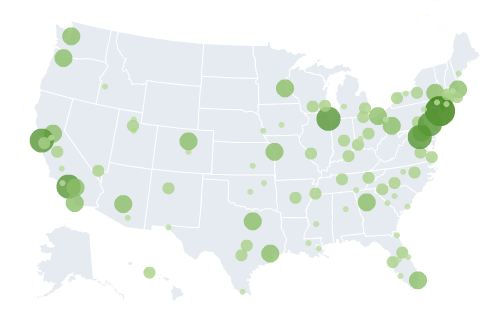
Before state and local governments jump onto the clean tech bandwagon, however, it helps to know if they are starting from scratch (not such a great idea) or building on existing strengths. According to Brookings, Virginia is not exactly a hotbed of clean-tech innovation. But it’s not a wasteland either. (Click on map to view more legible image of clean sector job clusters.) The main center of innovation is the Washington metro region — no surprise, there — but there are respectable centers of clean-sector activity in the Richmond and Hampton Roads regions.
Virginia has roughly 66,700 clean jobs, ranking it 15th among the 50 states and Washington, D.C. The clean economy contributes 1.7% of all jobs in the state, ranking it only 36th in intensity, however. Annual wages are $43,400 and exports per job are $11,000. (See details in this state profile.)
Take a closer look, and the details are less impressive. Waste management and treatment is our second largest jobs category. Mass transit is third, and “regulation and compliance” is fourth. In other words, we’re counting a lot of waste treatment plant workers, bus drivers and government administrators in our total. “Conservation,” whatever that is, is the No. 1 category. It sounds very Virginian.
The cool categories are pretty underwhelming: 142 jobs in the smart grid segment, 71 in green consumer goods, 103 in biofuels/biomass and 410 in wind. The one broad category that shows some potential is professional environmental services, which employs 4,642.
Maybe I’m getting old and cynical, but I’ve seen these economic development fads come and go. As a contrarian by nature, I’d be wary of chasing after the same limited number of companies and deals that everyone else is lusting for. Better to focus our attention on some under-appreciated or out-of-favor sector — like logistics, medical devices, or nuclear power — where a little bit of love goes a long way.
Putting State Funds to Work Demos Frustrated with too-big-to-fail banks that have pulled the plug on small business lending? Put state tax-revenue deposits in a locally owned bank willing to lend to small businesses in the state.
Getting the Facts on Child Abuse
Government Accountability Office According to government figures, nearly 1,800 children died last year of maltreatment. And those numbers probably under-state reality given the difficulty of local officials in compiling the data.
Enforce Sex-Offender Registration Heritage Foundation
Sex offenders are running loose. Uncle Sam needs to enforce state participation in the Sex Offender Registration and Notification Act.
Zombies work in concert better than administrators in Virginia's school system. Despite being brain dead, zombies manage to collaborate in their human-hunting rampages.
Last year, the state Senate directed the Joint Legislative Audit & Review Commission (JLARC) to suggest how the Secretary Education could “improve the coordination” between state public schools, community colleges and four-year colleges. The result of such a vague directive has resulted in a new JLARC report that is, for the most part, utterly useless. I pity the four staff members who were assigned to investigate the topic. I would have rather spent the duration strapped to a chair with wild gerbils gnawing on my ankles.
Many aspects of the educational system are coordinated already, concluded the authors of the draft report, “Review of Coordination Needs within Virginia’s Education System,” but some are not. The authors detect insufficient coordination in the areas of college readiness, student transfers between community colleges and four-year colleges, teacher preparation, career readiness and the state’s longitudinal data system.
I will let others assess whether or not there is a coordination gap in the realm of the latter four items. I did not reach the detailed discussion of them during my perusal of the report. I got stuck on the narrative of the first problem area, college readiness, and could go no further.
There is a “college readiness gap” in Virginia, asserts the JLARC report. Upon that much, we can agree. In the commonwealth, 56% of entering community college students who completed high school the previous year wind up in a remedial English or math course, and about 24% of first-time college students do. This gap, which exists in most other states, is rightfully regarded as a national disgrace.
To any normal person not marinated in the logic of bureaucratic excuse-making, the reason for the gap is blindingly obvious: Schools are letting students graduate without acquiring basic skills in reading and math. There is no need to “coordinate” between Virginia school systems and state colleges about anything. High schools simply need to stop graduating students who can’t do the work their diplomas say they can.
But JLARC, drawing upon a 2006 Spellings Commission report, espies a more nuanced problem:
The continued growth of high school graduates who need remediation at the postsecondary level illustrates a need for better communication and coordination between high schools and colleges to address the issues of college readiness for recent Virginia public high school graduates.
High school grads aren’t ready for college? Perhaps better “coordination” can “clarify the expectations” about what colleges need from the K-12 system. What form might that coordination take — over and above appointing a Secretary Education to oversee the entire system, and supplementing his efforts with such initiatives as (I’m not making this up) the Joint Agreement on Virginia’s College and Career Ready Mathematics and English Performance Expectations?
Here’s a for instance of what JLARC has in mind: Get K-12 bureaucrats together with college bureaucrats to develop college readiness standards. States the report: “The higher education system needs to share its expectations of what students should know with the K-12 system, and the K-12 system should incorporate, as much as feasible, these expectations into the learning standards.”
What balderdash! The scandal of 56% of entering community college students being unable to compose a coherent sentence does not stem from unclear expectations about college. It comes from (1) the inability of schools to teach, and/or (2) the unwillingness of students to learn. Until we solve those two problems, getting bureaucrats to agree on readiness standards is like trying to win Biggest Losers by eating a Lean Cuisine for lunch.
Do we really need more educrats acting as “liaisons” between each others’ boards and agencies? How about all those high school guidance counselors — what do they do? Isn’t it their job to bone up on college standards and communicate them to students? Or, how about the people who design high school curricula and standardized tests? In an era when 60% of all high school grads go on to college and community college, are they so out of touch with college standards that nearly half of all high school grads fall short?
Will bolstering “coordination” between agencies do anything to address the fact that tens of thousands of children are failing to learn basic skills in school, that our education system is pushing them through to graduation anyway, and that everyone from our Republican governor to our Democratic president is urging them to attend college? I don’t think so. Virginia’s state senators are asking JLARC to answer the wrong questions. The findings are barely worth reading.
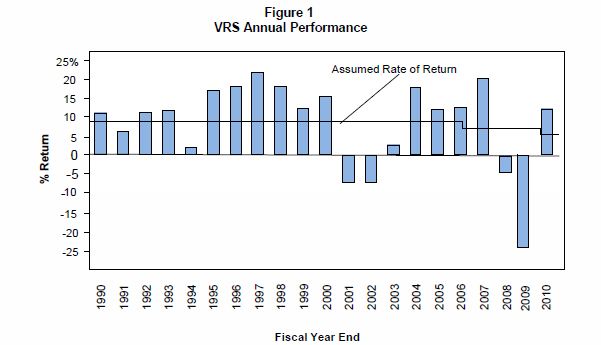
The Virginia Retirement System has recovered most of the losses it experienced during the 2008-2009 stock market crash, reaching $54.3 billion in assets as of March 31 after a 13% gain in its investment portfolio over the previous year, reports the Joint Legislative Audit & Review Commission in the draft of a semi-annual oversight report.
While the fund has under-performed 3- and 5-year benchmarks, due mainly to the stock market crash of 2008 and 2009, it has earned a compounded return of 5.9% over the last 10 years. The annualized return from 1990 to the present was 8.5%. (Click on graph for more legible image.)
The board uses a 7% ROI investment in its actuarial projections for long-term performance. The state assumes an 8% return.
But an improving performance doesn’t let the state or state employees off the hook for making up unfunded liabilities. “You can’t invest your way out of these unfunded liabilities,” said Diana F. Cantor, chair of the VRS board of trustees, after a briefing of state legislators Monday. (See the Times-Dispatch report.)
State contributions this year are significantly lower than called for by sound actuarial practice, but the state will make up the difference for this year and last, about $620 million, with interest in future budgets.
The Bacon’s Rebellion blog migration continues. I have succeeded in moving all 3,500 blog posts to this website, but only 40% of the comments. Additionally, I need to undertake an additional maneuver to move the author attributions. In other words, we have the stories, but not who they are written by! I will be working on these and other issues over the next week or two.
I have deferred until later the task of assigning categories and tags to blog posts. Any thoughts on how I should organize the blog content would be welcome. Thanks for your patience.
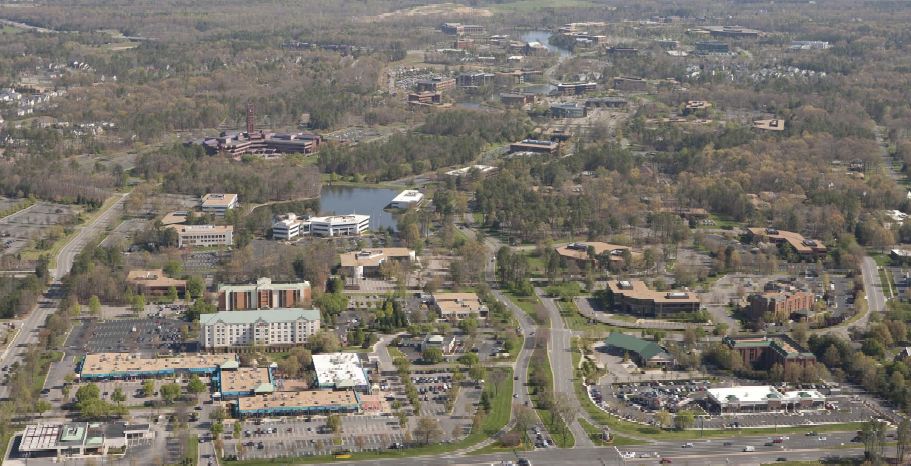
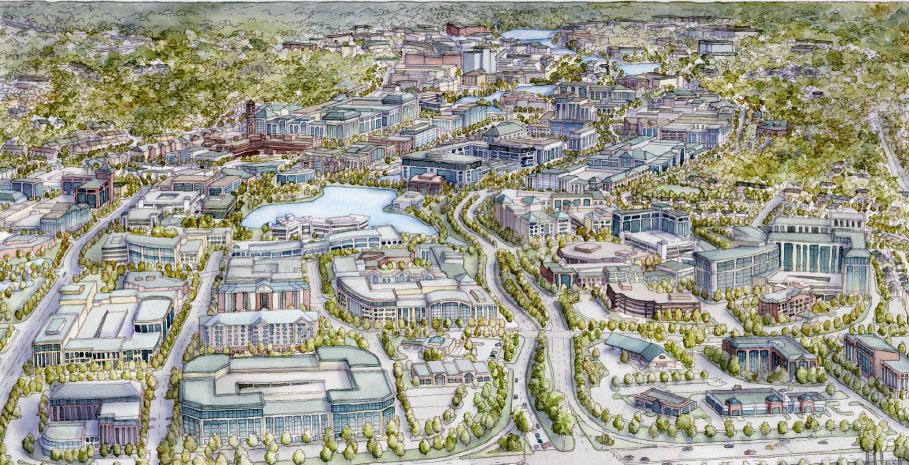
Highwoods Properties, owner of roughly one-third of the Innsbrook Corporate Center, has asked the county to rezone 188 acres to allow intensive, mixed-use development, including office towers up to 16 stories tall. If approved by the county, the project would commence the transformation of the second largest employment center in the Richmond region from a meandering 80s-era campus of two- to three-story offices surrounded by parking lots and tree groves into an urban oasis. (Click on photos to view more legible images.)
Innsbrook in 20 to 40 years?
The Highwoods plan calls for an additional 3.5 million square feet of office space, 415,000 square feet of retail and restaurant space, 1,000 hotel rooms and 6,000 residential units to be redeveloped over 20 years, reports the Times-Dispatch. “We have come as far as we can as a suburban office park,” said Paul W. Kreckman, Highwoods vice president. “We are very proud of it, it is beautiful, it is great. But you can’t stay here, you got to move on.”
The Henrico Board of Supervisors must approve the request but it laid the groundwork in September 2010 by adopting the Innsbrook Area Study study, which designated a 1,351-acre tract in the western county as an Urban Development Area (UDA). The study articulated a set of guiding principles for the area, including the need for (a) greater density, (2) a balance of jobs, housing, retail, entertainment and other amenities, and (3) urban design that encourages walking and mass transit as an alternative to the automobile.
The study critiques the current design, which separates buildings by large areas of surfacing parking, places services and amenities on the periphery, and banishes all housing, thus forcing people to use automobiles for nearly every trip. Henrico planners recognize that traditional “suburban” development (low densities, separated land uses, cul de sac subdivisions, massed concentrations of retail) will not be able to economically accommodate anticipated residential growth of 50,000 new housing units by 2026.
The county’s goal is to maintain a ratio of 65% residential to 35% nonresidential development, not just countywide but within the Innsbrook development area. It makes sense to locate a portion of that residential growth close to the county’s largest employment center on the grounds that it “could reduce workforce dependency on the automobile.”
The need for balance goes beyond housing and jobs. It extends to daily services such as grocery stores, banks and childcare. Re-development also should support mass transit and, above all, walkability. The study aims to create a comprehensive “pedestrian circulation system” by means of grid or modified-grid streets, individual blocks, alleyways, sidewalks and streetscapes, paths, trails and links to adjacent neighborhoods. Cul de sacs and other dead-end streets should be avoided unless necessitated by the presence of natural features or other site constraints.
The big question is whether existing connectors, such as the congested Broad Street Corridor and the under-utilized Nuckols Road can handle the increased traffic. In theory, if enough people can accomplish most of their trips on foot, in trams or in short car trips within the re-development area, the densification of jobs and residents will have only a modest impact on connector roads and Interstates. Henrico County undoubtedly will have to spend to upgrade its connector streets, but it will arguably spend less than it would if the construction were all green-field development.
Henrico botched the planning in the nearby Short Pump area, a horrendous mass of strip and mall commercial development where the traffic bogs down in the worst congestion in the Richmond region. As a Henrico resident, I hope that the planners and supervisors get Innsbrook right. Early indications are that they will.
I celebrated Independence Day yesterday. Not America’s — the Southern Sudan’s. I joined a couple of hundred Southern Sudanese, the so-called “lost boys” and their families, who had gathered from all corners of Virginia at a Methodist church in Richmond’s West End to mark the birth of the world’s newest nation. These black Africans were all refugees of the Darfur-style warfare that the Arab regime in Khartoum had inflicted upon the region before the United States brokered a peace several years ago.
There was dancing, feasting (an interesting mix of Sudanese and American cuisine) and, of course, speech making. At last, the people of the Southern Sudan have a chance to build normal, peaceful lives. Thousands of refugees living in America, many of whom are now college educated, share their aspirations and hope to help.
As my artist friend Awer Bul told me, the last time he went back to the refugee camps, where he spent much of his youth growing up, the children there would draw pictures of soldiers, war and mayhem. After 10 years of peace, he hopes, they will be drawing pictures of happy domestic scenes.
Whether lasting peace will come is anyone’s guess. Oil deposits have been discovered in the Southern Sudan, and many fear that the genocidal Khartoum regime may renew the conflict by arming the militia of neighboring tribes. This time, though, the southerners will be prepared to defend themselves. Still, what a shame it would be to spend the emerging nation’s oil wealth on arms. Awer’s goal is to bring schools and water wells to the villages of his people — and, who knows, to build a museum to preserve their history and culture. Let us all pray that Awer’s vision prevails.
Saving Mass Transit: Competitive Contracting Heritage Foundation
To become an economically competitive form of transportation, mass transit needs to bring down costs. One place to start is to implement competitive contracting.
Putting Low-Income Fathers Back to Work Brookings Institution
Low-income men need to financially help support their children. The authors point to Texas’ Noncustodial Parents’ Choices as a program that works.
Higher Ed Policy Making for Dummies American Enterprise Institute
Among the lessons legislators need to remember when discussing higher ed funding: Do not confuse enrollments with degrees. Many students never graduate. Also remember, not all degrees are created equal. Some cost more, some provide more marketable skills.
Note: Some may have seen that AZA and TMT have been playing “I post, you post” in the comment threads following somewhat unrelated posts concerning the parameters of functional density of Alpha Communities and how these densities relate to the Beta Community of Reston.
In response to TMT’s latest note I have tried to put these perspectives – clarified and updated – together in one place. I asked Prof. Risse to post it and welcomed him to edit and add notes from his perspective. Since this is all about human settlement patterns, I also asked him to alert those that review comments for violations of The Litmus Test to be especially watchful of unfounded Idea Spam and Intentional Information Sabotage.
AZA
DENSITY IN FOCUS
Following the post by Mr. Bacon on school reform, I noted:
Only when there are densities of around 30 persons per acre at the Alpha Community scale can there be efficient and effective transport alternatives that enable students to choose different educational options.
This statement is based on our understanding of the transformations that reflect 1) the end of the era of the ‘Autonomobile’ domination of settlement patterns, 2) the end of vast subsidies for dysfunctional settlement patterns, and 3) the changes in citizen settlement pattern preferences noted below.
In a later comment, TMT noted that “30 persons per acre” seemed high to him. (Most of the dialogue from his comment and my response is summarized below.)
I responded to the reference to “30 persons per acre” by noting that the original statement was “30 persons per acre AT THE ALPHA COMMUNITY SCALE.” I suggested that without a spacial quantifier, a statement on density is a meaningless abstraction. This is NOT just nit picking. Density must always be expressed in terms of quantity per some measure of area that has a specific definition.
TMT said: “I don’t think this level of density is politically feasible except in selected locations.” Read more.
As I argued back in April (see “Sandy Alberta, the Saudi Arabia Next Door“), America can import its oil from our democratic, market-oriented, environmentally friendly neighbor to the north, or from anti-American crackpots like Venezuela’s Hugo Chavez and anti-American madmen like Mahmoud Ahmadinejad. The Obama administration appears to be leaning toward the crackpots and madmen.
As the Wall Street Journalreports today, the administration has been causing endless to a TransCanada Corp. proposal to build a pipeline linking the oil sands of Alberta to the Gulf of Mexico refinery complex. By approving the pipeline, the United States could create thousands of construction and oil refinery jobs and capture much of the economic value of the oil production in Canada itself– American companies are big participants in the oil sands boom –in the process.
But President Barack Obama has said publicly that he wants to investigate “how destructive” oil-sands operations might be to the environment before approving the line. The Environmental Protection Agency has urged a more thorough environmental impact study. And the State Department is dragging its feet in signing off on the transnational pipeline, which would cross the Canadian-U.S. border.
Let’s set aside the concern that America’s job creation numbers remain dismal: only 18,000 net jobs created last month. Let’s overlook the arrogance of the United States dictating environmental policy to Canada, a nation with mature democratic institutions and a mature environmental movement. Let’s look at the hypocrisy. Canada’s heavy oil is very similar to the heavy oil we import from Venezuela. Which country do you think is a better steward of its environment — Canada, where the nation’s strong democratic institutions provide for ample input by environmentalists, or Venezuela, a Third World kleptocracy where a populist thug is running the economy into the ground through short-sighted policies geared to keeping him in power?
Is President Obama concerned about the oil pollution in Lake Maracaibo and the Caribbean? Does he want to investigate “how destructive” Venezuelan policies are to the Amazonian rain forest?
Wow, this is just breathtaking. In one policy-debacle trifecta, the Obama administration is harming U.S. energy security, dampening U.S. job creation, and discriminating against an environmentally friendly democracy.
Studying Health Care Disparities National Academy for State Health Policy A Virginia study of health care disparities is one of two initiatives highlighted in this report. That document, the 2011 Health Equity Report, should be published soon.
A half year ago, I didn’t think that I had a weight problem. At 6′ tall, I tipped the scales at 193 pounds. I exercised fairly regularly, ate balanced meals and indulged little in desserts, snacks or fast food. I had a little flab around the waste but didn’t feel overweight, much less obese. Then, in a routine physical, my doctor told me my blood sugar was running high. I was pre-diabetic, he said. If I didn’t control my nutrition, I could wind up a full-fledged diabetic.
Boy, was that a wake-up call! There was no way I would let myself become a diabetic. I would take control of my diet. Out went the soft drinks; in came the flavored water. Out went the starch at dinner time; in came the vegetable salads. Out went the breakfast cereals; in came yogurt, granola and fresh fruit. Out went the processed bread; in came whole-grain bread. My intent was to restore my blood sugar to healthy levels. I wasn’t looking to lose weight. But as a side effect of adopting a better diet, I did lose 10 pounds.
Through the lens of that experience I now report the latest findings of a new study by the Trust for America’s Health, “F as in Fat: How Obesity Threatens America’s Future 2011.” Twelve states now have obesity rates above 30%. Four years ago, only one state was above 30%. The obesity epidemic is the worst in the South, lowest in the Northeast and West. But viewed over a 20-year timeline, obesity is increasing across the board.
Virginians can take some small consolation that we are less fat than the national average. We rank 30th nationally. But considering that higher-income people are less likely to be fat and we Virginians rank among the 10 highest income-per-capita states in the country, we have no grounds to get smug. Obesity is a major contributing factor to heart disease and diabetes, which runs up health care costs, which we all pay. So, one person’s obesity is not just his or her problem, it’s everyone’s problem.
(See the detailed statistics for Virginia here. Fifteen years ago, Virginia had a combined obesity and overweight rate of 48.9 percent. Today, the combined rate is 61.2 percent.)
There are many explanations of America’s rising obesity rate. The population is getting older, for one, and people who put on one or two pounds a year can find themselves overweight by middle age. Our lifestyles are more sedentary, and we get less exercise. (Our auto-centric human settlement patterns play a role here.) And we eat way too much processed food, and not nearly enough fresh fruit and vegetables. But none of these contributing factors is destiny. Every one of us has free will. We all know what we need to do — it is impossible to escape the mantra that we need to eat right and exercise more. We just need to do it.
I know that it can be done because I have done it. It’s not easy changing food-eating habits but it is possible. It’s not easy finding the time and energy to exercise but it is possible. Here’s the question: Will other Americans do the right thing? Or do they have such an entitlement mentality — “I’m entitled to health care, and I’m entitled to have someone fix my medical problems, even if they are of my own making”– that most of them are too complacent and lazy to change? My fear is that preaching and moral suasion will not work. The morality of personal responsibility is dying in this country. And the logic of the social engineer — we’ll tax soda pop so people will drink less of it — is all that is left to save us from ourselves.
To be frank, I have always had a bad feeling about blogging for Bacon’s Rebellion while its sister electronic magazine of the same name was controlled by a right-wing, lobbyist-infested outfit grandly called the Thomas Jefferson Instutute for Public Policy.
Thankfully, this unholy arrangement will be coming to an end soon. Bacon’s Rebellion has achieved a good reputation as a spot where serious policy discussions can be found — an important point given that mainstream media outfits have so badly cut their staff there’s not a lot of informed discussion. Sure there’s a lot of sparring that sometimes goes over the top. Ditto the e-zine which used to have some of the best reporting and analysis on Virginia’s land use and transportation issues.
Somehow, the so-called Thomas Jefferson people got hold of the e-zine and now they are supposed to give it back. From the git-go, it was a bad conflict of interest since their supposedly scholarly and libertarian sounding board was actually run by a bunch of less-than-scholarly hacks who were really lobbyists in sheep’s clothing.
Nowhere is this more clear than in a study the institute did regarding affordable housing policies in Fairfax County. The report, written by Michael Thompson, a major Republican contributor and director of the “institute,” slams the county for “subsidizing” luxury housing by putting housing aid recipients in apartments where there may be swimming pools, gyms and other benefits, according to The Washington Post. The reasoning seems to be that if you are poor and you get government aid, you have no right to exercise.
Thompson’s skewed report has split the supervisors down party lines. Board Chairman Sharod Bulova, a Democrat, says only 15 of the 41 condo projects where the poor are housed have swimming pools. Thompson apparently ignores the fact that many of the county’s housing units
were built with amenities and that in towards serious downturn, many more people can’t afford the usual, high rents.
So what are they supposed to do? Live in cinderblock cells without TV sets because they are poor? Michelle Krocker, executive director of the Northern Virginia Affordable Housing Alliance characterizes the report this way: “There are no data, no interviews, no sources. There are no statistics. I’m finding it very curious that a think tank would put out something less than scholarly.”
No surprise there. I’ve scratched my head at some of the papers I’ve read from the TJ people because they don’t offer many statistics or facts to back up their opinions. I remember one Thompson report lauded offshore drilling and gave a laundry list of supposed benefits without any sourcing.
The point is that the institute is not really a think tank — it is a Republican lobby. It is hardly “non-partisan” as it pretends to be. Bacon’s Rebellion is severing its relationship with these people. Not a moment too soon.
The year: 2075. The American colonies on the Moon are getting restless under Washington’s tyrannical rule….
This second edition of “Dust Mites” has a snazzy new cover, includes helpful lunar maps, and is 5,000 words tighter than the original. The sequel, “Trogs,” is scheduled for publication this summer.
Advertisement
Advertisement
Advertisement
Advertisement
About
Bacon’s Rebellion is Virginia’s leading politically non-aligned portal for news, opinions and analysis about state, regional and local public policy. Read more about us here.
Fund the Rebellion
Shake up the status quo! Your contributions will be used to pay for faster download speeds and grow readership. Make a one-time donation by credit card or contribute a small sum monthly.
Can’t wait until tomorrow
For your Bacon’s Rebellion fix?
Enter your email address to receive immediate notifications of new posts by email.
SUBSCRIBE
Search Bacon’s Rebellion
Categories
Archives
The Jefferson Council
Protecting Thomas Jefferson’s Legacy at the University of Virginia
Forgot Your Password?
Shoot me an email and I’ll generate a new password for you.