• Virginia Student Performance: Mediocre by International Standards

    by James A. Bacon

    How well are Virginia’s public schools preparing students for competition in a global marketplace increasingly dominated by the knowledge economy? Most people would say pretty well. Sure, there are pockets of dysfunction in inner cities and poor, rural counties but our suburban schools do pretty well… especially in Northern Virginia where local governments are willing to tax heavily to invest in higher quality education.

    How well does that perception stand up to reality? Not very well, according to a new report, “When the Best Is Mediocre,” published by Education Next. Instead of subjecting a city or county’s educational achievement numbers to national comparison, the Global Report Card (GRC) subjects it to a comparison with other developed countries with roughly comparable levels of development and wealth.

    “Even the most elite suburban school districts often produce results that are mediocre when compared with those of our international peers,” write Jay P. Greene and Josh B. McGee. “Our best school districts may look excellent alongside large urban districts, the comparison state accountability systems encourage, but that measure provides false comfort. Americaโ€™s elite suburban students are increasingly competing with students outside the United States for economic opportunities, and a meaningful assessment of student achievement requires a global, not a local, comparison.”

    There are a handful of U.S. school districts where excellence prevails. The average student in the Pelham school district in Massachusetts, for instance, stands at the 95th percentile in math internationally. But most districts show a mediocre performance , if not an outright dismal one.

    Let’s take Fairfax County as an example. Although the county does have challenges, including a large English as Second Language population, it has some of the best schools in the country and is widely perceived as one of the best school districts in the state. The average student in Fairfax County would perform better than 62% of the students in the United States in math tests — but better than only 49% of students internationally. In Henrico, the affluent suburban county where I live, the average student would out-perform 59% of students nationally but only 47% internationally.

    The average student in the city of Petersburg, serving a mostly poor and minority student body, would outperform only 26% of students internationally. No surprise there. But in Loudoun County, one of the wealthiest jurisdictions in the entire country, the average student would out-perform only 51%. (For the most part, Virginia schools perform somewhat better in international comparisons on reading scores than math — but math is the language of science, engineering and technology so critical for international competitiveness.)

    Use this interactive feature to compare your school district to state, national and international averages.

    It’s time that Virginia gets serious about school reform. We understand the implications for global competitiveness. We talk about the problem a lot. Then we tinker at the margins. Nothing serious is happening. We are already failing the current generation of young people in this state. Are we destined to fail the next one as well?

  • New Front in War on Rising Medical Costs: Hospital Readmissions

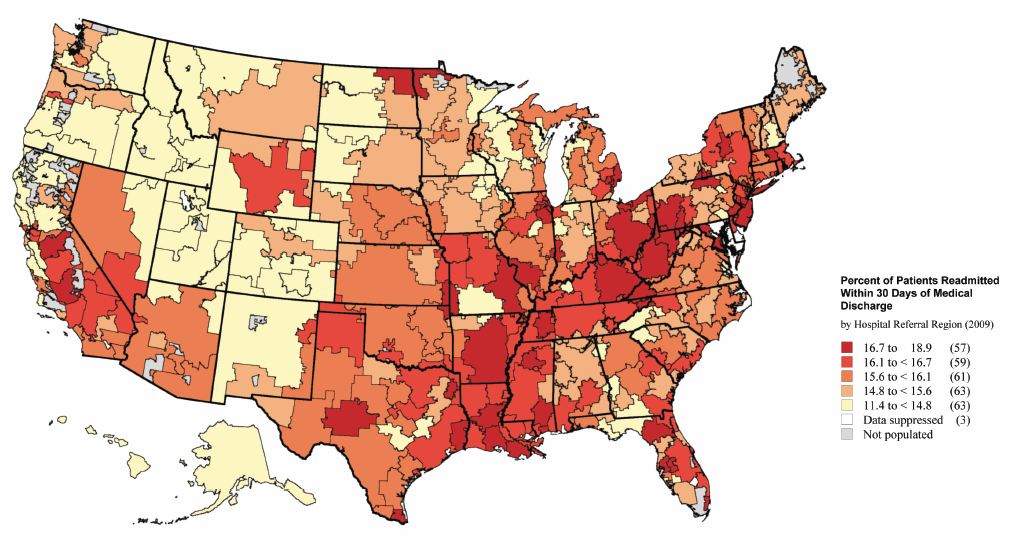
    Percentage of patients readmitted within 30 days of hospital discharge, by hospital referral region.

    by James A. Bacon

    In an effort to rein in runaway health care costs, policy wonks are paying close attention these days to a key metric of hospital quality and productivity: hospital readmissions. If too many patients are readmitted to the hospital shortly after they are discharged, it’s a sign that something could be wrong. Perhaps some patients are being released too early. Perhaps there is a disconnect in follow-up care with doctors outside the hospital.

    In an examination of the records of 10.7 million hospital discharges for Medicare patients, researchers with the Dartmouth Atlas Project found wide variations in 30-day readmission rates across regions and academic medical centers. More than half of Medicare patients discharged home do not see a primary care clinician within two weeks of leaving the hospital. “The report highlights widespread and systematic failures in coordinating care for patients after they leave the hospital,” said David C. Goodman, lead author of the study. “Irrespective of the cause, unnecessary hospital readmissions lead to more tests and treatments, more time away from home and family, and higher health care costs.”

    Centers for Medicare & Medicaid Services has estimated the cost of avoidable readmissions at more than $17 billion a year in a Medicare budget that exceeds $500 billion yearly. Despite the focus on readmissions in recent years, Dartmouth Atlas researchers see little progress being made in this metric.

    As you can see in the map above (click to view the map in more detail), Virginia hospitals are far from the worst offenders in the country. But they have ample room for improvement. Compare the performance locally with that of Utah, Idaho, Colorado, Oregon and New Mexico. In one of the few productivity-oriented cost control provisions to emerge from Obamacare, Medicare will start in 2013 to reduce reimbursements to hospitals deemed to have an excessive number of readmissions. That should concentrate administrators’ minds wonderfully on the need for coordinated care. It’s not clear, however, that the problem resides entirely with the hospitals. Do physicians bear any responsibility? Do patients or their caretakers? Could this be a job best tackled by the entire medical community?

    Stay tuned. As the cost of health care insurance takes an ever bigger bite out of business budgets and family pocketbooks, hospital readmissions is a problem that Virginians policy makers will have to grapple with.


  • Wilder’s Last Hurrah?

    By Peter Galuszka

    Doug Wilder has always marched to a different drummer.

    A major force in Virginia politics, he became the state’s first black state senator in 1969, the first black lieutenant governor in 1985 andย  then the nation’s first elected black governor in 1989. In the last post, he defied fellow Democrats by slashing state spending by $2 billion and not raising taxes.

    His independent ways carried over when he was mayor of Richmond and got into a cat fight with the School Board that cost $1 million in fees when he forced them out of their offices in City Hall. More recently, he has been a totally unpredictable political kingmaker — a Democrat but hardly a reliable one.

    So it’s somewhat typical, and also a bit sad, that he has stumbled so badly on his National Slavery Museum near Fredericksburg. The project that he started in 2002 filed for Chapter 11 bankruptcy on Sept. 22 and has tossed Wilder into a really big mess. The project has $2.3 million in unsecured debts, $215,000 in unpaid local taxes and a $5.1 million court judgment won by architect C.C. Pei, the son of famed architect I.E. Pei who designed the East Wing of the National Gallery of Art on the Mall.

    Wilder has responded to the bankruptcy in his usual fashion. He won’t talk to the public or reporters. No apologies. Nothing.

    To be sure, museums about slavery seem to be a hard sell, which is pathetic considering that we’re in the sesquicentennial of the Civil War and slavery was such a crucial and awful part of this country’s history. In Cincinnati, for instance, the National Underground Railroad Freedom Center started out with high hopes about a decade ago. By 2008, however, poor attendance forced it to cut its budget by $5 million and cut 30 percent of its staff. It also shifted its emphasis away from the underground railroad to more modern issues such as trading female sex slaves.

    This may well be the last hurrah for the aging and controversial Wilder.


  • Overhauling Mental Health Delivery for Medicaid Patients

    I will go to any lengths to get you to read this post, even if it means including totally gratuitous material like this photo of Holly Madison and her heavily insured breasts.

    by James A. Bacon

    Michael Martz is the guy that the Times-Dispatch assigns to important-but-boring stories about the nuts and bolts of state governance like utility regulation, health care exchanges and state retirement benefits. Today he highlights a McDonnell administration initiative for reforming (zzzzz) the way the state administers (Zzzzz) Medicaid-reimbursed (ZZZzzzzzz) mental health services (ZZZZZZ! Snort! zzzzz…)

    It’s an important story. But, unless you’re directly involved in the mental health system, you’re not likely to click away from today’s Huffington Post story about the $1 million insurance policy that Holly Madison (pictured above) has taken on her breasts just so you could read about the state’s proposed new service delivery systems. (Come to think of it, if you did click away from the story about Holly Madison, you could be certified as legally insane in 14 different states.) Martz deserves credit for doing the yeoman’s work of explaining the state’s effort to make the system work better. As he explains:

    The proposed new system would attempt to reduce the costs of the services to the Medicaid program by moving away from the traditional “fee for service” model to one that ultimately would have a private entity coordinating care for a contractual fee โ€” and the risk that comes with it.

    “The overall goal of the project is to improve the value of behavioral health services purchased by the Commonwealth of Virginia without compromising access to behavior health services for vulnerable populations,” said Cynthia B. Jones, state Medicaid director, in a memo to service providers last week.

    One source of concern is that a third party contractor will add another layer of management and cost. But Secretary of Health and Human Resources Bill Hazel said the proposed coordinated care system would be different from the kind of managed care that most people are familiar with.”Managed care was all about the price,” he said. “It was the gatekeeper whose job was to say ‘no.’ … We want to ensure that individuals are getting the care they need in the appropriate setting when it’s needed.”

    I have no idea whether this new arrangement will work, but we can’t continue doing what we’ve been doing. In stark contrast to Holly Madison and her bountiful assets, Virginia doesn’t have the money to throw at mental health. We have to experiment with new ways of delivering services and incentivizing providers and patients until we find something that works better. At least the McDonnell administration is trying.


  • The Wonk Salon, September 29, 2011

    Alcohol Wholesalers Seek to Preserve Regulatory Fiefdoms
    Competitive Enterprise Institute
    Alcohol wholesalers run to Congress to preserve regulatory fiefdoms eroded by a recent court case. Count on a Republican to craft the anti-free market legislation.

    Foreign Teachers: Exploited and Exploiters
    Center for Immigration Studies
    The importation of teachers from the Philippines under temporary worker programs is rife with abuse. Many teachers are exploited by local school boards. At the same time, they cheat on their taxes. It ain’t a pretty picture.

    How Medical Debt Threatens Family Stability
    New America Foundation
    Sixteen percent of American households are being dunned for medical payments. Obamacare will help. And states can help by asking hospitals not to report medical debts with credit agencies.

    Why the High Cost of Public Sector Employees Comes as a Surprise
    Mercatus Center
    States get blindsided by the cost of public employees because they make unrealistic actuarial assumptions and they do a lousy job of making information available to the public.


  • Why College Students Aren’t Graduating

    More information on the college drop-out crisis comes from a study just published by Complete College America: “Time is the Enemy: The surprising truth about why todayโ€™s college students arenโ€™t graduatingโ€ฆ And What Needs to Change.” Based on data from 33 states (including Virginia), the study finds that 75% of college students are juggling school, jobs and sometimes family, and that part-time students rarely graduate. On average, students are taking too many credits and taking longer than necessary to complete. And, for the most part, remediation courses are “broken.” They do not work.

    Peter Blake, interim executive director of the State Council of Higher Education for Virginia, put a positive spin on the data for the Times-Dispatch:

    Virginia’s on-time graduation rate for a four-year degree was second among the 33 states, and the state ranked first for its six-year graduation rate. The state also did well with underrepresented populations in higher education. … Virginia was first in the six-year graduation rate for full-time Hispanic students, and second for both African-American students and for recipients of Pell Grants, which aid those with the most need.

    View the state-by-state data, including Virginia’s, here.

    While the Old Dominion may fare well by some measures, the trend lines are much the same as for other states. If there’s one easily digested bottom line from the study, it’s this: State systems of higher education need to focus less on enrollment and more on degree completions. At present, colleges and universities are rewarded for the number of students signed up for classes, not the number who graduate – much less the number who graduate on time. The result is excess public support for higher education and years (and money) wasted by the students. Virginia is no exception. The time for change is now!

    — JAB


  • Warner Backs another Potomac Crossing

    American Legion Bridge

    by James A. Bacon

    It looks like the Outer Washington Beltway, which would connect with Maryland by means of a bridge across the Potomac River, is not just an idea being pushed by the McDonnell administration. Sen. Mark Warner declared on the Kojo Nnamdi radio show that he supports a new bridge himself.

    Tom Sherwood, an NBC reporter and Currents Newspapers columnist, quoted John “Til” Hazel, one of Northern Virginia’s more prominent developers, to the effect that the American Legion Bridge is crowded and due to get 50,000 more vehicles the next 10 or 15 years. Did Warner, he asked, see a need for new bridges across the Potomac?

    “Yes, yes,” said Warner. “We can’t keep funneling all the traffic into, you know, these few choke points across the river. But the money won’t be easy to find, he conceded. As governor he campaigned in support of a funding source for Northern Virginia transportation in the form of a half-cent regional sales tax, he said, but “I got my tail beat.” Now state transportation funds are “close to bankrupt,” the senator noted, and the federal Highway Trust Fund “is broke as well.”

    But the need is there. “Infrastructure, which used to be a competitive advantage for our country, infrastructure, which, in the Capitol region, helped us grow, now is becoming a choke point and is going to kill the golden goose where the jobs are, whether it’s in Montgomery County, PG County or out in Northern Virginia, in the Dulles courthouse square.” People have been talking for 10 to 15 years and the progress, he said, “has been, at best, incremental.”

    Northern Virginia’s power brokers, whether Republican or Democratic in their partisan loyalties, likely will line up behind the Outer Beltway — sometimes referred to as the “techway” — while the smart growth movement assuredly will oppose the mega-project. The Coalition for Smarter Growth makes two main points: (1) the Outer Beltway and bridge will do little to alleviate traffic congestion, and (2) the money would be better spent on easing existing congestion hotspots.

    I have no problem with building a Bypass as long as those who use it and benefit from it also pay for it. I see that as unlikely. The pattern in Virginia is to tax (or toll) the general public on amorphous grounds like “economic development” and “quality of life” to pay for projects that the power brokers crave but don’t want to pay for — like the Rail-to-Dulles METRO project.

    It will be interesting to see if the smart growth guys can revitalize the same informal alliance with fiscally conservative populists, like those who helped defeat the NoVa sales tax increase last time, to oppose the Outer Beltway project which appears to be regaining momentum.


  • The Wonk Salon, September 27, 2011

    Mapping Infant Mortality
    Healthcare Cost and Utilization Project
    A study of infant geographic patterns in infant mortality indicate that inequities in birth outcomes exist mostly in communities where there is low education attainment, a significant African American population, and high poverty rates.

    Expanding Health Coverage to Low-Income Families
    Urban Institute
    Implementing the Basic Health Plan option under Obamacare, with a modified cost-sharing approach, would provide coverage for an additional 120,000 Virginians — two out of three who are eligible.

    Why Are Urban Charter Schools So Successful? They Offer a “No Excuses” Approach to Education
    National Bureau of Economic Research
    The effectiveness of urban lottery-sample charter schools can be traced to their “distinctive pedagogical features” — their embrace of the No Excuses approach to education.

    Improving Medicaid Delivery and Quality
    Kaiser Family Foundation
    Medicaid administration varies widely across the 50 states. Many are experimenting with new delivery models, trying new payments systems and utilizing Health Information Technology.

    Helping Families Save for College
    New America Foundation
    The City of San Francisco is opening college savings accounts for 1,000 Kindergartners and seeding each account with $50. Just having the accounts makes families more likely to save.

    Fostering Ties between Foster Children and Incarcerated Parents
    Government Accountability Office
    In 2009 some 14,000 children entered foster care due to the incarceration of their parents. States are using a variety of strategies to support the family ties.


  • Map of the Day: Property Tax Growth

    Source: The Tax Foundation

    Virginia’s property taxes increased (as a ratio of the median real estate tax to median home value) by 4.5% between 2009 and 2010. Thirty-three states saw property taxes rise at a faster rate. North Dakota and Indiana were the only states to see their rates fall. (Click on map for more legible image.)


  • You Say You Want a Revolution, Well You Know…

    According to the Gallup organization, dissatisfaction with the way the nation is being government has reached a new high, along with mistrust of Congress and contempt for public officials generally. Fifty-seven percent have no confidence in the federal government to solve domestic problems. Forty-nine percent believe the federal government has become so large and powerful that “it poses an immediate threat to the rights and freedoms of ordinary citizens.”

    The Beatles penned their famous song, “Revolution,” in 1968, a fewย  years before the Watergate scandal inspired a wave of distrust in government. Dissatisfaction during that era of turmoil peaked at 66%. Today, the figure stands at 81%. The institutional configuration that has governed the country since World War II is on the verge of collapse. The people get it. Our rulers have too much invested in the status quo to bring about fundamental change. If people thought a revolution was looming then…


  • Congressional Republicans Cave — Again

    The Obama administration has successfully painted House Republicans as mad, uncompromising Tea Partiers willing to push the federal government to default in pursuit of their extremist agenda. Of course, when Republicans cave on major spending issues, like the transportation bill, we hear little about it. This column was penned by an observer of the Washington scene whose sponsoring organization found it too embarrassing to publish. We run it here. — JAB

    From left: Transportation Secretary Ray LaHood, Chamber of Commerce COO David Chavern and President Barack Obama. Photo credit: UPI

    by Publius

    Flanked by the leaders of the U.S. Chamber of Commerce and the AFLโ€“CIO, President Obama in late August urged Congress to pass a โ€œcleanโ€ extension of the surface transportation bill and a โ€œcleanโ€ extension of the FAA bill โ€œto give workers and communities across America the confidence that vital construction projects wonโ€™t come to a halt.โ€ Joining this august assemblage were two federal employees who, confronting the temporary loss of a job, were on the podium to serve as White House hostages.

    Two weeks later the leadership of the House of Representatives obliged the President by doing what he requested, and in the process effectively canceled one of the House Republicanโ€™s most significant initiatives to restrain spending and limit the scope of government.

    Until that fateful Tuesday vote, the House was on track to make serious reductions in, and significant reforms to, the existing highway legislation that was enacted in 2005 under the leadership of former Transportation Committee Chairman Don Young. Instead, the House ignored its many pending reforms and spending limits and joined the President in embracing and extending for six more months what many analysts consider to be one of the worst pieces of legislation ever signed into law. Called SAFETEA-LU, that law was 2,000 pages long, and included 7,000 earmarks, including the infamous โ€œBridges to Nowhere.โ€ SAFETEA-LU expired in 2009, but the absence of a replacement has led to several extensions of it since then, the most recent of which was set to expire at the end of September.

    In the months leading up the expiration date the House majority had made many impressive changes in transportation spending and policy in ways that were well within the spirit of the new majorityโ€™s commitment to change the culture of Washington. The House Budget Committee recommended, and the House endorsed, significant cuts in transportation spending with a focus on wasteful rail programs. The appropriations committee incorporated these targets into their bill, and the Transportation and Infrastructure Committee produced an impressive five year re-authorization plan that cut spending by $50 billion compared to SAFETEA-LUโ€™s totals.

    All this progress, however, was cast to the wind when the House leadership did as the President requested and extended for six months โ€“ at higher levels of spending than the House had already agreed to for FY 2012 โ€“ the remnants of SAFETEA-LU. As was the case with the earlier dispute over the re-authorization of FAA and the effort to eliminate egregious subsidies for a handful of privileged passengers and sweet-heart contracts for unions, both sides held the program hostage in their effort to advance policy. But as past conflicts demonstrate, the President and his congressional allies were prepared to shoot the hostages. The Republicans were not.

    One way to view this sorry outcome is that some Republicans are losing their will to fight for their policies against a determined President, his union supporters, and a do-nothing Senate. With recent fights on the debt limit and the FAA extension leading to uncertain outcomes, House Republicans seem farmisht from the relentless combat common to revolutions.

    They also seem worried about the presidentโ€™s embrace of the jobs issue, however wrong he may be about it. In demanding a clean bill, the President argued that 4,000 workers would be furloughed if Congress didnโ€™t deliver. Congress did deliver, suggesting that it too may now believe that jobs come from more federal spending. If so, we have come full circle from President Reaganโ€™s policies and are frighteningly close to 1971 Republican attitudes when President Richard M. Nixon said that โ€œI am now a Keynesian in economics.โ€

    Congress will be facing many more such fiscal challenges over the next few months, and some will be more intense than the highway extension they just gave up on. It wonโ€™t be easy, but many of the new members came to Washington to shake things up, and voters still expect that they will โ€œStiffen the sinews, summon up the blood,โ€ reverse this sorry setback, and get America back on the road to fiscal sanity. Weโ€™ll all be watching.


  • The Wonk Salon, September 26, 2011

    Many Parole Programs Still Winging It
    Urban Institute
    Evidence-based practices are making inroads in state correctional programs that oversee the release of 500,000 prisoners a year into the population. But many programs still appear to be flying by the seat of their pants.

    Want to Avoid Flood Damage? Elevate Your Stinkin’ House!
    Rand Corporation
    Want to avoid flood damage in New Orleans? Tip one: Move your stinkin’ house to a higher elevation! Tip two: If you refuse to do that, prop our stinkin’ house up on cinderblocks!!


  • Making the light rail boondoggle even bigger

    By Norm Leahy

    The Virginian-Pilot is on board with an expansion of Norfolk’s short, costly and scandal-plagued light rail line. But in a fine display of Babbittry, we’re not supposed to pay attention to the scandals, cost overruns, delays and such. Those petty concerns only get in the way of progress. And how to pay for it all? The paper manages to mention, in passing, that money for such an expansion may be hard to come by. But that’s a secondary consideration compared to the planning that needs to take place now for an even bigger, more costly system.

    But before the planners, great and small, get too excited about adding on to their train set, Randal O’Toole has a few things about the existing rails that ought to be kept in mind. I’ll quote his post in its entirety:

    Norfolk Virginia finally opened its light-rail line, and ridership โ€œexceeds expectationsโ€ at 5,600 riders a day. Considering they run 212 trains a weekday, thatโ€™s just over 26 passengers per train. How many 40-passenger buses would have been needed to handle all that traffic?

    Of course, the rail line exceeded expectations in many other ways as well. The 7.4-mile line was originally expected to cost less than $200 million. The final cost was at least $120 million over that. It was also supposed to be open for business in 2008. They exceeded that expectation as well. The original projection was for 10,500 weekday riders by 2021. Theyโ€™ll have to double ridership to meet that. A lot of city and transit officials also expected the rail line would be a feather in their caps. Instead, they were lucky not to be tarred and feathered when they were run out of town over cost overruns.

    Despite the underestimated costs and inflated ridership numbers, the Federal Transit Administration gave Norfolk light rail a โ€œnot recommendedโ€ rating in 2004. Too bad the agency changed its mind (or had its mind changed for it by Virginiaโ€™s congressional delegation). They could have saved taxpayers a lot of money on a truly wasteful project. But thatโ€™s the story of all light rail in a nutshell.

    It’s also the theme of a classic Simpsons episode — “Marge v. the Monorail,” which gave the world this snappy tune. The mob (or in this case, the Pilot) has spoken!


  • Second Chart of the Day: How Not to End Poverty

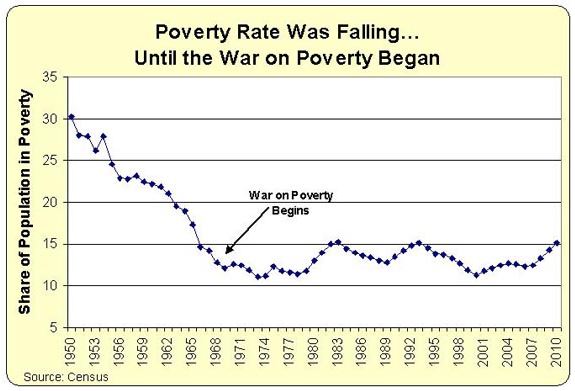
    Poverty in the United States declined dramatically in the Post World War II era until 1970 or so, and then it plateaued. In other words, poverty fell until the federal government declared war on it. Then the very institutions that the welfare state erected to ameliorate poverty ended up perpetuating poverty. (Source for the chart: the Cato Institute.) If you’re looking for an explanation of the yawning income gap, this is part of the story. The enervating effects of welfare reduce the incentive for the poor to increase their income. Talk about a high tax bracket! When benefits like the Earned Income Tax Credit, food stamps, housing assistance, Medicaid and more are peeled backย  as a poor household earns more money, it’s remarkable that people work as hard as they do! — JAB


  • Charts of the Day: Crashes vs. Crime

    by James A. Bacon

    It is axiom of the smart growth movement that, although fear of crime may predominate in the popular mentality, motor vehicle crashes represent every bit as much of a threat to peoples’ safety and well being. Because accidents are more likely to occur in the countryside and the ‘burbs (my term for human settlement patterns that are characterized by segregated land uses, low density and disconnected development), people are arguably less safe than if they lived in urban areas that are traditionally thought to be hotbeds of crime.

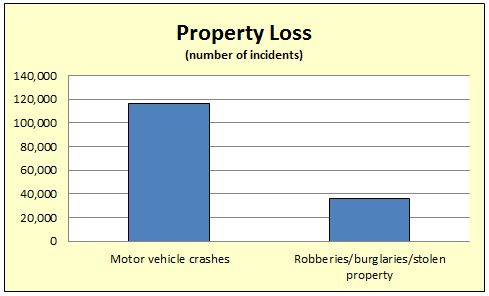
    Just for yucks, I pulled 2010 data from the Division of Motor Vehicles and the State Police’s “Crime in Virginia 2010” report. Here, for your viewing pleasure, I compare the impact of crashes vs. crime upon public safety.

    First, let’s compare the number of incidents involving property loss: motor vehicle crashes on the one hand and robberies, burglaries and stolen property on the other. It’s not even close. Automobile accidents are a much more frequent occurrence. (Click on charts for more legible image.)

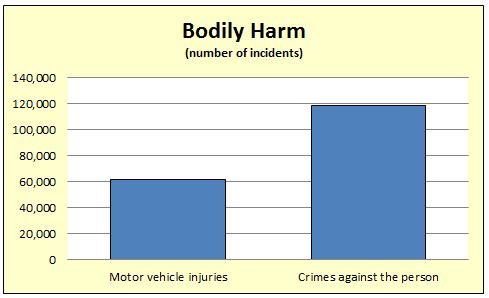
    Next, let’s take a look at the number of incidents involving bodily harm: the number of people injured in traffic accidents versus the number of people reported as victims of violent crimes (including murder, manslaughter, kidnapping, abduction, sex offenses and assault). In this case, you are more likely to be a victim of a violent crime than to be in injured in a traffic accident. However, it is important to note that the vast majority of these offenses consist of “assaults,” and that the overwhelming majority of “assaults” consist of “simple assaults” or threats in which the victim suffers no “obvious severe or aggravated bodily injury involving apparent broken bones, loss of teeth, possible internal injury, severe laceration or loss of consciousness.” I’m not a lawyer, so I may be mistaken about this, but if someone shoves you and you fall over, that’s an assault.

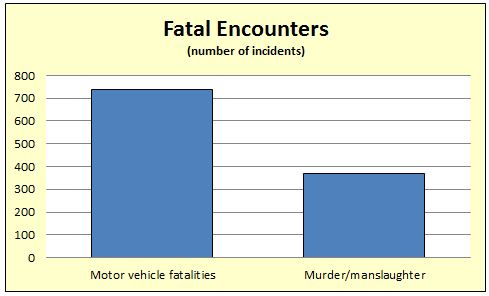
    Finally, take a gander at fatal encounters: motor vehicle fatalities versus . homicides and manslaughter. Virginians are twice as likely to die in an automobile accident as to be killed in a crime. Furthermore — and I say this in the belief, perhaps mistaken, that relatively few Bacon’s Rebellion readers are selling crack or operating meth labs, and thus are less likely to consort with people who settle their disputes with guns, knives and blow torches — law-abiding citizens are way more likely to die from being hit by a random car than to be murdered by an anonymous criminal.

    So, there you have it. The statistics speak for themselves. If you live in the country or the ‘burbs, you’re not nearly as safe as you think.

    Update: Ed Risse reminds me of the detailed work on this subject conducted by Bill Lucy at the University of Virginia. (Heck, I probably blogged about it.) See a summary of his findings here.