Internal Migration Slowing in U.S. National Bureau of Economic Research
Internal migration within the United States has diminished somewhat over the past three decades. The reasons remain elusive — but the “house lock” theory of low housing prices discouraging people from moving does not hold up.
Right-to-Work Wrong Answer for Michigan Economic Policy Institute
RTW laws lower wages and compensation for union and non-union workers alike. And they do not promote superior state economic performance — of the top 10 highest-unemployment states, seven are RTW states.
Conservation Easements Lag in the South World Resources Institute
The South accounts for 37% of the nation’s privately owned land but only 18% of its acreage under conservation easement.
Health Reform a Job Killer in Massachusetts Beacon Hill Institute
Romneycare health reform in Massachusetts is a job killer. The state created 18,300 fewer jobs in 2010, as a result, and economic output was $2.5 billion lower.
Economic Development through Renewable Energy Southeast Agriculture & Forest Energy Resources Alliance
The Tennessee Renewable Energy and Economic Development Council
was created with the aim of promoting the biofuels sector in Tennessee. The approach can work in other states, too.
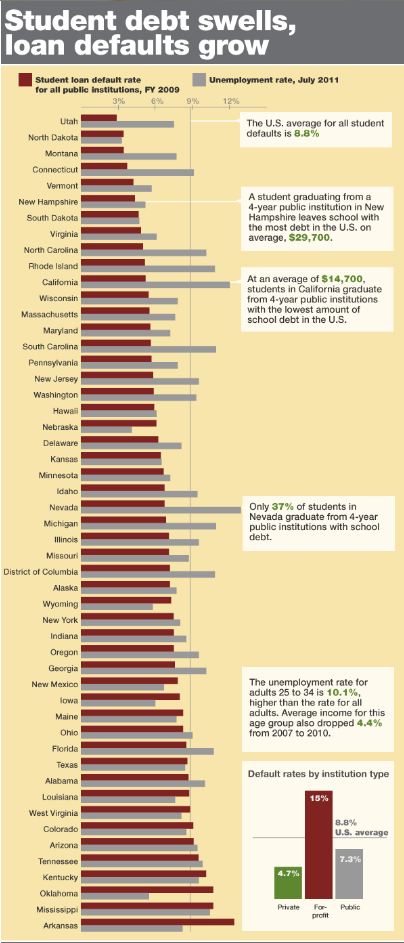
Virginia public universities have among the lowest rates of student loan defaults in the country. Not a surprise considering that Virginia also has one of the lowest unemployment rates. — JAB
More bad news on the reading, writing and ‘rithmatic front. SAT scores for the high-school graduating class of 2011 fell in all three subject areas to the lowest levels ever recorded, according to data released by the College Board Wednesday. Only 43% of students posted scores high enough to suggest they were ready to succeed at college. (Read the story in the Wall Street Journal.)
One reason scores are falling is that a higher percentage of high school students are taking the exams than ever before. Writes the Journal:
Declining scores can be attributed, in part, to a larger and more diverse test-taking population. As more students aim for college and sit for the exam, scores decline. Ten years ago, 8% of test takers were Latino, compared with 15% in 2011. For black students, the percentage jumped to 13%, compared with 9% in 2011. A growing percentage of students also grew up speaking a language other than English, and more than one-fifth of this year’s test takers were poor enough to receive a waiver to take the exam for free.
The fact is, more kids from disadvantaged backgrounds and crummy schools are taking the SATs. More people are aspiring to college, even though they are not academically prepared for it. Colleges will be happy to take them all, as long as someone can be found to pay, meaning more loans from Uncle Sam to students who may never graduate.
It may be true, as many studies have documented, that an increasing number of future jobs will require a college education. It’s a sad fact that a majority of American children will not be qualified to fill those positions. A large number of jobs probably will be exported overseas.
But cramming more students through the educational pipeline, regardless of their ability to succeed, is (a) a misallocation of society’s resources, (b) cruel to students whose unrealistic expectations are dashed, (c) costly to students who could be undergoing training and earning money in a job, and (d) shackling students with debt that an increasing number are unable to repay. Public policy needs to focus on fixing the K-12 educational system, not extending the practice of social promotion into college!
Biiig Medical Malpractice Reform in Texas Texas Public Policy Foundation
Texas was bleeding doctors before 2003 when the state enacted comprehensive medical malpractice reform. The Texas Medical Board has received 83 percent more applications and licensed 60 percent more doctors in the past four years than in the four years preceding reform.
Does Staunton Really Need Subsidized Airline Flights? Taxpayers for Common Sense
It costs a $105 subsidy per passenger under the Essential Air Service program to provide airline service from Staunton, Va., to Washington Dulles airport. An inter-city bus traveling the same route would require a subsidy of only $38.
State Laws Regulating Sex Offenders Vary Government Accountability Office
No one keeps statistics on the number of children abused in child care facilities. All states require criminal background checks for employees, but penalties and exemptions vary.
Updating the Measure of Poverty Urban Institute
Official poverty statistics measure earned personal income but excludes transfer payments. The Supplemental Poverty Measure captures those payments, adjusts for living costs, and gives a more realistic measure of poverty across the United States.
Recession Over but Poverty Up Economic Policy Institute
Since the Great Recession ended, the number of jobs fell by 658,000, the unemployment rate increased from 9.3 percent to 9.6 percent, and the share of unemployed workers who had been unemployed for more than six months climbed from 31.2 percent to 43.3 percent.
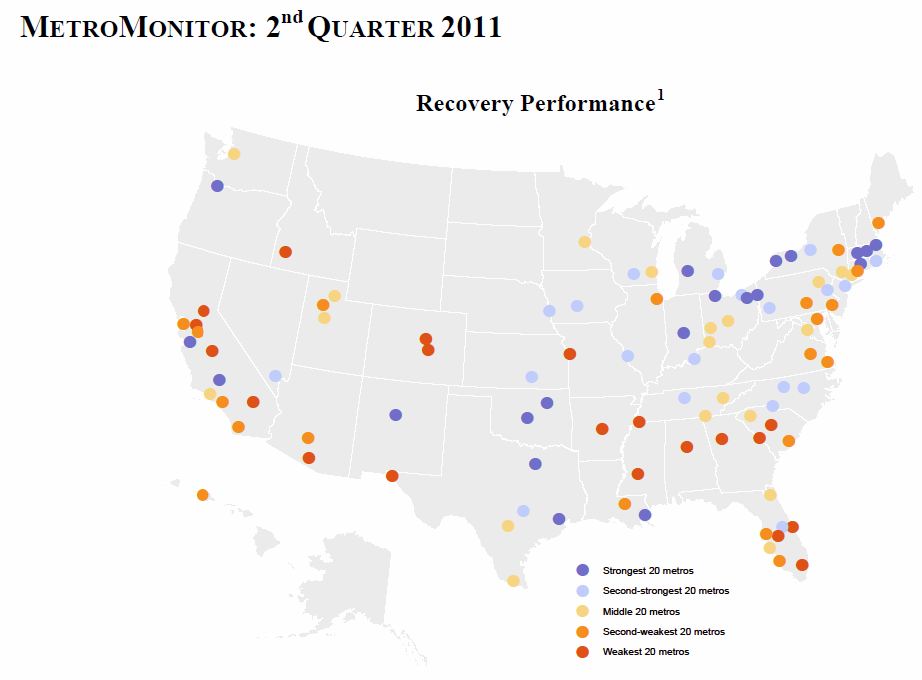
Source: Brookings Institution Metro Monitor. Brookings tracks the following indicators: employment, unemployment rate, gross metropolitan product, housing prices, real estate-owned properties, earnings and recession comparisons. (Click on map for more legible image.)
Richmond and Norfolk are looking pretty grim, and even the Washington metro is nothing to brag about.
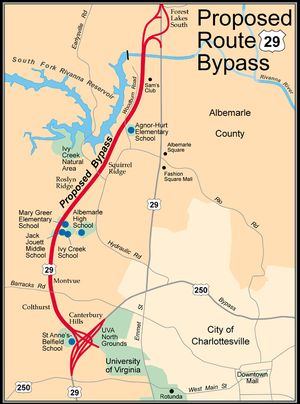
Albemarle Supervisors declined to ask state highway officials to update an 18-year-old analysis of the Charlottesville Bypass before putting the project out for bids. It’s full speed ahead for the controversial, $245 million project.
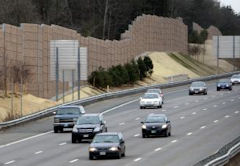
Sound barriers — will they be in the RFP?
by James A. Bacon
The Albemarle County Board of Supervisors nixed a resolution Wednesday to ask the state highway department to update a traffic and environmental analysis of the Charlottesville Bypass before putting the $245 million project out for bids. The board voted instead to ask the Virginia Department of Transportation to complete the update before construction commences.
Why the controversy? Ann H. Mallek, the board chair, and Dennis S. Rooker argued that it is crucial to get updated information in circulation before VDOT issues the Request for Proposal. That way, contractors will know exactly what they are bidding on and the state won’t have to come back later with expensive change orders.
But a majority of board members were satisfied that the project schedule laid out by VDOT at a previous board meeting would accommodate any needed changes. They worried that putting off bids until the completion of the Environmental Impact Statement would create unnecessary delays for a project that has languished for nearly 20 years.
In remarks after the board meeting, Mallek conceded that the compromise resolution “has no power.” VDOT is not obligated to honor the board’s request. Further, once a contract is awarded, it will be too late to request changes to the project design without incurring extra charges. Morgan Butler, senior attorney with the Southern Environmental Law Center, termed the final resolution “meaningless.” Even Neil Williamson, president of the Free Enterprise Forum, described it as a “toothless resolution.”
The original Environmental Impact Statement (EIS) for the U.S. 29 Bypass was written 18 years ago, and a supplemental impact statement, focused mainly on protecting the county’s drinking-water reservoir, was completed eight years ago. Although the project has received all necessary approvals, VDOT is required to conduct a written re-evaluation before construction begins. Mallek and Rooker contended that the data in the old evaluations are seriously out of date and that new data could influence the final design. Not only are the traffic numbers obsolete, but recent scientific research has documented the detrimental effects of highway pollutants on the health of children – a particularly sensitive issue given that six schools are located near the proposed Bypass route.
The resolution called on VDOT to update traffic modeling of the bypass, consider the scientific research on the effects of highway pollutants, conduct an analysis of health and noise impacts, engage with citizens in a public hearing, and consider a reduction in the bypass design speed from 60 miles per hour to 50 miles per hour.
Supervisor Kenneth Boyd contended that it was not necessary to hold up the RFP, which VDOT has scheduled for September. “They’ve told us they’re going to award a design-build contract with the caveat that they’ll come back after the public hearing and may make change orders.”
Dental School for SW Virginia? Maybe Not Such a Great Idea Weldon Cooper Center for Public Service
No question: Southwest Virginia would benefit from having a dental school. But there are three big challenges: finding the money to build the school, recruiting faculty, and enrolling college grads with the necessary skills and ability to pay the tuition.
Pittsburgh Promise Fulfills Its Promise Rand Corporation
Pittsburgh Promise offers $40,000 scholarships to public school kids who excel academically with the goal of fostering high school completion and college readiness. The program works.
Expanding Access to Health Insurance Will Drive Up Hospital Utilization American Enterprise Institute
Obamacare advocates say their health reform will drive down costs by expanding access to primary care. Foes say it will mean more hospitalization and higher costs. It ain’t even close. Buckle your seat belts and brace yourself for higher costs.
Single Parenthood, Risky Behavior, Dropping Out and the Perpetuation of Poverty Urban Institute
It’s the indirect influence of single parenthood that perpetuates poverty. Children of single mothers are more likely to engage in risky behavior like sexual activity, drug abuse and crime, and are more likely to drop out of school. Those behaviors turn poor children into poor adults.
Preventing Sexual Assault in Prison Urban Institute One out of 33 inmates in local jails reports being sexually assaulted in the past 12 months. Some practices that can reduce the problem: Put cameras in cells, provide training to correctional officers, and encourage officers to wander around and interact with inmates.
This chart comes from a new paper by Shawn Fremsted, “Talking about Poverty in a Jobs and Economy Framework,” published by the Center for Economic Policy Research. Fremsted’s aim is to to re-cast the debate over poverty, which opinion polls show most Americans don’t care about, to one of “jobs” or the “economy,” which appeals to a much broader cross section of the population. This chart goes to the heart of the problem. In the first two decades following World War II, worker pay rose with productivity, and all income classes shared in the rising income. Then, around 1980, the relationship between productivity and pay diverged, with an increasing share of income going to the wealthiest Americans. (Click on chart for a more legible image.)
Explaining that divergence and responding to it appropriately, it seems to me, is one of the great challenges of our era. The left-of-center narrative is that the divergence represents a trend that can be corrected by redistributive policies. A right-of-center narrative suggests that the divergence can be attributed to the dysfunctions created by an ever-growing government that consumes an increasing share of society’s resources. Whichever side you favor, the graph does help clarify the debate.
Robert Reich thoughtfully addressed the Great Divergence from a leftist perspective. In “Supercapitalism,” he blamed the evolution of the capitalist system from a syndicalist arrangement in which America was dominated by industrial oligarchies and trade unions to divvy up the economic pie more justly into a hyper-competitive capitalist society. He captures elements of reality in his explanation.
But I think there’s a lot more to the story. The Great Divergence in worker pay and compensation began well before 1980 — it began in the mid-1960s, although it markedly accelerated in the 1980s. What happened in the mid-1960s? President Johnson launched the Great Society, the greatest expansion in the size, scope and activism of government since the Great Depression. Coincidence? I think not. Even those who would lay the blame elsewhere (globalization, automation, the rapacity of the private sector, supercapitalism) have to confront this basic fact: The unprecedented growth in the size and intrusiveness of government has failed to reverse the Great Divergence.
I will concede that government may not be the only factor accounting for the divergence. The 1960s also marked the rise of the counter culture and the assault on traditional boring, “bourgeois” middle-class values such as thrift, self-reliance, traditional family structures and the deferral of gratification. The “Save for a Rainy Day” ethic was replaced by the “If It Feels Good, Do It” ethic. Those who clung to the work ethic tended to prosper. Those who rejected it tended to fail. Just a theory.
Bearing Drift Media has announced a merger with Virginia Line Media LLC to provide conservative content to Virginians across multiple channels, including the Internet, print, radio and social networks. The combination represents the first instance I can recall of Virginia bloggers making a serious bid to bootstrap their way into mainstream media.
Bearing Drift produces the Bearing Drift blog, the most highly trafficked right-leaning blog in the Virginia blogosphere, as well as a monthly magazine. Virginia Line Media owns The Score Radio Network, a conservative radio interview show broadcast on stations in Richmond, Williamsburg and Lynchburg as well as three online radio networks.
“This is yet another step forward for Virginians who are looking for a substantial, statewide conservative alternative for their news and information – how they want it and when they want it,” said Jim Hoeft, Bearing Drift’s founder and new president of Virginia Line Media in a prepared statement. “By combining with Virginia Line, conservatives now have a clear alternative to hear, read, and instantaneously share the political information that is most important to them – information that affects their family and livelihood.”
“To partner with Bearing Drift means we instantly gain access to a well-established online conservative voice – and we provide a well-established radio voice to amplify the message,” said Norman Leahy, founder of Virginia Line, and a contributor to Bacon’s Rebellion. “Our combined efforts will give conservatives an outlet for their concerns, and will provide feedback to legislators and pundits about what a substantial part of the electorate believes is the right direction for the commonwealth – without censorship or condescension.”
Although I am a periodic guest on The Score, I don’t speak with any inside knowledge. However, I would expect that the most obvious “economy of scale” in the merger will be the ability to better support an advertising staff. I suspect that it would be difficult for either group to generate enough sales to support a full-time sales staff on their own. But the two combined could well pull it off.
A sure sign that Bearing Drift Media has broken out of pigeonholing as a niche political publication is if it can start generating more than Republican-campaign and conservative-advocacy ads. Given the polarized nature of media today and its line-up of some of the top Republican/conservative writing and radio talent in Virginia, Bearing Drift has a very good shot at building a significant audience. The big question is whether it can pull in enough advertising to build a profitable and enduring enterprise.
Is Bearing Drift Media the future of Virginia media in a digital world? We’ll have a clue if Blue Virginia or Not Larry Sabato start orchestrating mergers with other blue-state blogs. Stay tuned…
How Middle-Class Schools Are Failing their Students Third Way
Three out of four middle-class high school students fail to earn a college degree. As it happens, middle-class schools spend the least per pupil, pay teachers the least and have the highest enrollment to teacher ratios compared to schools in upper-income and lower-income school districts.
Virginia Third Grade Reading: Pretty Good, but Could Be Better Joint Legislative Audit and Review Commission
Student pass rates on 3rd-grade reading SOLs have improved substantially over the past 10 years, reaching 83% in 2010. But the goal of 95% is “questionable.”
When JLARC Speaks, Legislators Listen Joint Legislative Audit and Review Commission
JLARC’s 2011 annual report summarizes the watchdog group’s activities over the past year.
A Blueprint for Restoring Virginia’s Prosperity The Commonwealth Institute
Virginia’s center-left think tank hits the big themes: Pave the way for an economy that works, educate tomorrow’s workers today, ensure a healthy and productive workforce and create a 21st century revenue system for a 21st century economy.
What’s holding back black Americans? Government, not discrimination
Image credit: Washington Times
by James A. Bacon
After nearly a half-century of government-led exertion to lift black Americans out of poverty, how are they faring? New data and research tell the story. According to census data, 26 percent of blacks, compared with 10 percent of whites, lived in poverty in 2009. The unemployment rate for blacks is 16.7 percent, more than twice the rate for whites. And a study by the Pew Charitable Trusts Economic Mobility Project finds that black men in the middle class are 37 percent more likely than white men to tumble down into the bottom 30 percent of income earners.
A recent study by the Economic Policy Institute concludes that wealth destruction suffered by Americans during the Great Recession hurt blacks more than others. According to “The State of Working America’s Wealth,” the median net worth of black households slid to $2,200, compared with the median net worth of whites at $97,900. Forty percent of black households had zero or negative net worth.
Liberals, race hustlers and others committed to the idea that America is an unjust society in need of remediation have a ready explanation: Blacks continue to suffer discrimination. Racism may be more subtle than when Bull Connor unleashed the dogs upon civil rights marchers, they say, but it is still pervasive and damaging. Yet that narrative is getting harder and harder to maintain. Indeed, it is dawning upon many that blacks remain mired in poverty precisely because their political leaders have looked to government for salvation. And government – far from rescuing blacks from poverty – has kept them trapped in it.
Uncle Sam still transfers hundreds of billions of dollars yearly to the poor and downtrodden in the form of Medicaid, the Children’s Health Insurance program, nutritional assistance (food stamps), Temporary Assistance for Needy Families, the Earned Income Tax Credit, fuel assistance and a host of narrow-bore programs aimed at ameliorating the hardships of poverty. Social scientists have long warned of the corrosive effect of welfare upon black Americans’ family structure, self-reliance and initiative.
If that’s where government “help” ended, the condition of blacks today might not be as dire. But one reason blacks suffered such devastating financial losses in recent years is that much of their net worth was tied up in real estate. When the housing market imploded and equity values collapsed, much of their net worth evaporated. While people of all races experienced equity losses, black homeowners suffered more than others. A 2010 study by the Center for Responsible Lending found that among recent borrowers, 8 percent of blacks and Hispanics, compared with 4.5 percent of whites, had lost their homes to foreclosures. (Of course, the foreclosure crisis is far from over – those percentages have climbed higher since.)
While the causes of the housing bubble are complex – low interest rates, financial innovations on Wall Street and a general decline in lending standards fed the frenzy – government policy played a supporting role. Under a bipartisan banner of promoting homeownership, government agencies encouraged subprime lending to households that had no business having mortgages. Then, after the crash, Obama administration policy prolonged the financial agonies of homeowners facing foreclosure through a mortgage-modification program that spared some homeowners but caused others to deplete their savings by making payments they couldn’t afford.
The latest canard is the notion that everyone should be entitled to a college education. President Obama has ramped up loans and grants for college students to unprecedented levels. Unfortunately, no one seems to be checking how many are graduating. Many Americans, including blacks in disproportionate numbers, are not academically prepared for college and never make it through. The result is a silent college dropout crisis. States a recent study from the American Institutes for Research: “Much of the cost of dropping out is borne by individual students, who may have accumulated large debts in their unsuccessful pursuit of a career.”
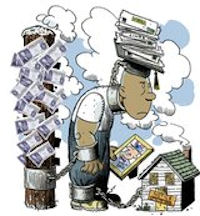
In tacit acknowledgment that there is a big problem, the Obama administration is targeting for-profit colleges, where tuition costs and defaults tend to run higher, for criticism. But the underlying premise, that government should help pay for anyone to get a college education, is as flawed as the premise that everyone should own a house. The result of good intentions gone awry is a generation of college dropouts living in modern-day indentured servitude.
The do-gooders have all the best of intentions, of course. They just don’t pay attention to results. In the name of compassion, they keep blacks hooked on initiative-sapping welfare dependency. In the name of building the American dream, they promote home ownership for people who lack the financial wherewithal to keep up payments. In the name of equal opportunity, they dispense college loans to people who will never graduate. Lord, deliver us from those who would save us.
I don’t begrudge Democratic Senate candidate Tim Kaine’s desire to stir-up the base with this meeting, or forum, if you prefer, on Social Security. It is amusing, though, to read the quote Wes Hester pulled from the Kaine campaign’s press release announcing the event:
A release from Kaine’s campaign announcing the Tuesday morning said that Perry “will no doubt promote the extreme Republican agenda which labels Social Security a ‘Ponzi’ scheme and seeks to privatize it.”
Damn those extreme Republicans and their wicked attempts to denigrate the most successful of entitlement programs…it puts them in the same league as that equally nefarious Paul Krugman:
“In practice it has turned out to be strongly redistributionist, but only because of its Ponzi game aspect, in which each generation takes more out than it put in. Well, the Ponzi game will soon be over, thanks to changing demographics, so that the typical recipient henceforth will get only about as much as he or she put in.”
One can only imagine what Mr. Kaine will have to say about that…
Scott Lee with the Score Radio Network interviews Chris Horner with the American Tradition Institute about ATI’s Freedom of Information Act battle with the University of Virginia, Norm Leahy about Eric Cantor’s federal disaster kerfuffle and yours truly about President Obama’s government-centric jobs program. Click here to access the radio clips.
Opponents of the Charlottesville Bypass are calling for an update to the project’s 18-year-old environmental impact analysis.
by James A. Bacon
How old does a traffic impact analysis for a major highway project have to be before it gets so old that you should throw it out and start over?
To be more specific, if the traffic analysis contained in the Environmental Impact Statement (EIS) for the Charlottesville Bypass is 18 years old and the supplemental EIS is eight years old, should the Virginia Department of Transportation conduct an update before building the controversial, $244 million project?
Ann H. Mallek and Dennis Rooker, members of the Albemarle County Board of Supervisors think so. And they have submitted a resolution, to be considered Wednesday, for the board to formally request VDOT to update traffic modeling for the bypass and consider new scientific research documenting the effects of highway pollutants on children in nearby schools before awarding a contract.
The Commonwealth Transportation Board has approved $197 million funding for the project — on top of tens of millions of dollars already spent on right-of-way acquisition and engineering — and is moving expeditiously to get the project underway. However, foes of the project, who insist that the money could be better spent on alternate projects in the U.S. 29 corridor, say that the project “is not a done deal.” (See “Battle over C-ville Bypass Moves to Next Phase.“)
“Among other items, the traffic modeling, the traffic estimates, the air quality analyses and the noise analyses in the environmental impact statements are now outdated and additional analysis needs to be done,” states the resolution. “There is significant new information that has been developed since the environmental impact statements were prepared, including new scientific research documenting the detrimental effects of highway pollutants on the health of individuals, and children, especially.”
“There has been tremendous growth around the northern terminus of the Bypass,” says Rooker. The largest residential development in the county, Hollymead, was not fully built out at the time. Hollymead Town Center, one of the county’s biggest shopping centers did not exist. Either did major employment centers such as the National Ground Intelligence Center and the University of Virginia Research Park. Also, although the U.S. 29 corridor was zoned for development in the early 1990s, he says, much of it has been rezoned.
“You’ve got thousands of people living there that weren’t there,” says Rooker. “You’ve got more vehicles in and around that area now.” Travelers through Charlottesville will encounter miles of stoplights and congestion north of the Bypass, making the project obsolete the day it opens.
Furthermore, new scientific research has documented the detrimental effect of highway pollutants on the health of children. That point was made repeatedly during public hearings by citizens concerned that the Bypass would run very close to six different schools. “Several states have outlawed the building of highways within 1,000 feet of schools,” Rooker notes.
The resolution is sure to inspire opposition from supporters of the Charlottesville Bypass, who argue that after nearly two decades of obstruction it’s time to start construction. Neil Williamson, president of the Free Enterprise Forum, sees no point in studying the traffic impact again. What’s it going to change, he asks? A new count showing more commuters than projected two decades ago will provide all the more justification for the bypass.
“It’s not a huge leap of faith to think that traffic has increased,” he says. Thousands of commuters living north of the Bypass terminus and commuting to the University of Virginia or other Charlottesville destinations will gladly take the bypass to circumvent part of the congestion.
As for the impact of automobile emissions on child health, Williamson says, the EPA website says that findings should not be used at this time in determining road-siting decisions.
How Hospitals Cross-Subsidize Medical Services National Bureau of Economic Research
When hospitals face competition in their profitable medical services, surprise, surprise, profits erode and they respond by curtailing subsidizes of less profitable medical service lines.
Why Emergency Rooms Are Closing Rand Corporation
Between 1990 and 2009, the number of emergency rooms in the United States declined by 27 percent (from 2,446 to 1,779). Why? This fact sheet doesn’t make it clear but it apparently has something to do with… losing too much money!
Inadequate Education Hurting Employment in U.S. Metro Areas Brookings Institution
One factor holding back the recovery of employment in some metropolitan regions is a mismatch between the supply of, and demand for, educated labor. Brookings’ solution: More investment, guided by wise liberal elites, into sectors like manufacturing and the “green” economy.
The year: 2075. The American colonies on the Moon are getting restless under Washington’s tyrannical rule….
This second edition of “Dust Mites” has a snazzy new cover, includes helpful lunar maps, and is 5,000 words tighter than the original. The sequel, “Trogs,” is scheduled for publication this summer.
Advertisement
Advertisement
Advertisement
Advertisement
About
Bacon’s Rebellion is Virginia’s leading politically non-aligned portal for news, opinions and analysis about state, regional and local public policy. Read more about us here.
Fund the Rebellion
Shake up the status quo! Your contributions will be used to pay for faster download speeds and grow readership. Make a one-time donation by credit card or contribute a small sum monthly.
Can’t wait until tomorrow
For your Bacon’s Rebellion fix?
Enter your email address to receive immediate notifications of new posts by email.
SUBSCRIBE
Search Bacon’s Rebellion
Categories
Archives
The Jefferson Council
Protecting Thomas Jefferson’s Legacy at the University of Virginia
Forgot Your Password?
Shoot me an email and I’ll generate a new password for you.