
1.4 million students, lower test scores, and a 34% increase in spending. What is going on with public education?
by Shaun Kenney
Recent numbers from the National Center for Education Statistics (NCES) offer a gripping overview of the state of public education in America. Fewer children to teach, lower test scores, and a massive infusion of federal cash to hire more teachers and administrators is evaporating post-pandemic — leaving state and local governments in the lurch.
Tosin Akintola over at Reason outlines the results:
Still, more money hasn’t led to better student outcomes. At each grade level and across subject areas, there’s a decline in current achievement when compared to student benchmarks from 2019. In 2024, the most recent data available, only 60 percent of fourth graders and 67 percent of eighth graders were reading at or above a basic level, the lowest performance tier used by the National Center for Education Statistics.
It doesn’t get better as students age, with just 68 percent of high school seniors reading at or above a basic level.
Of course, this is a very high gloss look. Pushing $190 billion in temporary relief during a pandemic perhaps served to highlight problems that have been cropping up in classrooms since the introduction of the smartphone. The ubiquity of artificial intelligence has introduced a degree of pragmatism in students conditioned to produced test results rather than engage in deep learning — again, another factor not easily measured by either the NCES or NAEP.
America spends more on consumer marketing than on federal K-12 spending while families have undergone catastrophic changes over the last five decades. Sixty-nine percent of Americans own fewer than 100 books — and don’t bother asking about the quality of those books. Forty percent of Americans never cracked the spine of a book in 2025 with 19% of all Americans doing 82% of all the reading. Why pursue a graduate level education? For 62% of Americans, the answer isn’t learning or excellence but money or prestige.
If parents themselves do not reinforce learning for its own sake, why should their children and our students ask for better? Which isn’t a critique of parents who have their own daily struggles: mortgage, insurance, food, clothes, etc. Yet it is a reminder that much of what we do is for consumption and precious little is directed towards the cultivation of things good, beautiful, and true. If education is the transmission of culture, then we are most certainly transmitting the results but not the process by which we earn the condition of being educated.
Virginia by the numbers
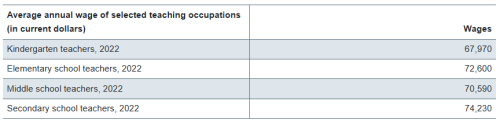
Taking a closer look at Virginia, the average salary for schoolteachers is certainly not the issue, especially when one includes the total compensation package offered by most local school boards:
Per pupil spending in Virginia? A generous bump in real dollars from about $15,000 to $17,000 per pupil. Enrollment? Over 40,000 fewer students from 2012 through 2022.
Click here for the full Virginia NCES Dashboard.
Click here for the full Virginia NAEP Dashboard.
Obviously, quality teachers deserve quality pay. What is too often missed in the debate over public education spending is that conservatives writ large would gladly pay more for a public education if it meant a proportionate increase in student achievement.
Yet if the counterpoint is true that public education in America is awash in resources, then why are we not seeing a corresponding increase in anything? The answer is perhaps a bit more complicated than return on investment, but rather what we expect out of our education system. Once upon a time, a parent-teacher conference put Little Johnny in the hotseat. Today, those same conferences put the teacher in the hotseat, because if a teacher holds a student to any standard whatsoever, parents are quick to remind them that they are the primary educators of their children — and certainly, Little Johnny’s achievements being a reflection of one’s parenting, teachers are in no condition to pass judgment much less grade that performance.
Grade inflation is by no means limited to institutions great or small. Neither is the use of artificial intelligence in the pursuit of higher grades at the expense of actually learning. Students are being habituated into producing a result without being able to explain how they arrived at that result. Blaming data centers is no solution. Neither is blaming the misuse and abuse of artificial intelligence. Knowing-how is a very different thing than knowing-that.
Yet the real problem is that over the last 30 years, we have trained both students and teachers — and habituated parents — to the idea that grades, credentials, and salary are the fruits of an education. This makes excellent consumers, but it hardly inspires excellence for its own sake.
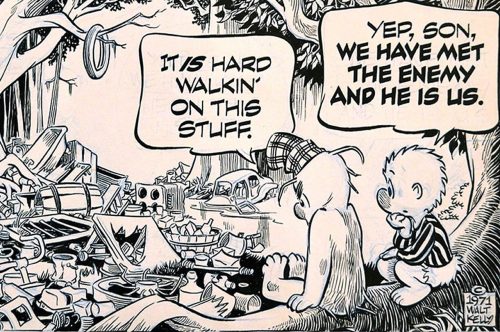
“We have met the enemy and he is us.”
When the cartoonist Walt Kelly revised the immortal words of Commodore Oliver Perry from the War of 1812, he did so with regards to an Earth Day poster in 1970 to emphasize that we become the environment we are in.
Sadly, public education in America has been wholly resistant to change resembling the meaningful. Jefferson’s vision of public education has been entirely subsumed by an entirely alien 19th century system equipped with and funded by 20th century tools all trying to produce a 21st century result — and by every objective standard, it is failing our students. Yet $190 billion more in resources later, it is clear that the answer is not to shovel more money into the maw of a bureaucracy. Nor is it to continue to beg those in power to actually involve the communities they claim to represent as they wonder aloud why an institution breathing with one lung is failing to meet their own standard only to scold those skeptical of public education’s results of not being sufficiently enthusiastic about a system striving for mediocrity.
Empowering teachers to actually be teachers without the administrative bloat heaped upon their shoulders over the last 20 years would be a radical step forward.
Yet fiddling within a broken system saddled with administrators, bureaucrats, and bevy of federal and state mandates (funded and unfunded) simultaneously ignores and confesses the problem — it is the system itself which remains the problem and is in desperate need of creative reform and direct competition.
Case in point — Spotsylvania County Public Schools recently took a vote against drug testing for public school teachers and staff. Against.
Spotsylvania Superintendent Clint Mitchell argued that if such draconian standards such as drug testing were implemented, then who would teach the children?
“Implementing such a program would completely negate the work that we have done over the last eighteen months plus in the school division on teacher retention,” Superintendent Mitchell said earlier this year. “I guarantee you that our neighbors, whether it’s Stafford, Fredericksburg City, Caroline, Louisa, Orange County, Culpeper, Prince William, they’re looking for you to implement such a policy because here’s what’s gonna happen. You think we have a problem hiring and retaining people and filling positions? You’ll have vacancies because no one wanna work here.”
In a 4-3 vote, the local school board concurred with such reasoning.
The reason this issue has come up is because a 2nd grade teacher (allegedly) died of a fentanyl overdose inside a classroom last year. I’m sorry — but we aren’t talking caffeine, energy drinks, or even one of these three-letter gummies that have become so ubiquitous over the last few years, but if you’re coping mechanism is actual fentanyl then we should have more than just a few questions. If fentanyl is what someone needs to get by? How are the students doing?
Just a one off? Don’t worry — the story gets worse:
The plea agreement says that law enforcement reported that the teacher’s husband allegedly brought her drugs at school and was also found suffering from an overdose in the school parking lot and their two-year-old daughter was with him. The teacher was convicted and sentenced to two years behind bars for possessing drugs in school and 17 counts of child endangerment and felony child neglect.
One might imagine that a strict regime of mandatory drug testing would be warranted. Even a more stringent version of randomized screening. But no — not only did the system refuse to act, the oversight of that system collectively shrugged in the face of imperious evidence.
This is not a system that seeks to reform. No small wonder why the parents who can are rescuing their children and looking for alternatives: private schools, parochial schools, and even the old way of homeschooling and the Virginia Community College System (VCCS) rather than the mendacity of a school system more willing to protect its own than protect our children.
Florida seems to have figured it out on school choice with a system championed by former Governor Jeb Bush (R-FL) which gives $8,000 so that parents can choose which education best suits their children. The results? Predictably, they vary from school to school in the same way not every public high school in Virginia produces similar results, but two data points should strike us. Not only are private schools on the balance producing better test scores, but the litany of horribles regarding the collapse of public education simply hasn’t happened.
In fact, competition has not only made the sum total of Florida’s education system stronger — public, private, parochial, charter, and homeschooled — but parents themselves are taking a more active role in how their children are being educated, which is the signal marker of student achievement.
Incentivizing reform? Or simply forcing the question?
Obviously, this merely scratches the surface — smartphones have had their impact, artificial intelligence vs. the 3-page-5-paragraph essay, basement level literacy rates, changing economies, and an emphasis on prestige and income potential as opposed to the higher goods of cultivating a taste for excellence (from which prestige and income flow as a byproduct and not an end unto itself) are all contaminants.
Yet much like wars of choice, any moment a government chooses to throw unlimited amounts of money at a problem nearly always attracts the wrong sort as an admixture to those who see education as a vocational pursuit — up to and including those who need actual fentanyl to get by in their daily routine.
The problem isn’t money. The problem is and remains a system with no incentives to reform.
Until those who truly are concerned about ending the monopsony which holds public education in thrall, then any pretense to reform is merely that — a disconsonance without result which only bears fruit by accident and not intent. Until parents and lawmakers press, then there is never going to be either progress or change — and that serves no one, least of all future generations of Virginians.
Shaun Kenney is senior editor of The Republican Standard. This column has been reposted here with permission from The Republican Standard.
Leave a Reply
You must be logged in to post a comment.