• Occupying Richmond

    by Norm Leahy

    On or about October 15th, the “Occupy [insert city name]” phenomenon intends to make its Richmond debut. The nascent group has quite a large Facebook presence — larger than what the tea parties were able to muster at their height back in 2009 — and reading through the postings provides an education in online organizing. It’s also a sometimes hilarious, sometimes depressing, trip through the fever swamps.

    There are a few earnest folks trying to herd the cats into Richmond’s Monroe Park this weekend for an organizational meeting to help determine why they intend to conduct an occupation and where that occupation will take place. Early on, it was supposed to be near the Federal Reserve building in downtown — completing the echo of the tea party protests held near there in 2009 and 2010. Or maybe it won’t be there. In one of the Facebook posts, we learn:

    Kanawha Plaza has not been decided by consensus as our place of occupation. We will, however, reach a modified consensus at our next *full* General Assembly meeting on October 15th; Monroe Park, 4pm. Come back to stay informed on additional General Assembly/Working Group meetings that arise between now and then. This is our time, let’s seize it in solidarity.

    The resulting discussion would make Monty Python proud.

    Yet under the conflicting visions, incompatible agendas and vague ideas, there’s no denying that, like the tea partiers before them, this potential gathering has a problem with what they see as an unaccountable force lording it over the rest of us. It must be stopped.

    But what is this force? Is it the Federal Reserve that insists on propping up a system that has become rotten? Is it the financial institutions that were rescued from an abyss of their own making with taxpayer dollars? Or is it the larger corporate world, parts of which are increasingly wed to, and dependent upon, government for their livelihoods?

    It seems to be all of these things — but we’ll have to wait for the reports of the working groups to be sure.

    Until those minutes are read, these would-be occupiers do seem to have a lot in common with elements of the tea party movement. Those earlier protesters had no love for the bailouts, the Fed or government giveaways to corporations. But the similarities tend to blur after that.

    The tea partiers, in general, wanted and continue to advocate for less government. If the list of grievances published by the occupiers of Wall Street offers any guide to what this new order of protesters wants, it’s more government and less (much less) of what they see as corporate over-reach. Consider:

    They have poisoned the food supply through negligence, and undermined the farming system through monopolization.

    They have profited off of the torture, confinement, and cruel treatment of countless animals, and actively hide these practices.

    They have continuously sought to strip employees of the right to negotiate for better pay and safer working conditions.

    They have held students hostage with tens of thousands of dollars of debt on education, which is itself a human right.

    They have consistently outsourced labor and used that outsourcing as leverage to cut workersโ€™ healthcare and pay.

    They have influenced the courts to achieve the same rights as people, with none of the culpability or responsibility.

    They have spent millions of dollars on legal teams that look for ways to get them out of contracts in regards to health insurance.

    They have sold our privacy as a commodity.

    And so on. The irony, intentional or not, is that not a few of these grievances are the result not of corporate greed, but individual choice. Holding students hostage to loan debt? Sorry, you (or your folks) singed for those loans. We can debate — and often have here at the Rebellion — the costs of higher education. The beef these folks have is with the schools, not corporations. And also with themselves, for choosing to sign on the dotted line.

    Have evil corporations sold your privacy down the river for their gain? Undoubtedly some have. That would include Facebook, the platform these folks use to organize. But also remember — Facebook and others can only sell that which you give them. Want to take back your privacy? Here’s small tip: never fill out warranty cards. Their real function is to build a marketing database, not to give you better service.

    But let’s also hope that these protesters understand that what they, the tea parties and others rail against is not new. Whether it was the king and his ministers, the Bank of the United States, the Freemasons, Demon Rum, the railroads, the gold standard, war profiteers, the Red Menace or any other vague, faceless, utterly nefarious entities, bad economic times breed discontent. Even it what some consider the best of times, there are those who seethe below the surface, hoping for revolution.

    It’s the American way. And it usually results in folks getting the bile out of their systems and then going back to their own thing until the next perceived crisis rears its head.



  • Transportation Construction Funds to Run Out in Five Years

    Virginia's Incredible Shrinking Construction Budget

    Virginia will run out of state money to build new roads in about five years, Transportation Secretary Sean Connaughton told the Chamber of Commerce’s newly established transportation committee Wednesday. Eroding motor fuels taxes and high maintenance costs are consuming the transportation budget. (Read the Times-Dispatch story here.)

    The state’s dilemma is familiar to readers of the Bacon’s Rebellion blog. (Seeย  “The Crossover Conundrum.”) Most of the information detailed in the T-D article has been reported here already. But writer Peter Bacque did find a few new wrinkles — most notably the astounding fact that funds for new construction will be gone in five years. I don’t remember anyone making that point at the last Commonwealth Transportation Board meeting.

    The other nugget is this: The McDonnell administration, wrote Bacque, is “considering seeking additional revenue sources dedicated to maintenance.”

    What revenue sources would those be? More tolls? Connaughton has already rolled out his proposal for tolls on Interstate 95. An increase in the gas tax? Connaughton gave no hint of such a thing at the September CTB meeting.

    I am torn. Clearly, the fiscal situation is unsustainable. Virginia needs more money to build a transportation system capable of carrying the state through the 21st century. Trouble is, there is no system for coordinating transportation investments with land use decisions, nor is there a methodology for prioritizing projects on the basis of Return on Investment (measuring payback in terms of congestion mitigated, improved safety, economic development and environmental impact). Many Virginians believe that funding decisions are made on the basis of ideological and political considerations, not to benefit to the taxpaying public. Until trust is restored, there will be limited support for higher taxes and fees.

    — JAB


  • The Wonk Salon, October 6, 2011

    Non-Precinct Voting on the Rise
    Baker Institute
    Non-precinct voting (either early in person or by mail) has been on the rise over the past 15 years and could become a majority of all voting as Americans place a greater emphasis on convenience.

    Hunger Costs America $168 Billion a Year
    Center for American Progress
    Add up all the costs of hunger — illness, lost productivity, charity and impact on education — and the “hunger bill” for Americaย  is $167.5 billion a year. The bill for Virginia is $3.13 billion.

    Strengthening Career Pathways for D.C. Youth
    Brookings Institution
    Too many D.C. youth are quitting their education before completing high school or college degrees. Let’s set a goal for 90% of D.C. youth to earn post-secondary credentials and find work by age 24!

    Revitalizing Community Journalism
    Aspen Institute
    As the distribution of news migrates from a top-down model to a distributed model, the journalism profession needs to reinvent itself. Donate generously to Bacon’s Rebellion. (Nah, they didn’t really say that — but they should have.)


  • The Wonk Salon, October 5, 2011

    Yes, Private Universities Are Subsidized, Too
    American Enterprise Institute
    State aid? Chump change. When you factor in not-for-profit status and student loans, elite private colleges and universities receive greater public support than public institutions.

    ESAs: Another Path to School Choice
    Heritage Foundation
    Educational Savings Accounts (ESAs) offer several advantages over other forms of school choice, including the flexibility of allowing families to spend the money on tuition, tutoring, textbooks and virtual classes.

    What to Do about “Dual Eligibles”
    Urban Institute
    Nine million Americans are eligible for both Medicare and Medicaid, creating an incentive for states to shift Medicaid patients, whom they help pay for, to the Medicare program, which Uncle Sam pays for — a trend that may undermine care for vulnerable populations.

    Benchmark Assessments Do Help Math Achievement
    American Institutes for Research
    A study of 59 schools in Indiana found that the mClass and Acuity benchmark assessments had a measurably positive impact on student achievement in grades 3 through 8.


  • The Wonk Salon, October 4, 2011

    Yelp, Here Comes ILP (Intelligence-Led Policing)
    Rand Corporation
    Law enforcement has evolved from political policing to professional policing to community-based policing, and it’s morphing again — to Intelligence-Led Policing, which relies heavily upon database analysis.

    Rebuilding Wisconsin’s Interstates with Tolls
    Reason Foundation/Wisconsin Policy Research Institute
    Over the next 30 years, Wisconsin’s Interstate system will exceed its 50- to 60-year life span. Modernizing it will cost $26.2 billion, way more money than Wisconsin has. Thirty-year bonds backed by tolls could pay for most of the reconstruction.


  • Should Dominion Virginia Power Spin Off its Nukes?

    Over the past two years, Dominion Virginia Power has experienced 14 unplanned shutdowns of its four nuclear reactors, by the Times-Dispatch’s counting. Is it time for the power company to consider spinning off its nukes or selling them to someone who can do a better job of running them?

    I ask that question after encountering a new study by Lucas W. Davis and Catherine Wolfram, “Deregulation, Consolidation and Efficiency: Evidence from U.S. Nuclear Power,” published by the National Bureau of Economic Research. Here’s the argument they make:

    For four decades all nuclear power reactors in the United States were owned by regulated utilities. Few utilities owned more than one or two reactors and utilities received a rate of return on their capital investments that was largely disconnected from operating efficiency. Beginning in the late 1990s electricity markets in many states were deregulated and 48 of the nationโ€™s 103 nuclear power reactors were sold to independent power producers selling power in competitive wholesale markets. These divestitures have led to substantial market consolidation and today the three largest companies control more than oneโ€third of all U.S. nuclear capacity.

    … We find that deregulation and consolidation are associated with a 10 percent increase in operating efficiency, achieved primarily by reducing the frequency and duration of reactor outages. Efficiency gains were experienced broadly across reactors of different types, manufacturers, and vintages, with the largest increases in the spring and fall during the peak months for refueling.

    The resulting increase in electricity production exceeds 40 billion kilowatt hours annually, valued at $2.5 billion annually at current prices. “This increase is almost pure efficiency gain, achieved without building a single new plant or constructing a single additional mile of transmission capacity,” the authors note. The increased electricity output, they add, displaces mostly coalโ€ and naturalโ€gasโ€ fired power, implying an annual decrease of 38 million metric tons of carbon dioxide emissions.

    I was always under the impression that Dominion ran its nukes pretty well, so that 10% efficiency gain may not apply here. But we won’t know for sure if we don’t ask. Such a gain, if possible, would delay the need to add more power-generating capacity, thus keeping a lid on electric rates. Lower CO2 emissions are a bonus that environmentalists should love. Perhaps the State Corporation Commission should look into it.

    — JAB


  • High Speed Rail’s End

    by Norm Leahy

    The latest issue of Ken Orski’s “Innovation News Briefs,” delivers a blow to the hopes of those who thought that, one day, high speed trains would zip between Washington, DC and pokey old Richmond:

    By including only a token $100 million for high-speed rail as a “placeholder” in their FY 2012 budget recommendations (a sum that is likely to be further cut in the House-Senate negotiations on the FY 2012 appropriations), Senate appropriators have done more than merely declare a temporary slowdown in the high-speed rail program. They have effectively given a vote of “no confidence” to President Obamaโ€™s signature infrastructure initiative. Along with their House counterparts who had denied the program any new money, the Senate lawmakers have sent a bipartisan signal that Congress has no appetite for pouring more money into a venture that many lawmakers have come to view as a poster child for wasteful government spending.

    That doesn’t mean the feds aren’t trying to spend whatever monies they still have at their disposal. Quite the contrary:

    In the meantime, the Department of Transportation has rushed to distribute the balance of the authorized HSR dollars, lest Congress decides to rescind any funds that remain unobligated. Continuing its practice of scattering money far and wide rather than focusing it on one or two worthwhile projects, the Federal Railroad Administration approved in September over $ 480 million worth of planning, engineering and construction grants “to improve high-speed and intercity passenger rail service” in 11 states. The beneficiaries are New York, Texas, New England (Maine, Vermont, Rhode Island, Connecticut), North Carolina, Virginia, Washington State, Oregon and Pennsylvania. The awards range from $149 million to New York State to as little as $13 million to the state of Oregon, and they average under $40 million per individual grant. It remains to be seen how quickly the recipient states will put these funds to workโ€” and what kind of service improvements these grants will bring about.

    Probably not much. As BR’s own Peter Galuszka noted in this Style Weekly piece from 2010, bringing the rails that run through Richmond and the preferred Main Street Station site up to high speed snuff would cost anywhere between $122 million and $600 million. The $44 million federal grant given to Virginia is reserved for “environmental analysis and preliminary engineering.”

    In other words, the trains won’t be getting faster, but there will be a few more studies published.


  • Restraining State Spending through Governance Reform

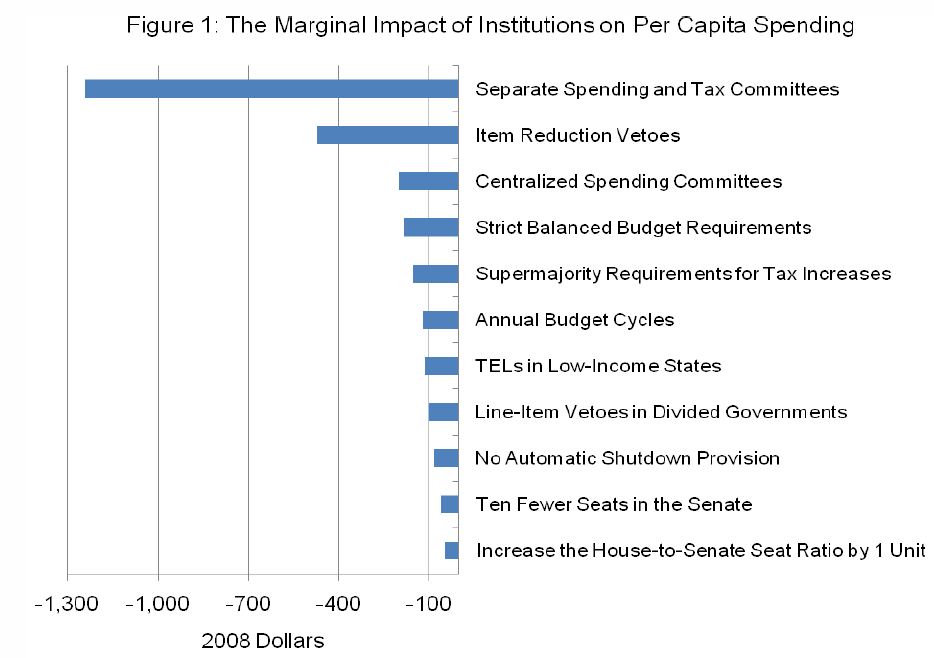
    Fiscal policy is on an unsustainable path at all levels of government. While reformers should look for ways to reduce spending on particular budget items, tomorrowโ€™s legislatures may easily reverse these cuts, argue Matthew Mitchell and Nick Tuszynski with George Mason University’s Mercatus Center. By contrast, they write, “a change in the rules that govern the political processโ€”the ‘institutions’ that shape a budgetโ€”can have a lasting effect on spending for years to come.”

    In a new paper, “Institutions and State Spending: An Overview,” the two scholars survey the literature to ascertain which institutional characteristics of state governance are associated with the lowest rates of spending growth. The clear winners: (1) separate spending and tax committees in the state legislature and (2) item reduction vetoes. Other commonly touted measures such as line-item vetoes and tax-and-expenditure (TEL) limits do have an effect but that effect is modest.

    In 2008, state and local expenditures per capita averaged $5,708 across the country. States that embraced the institutions of governance listed above enjoyed lower per capita spending by the stated amounts. (Click on chart for more legible image.)

    If only Mitchell and Tuszynski would tell us which institutions are in effect in Virginia, we’d know where to get started!

    — JAB


  • Virginia: A Beacon of Job Opportunity for African Americans?

    Even before the recession, many Midwestern African-American communities were in distress, writes Algernon Austin with the Economic Policy Institute in “High Black Unemployment Widespread across Nation’s Metropolitan Areas.” Black unemployment was especially high in rust belt cities like Detroit, Cleveland and Milwaukee. By contrast, he notes, blacks fared relatively well in Sun Belt metro areas such as Tampa, Miami and Las Vegas.

    And in which of the 31 metro areas surveyed did blacks do the very best of all? Let’s see. The Washington metro area ranked 29th in black unemployment in 2007, with a rate of 4.8%. Richmond ranked 30th, with 4.7% black unemployment. And Hampton Roads ranked 31st, or the lowest of all, with 4.1% black unemployment. Virginia metros grabbed the three lowest slots! Say what you will about Virginia’s Scrooge-like social safety net and allegedly retrograde social attitudes, but when times were good, blacks enjoyed greater employment opportunities than in the supposedly progressive states of the Midwest and Northeast.

    What happened when the recession hit and unemployment soared? African-Americans were harder hit than other Americans; arguably, they were the most vulnerable because they were the least equipped with skills and education. Even so, they still were better off in Virginia than they were elsewhere in the country.

    Of the 31 metro areas surveyed, Richmond ranked 28th in black unemployment, with a rate of 10.6%. Then came Washington in the 29th spot with 9.6% black unemployment. New Orleans snuck into the 30th spot. But Hampton Roads still stood out as the metro area with the lowest rate of black unemployment: 8.5%.

    To some degree, low black unemployment rates in Virginia metros reflect the fact that unemployment generally is and has been lower in Virginia than elsewhere in the country. Delving a little deeper, Austin compiled one other measure of interest: the black-to-white unemployment ratio. By that measure, Virginia doesn’t score as well.

    With a black-to-white unemployment ratio of 2.0 — meaning that blacks were two times more likely to be unemployed than whites — the Washington metro region ranked 13th in the country in 2010 (tied with four other regions). Richmond ranked 20th with a ratio of 1.8. But Hampton Roads was still looking good, tied with Kansas City and New Orleans with a ratio of 1.3 for the lowest black-to-white unemployment ratio in the country.

    All things considered — overall economic health and a low black-to-white employment ratio — Hampton Roads would seem to be a beacon of employment opportunity for African Americans. Basket cases like Detroit and Milwaukee garner a lot of attention for African American economic hardship. Maybe someone should look at Hampton Roads as a case study in African American opportunity.

    — JAB


  • A Step in the Right Direction

    Land use — the missing piece?

    This just in… The Virginia Department of Rail and Public Transportation (DRPT) will conduct a “Super NoVa” study of commuting patterns to help determine transit and transportation demand management (TDM) enhancements for Northern Virginia. The study will disregard jurisdictional boundaries, and it will extend beyond the traditional definition of “Northern Virginia” to encompass the entire commuting shed of the Washington area, including points as far west as the Shenandoah Valley and as far south as Culpeper and Caroline counties.

    The study will evaluate existing and future population and employment centers to identify potential transit and TDM improvements that will increase mobility and provide greater transportation choice in the northern part of Virginia, states a press release from the governor’s office. The study will produce concrete recommendations with a strategic regional focus.

    โ€œEvery locality in Northern Virginia faces transportation challenges and most have developed jurisdictionally specific projects to address those challenges,โ€ said Secretary of Transportation Sean Connaughton. โ€œWe must broaden our focus and find the most cost-effective transit and TDM services that have the biggest impact on a region-wide basis. The Super NOVA study will help us do that.โ€

    Here’s what’s good about the study. First, it is taking a labor-market view instead of jurisdictional, planning-district or even metropolitan-area view. That means the findings will better reflect economic reality. Second, the Department of Transportation is expanding its focus beyond building roads, it’s main preoccupation until now, to include not only transit but transportation demand management. Both are important steps forward.

    Here’s what’s lacking: Judging from the press release, the study will not make the land-use connection. Talking about transportation without understanding its interplay with human settlement patterns is like describing how to bake a cake with flour, sugar and eggs… with no reference how to mix them with milk and water. As described, the study will take existing human settlement patterns as a given and endeavor to fashion transportation policies to serve them. But human settlement patterns are dysfunctional and unsustainable throughout much of the Washington metropolitan area, especially in peripheral counties, and probably cannot be served economically with the resources Virginia has available.

    But it’s too early to judge the study. If it concludes that much of the Northern Virginia commuting shed is impossible to serve with mass transit in the absence of dramatic changes in human settlement patterns, then it could prove to be well worth the effort. Here’s hoping that the authors take an extra-wide view of their task.

    — JAB


  • More Bad News — and Bad Advice — from the 2011 Urban Mobility Report

    by James A. Bacon

    The recession may have provided a temporary respite in traffic congestion — people tend to drive less when they’re not working, and trucks move less freight — but the picture will worsen rapidly when economic recovery takes hold. So say the authors of the 2011 Urban Mobility Report published by the Texas Transportation Institute.

    The national picture will play out in Virginia’s three metropolitan areas included in the study. The congestion relief provided by the recession for the Washington, Hampton Roads and Richmond regions has largely evaporated already. The picture is especially bleak for Richmond, once one of the least congested of the nation’s largest metro areas, whose ranking in the national congestion standings continues to rise.

    The Urban Mobility Report is simultaneously a highly useful exercise in documenting the cost of traffic congestion in the United States and a disturbing part of the problem. On the one hand, the range of data it collects is the most extensive and authoritative anywhere and, for all of its limitations, it remains the best gauge we have for measuring congestion and its costs. On the other hand, the authors persist in the belief that a Texas-styled approach of building more roads will get us out of the mess we have created.

    To be sure, the authors advocate a “balanced” approach that includes investing in mass transit, traffic management strategies such as signal coordination and rapid crash removal, and demand management strategies like telecommuting and flexible work hours. And they add, “Land use and development patterns can play a positive role, as well.” But the report perpetuates the belief that regions can build their way out of their congestion woes. โ€œIf you invest in roads and transit, you get better service and access to more jobs,โ€ says co-author Tim Lomax. โ€œGenerally speaking, mobility investments in congested areas have a high return rate.โ€

    Lomax offers no evidence to justify that last statement. The truth is, many projects are driven by political considerations in the total absence of Return on Investment analysis. Moreover, the complex interplay between transportation and human settlement patterns means that the rate of return is exceedingly difficult to ascertain even if some one tried to perform an analysis. Yes, Virgina does need to invest more in transportation. The trick is figuring out which investments to make. Dumping billions of dollars into “doing something” on the grounds that it’s better than doing nothing could, in fact, be worse than doing nothing if we put money into the wrong projects.

    With those caveats, let’s look at the picture in Virginia’s largest metro regions…

    Washington metro area: 68% of the region’s arterial and interstate lane-miles and 84% of vehicle miles traveled (VMT) are congested during periods of peak travel. (“Rush hour” lasts seven hours each day.) The cumulative delay per person is 74 hours yearly and the cost per commuter in time and fuel is $1,495.

    Virginia Beach metro area: 44% of the region’s arterial and interstate lane-miles and 50% of VMT are congested during periods of peak travel. (Rush hour lasts four hours each day.) The cumulative delay per person is 34 hours yearly and the cost per commuter in time and fuel is $654.

    Richmond metro area: 36% of the region’s arterial and interstate lane-miles and 33% of VMT are congested during periods of peak travel. (Rush hour lasts 2.5 hours each day.) The cumulative delay per person is 20 hours yearly and the cost per commuter in time and fuel is $375.

    To me, the big story is the continually worsening situation in the Richmond region. No one needs to tell Northern Virginians and Hampton Roadsters that they have huge traffic problems but, except in spot locations, congestion has yet to become a major concern of Richmonders. Accordingly, Richmond political and civic leaders perpetuate dysfunctional human settlement patterns. But congestion is steadily worsening and will become a major problem in the foreseeable future. In 2005, Richmond was ranked 88th among 101 metro areas by the cost of congestion per commuter. In 2010, it ranked 68th. The number of congested lane-miles has increased from 30% five years ago to 36% in 2010. The percentage of vehicle miles driven increased from 28% to 33%.

    And why is that? The Richmond region is sprawling faster than almost any other region in Virginia, opening up more land for development, building at lower densities and perpetuating the pod form of development with disconnected and segregated cul de sacs, office parks and shopping centers. While our civic leaders focus on panaceas like high-speed passenger links to Raleigh and Washington, they remain blissfully unaware as builders and developers, working within the parameters set by government, pour billions of dollars into outmoded human settlement patterns. Will we be the last region in America to wake up and see how we are suffocating our future?


  • Update to “Bedeviled and Becalmed”

    Alert reader “Too Many Taxes” brings to my attention the sponsorship of House Bill 1198ย  by Del. James M. LeMunyon, R-Chantilly, in the past session of the General Assembly. The bill would have required state transportation agencies to “evaluate all significant transportation projects in and near the Northern Virginia Transportation District, including both highway and mass transit projects, and provide an objective, quantitative rating for each project according to (i) the total amount of reduction in traffic congestion regionally and, separately, (ii) the amount of reduction in traffic congestion expected to be achieved per dollar cost of the project.”

    The bill would have been even more useful if it had applied the requirement statewide to all projects over a certain size, and if it had required the state to document the impact of transportation projects on accidents, economic development, the environment and public safety. According to TMT, the bill sailed through the House but died in the Senate Finance Committee.

    If someone knows why, please let us know — post a comment!


  • Bedeviled and Becalmed

    The Commonwealth Transportation Board seems adrift, unsure how to cope with shrinking resources. Here’s a place to start: Fund projects that provide the greatest Return on Investment and focus on the nexus between transportation and land use.

    by James A. Bacon

    Last week Transportation Secretary Sean Connaughton held a strategic planning session with the Commonwealth Transportation Board, the state entity that sets policy and funding priorities for Virginiaโ€™s transportation system. The dilemma: Given the relentless erosion of the motor fuels tax that leaves Virginia fewer and fewer resources to meet its transportation needs, what can the commonwealth do differently to run the system more efficiently and equitably?

    In a series of presentations, Virginia Department of Transportation (VDOT) and Department of Rail and Public Transportation (DRPT) staff described McDonnell administration initiatives such as the creation of a state infrastructure bank, new cash-management policies and a shift to design-build contracts. Exploring big-picture ideas, the board heard from Jonathan L. Gifford, a George Mason University professor who laid out options for devolving responsibility for secondary roads to the counties and from a subcommittee that had looked into ways of making the maintenance system work better.

    The two-day retreat in Portsmouth covered a lot of ground and provided a lot of valuable data, but it didnโ€™t elicit much in the way of guidance from the board. From my perspective as an observer on the sidelines, frankly, it seemed as if board members were overwhelmed by the enormity of the challenge. While several board members expressed the opinion that the transportation system needs more money, no one saw fit to propose a resolution urging the General Assembly to raise taxes or fees. The session ended abruptly and inconclusively with no decisions made or votes cast.

    One possible reason for the irresolution is that the two most vital topics affecting transportation in Virginia were not on the agenda. There was no thought given to the idea of rationalizing the system for allocating scarce resources according to Return on Investment criteria, as any multibillion-dollar corporation might do. And there was exceedingly little thought given to the nexus between transportation and land use.

    While Virginia transportation departments may conduct project-ROI analysis on an episodic basis, several flaws in the CTB’s decision-making process seem evident. First, ROI analysis, even when performed, is not presented in a way that helps the board compare the merits of one project versus another. Second, no agreed-upon methodology exists for conducting an ROI analysis that is valid for roads, rail, transit, ports and airports. Thirdly, no unified database of all projects approved or under consideration exists so that ROI can be ranked across transportation mode. And fourthly, there is no process for re-prioritizing projects based upon new economic realities; once projects enter VDOT’s Six-Year Improvement Plan, they are extremely difficult to dislodge.

    If I had served on the CTB, I would have urged Secretary Connaughton to convene a working group comprised of stakeholders from all transportation modes and supplemented by paid academic experts from, say, the Texas Transportation Institute and the Victoria Transportation Policy Institute. The goal would be to develop a methodology for calculating Return on Investment on transportation projects of all types. Such a methodology would include placing an economic value upon traffic congestion mitigated, safety enhanced, economic development and environmental impact.

    Congestion mitigation would take into account the number of hours of travel time saved and the value of that time for motorists and freight. Safety would encompass the value of reduced traffic accidents, injuries and fatalities. Economic development would incorporate gains in the number of jobs, personal income and tax revenues while distinguishing between primary job creators such as manufacturing or professional services, which bring income into a region, and secondary job creators, such as housing and retail, which largely track population and income growth. Finally, the methodology would take into consideration the effect of increased or reduced emissions from fossil fuel consumption, storm water runoff and air quality upon the environment and public health.

    Until CTB board members are given such information, they are fumbling in the dark. With no ROI analysis to draw upon, they base decisions largely upon preconceived ideas, politics and what they are spoon fed by administrators. As a result, the allocation of resources is sub-optimal.

    The other elephant in the room is the transportation-land use nexus. The McDonnell administration currently views that policy pachyderm through the prism of โ€œcorridors of statewide significance,โ€ in which local governments make land use decisions that effectively treat state highways as main streets. VDOT is moving slowly but surely toward a policy of more aggressive enforcement of โ€œaccess management,โ€ which rationalizes local traffic access to state highways. At the same time, the commonwealth is back-pedaling on the questions of subdivision connectivity and VDOT traffic-impact analysis for major development proposals. Read more.


  • The Wonk Salon, September 30-October 1

    Paring the Texas Prison Population
    Texas Public Policy Institute
    Believe it or not, Texans don’t execute all their prison inmates! Since 2005 the state has worked to reduce the size of its inmate population by providing more intermediate sanctions for parole offenders and funding more prison alternatives.

    Time to Revise Back-Loaded Teacher Pensions
    Center for American Progress
    Most teacher pensions, which give disproportionate rewards to teachers who have taught a long time in the same state, aren’t as effective as they could be at motivating people to enter the profession. Restructure pensions to provide a more even accumulation of benefits.

    Using Report Cards on Ethnic Health Disparities
    Healthcare Cost and Utilization Project
    Report cards that assign letter grades based on race/ethnicity-specific measures are one method that states can use to document and provoke action on data related to racial and ethnic health and health care disparities.


  • The Crossover Conundrum

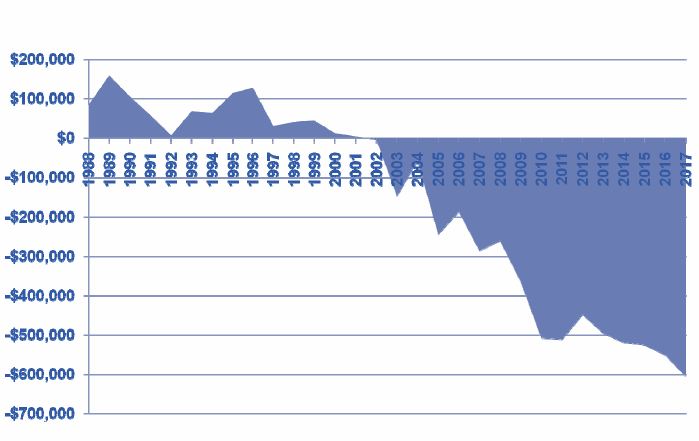
    History of Crossover (in $1,000s)

    by James A. Bacon

    Once upon a time, the Highway Maintenance Operations Fund was flush with cash. Between 1986 and 2002, the Virginia Department of Transportation was able to transfer millions of dollars from the HMOF into the Transportation Trust Fund, which pays for new construction projects.

    Those days are long gone. In Fiscal Year 2002, the Commonwealth Transportation Board approved the first transfer from the highway construction fund, $3.6 million, to the maintenance fund — a practice known as crossover. Since FY 2008, crossover transfers have averaged $418 million annually. Transfers are projected to increase to $600 million yearly byย  2017.

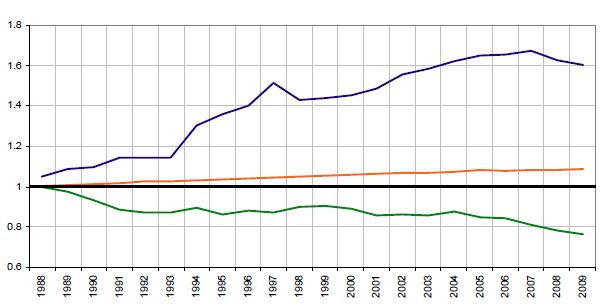
    Growth trends: vehicle miles traveled (blue), lane miles (orange) and motor fuel tax revenues (green) in 1988 dollars.

    Basically, there are two reasons why crossover is necessary, Jose Gomez, director of the Virginia Center for Transportation Innovation and Research, told the CTB during a strategic planning session in Portsmouth last week. First, revenues from the motor fuels tax has been steadily eroded by inflation in theย  price of asphalt and other construction materials. And second, Virginia’s highway system is aging and requires increasing maintenance resources to keep up.

    Here are some of the scary numbers he presented:

    • 1,116 lane-miles of interstate highways are in poor condition.
    • 5,032 lane-miles of primary highways are in poor condition.
    • 27,166 lane-miles of secondary roads are in poor condition, or 34% of the secondary system
    • 1,730 bridges are structurally deficient

    Looking ahead, 4,600 structures are in danger of becoming structurally deficient within the next five years, and an increase in Vehicle Miles Traveled (only temporarily in abeyance since the recession) will add to the wear and tear on the system.

    For solutions, Gomez didn’t have much to offer. Eliminating the practice of taking subdivision streets into the secondary road system would save about $1 million yearly, he said. But even after 10 years, that would save only $10 million a year, a tiny fraction of the sum needed. Another option is devolution: transferring responsibility for secondary roads to localities. But politically, that’s a non-starter because localities are convinced that VDOT will not provide them with enough money to maintain the roads properly, much less to whittle down the backlog of bad pavement and structurally unsound bridges. Until VDOT can afford to pay more, it will be stuck with the secondary roads.

    There was widespread sentiment among CTB members that the transportation system simply needs more money, but that belief was coupled with an acknowledgment that their job was to work with the resources they had, no matter how meager. Concrete ideas were in short supply. In fact, about the only proposal of any kindย  came from L. Aubrey Layne, Jr., an executive with Great Atlantic Management in Virginia Beach, who asked, “Do we have the ability to shrink the system?”

    No, came the answer from Rick Walton, VDOT’s chief of policy and the environment. The state cannot abandon a road unless it can show that a public necessity no longer exists. As long as a single family depends upon a road, it’s practically impossible to shut the road down.

    The strategy session ended without any meaningful proposals to emerge from the group. But Transportation Secretary Sean Connaughton closed with an important point. “If people admit it or not, we’ve … de facto devolved the system.”ย  If counties want to build more secondary roads, they’ll have to foot the tab themselves. “There has to be a major reform of the program.” What that reform might be, he did not say.

    This article was made possible by a sponsorship of the Piedmont Environmental Council.